 BlackArcher
Russian Be-200 amphib jets update and Chinese order
Didn’t the Chinese roll-out an amphib just a few months ago? Why order the Be-200 in that case?
Another case of paying for access to technology that can be ported onto the Chinese AG600, like the Su-35S it appears.
BlackArcher
BlackArcherYes, for any non-operator of the Jaguar, it makes no sense to bring in a new type, that too an older generation aircraft. And now since IAF is the only Jag operator left, one can’t really talk about any other nation that could do such deep upgrades to its Jag fleet.
But I really feel that Oman could have gone with the upgrades for its Jaguar fleet (which was being supported by HAL for spares) to bring them to the DARIN 3 standard and then purchased a cheaper multi-role fighter than the Typhoon. That deal, with 8 Hawk Mk 166 cost them $4.5 billion and I’m sure that a cheaper fighter, such as the F-16 Block 52+ could have served them well enough. But I guess money isn’t as big a deal for a middle-eastern Sultanate as much as political ties are.
BlackArcherBut even if the Indians did lease or sell out Jaguars, they wouldn’t be the upgraded airframes but the oldest and least valuable ones. As for UK, I don’t think they have stored airworthy Jaguars left – just bunch of examples used in maintenance training, I believe.
Jaguar is an old style ‘bomb truck’, relatively simple and cost-efficient one-trick pony aircraft. But this kind of plane doesn’t fit to modern requirements where you have to hit precisely and avoid losses. To be useful it needs to be upgraded heavily and then it is no longer cheap. If one for some reason would want to acquire used attack aircraft, there are better options – retired Mirages or F-16’s, or recently retired French SEMs which were already upgraded to the max.
I don’t agree that the Jaguars doesn’t fit into modern requirements to hit precisely and avoid losses. Un-upgraded ones, yes, perhaps.
But IAF Jaguars of even the earlier DARIN 2 standard for the IAF carry LGBs, have a modern HOTAS cockpit with autopilot so the pilot can focus on the target ID, designation and self protection suites with RWR and chaff/flares. With in-flight refueling their ranges are way better than earlier and the IAF has even used the DARIN 2 Jaguar IM variant to fly out 200 NM into the Arabian Sea, fire a Harpoon AShM and fly back.
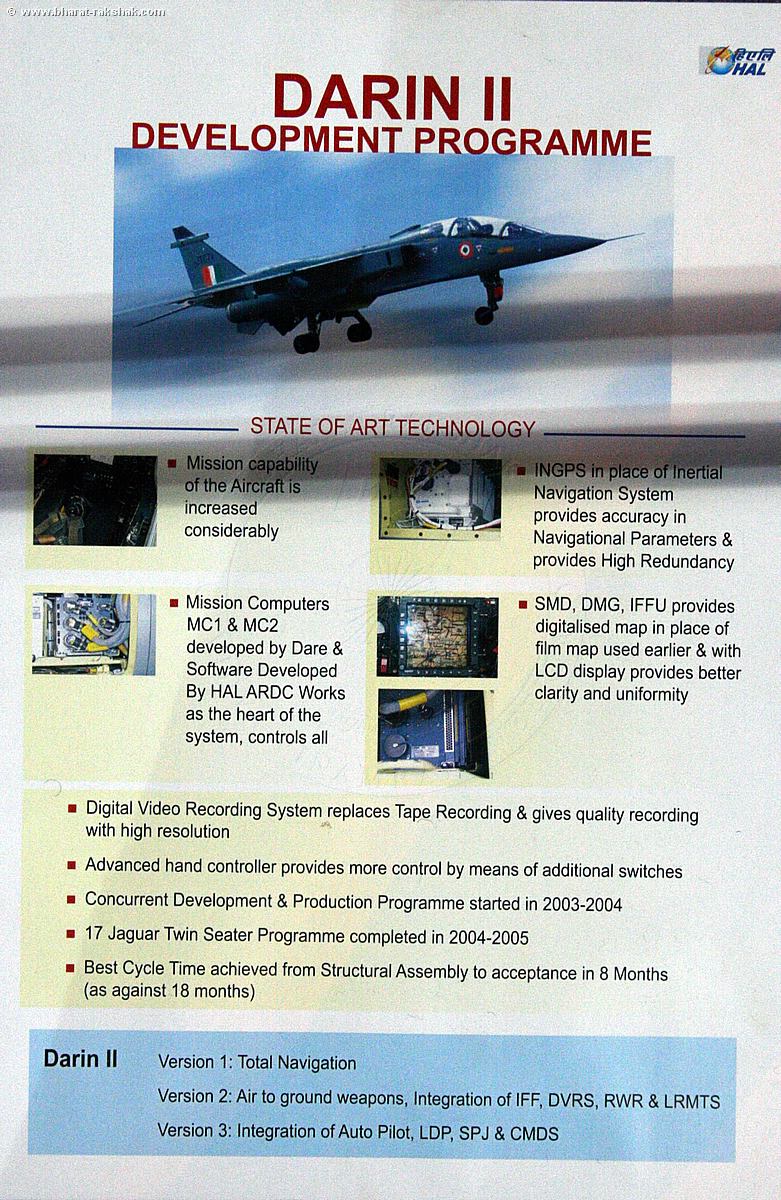
The new DARIN 3 Jaguar is a much upgraded variant that in avionics terms is really upto scratch. Nearly fully digital cockpit with a new HUD, new open architecture mission computer, etc. and will be used for the SEAD role as well.
From ACIG.org, although a bit dated, by now the first DARIN 3 has already flown and configuration would have been frozen.
The so-called ‘D-3 Jaguar IS’ are featuring the same HUD as on LCA ‘Tejas’, along with three MFD-55 AMLCDs supplied by THALES-Samtel Display Systems and full HOTAS controls, all utilising a MIL-STD-1553B digital databus. The core avionics computer – reportedly the same as in the MiG-27UPG upgrade at HAL-Nasik – is the OSAMC (Open Systems Architecture Mission Computer) originally developed by DARE and now produced by an India-US joint venture involving HAL, ‘Edge Tech India’ and US-based ‘Edgewood Ventures LLC’. An integrated defensive aids suite (IDAS) is coming from DRDO and Cassidian, including the D-3’s to be equipped with RAFAEL Litening-3SU laser designation pods for all-weather standoff-attacks using precision-guided munitions.
Undecided in DARIN-III are the EW escort-jammers/towed-decoy systems, with offers from Raytheon (ALQ-184(V)9), BAE-Systems (ALE-55), IAI/ELTA (EL/L-8251) and RAFAEL (‘Sky Shield’ escort-jammer / ‘X-Guard’). The fibre-optic towed-*decoy is to produce a full range of noise- and deception-signals be*tween 4.5GHz and 18GHz.
and the Raytheon MCU that allowed for integration of a wide range of weapons.
Ray*theon, meanwhile, since late 2009 has sucessfully integrated its munitions control unit (MCU) on an IAF Jaguar IS testbed, not allowed to be seen. The MCU is described as plug-and-play to enable integration of many modern weapons on legacy aircraft with minimal modifications to aircraft wiring and no changes to the flight and stores management software. Once integrated on an air*craft, aircrews can employ both exsting standoff-PGMs and A/A-missiles while using the aircraft’s existing weap*ons management system. Raytheon plans to finish the work by mid 2011.
But, they did delete the internal gun and replaced it with an internally-mounted ELTA Systems-supplied EL/M-8022 self-protection EW suite.
from another blog
The Tribune reported on September 9, 2015 that certain issues “over offset clauses involving HAL” were holding up the contract with Honeywell for upgrade of Jaguar engines; these have now been resolved, paving the way for commercial and technical negotiations to start.
Need for Upgrade
The IAF currently operates around 110 (5 1/2 sqns) Jaguar strike fighters powered by Rolls-Royce Adour-811 turbofan engines. The aircraft, which first entered squadron service in the early 80s, is optimized for strike after low level penetration of contested airspace. At medium altitudes, the Jaguar’s maneuverability and acceleration are poor. As a result, the fighter is not suitable for stand-off close air support using Precision Guided Munition (PGM).The IAF is making a doctrinal shift from specialized aircraft to multi-role aircraft, Based on fatigue analysis, the IAF estimates that Jaguars could remain operational till 2030. As a result, the IAF is keen to upgrade the Jaguar with more powerful engine, fourth-generation cockpit and mission avionics, and self protection suite so that it better fits IAF doctrinal thinking.
Upgraded Jaguars will feature all weather precision attack capability with enhanced weapon load.
Upgrade Features
The planned upgrade includes:
More powerful engines
Higher capacity alternators
Multi-mode radar
Glass cockpit with DARIN-3 navigation and attack avionics suite HOTAS controls and improved HUD
Auto Pilot
Helmet mounted DisplayAn Integrated Defensive Aids Suite (IDAS) is being co-developed by the DRDO’s Defence Avionics Research Establishment (DARE) and Cassidian (formerly EADS Defense Electronics). The suite includes DRDO developed Tarang radar warning receiver (RWR).
..
DARIN 3 upgrade features
What it cannot do as well as the multi-role 4th generation fighters is self escort or self defend well. It has the ASRAAM as its primary self defence missile.
But, it is underpowered for some types of missions, at medium and high altitudes. This was found to be an issue during the Kargil war, where the Mirage-2000 was able to take over that mission.
Anyway, since the fatigue analysis revealed that the Jaguar fleet still had adequate life left in it, they’ll go on serving till 2030. Basically, the IAF has a large fleet of these, they can continue serving without any fatigue issues and can be modernised relatively cheap, compared to what the Mirage-2000 upgrade cost. As mentioned earlier, the IAF needs every airframe it can keep in service, but they need to be relevant and able to survive their missions. Without those upgrades, the Jaguars of French AF or RAF spec are not relevant in some scenarios.
BlackArcherBlackArcherWell, the RAF prematurely retired their Jaguar force to keep the Tornado force intact, didn’t it? Don’t see how they could ever be convinced to pull stored Jaguar airframes (if there are any stored) and put them through upgrades to bring them back into service. The question of leasing Jags from the IAF doesn’t even arise since the IAF needs every airframe it can keep in service. 61 of the latest Jaguars are going through DARIN 3 upgrades, but there are other DARIN 2 upgraded Jags that could have been sold or leased if the IAF itself didn’t want to keep them in service for as long as possible.
But I didn’t understand how the French AF would benefit from a Jag force..they’re upgrading their Mirage-2000Ds and those Mirages will be a more flexible and capable jet anyday.
As for Sweden, I can’t see how a Jag force would make any sense for them..never operated Jags, and they have Gripen A and Cs in storage. They are struggling to find the justification to keep as many in service and storage as they can. Spending money on any other procurement is just never going to happen.
BlackArcherWhy pinch of salt? That plan’s been well known for a while now.
120 Tejas – 40 Mk1s + 80 Mk1As.
Unless you referring to the Mk2 ambitions, in which case yeah… that program is all but dead if an F-16 or Gripen line is set up.
Yes indeed, the plan to induct 120 Tejas Mk1 and Mk1As was known, this is the actual contract signature related news. Now that the contract will be signed, HAL will get busy in scaling up the assembly line to 16 per year. And once that investment is made, IMO, there is all the more reason to have the Mk2 after the 120 are delivered. Since HAL is not participating in the other assembly line, they will be motivated to push for the Mk2 for the IAF.
BlackArcherSo are the MiG-35 pre-production prototypes going to be fitted with the Zhuk-AMEh AESA radar?
BlackArcherSuryakiran display team with the Hawk


credits; Suryakiran IAF
BlackArcherit all depends on the price of making it. a huge chunk of that price is manhours to make it… if you can have competent workers for a lesser price, your selling price can be lower as well
I doubt that Embraer would’ve been able to make the Rafale in fewer number of man-hours than Dassault could. Even so, even with a 10% reduction in price, the Rafale is too expensive for ANY nation in Latin America, simply based on its flyaway cost. Simply put, none of them face a threat scenario that would drive them to such an expensive system. It is one of the best, absolutely, but overkill and too expensive for them. And so, an exclusive right to sell Rafale in Latin America would’ve meant nothing in reality in terms of sales.
BlackArcherIt’s not Sputnik, it’s German defense ministry report (Ursula von der Leyen)..
Thanks. I was going to go look for the original article.
Sometimes, it makes sense to look to check if what is stated are facts rather than summarily dismissing them based on the news source.
So Swerve, now that BBC says the same thing, is it more reliable? In fact this carries even more details. Previous year’s Tornado availability was also dismal at 42%.
Only 29 of Germany’s 66 Tornado jets are airworthy, a defence ministry report has revealed.
…
The defence ministry report, obtained by German media, blamed the problem on the “lack of availability of various spare parts”.
..The latest defence ministry report showed Germany’s air force capability further depleted from the year before, when 38 of 89 Tornado fighters were operational.
BlackArcherIndian Navy scouts 7 new Indian corvettes
Following on from its big pitch last year to replace its Veer-class (Tarantul-class/1241RE) missile corvettes with six new Indian-built missile vessels, the Indian Navy has just published interest in acquiring an additional seven missile corvettes to replace its Khukri-class boats with Next Generation Corvettes built at an Indian shipyard. The Indian Navy currently operates about 10 of the Veer-class and four of the Khukri-class.
The request for information sent to Indian shipyards, both private and state-owned calls for Next Generation Corvettes’ (NGC) capable of offensive SSM attack, anti-submarine warfare operations, local naval defence, maritime interdiction operations and VBSS, with deliveries of the seven boats from 2023. While the navy is known to have been considering publishing significantly greater performance requirements from the new line, it has stated criteria that are largely similar to the Khukri-class boats they will replace: 4,000 nautical mile range, maximum and sustained top speeds of 25-27 kn,
Expectedly, the Indian Navy is keeping requirements in line with the build doctrine it is in the process of validating with its Project 15A/17/28 warships in terms of low observability qualities. The RFI stipulates, “The ships should have Low Radar, Acoustic, Magnetic, Visual and Infra Red Signatures and adequate NCO and communication capabilities.” The RFI also maintains the navy’s expectations with the Integrated Platform Management System (IPMS) it is looking to standardise across its new generation frontline surface combatants.
In terms of weapons, the Navy is clear: it wants an 8-BrahMos AShm/land attack configuration, a SAM system (almost definitely the under-test LR-SAM), standard deck CIWS, a medium-range gun system with an attack field out to 15 km and a twin deck-borne light torpedo launch system. As with all of its current and future ships, the NGCs will need to be capable of deploying ALH/NUH chopper platforms, in addition to unmanned rotorcraft.
..
BlackArcherAhh … people forgot BAE provided used spare parts and were fined for it. I agree, it is all India’s fault 😉
As for BAe’s record when it comes to bribery, one just has to look at the Al-Yamamah deals and the way in which the whole investigation was canned, in order to save jobs. Fact is, corruption in defence deals is endemic and is not new to India. European firms are no angels and have known for a long time that they can get things done by bribing key officials. The person/firm offering the bribe is no better than the one asking/accepting one when it comes to ethics.


 Sign In







