 BlackArcher
36 rafale for india was 8.8 billion, 36 gripen for brazil was 5.4 billion -> gripen 39% cheaper than rafale,
assuming ToT and the rest was similar value.here is an apples to apples comparison if true
“The two cheapest options now became the front-runners. The Super Hornet offer—for 36 fighters—was for $7.5 billion, while the Gripen offer cost $6 billion. The Rafale offer exceeded $8 billion.”
https://warisboring.com/it-took-a-while-but-brazils-finally-getting-a-new-fighter-a47fc9df3333i’m guessing f-16 & gripen E is roughly same money, was there any competition where f-16 was pitted against f-18 SH to get a relative price difference between them two ?
Did the Gripen deal for Brazil include weapons as well? the Indian deal included the cost of weapons.
BlackArcherthing is, they have bought the Rafale, just as the customisations they wanted and support structure as well (they had to, as for any aircraft)… building another type would require to buy/build the support structure for it as well… while they’ve invested in the Rafale already, buying another batch would cost significantly less than that initial buy that included support and development costs.
Now, as far as “make in India” goes.. I’m still puzzled by the way it went with the MMRCA. Dassault proposed to do it at a given price, under precise conditions, and won.. and then, during negotiations, the price went through the roof… Now, one has to wonder how it could happen… what changes were asked from Dassault to raise the price so much? Some here hinted that Dassault gave a price while omitting plenty of theings, opr proposing to do it in a way that was clearly not the one it was required to do.. ok, but: if it was Dassault not accounting for plenty of stuff supposed to be included, and not respecting the the rules, one has to wonder what the Indian guys were doing to accept an offer that had so many things messed up?
Again, strangely, with the offsets, Dassault teamed with Reliance Group to invest in India… Strangely, it is the very same group that they proposed to make the rafales in India with, and, as some said here, has no business in aviation in the same time… Curious choice for a company that would have to deliver, who, btw makes highly praised business jets and one of the finest fighter aircraft in the world, the very one that won the MMRCA btw…
I’d say they (Dassault) most certainly know a few things about building aircraft that pretty much everybody here does not know, and they have made their choice… If MMRCA understood that the fighters HAD to be made by HAL (which seemed to pose a problem), IMO India, once MMRCA cancelled, would be well inspired to propose Dassault to make another offer as teh one they proposed for the MMRCA, taking into account that some stuff in it are already paid for (training and support infrastructure) and see what they can propose now. Their offer may very well be quite competitive today… even more than a few years back
As per some reports (again one can never be sure about these reports), Dassault left out some scope from their response and that was only added later, which added to the cost. But then again, the fly-away cost of the Rafale that has been reported was pretty much as expected- ~$ 91 million per unit flyaway. But add all the other things that are needed to train personnel, operate and sustain the fleet and the weapons and you have a big big bill.
The funny thing is that Dassault back then claimed that HAL couldn’t build the Rafale without spending thousands of additional man-hours per jet due to the lower automation levels and the learning curve associated with building a new jet. And that would lead to the Rafale being even costlier to build in India than in France.
Now, if they make an un-solicited or even solicited offer to build Rafale jets in India, they’ll somehow have to prove that an even less experienced private sector partner will somehow magically scale up to build Rafales in India at a competitive price.
BlackArcherFact is, the IAF gets 36 Rafales that outclass anything the PAF can possibly hope to get in a long time. Not the number they wanted, but put the Rafales in a mixed force with the Su-30MKIs or Mirage-2000-5, MiG-29UPGs or Tejas and as long as they’re networked, they can take down anything in the PAF or PLAAF. With a mix of Meteor, R-77, R-27, MICA, Derby and Astra BVR AAMs, even jamming will not be guaranteed and is a guaranteed headache for the enemy.
Add the S-400, Brahmos ALCM and Scalp and you have massive new capability jumps that have been added in just these past few months. With 270 Su-30MKIs and the upgrades to the existing fleet of 53 Mirage-2000s and 63 MiG-29s and the Tejas entering service, plus over a hundred upgraded Jaguars, the situation is not as dire as they’re making it out to be.
Fact is, the IAF has gained capabilities and are now able to carry out missions that the IAF of the 1990s had no way of carrying out. Firepower and survivability wise as well, the IAF is way better off now. the IAF Chief of Staff routinely talk about such things in interviews given to the press, but never allude to it when talking about squadron strength.
But one can trick politicians into thinking that without a one-to-one replacement, the IAF is in a bad way, which gets them more jets..the more the press reports about falling IAF numbers, the better for them, since public pressure forces politicians to go in for these costly imports at the expense of spending time and effort in getting the local products. Manohar Parrikar was very reluctant to sign up for the Rafales thanks to the bill that was presented. But, a public pronouncement by Modi left him no choice but to go with it.
The MRCA had no engine number requirement. Originally, the Mirage-2000-5 is what the IAF wanted. Then, the MoD asked for a competition. The original one, like the Brazilian F-X, had the Mirage-2000, F-16 and MiG-29 M2. Then out went the Mirage thanks to its going out of production, in came the Rafale, then the Typhoon, and then the F/A-18 E/F. And the F-16 offer changed to the F-16IN derived from the Block 60. So its obvious that the IAF didn’t specify a requirement for a twin engine type. But yes, attrition wise, it is better to have a twin engine type- multiple Su-30MKI in flight engine failures didn’t result in crashes for this precise reason. But now its obvious that Western twin engine jets are simply not affordable in large numbers. And so the preference for what is affordable (for the IAF i.e.) and still outclasses everything the PAF has, and either outclasses or matches the PLAAF.
Modi wants the MII thing to take off in the private aerospace sector and the Rafale will be too costly for that.
Regarding the Rafale deal, it has more to do with a strategic relationship with France than anything else after it became clear that the deal was going to be monumentally costly if 126 were bought and built locally. The entire deal could have been scrapped like the A330-MRTT on the grounds of cost, but it would have affected its relationship with France, considering the worth of the deal. Modi decided to go with the 36 to save that relationship and salvage something for the IAF, and get at least a couple of squadrons till something else was figured out. And so, the IAF gets a small force of fighters that will eventually also be its strategic nuke carriers.
BTW, there hasn’t been a confirmation from anyone in the Govt. that a future Rafale purchase may not happen.
BlackArcherIt’s simple.. They have defined a twin-engined type which they intended to build under a license. After lengthy negotiations they have found out that it’s actually much more expensive than originally anticipated.. In the desired standard, Rafale is way too costly even as a direct buy, let alone considering required investments for a new production line at HAL.. Now they’re hoping to get something smaller/cheaper..
Precisely.
BlackArcherTopSight-I
Thanks. So its similar to the IN’s MiG-29Ks.
BlackArcherI am a happy owner of John Golan’s book, the exact values are: 6940 kg empty weight, 19280 kg maximum takeoff weight and 2720 kg of internal fuel.
Great. I just ordered a copy as well. If those are the numbers then it is indeed quite astonishing to see such a high MTOW.
BlackArcherWhat I find very impressive (and somewhat surprising) about the Lavi is MTOW.
MTOW (according to Wiki) was a whopping 19,227 kg!
According to WIki: Length: 14.57, wingspan: 8.78, empty weight: 7,030kg(?)
Compare this to Mirage 2000:
MTOW: 17,000 kg
Length: 14.36, wingspan: 9.13, empty weight: 7,500 kgand then the really odd thing; Gripen E:
MTOW 16,500 kg
Length: 15.2; wingspan: 8.6, empty weight 8,000 kgHmmmm.
Wiki figures are not right. John Golan states that the empty weight of the Lavi was ~10% lower than the Block 30 F-16. I calculated it as being ~7400 kgs.
BlackArcherThe Lavi was quite a bit larger than the Tejas and FC-1 designs. As John Golan mentioned in his book, it had a 10% lighter empty weight than a F-16 Block 30, whose empty weight was 8290 lbs. Which gives us ~7400 kgs empty weight for the Lavi. That’s ~800 kgs heavier empty than the Tejas or FC-1.
And as his blog post on the Lavi mentioned, it was designed with range in mind, and hence a lot more internal fuel
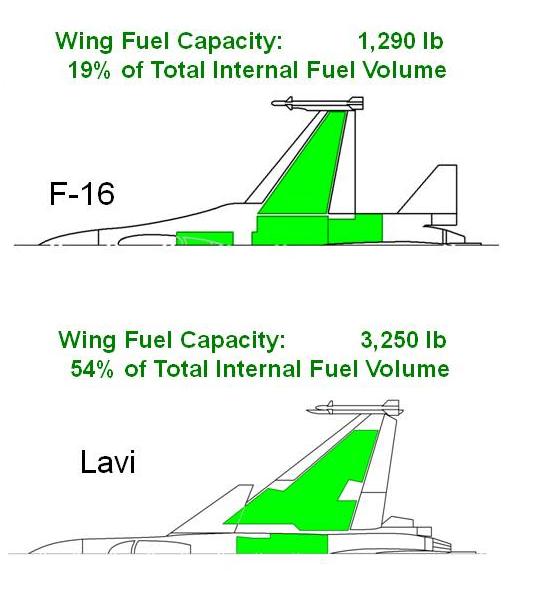
BlackArcher1) F-16 – a beautiful airplane, even the recent blocks that have gained weight compared to the F-16 A/B. I would rate the F-2 as the same since they are essentially the same airplane, enlarged wings and a different canopy aside
2) Lavi – another beautiful airplane
3) Typhoon – the production variants were so much better looking than the EAP
4) J-10 – all the wrong proportions. excessively large tail, something just seems off in that design. J-10 twin seater looks even worse
5) X-32 – a toad. one of the fugliest designs ever
BlackArcherSu-30MKIs deployed to Thanjavur Air Base, in Tamil Nadu.

Satellite imagery confirms that the Indian Air Force (IAF) continues to forward deploy advanced, frontline fighters to its southeast flank. Given India’s threat environment, it’s a positive sign that the South Asian giant may have made headway addressing issues spotlighted by Indian Defense Minister Manohar Parrikar last year regarding the aircraft’s Saturn AL-31FP engines. Earlier this year, Parrikar clarified that engine issues meant that the fighters broke down fairly regularly.
Satellite imagery, acquired by DigitalGlobe and Planet Labs, indicates the presence of the SU-30MKI Flanker H multirole fighters at Tamil Nadu’s Thanjavur airbase. The airbase, subordinate to India’s Southern Air Command (SAC), remains an important deployment location to project power from the southern peninsula. Thanjavur is the only airbase in India’s SAC where observers routinely see the frontline fighters deployed.
..
The satellite imagery, some of which is available in Google Earth, shows a detachment of seven advanced Flankers parked on Thanjavur’s northwest apron. They arrived at the airbase in August and were previously spotted on space snapshots in January. The latest flight departed the airbase by mid-September, Planet Labs imagery shows. The Thanjavur airbase is subordinate to India’s SAC, a command whose operations stretch from Lakshadweep in the Arabian Sea to the Andaman and Nicobar Islands in the Bay of Bengal. Given the growing importance of projecting force beyond India’s borders, the airbase was included in the IAF’s 15-year modernization program and publicized in 2005. Previous commercial imagery monitored the refurbishment of the now dual-runway air station since work began in earnest in 2011. Two years later, Thanjavur was inaugurated featuring a new parking apron, expanded turnarounds, taxiways, new radar and a lengthened runway to enable the take-off and landing of heavier aircraft. The latter is particularly notable, as India responds to natural disasters at home and develops a greater interest in providing regional humanitarian assistance.
To date, construction activity continues at the airbase with additional support buildings almost complete. The two triple-fence secure structures, typically erected near hardened munitions storage areas or aircraft dispersal areas, are likely associated with the airfield’s weapons handling activity. The structures stand at least 1000 meters apart and represent another sign that India is preparing to ready the airbase to support the advanced fighters. According to Indian press reporting, a Flanker squadron will be relocated permanently to the southeastern state by FY 2017-2018.
..
BlackArcheroops..:D
BlackArcherMig-29 upgrade
Mirage 200 upgrade
Rafale
FGFA
SU30 upgrade
Gripen or F16 “make in India”
LCA
AMCAHow is this possible for India ? This doesn’t make any sense to me to have so much platform in inventory even though some will progressively retire but still…
I can’t believe every program above will go as advertised as today.
the only advantage that this does offer is that there is no way that a single country can sanction India and ground most of the fleet.
And this is all the more reason why a private sector entity needs to be brought in to ease the workload on HAL and also bring in competition. Apart from the ones you’ve mentioned, there is the Jaguar DARIN 3 upgrade, Hawk production, HJT-36 development and production (if it enters service), HTT-40 development and testing program and the 3 different helicopter programs. MiG-29UPG upgrade is being handled by 11 BRD of the IAF, so that is one program that HAL is not handling.
BlackArcherAnd another FG article that basically states that Pakistan made it a pre-condition for its participation that China also commit to the aircraft. This was common knowledge, that the PAF need was more urgent, that they would be the launch customer while the PLAAF focused on getting the J-10. And there are articles around the web where PAF officials have stated that China will buy the JF-17/FC-1.
BlackArcherI think FC-1 would’ve been considered by the Chinese Air Force for use (and subsequently rejected given the rest of the Air Force’s orbat structure probably made it unnecessary), but I don’t think that fits the term of “intended”.
I’m sure CAC hoped that the Air Force would be enticed by FC-1 and they probably tried to market it, but that is different to projects that are driven primarily by the Air Force from setting requirements for a given product, and then driving the development stage and onwards — like J-10 which was driven by the Air Force from the beginning rather than being company driven and only then subsequently marketed to the military.
FC-31 is another example of an aircraft whose development and testing was driven by a company (by SAC in this case rather than CAC), and marketed heavily to the military, but appears to have elicited no interest. That is in contrast to the J-20, which was driven by the Air Force/military itself from the beginning with a requirement for the aircraft.
edit: that said, FC-1 has a bit of an on and off flirtation with Chinese Air Force interest… all the way from the Super 7 to the JF-17 as we know it, the Air Force occasionally has appeared interested then turned its back. That said I think the commitment of the Air Force to the project is far less than say, the J-10 programme.
(Of course there are some projects that appear to be company driven and successfully marketed and bought in by the military, but that is another matter)
I think there are various sensible critiques that could be levelled to the JF-17/FC-1 regarding its capabilities, but the lack of service in the Chinese Air Force is not a particularly strong one IMHO.
Blitzo, see the article that I posted in my post above yours. It’s from FlightGlobal, dated 3 October, 1995. The FC-1 design is evident there- no major changes since then except the LERX and DSI. And the fact that CATIC and Chengdu Aircraft tried to get state support for the FC-1 is mentioned there.
The second article states “CATIC is pushing for support from AVIC and is confident of selling the lightweight fighter to China’s PLA Air Force.”
There was always an intent to get PLAAF to buy them, but it never materialised and naturally so, since the J-10 was available.
And here is a snippet of another FG article that states exactly the same thing I said- that it was meant to meet PLAAF and PAF needs. With such a large number of Q-5 Fantans and J-7s to be replaced, the FC-1 was intended to replace at least a portion of those. That hasn’t transpired and unless the PLAAF believes that light fighters are useless, I think it is an indictment of the FC-1 itself. At least at its current stage. Maybe a Block 3 with AESA and other technology upgrades may finally get them interested. But I doubt that will happen.


 Sign In








