 BlackArcherBlackArcher
Thats a nice bird. How much does it cost?
Supposedly 25% cheaper than the PC-7 Mk2, which itself won the IAF tender for a basic trainer by being L1 (lowest bidder)..of course we now know how that was possible, by diluting air staff requirements deliberately, so that the cheapest Swiss trainer on the market could be acquired and not the South Korean KT1 Woong bee.
As for the ejection seat on the HTT-40, its a Martin Baker Mk10 or Mk11 zero-zero ejection seat
BlackArcherAnd a look at HJT-36 Sitaras on the floor at HAL facilities in Bangalore


BlackArcherBlackArcherBlackArcherMore on the HTT-40’s official flight tomorrow.
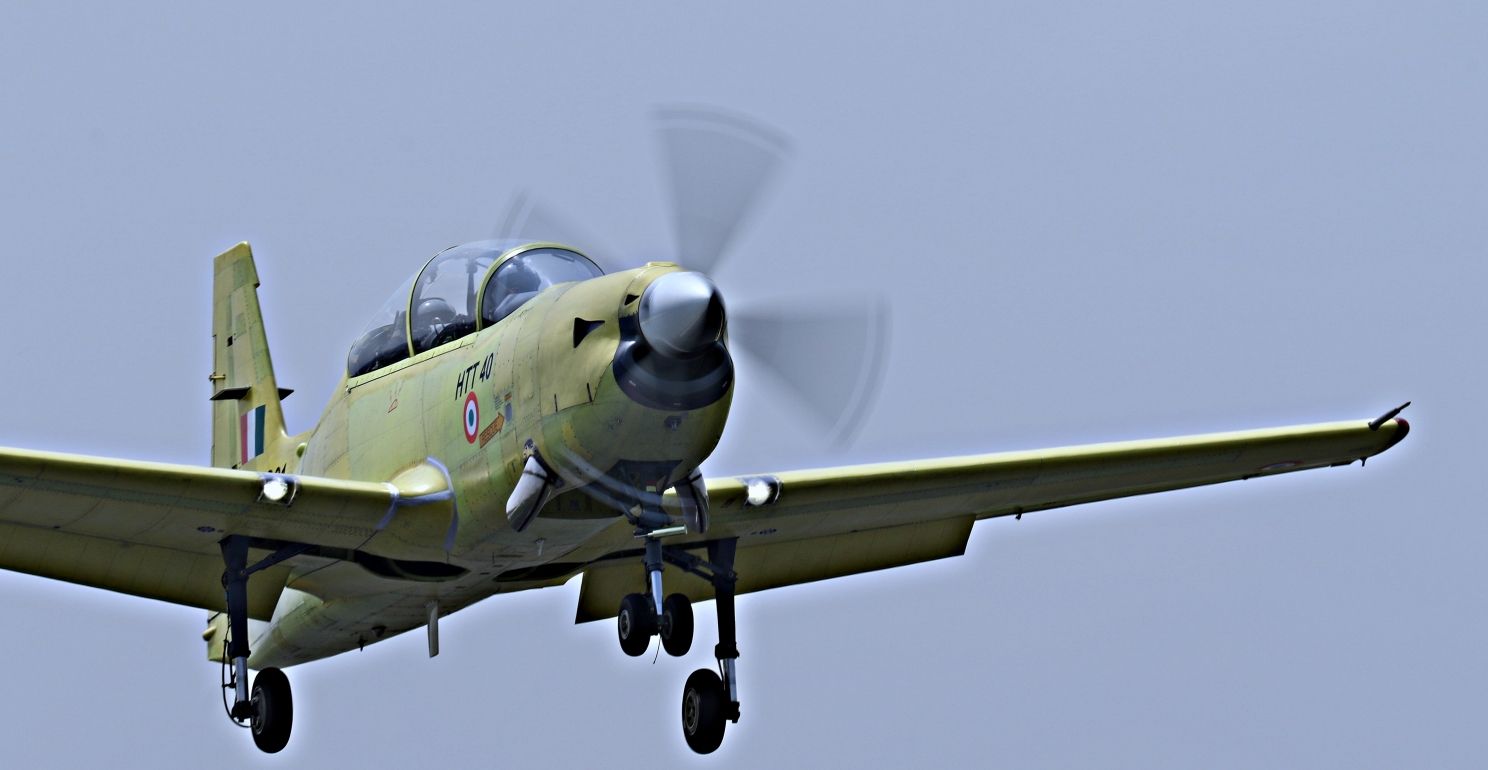
Bengaluru: Hindustan Aeronautics Ltd (HAL) will roll out their Basic Trainer Aircraft (BTA) – the Hindustan Turbo Trainer (HTT-40) – for an ‘official flight’ at Old Airport in Bengaluru tomorrow.
..
In the last two weeks, the HTT-40 had seven flights, logging over three-plus hours totally.
HAL insiders say that during the initial flights the aerodynamic functionality, landing gear operations, roll-over take off, avionics system tests and gliding test were held. The aircraft also had an unscheduled wet-landing, thanks to the prevailing Monsoon in the city.
..
and
HAL built trainer HTT-40’s inaugural flight tomorrow
The inaugural flight of HTT-40, designed and developed by Hindustan Aeronautics Limited, is likely to take place at 09.15 AM tomorrow at the HAL Airport here.
The sortie is expected to take place for about 25 to 30 minutes, HAL officials told PTI.
Aimed at being used for the first stage training for all flying cadets of the three services, HTT-40 had made its maiden flight after much delay on May 31.
Officials said detailed design phase of HTT-40 was launched in August 2013 with HAL’s internal funding and was completed in May 2015 and from there it has taken 12 months to fly the first prototype.
Indian Air Force is expected to procure seventy HTT-40 aircraft.
HAL has said that the programme aims to achieve its operational clearance by 2018, and towards this the company will be manufacturing three prototypes and two static test specimens.
Designed to meet the current demands of the Air force, there is also a provision to include weapons for the trainer aircraft.
According to officials, the indigenous content on HTT-40 is close to 80 per cent with about 75 plus systems out of the total 90 on the aircraft sourced from local players and sister divisions of HAL.
HTT-40 aircraft weighs about 2,800 kg and has Turbo Prop engine of 950 shp class.
BlackArcher80% availability on IAF and IN’s Hawks
Steve Timms, managing director of defence information and training systems at BAE’s Military Air & Information business unit, notes that from a lifetime order book for 1,020 Hawks – including Boeing T-45 Goshawk derivatives produced for the US Navy – there are typically 650 aircraft in use daily. Flightglobal’s Fleets Analyzer database shows that approaching 100 of this total are in use with the Indian air force and navy.
“India’s Hawks are flying 100 sorties a day, with an 80% availability rate,” says Timms, who adds that the nation “is exploring whether it can get more out of the Hawk”. This activity includes BAE working with local production partner Hindustan Aeronautics (HAL) on an advanced variant, to potentially include an updated cockpit with a large area display, and a new wing. Featuring moving slats on the leading edge, the wing would shorten take-off and landing runs and also enhance agility when carrying external stores, such as weapons or sensors.BAE’s Hawk new development aircraft is to have the new wing installed, but BAE is tight-lipped about its plans regarding flight-testing the enhanced platform. “We want to demonstrate it within the next 12 months, to give confidence in the product,” Timms says of the development. “If we feel we need to fly we’ll fly it,” he adds.
Meanwhile, BAE is in discussions with HAL and the Indian air force and navy about establishing long-term support arrangements for the nation’s Hawks. “We want to stay in partnership,” Timms says. “We are discussing how we can support them longer-term, looking at our T2 experience [with the UK Royal Air Force].”
To cover spares, repairs and absolescence management, this support arrangement is likely to be advanced through a proposed new joint venture with HAL, which also would encompass the Indian air force’s fleet of Sepecat Jaguar ground-attack aircraft.
BlackArcherAs per AW, the Tornado IDS fleet will continue to serve for a long while and industry is already looking at ways to sustain it upto 2040
Keeping Germany’s fleet of Panavia Tornado combat aircraft in service into the 2030s—or until 2040—has become an industry goal.
The backbone of the Luftwaffe’s ground-attack capability, the Tornado entered service in 1979 to provide ground-attack, reconnaissance and suppression/destruction of enemy air defenses (S/DEAD) as well as to act in the little-discussed and controversial—in Germany at least—nuclear-strike mission. This was forged through a dual-key arrangement with the U.S. that permits Luftwaffe Tornados to carry and drop the U.S. B61 nuclear weapon.
But while Tornado partners Britain and Italy are downsizing their fleets ahead of the type’s retirement, Germany has no clear plan to replace the aging aircraft.
Britain plans to remove the Tornado from service in April 2019, filling the gap with the Typhoon and F-35 Joint Strike Fighter. Italy is on the same path but will retire its aircraft in the 2025 time period.
Germany’s future air capability manifesto remains partially formed. It plans to integrate more air-to-ground weapons on the Eurofighter fleet at some point, but progress has been slow.
If Germany’s replacement for the Tornado, the so-called NextGen WS, comes to fruition, it might not be ready until the 2030s. Credit: Tony Osborne/AW&ST
So without any clear direction from politicians, industry believes it may have to be ready to help the Tornado limp through until 2040, by which time the aircraft will have been in service nearly 60 years.
Earlier this year, the German defense ministry published its aviation strategy, which hints at replacing the Tornado with a new capability—the so-called NextGen Weapon System (NextGen WS)—taking a lead role in any new multinational program that could follow.
There has been little sign of any tangible progress, however. At the recent Berlin ILA Airshow, industry officials said no meaningful discussions were in play.
“The ministry of defense and the air force have to make up their minds about what they really want,” said one official. Others have described the NextGen WS as a placeholder meant to indicate to industry officials that a commitment to a new program will be forthcoming.
Panavia, the company that manages the aircraft, has started to prepare a rolling upgrade road map in order to keep the fighter relevant for Germany until 2035—long after the other nations have retired theirs, including export customer Saudi Arabia.
…
BlackArcherThe radome on the Israeli M-346 looks different than the other Masters that we’ve seen..any chance it sports a larger radar? Or is that just a paint scheme that gives it that impression?


 Sign In








