 BlackArcher
PAF’s entire A/B fleet went through Falcon UP/Falcon STAR. No Indian plan has been through such an upgrade, This essentially gave the PAF zero timed airframes.
Thanks
Zero time airframes? LOL..yeah right..so then you’re saying that the F-16’s life is now 8000 hours + whatever hours were already on it? And when it reaches the end of those 8000+x hours, just go do another Falcon STAR and voila! another zero-timed airframe is available for the PAF to keep around for another 40 years..:D
The Falcon STAR upgrade was just so that the F-16s could attain their designed 8000 hour life, not to re-time them back to 0 airframe hours. If they already have had x % of their 8000 hour airframe life used up, this upgrade ensures that they won’t fail before the remaining 100%-x % life is used.
Thursday, January 27, 2005 – Defense Supply Center Richmond officials are working on a billion-dollar, multiyear project that will extend the service life of the Air Force’s F-16 Fighting Falcons.
The F-16 Structure Augmentation Roadmap, or “Falcon STAR,” program uses parts kits to strengthen the aircraft’s structure, officials said. The kits contain everything necessary to accomplish a maintenance task.
Officials said using the kits reduces maintenance turnaround time, ultimately increasing readiness.
Center officials develop support strategies and initiate kit contracts.
Without the modification, the F-16 will not be able to attain its projected 8,000-hour service life under current operational usage, said Pat Livingston, the center’s F-16 weapon system support manager. Falcon STAR will allow the aircraft to remain in service through 2025, she said.“(The Air Force’s) aircraft structural integrity program continues to identify areas that will not meet the service life of 8,000 flight hours,” Ms. Livingston said. “The (goal is) to modify the aircraft structure before the onset of widespread fatigue damage and aircraft grounding.
“This is a ‘tip-to-tail’ modification — 13 structural modifications including replacing bulkheads and wing-attachment fittings,” she said.
Falcon STAR contains the list of structural parts necessary to address the areas identified by the aircraft structural integrity program, she said. There are more than 79,000 parts under 428 national stock numbers, all of which are managed by Defense Logistics Agency officials.
…
BlackArcherHAL eyes export potential of light attack Hawk
Hindustan Aeronautics (HAL) has conducted weapons tests with its license-built BAE Systems Hawk 132 advanced jet trainer (AJT), and is confident of the project’s export potential.
The light attack Hawk upgrade also includes display and avionics modifications revealed at the Aero India show in Bengaluru in February.
“We are looking at exports of the weaponised Hawk or Light Attack Hawk and feel that there would definitely be a requirement for this type of aircraft in many countries,” says HAL chairman T Suvarna Raju.
“We are looking at the further weaponisation of the Hawk, though it has already been declared as weapons capable to a limited extent with guns and rockets,” he adds. “We have done some trials with rocket pods and are looking beyond this.”The Indian air force likes the upgrade proposal, and the airframer will incorporate further suggestions made by the service, Raju told Flightglobal at HAL’s corporate office in Bengaluru.
On 26 May, the airframer announced that a memorandum of understanding with BAE had been concluded, “for a Hawk Mk 132 upgrade, development of combat Hawk for Indian and export markets and maintenance solutions for supporting the Jaguar and Hawk fleet.”“Customers have been kept up to date with developments for Hawk, which include targeting pod simulation, laser designator pod, real and simulated ‘smart’ weapons integration, helmet-mounted display system and increased thrust engine with full authority digital engine control,” said a BAE official, in an earlier email response to Flightglobal.
Commenting on the Hawk upgrade at Aero India, an MBDA official said: “Should we be asked to weaponise Hawk with ASRAAM, we would certainly be able to assist.” The company’s Brimstone “could be ideal for the Hawk,” the official said. “At only 50kg [110lb] per missile, with a dual-mode seeker for added operational flexibility, this air-to-ground multi-target weapon would certainly add a major capability to the Hawk.”
HAL has proposed a unique display and avionics upgrade for the Hawk, with two large 8 x 6” multi-function displays replacing the smaller, existing displays. A moving map display will be added and electro-mechanical instruments such as vertical speed indicator and altimeter will be removed.
The Indian air force has 91 Hawks, with a single example having been lost in a crash (attributed to pilot error) in 2008. The first contract for 66 Hawk 132s was signed in 2004, which saw BAE deliver 24 aircraft in fly-away condition; HAL completed licensed production of the last of the remaining 42 in 2012.
A follow-on order for 57 aircraft – 40 for the air force and 17 for the navy – was signed in 2010, and 25 and 11 aircraft respectively have been produced to date. HAL will deliver the remaining 15 and six aircraft respectively by 2016-2017.
..
BlackArcherPAF K-8 trainer crashes..both pilots ejected
BlackArcherThey claim to have had preliminary discussions, among themselves I suppose, since they don’t yet have any exact customers in mind.
But what is the condition of A-10s in the boneyard? How many hours left on the airframe and would they need any re-winging like the 173 A-10s of the USAF?
BlackArcherThe article states that there are dozens of stored A-10s in near fly-away condition and those could be re-activated if required. So those would be the ones that would be offered, I guess. I don’t see why politicians would have a big issue with A-10s drawn from the boneyard being offered for sale to international customers.
BlackArcherMirage-2000 lands on Yamuna expressway near Delhi
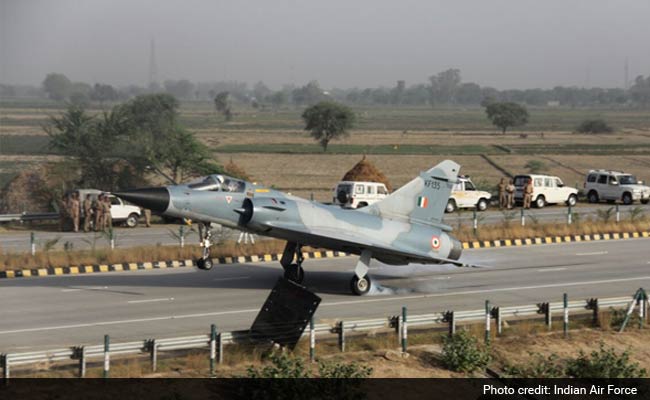
Noida: A Mirage 2000 fighter jet of the Indian Air Force (IAF) test-landed this morning on the Yamuna Expressway just outside Delhi, as part of emergency landing drills on national highways.
At 6.40 am, the fighter plane skimmed the highway and landed briefly before it took off again. Local people, including villagers, gaped at the sight.
“The aircraft made a practice approach on the highway, coming down to a height of 100 metres before landing off the next approach,” said an IAF statement.
..
Officials called it a practice drill to scope out possible landing strips on the national highway for fighter planes in case of an emergency. “IAF has plans to activate more such stretches on highways in the future,” said a spokesperson.The six-lane Yamuna Expressway on the outskirts of the capital connects to Agra in Uttar Pradesh. The jet landing stalled traffic on the highway for a few hours.
For today’s trial, “all facilities like make shift Air Traffic Control, safety services, rescue vehicles, bird clearance parties and other requirements were set up by IAF personnel from Air Force Station Agra,” the IAF said.
..
BlackArcherMore details on the INS Kavaratti
GRSE launches 4th P-28 corvette for IN
…
Designed by the Indian Navy’s Directorate General Naval Design Surface Ship Group in partnership with GRSE’s design team, Kavaratti (along with third-in-class Kiltan ) has a hull made of DMR 249A steel and a composite superstructure; the latter was selected to reduce top weight and, according to GRSE officials, about 100 tonnes in weight has been saved.The 109.2 m, 3,150 tonne Kavaratti has a hull and superstructure arrangement designed to reduce its radar cross-section. Other signature management measures include raft-mounted gearboxes to reduce vibration (supplied by France’s DCNS and its Indian partner Walchandnagar Industries Limited), an infrared signature suppression system in the funnel stack, and extremely low frequency electromagnetic signature suppression systems such as an active shaft grounding system and the multizone impressed current cathodic protection system.
The Indian Navy claims that about 90% of the ship is indigenous. While the metrics for determining this figure are not known, almost all of the combat systems are assembled or licence-built in India (with several locally developed systems also included).
Notable Indian-developed combat systems on the corvettes include the Revathi 3D radars, Kavach Mod II decoy launchers, the IAC Mod C ASW fire-control system, the Sanket Mk III electronic warfare suite, the CMS-28 combat management system and associated ship data and communications systems, a Link II tactical data link system, and the Humsa-NG hull-mounted sonar.In due course, the corvettes will be fitted with an Atlas Elektronik towed array sonar, the Israeli Barak 1 missile system, and the Indian-developed Mareech Anti Torpedo Decoy System.
BlackArcherWell I guess to answer this you have to ask yourself what types are doing exactly the same role?
Between the Mirage2000, MIG-29, Jaguar, MIG-27, SU-30, Rafaele and LCA there is much overlap.
Pretty insane
I suppose it would be a waste of time trying to explain how these fighters came into the IAF, since your real intention is known to us all..anyway..
the Jaguar was chosen based on a requirement for a strike oriented DPSA aircraft for the IAF in the 1970s and replaced the Marut. the MiG-23/27 was offered to India for CAS at friendship prices along with licence manufacture and the offer was accepted since it allowed the IAF to retire obsolete aircraft like the Hunter, Gnat and Ajeet. the MiG-23MF came into the IAF as an interim fighter to tackle the IAF’s F-16 acquisition, and this was the one fighter that really didn’t add much at all and consequently was retired quite early.
the Mirage-2000 was the fighter chosen as a result of PAF’s F-16 deal and then this deal was supposed to grow into a licence manufacture but high cost and the Soviet Union’s offer for much cheaper MiG-29s scuttled the licence manufacture deal.
The LCA has no overlap with these heavier fighters and arose from a requirement for a light weight MiG-21 replacement.
the Su-30MKI is nowhere near the other fighters and qualifies as a heavy fighter that completely changed the IAF’s orbat from a mostly tactical, single mission oriented force to a large number of long range, heavy multi-role fighters. Before it, the Mirage-2000 had some modicum of multi-role capability but even that was quite limited compared to what the MKI brought.
As Rii has explained in multiple posts earlier, geo-politics influenced many of these decisions. What the IAF’s requirements were, what was on offer, for how much and with whom India wanted to strengthen its relations or diversify its suppliers to avoid complete dependence..all these factors decided the mix.
In fact, the dependence on a supplier with whom they had already had a bad experience nearly got the PAF screwed..thanks to their dependence on the F-16 as their premier fighter..we all know how the PAF sat out the Kargil War thanks to the lack of spares and what would’ve happened had a real aerial war broken out between the IAF and the PAF..even with all the mix of fighter types, the IAF would’ve managed to put them into the air..wouldn’t have been so with the PAF, with its main fighter being hobbled. And we have this on record by a former PAF Air Cmde, Kaiser Tufail.
BlackArcherBlackArcherIndia launches new ASW corvette INS Kavaratti
The fourth Anti-Submarine Warfare (ASW) Corvette of Project-28, christened ‘Kavaratti’, was launched today at a glittering ceremony held at Garden Reach Shipbuilders and Engineers Ltd (GRSE), Kolkata.
..The four ships of Project-28 built by GRSE, Kolkata have been designed indigenously by the Directorate of Naval Design, New Delhi and bear testimony to the acclaimed legacy of Naval Designers.
The ships have been constructed using high grade steel (DMR 249A) produced in India. With a displacement of 3300 tonnes, the sleek and magnificent ASW Corvettes span 109.1 meters in length and 13.7 meters at the beam. They are propelled by four diesel engines to achieve speeds in excess of 25 knots and have an endurance of more than 3000 Nm.
The P-28 corvettes also boast of “firsts” such as the revolutionary Rail-less Helo Traversing System, Foldable Hangar Door, use of Personnel Locator System and use of Carbon Fibre Reinforced Plastic (CFRP) Superstructure integrated with the Steel Hull in the third and fourth ships of the Class.
These ships have common raft mounted Gear Box and Diesel Engines, which give the vessels very low radiated underwater noise. This is well complemented with an efficient propeller with very high cavitation inception speed. The P-28 Ships also have Total Atmospheric Control System (TACS) and an Integrated Platform Management System (IPMS) which include Integrated Bridge System as well as Battle Damage Control System.
The ASW Corvettes also incorporate new design concepts for improved survivability, sea keeping, stealth and manoeuvrability. Enhanced stealth features have been achieved by including Low Radar Cross Section (RCS) signature through full beam superstructure, inclined ship sides and reduced Infra Red (IR) signature by use of ‘Infra Red Suppression System (IRSS) device’ for cooling the Engine and Diesel Alternator exhausts. The ships are also equipped to carry and operate one multiple role helicopter.
Kavaratti will also be packed with an array of state of art weapons and sensors, including a Medium Range Gun (from M/s Bharat Heavy Electrical Ltd), Torpedo Tube Launchers as well as Rocket Launchers (from M/s Larsen & Tubro), Close-In Weapon System (from M/s Gun and Shell Factory) and Chaff System (from M/s Machine Tool Prototype Factory). With significant indigenous content, the Ship is a true hall mark of self-reliance attained by our country in warship design and ship building.
BlackArcherHungarian Gripen D crashes in Czech Republic
Its a writeoff..looks like the HuAF will need to replace this lost twin seater, one of only 2 they have..or else their training will be impacted.


 Sign In







