 savage-rabbit
A Pucara or Bronco would be an even better solution than the K-8, although I don’t remember hearing that the SLAF operated any of either type.
That depends on the target doesn’t it? For something like these Zlins a Pucara/Bronco/Tucano would be enough. According to AFM the Peruvian air force is using Su-25s for intercepting some of the faster drug runners. It seems the SLAF did indeed operate Pucarás as well as Aermacchi SF-260TP trainers. I don’t know what their status is these days.
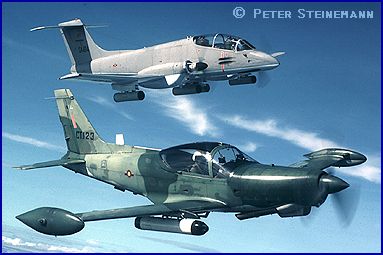
savage-rabbitSeems to me that the K-8 armed with a pair of gun pods or perhaps IR-guided AAM’s is the best option unless the SLAF has an armed turboprop I’m not aware of.
Give the crew in the K-8 a set of NVG’s and give them proper vectoring, and they should be able to intercept those Zlins.
Didn’t the SLAF have a bunch of turboprop powered Pucará CAS aircraft? Perhaps those aren’t operational any more?
It shouldn’t be all that difficult to get the Chinese or Israelis to lash together something similar to the SR-26B Tracker. A turboprop airliner with a FLIR pod, a good communications suite and maybe even an obsolescent fighter radar in the nose would be enough to vector a small makeshift interceptor onto these things. I’d be surprised if the Israeli’s in particular don’t have some sort of upgrade kit on offer for converting a civillian aircraft into a surveillance aircraft.
savage-rabbitLet me remind you that getting a night vision goggle kit is fairly easy. I got three NVGs at home and I can hardly call myself a millionaire. You can get a good binocular set with Gen3 or European XD4 stanbdard for less than 8000 EUR.
I know, I have a NV goggle kit but I was thinking of something more sophisticated than that. The way the Americans, Peruvians, Columbians etc. affected these kinds of intercepts back when they were still shooting down drug runners left right and center and asking questions later was by using turboprop powered light strike aircraft (Pucará?, Tucano) and small jet trainers (A-37) that were guided by some sort of lightweight or ‘pocket’ AWACS. IIRC AFM claimed that this is one of the things the Mexicans are planning to do with their EriEye equipped EMB-145s while Columbia uses a couple of C-26 metroliners fitted with an APG-66 radar for similar purposes
Oh.. and guys.. please don’t turn this thread into a flame war.
savage-rabbitI am convinced they use Czech-made Zlin Z142Cs.
It certainly looks the part. The one on that Tamil site looked like it had a forward sliding canopy. The landing gear and the canopy of the Zlin also looks the same.
It will be interesting to see how the SLAF deals with this. I don’t suppose these raids will last very long when the SLAF decides to deal with them. What would be the most suitable way of dealing with these things? Small caliber FLAK? Personally I’d go for the methods the Yanks and their S-American allies used v.s. the drug flights. The best thing to use would be some sort of armed turboprop trainer like a PC-9 or even a helicopter gunship equipped with night vision gear. I wonder if the SLAF’s K-8 jet trainers could be used to zap these things, the Chinese must ship them with gunpods (IR missiles would be overkill)? But perhaps the K-8 isn’t slow enough? 😀
savage-rabbitWould letting Lockheed Martin or Boeing integrate an indigenously developed weapon into F-16 or F/A-18 would always leak the weapon’s sensitive information to the Americans?
…..
Here are some questions:
Who did IRIS-T integration work on the Norwegian F-16s? Was there any “leak” of the IRIS-T’s sensitive information to the Americans?
How about the ASRAAM on the Australian F/A-18s, the AMRAAM on the Eurofighter Typhoon and the Swedish Gripen?
Cheers,
Sunho
I’m no expert but as far as I know integrating WVR missiles on an aircraft used to be pretty straight forward since it didn’t require a lot of electronics to be installed in the parent aircraft. The Pakistanis for example integrated Sidewinders Chinese F-6 fighters without much difficulty and Israel apparently integrated Russian made R-3 Sidewinder clones captured form the Egyptians into French Mirage III fighters. More sophisticated installations slaved the IR sensor in the missile to the aircraft’s radar which obviously was more difficult than the basic Sidewinder installations in something like an F-6 or an F-86 Saber. I’m not sure whether this task has become more difficult than it used to be. Modern IR guided WVR missiles are slaved to a helmet mounted sight which increases the complexity of the installation process. I’d expect a country with the technical knowhow to develop an indigenous WVR missile would also have the ability to integrate it on an American aircraft without the help of the Americans but normally there would be some sort of suitably paranoid arrangement going on between the Americans and the missile developer that ensured the required security level while still allowing reasonably smooth cooperation. There can however be legal issues, concerning the aircraft. There are for example some systems on your F-16 that you have to bring in American technical staff to do work on. You are not allowed to touch these systems your self. These restrictions apply to countries that bought their F-16s with American defense aid. I don’t know to what extent the Norwegians are allowed to modify their F-16. The Norwegians probably bought their F-16s outright without American financial handouts which may give them more control.
This is one of (absurd) arguments for developing an indigenous fighter aircraft into which indigenous weapons would be integrated.
One reason people are reluctant to do business with the Americans or European countries is that they are happy to sell you weapons but the moment you try to use them you are hit with sanctions, the spares and weapons supply dries up and there is no more support or training. The Russians and Chinese tend to have fewer scruples but dealing with them still makes you politically dependent. If there is a good argument for indigenous fighter designs it’s precisely freedom from dependence on another country would it IMHO. Of course developing your own fighter is hugely expensive these days. So most independent minded countries make due with manufacturing as much of their own air-to-air and air-to-ground weapons as possible and try to be as independent as possible when it comes to operating, reparing, overhauling and even upgrading and rebuilding their aircraft which they increasingly rarely draw from western sources.
savage-rabbitIs this the same MiG-21-2000 as ordered by Cambodia?
I’m not sure these aircraft were upgraded to that standard, they may have simply been subjected to a major overhaul. They were apparently in pretty poor condition when they were delivered from Poland (or Belarus depending on who you believe).
savage-rabbitAs an example he can shoot down an aircraft at BVR distances without having to switch on his own radar.
I haven’t studied the Typhoon in detail so please bear with me here… How can the Typhoon pilot do that? I don’t think that even cutting edge IR missiles have that kind of range yet. The only alternative I can think of is that the Typhoon uses third party supplied information to provide mid-course target updates to an MBDA Meteor, AIM-120 or some other similar missile. If that’s the case it’s certainly a nifty feature. One of the things I like the most about the Typhoon is the set of sensors it has, the PIRATE IRTS in particular is interesting. I have always wondered, how efficient is it (range) and how does it do in a heavily clouded environment? Theoretically if the PIRATE sensor’s range was great enough one could use the PIRATE to provide mid-course updates to an IR missile thus extending it’s range but using fully passive sensors. Except for the update transmissions there would be no telltale radio transmissions. Perhaps that’s an impractical idea?
Does this help a little?
It certainly was interesting to read. 🙂
savage-rabbitUgandan mig-21 😎
There’s never a dull moment in this thread… 😀
Pity about the low quality, can’t make out the Bort numbers. And I’d like to know if they have roundels on the wings. These are the ones they had upgraded in Israel, many of them do the Ugandans have?
savage-rabbitWOW!
I’m speechless…….
What all does the model do? I mean is it a flying one or do you drive it around or is it just for looks with a few features? I’ve never seen anything like this…..
This model looks like it is meant to be flown… I have seen some wierd RC models including a giant four engined WWII bomber with four chain-saw engines, a fully functional (i.e. in-flight seperating) Mistel fying bomb combo and fully functional jets. This thing, however, is in a league of it’s own. Some RC modelers take the hobby to the point where one wonders if they are insane. Of course it wouldn’t be any fun if they didn’t do that so I can’t blame them, especially since I am planning to build an small airplane in my garage some day which is a form of the same insanity :D.
savage-rabbitI should rephrase about what I said about F-7s appearing in both sides of the war. The F-7Ns Iran got was a bit too late for some Fishbed vs. Fishbed intramurals. Compared to the F-7Bs the Iraqis were using, this had a Martin Baker ejection seat, apparently a HUD, and the provision for four Western type AAMs when the F-7B had two.
Iraq used both the F-7B and the F-7M. Judging solely from photographic evidnece it seems clear that at least some of the Iraqi F-7M had a hud. IIRC a hud was standard equipment on the F-7M. The Iraqi F-7Bs would probably have had only a gunsight unless they were upgraded after delivery.
F-7B.
F-7M
savage-rabbitDepends on which MiG-21 you are talking about. The early ones, the ones with the -F, -FL, -PF, etc,. in their designations handle the best. The later ones, with the -MF and -bis, are trickier to fly, but has more power and better radar options. The J-7s are a different matter and has to be discussed seperately.
The interesting thing is that all three, the F-7B/M, MiG-21PF/MF/bis and F-5A/E took part in 1980-88 war between Iran and Iraq. According to the ACIG victory lists the Iranian F-5s and the Iraqi MiG-21s engaged in combat during this conflict, I’m not sure about the Iraqi F-7 fleet.
savage-rabbitMy hats off to those politicians, citizens and military that are smart enough and willing enough too have both studied and implemented the lessons learnt from WWII and wars after, in identifying that aircraft, and air forces silly enough to use massive fixed air bases, with countries bordering them having a well developed and dedicated strike / interdiction force (i.e. The United States and Soviet Union of old / Warsaw Pact!) are only asking for the immediate destruction of the primary line of defence within hours or days of commencement of hostilities (just ask Poland and France during WWII and Egypt and Iraq!).
For it may cost a little more and add inconvenience to the public.
But it will save lives and aircraft, and frustrate an enemy confidence.
IIRC the Soviet Union always built a rough airfield capability into it’s combat aircraft (I’m no MiG expert but that’s the reason for the louvers on the LERXs of the MiG-29 isn’t it?). They did this partly because of the lessons learned during WWII when a large portion of their air forces were destroyed on the ground in the opening stages of operation Barbarossa (you left that out of your list) and partly because many Soviet airfields were pretty low in quality anyway. Basically the Soviet air forces, during the cold war, were if anything more capable of ‘roughing it’ than the USA. The German Luftwaffe (as has already been pointed out) also never quite forgot the lessons it learned during the closing stages of WWII and AFAIK they still haven’t.
savage-rabbitedit edit..
I’m a perfectionist… 😀
Thanks!! I will start with the Mi-8
I’m not really into modern Military aviation. My interest begins to taper off after the 1970s except for small modern air forces (I come here for the small airforces picture thread 😀 ) and stealth technology. There are probably better examples than the ones I cited but I imagine the Mil Mi-8 should make a good start. I’m pretty sure it was never intended to be a gun-ship by it’s designers. The Rhodesians also make a good study in do-it-your-self-on-a-budget combat aircraft procurement under a UN arms embargo. They converted Cessna Skymaster utility planes into COIN aircraft and the Aerospatiale Alouette III utility choppers as gun-ships. They built their own ELINT aircraft to monitor insurgent radio communications out of an old DC-3 using AFAIK commercially available radio equipment. When they got their hands on real military trainers or powerful military choppers these were usually preferred to the before mentioned types because these were superior for their purposes. The Rhodesians converted eight SF.260W trainers to SF.260TP standard by fitting them with a turboprop and used them as COIN aircraft. They also went through considerable trouble and expense to refurbish a batch of Augusta-Bell 205 military helicopters most others would have scrapped because they were better gun-ships than the Alouettes. The Rhodesians also designed and manufactured alot of their own air dropped munitions them selves, from scratch.
savage-rabbitThanks for the information on the South American countries militarizing civilian aircraft, I will research this further. Is there any particular country in South America that engages in this behavior much more than the other countries?
My paper is almost done and anyone who wants to read the final draft can send me a private message.
Well most S-American countries have been pretty well supplied by the USA with surplus military aircraft since the Cold war especially pure combat types so the practice of converting civil designs or adapting military ones not originally intended as combat types got rarer. You still have some examples. A good one is for example the Basler Turbo conversions of the C-47 military transport version of the DC-3. El Salvador and Colombia IIRC still use these as gunships for popping guerillas and mercs the cartels hire to guard drug labs and crops. I find that remarkable, the basic DC-3 design is over 70 years old. As a side note, the USA also oprerates a fleet of armored crop dusters to spread defoliants on Cocaine fields. They regularly get shot at with surprisingly heavy ordinance considering that the ones doing the shooting are drug lords. There are of course the numerous examples of Tucano, Pilatus and Cessna T-37 trainers being used as COIN aircraft (and often on anti drug operations to boot). In El Salvador, during the 1960’s they used to buy up civilian operated P-51 fighters (surplus from WWII) that had been rebuilt as sports planes for rich clients by Cavalier in the USA. The FAS would then arm them up again and used them fighter-bombers. Another good gunship example with a dual civil and military track record is the Mi-8 and it’s descendants. You might acutally draw a parallel between it and historical examples like the bomber/transport conversions of the 1920s-30s such as the the Junkers W.34. The Mi-8 was originally conceived as a civli/military transport but it is widely used as an armed gunship as well. They even have arms, armor and even sensor kits for it.
savage-rabbitAre you shure? Unmarked planes. Where is the evidence?
These look a lot like the Su-24 aircraft depicted on page 21 of the February 2007 issue of AFM, right down to the background setting. In that article it was claimed these Su-24s were being handed over to the RuAF after modernization to Su-24M2 standard along with their first two Su-34 bombers. Curiously the Su-34s were marked and had tactical numbers: Red 01 and Red 02, but only one of the four Su-24s was marked and it is missing from these shots. The location was given as the Chkalov Aircraft Production Association Factory in Novosibirsk.


 Sign In







