dark light

QRO?

Forum Replies Created

Viewing 3 posts - 1 through 3 (of 3 total)
  • Author
    Posts
  • in reply to: Adam Air jet missing (Boeing 734) #583414
    QRO?
    Participant

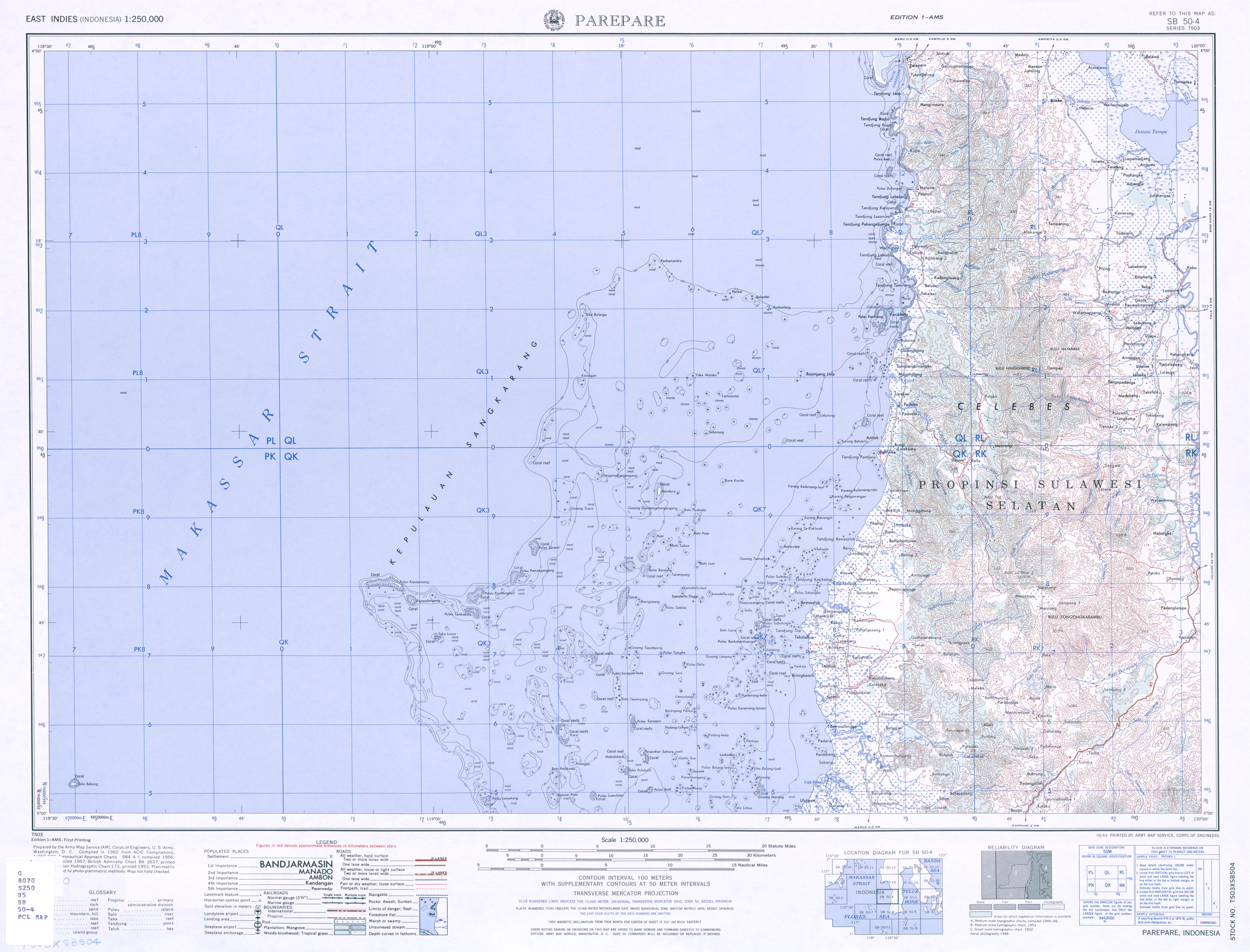
    The coordinates for ELT positioning (030 13’92” S 1190 09’17” E) given in the Adam Air site (after you correct the end zeroes which apparently are meant to represent degree signs) point to a location which matches the first reports about a wreckage location 20 km from Polewali.

    This is on the west slope of mountain Bulu Kananmanu (grid 50MQM4643) between Sabura and Suprakit and at elevation of about 1,950 ft above MSL.

    Also, the same Adam Air bulletin gives mention of

    Singapore Satellite Detection Signal

    which probably means the COSPAS/SARSAT ground station (LUT) in Singapore. This should mean a reception of an ELT signal which supports 20 km accuracy and the search should have yielded results by now.

    However, this later article contradicts any possible interpretation of the location information from Adam Air, giving the ELT signal location as

    Bambang Karnoyudho, head of the National Search and Rescue Board, told MetroTV Tuesday.

    He said the last signal detected by a Singapore satellite indicated the plane was in the water 30 kilometres northwest of Makassar, the capital of South Sulawesi province.

    That would put the location in grid 50MQK45 in this map.

    However, then there is this report (reputedly from an airliner pilot from the area) about the latest radar contact at 100 nm, 340°, I presume from WAAA, which would put it squarely at Bulu Kananmanu.

    Also had it gone to sea “30 kilometres northwest of Makassar” according to the ELT location claimed by Bambang Karnoyudho, it would have still been with good radar coverage which contradicts the information from “PK-KAR”.

    I wonder how it is possible even in the “local conditions of confusion” that they have either mistaken the emergency beacon activation from PK-KKW with something else, confused with the location of the correct signal for about 200 km (between the initial accounts of the search in the mountains and the new accounts of a search in the Makassar Strait) and in any case failed yet to locate the transmitter after 40 hours.


    in reply to: MiG-29`s combat record #2601837
    QRO?
    Participant

    I guess he meant that any antenna can physically be identified. The question is the magnitude. GPS-signals are very weak and its change by a passing aircraft might be very small.

    I think detection based on GPS receiver noise emissions is completely infeasible. Like you pointed out, the amplifier gains required (and resultant leakage powers at harmonic frequencies) is so insignificant, that basically the other avionics onboard should exceed that energy by several orders of magnitude.

    I recall that the highest noise emission from a GPS unit is not actually even from the superheterodyne receiver stages, but from the clock signal generator used to compare the timing signals from the satellites with (I think this is quite close to 1 GHz).

    The bottom line however is that Ramona, Tamara, Vera etc. are effective as ESM and ELINT systems against non-LO, traditional combat aircraft, which are not maintaining very strict EMCON because the mission requires use of various C3N systems and LO can’t be maintained anyhow. You can’t detect LO with current passive systems, you just can’t. LO aircraft are protected against leaking noise even better than they are protected against reflecting “hostile” energy back!

    There are interesting theories being offered for how passive ESM could be of use against LO, which is to utilize other battlefield EM emissions (and emissions from civilian sources, such as cell phones, WLANs, microwave links, PLC, etc.) radiated omnidirectionally to all airspace and then defect those bouncing off the LO aircraft, coming also from RCS-favourable vectors (because they basically come from everywhere). The problem with utilizing this “waste” EM energy effectively is however the same as with active systems, just worse, because the detectors must be very close to the target (range much less than in active systems). So a system with 3 or 4 stations would be useless, you would need hundreds of detectors to cover the same area. This is getting way OT, but I just thought it’s important to point this out, totally passive systems just aren’t effective enough in their current incarnations against LO aircraft.

    in reply to: PD evasion by "beaming" and why it still works? #2653726
    QRO?
    Participant

    With digital radar modes, flight path history & prediction, the rapid scanning ASEA radars, multispectral sensors, and datalinking that maneuver will not help.

    Maybe you meant to say “will not help that much”? Every second the radar doesn’t know where the target is, it can’t direct weapons against it (like give corrections to an AMRAAM that is not yet in active phase on its own).

    The datalink point is valid if other friendly radars are significantly off axis to get a better DS (this is not the case if the target feed is coming from your wingman).

    What I’m after in this discussion is basically to speculate whether, for example AN/APG-77 is able to not only gracefully fail when DS filter loses a target, but to actively attempt to reacquire the target through other means.

    I’m also of the opinion that DS filtering is not the only viable way to deal with ground clutter (this is a fact about radars generally, because there have always been systems that deal with it differently) in modern AA radars and that it should be possible to disable DS filtering also in LD situations to favor other methods.

    Abandoning DS for ground clutter rejection (even for a short time to pick up a beaming target) however comes with a performance cost. I speculated elsewhere that it would require much lower PRF and/or pulse frequency ramping to overcome the clutter present in the same time domain as the airborne target.

Viewing 3 posts - 1 through 3 (of 3 total)