Blitzo
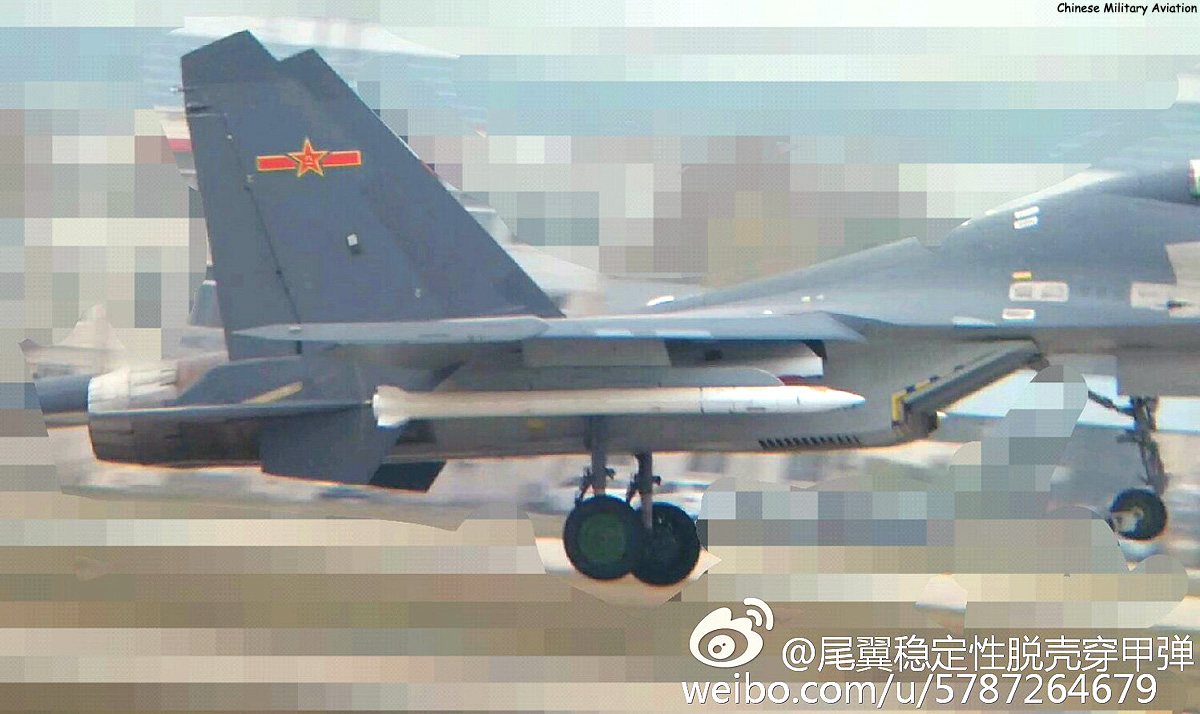
PL-15 AAM – http://chinese-military-aviation.blogspot.com/p/missiles-iii.html#PL-15
A J-16 seem to have carried out test firings of these new missile.
I’m personally not yet convinced that this new missile is called PL-15, because previously the “old” PL-15 was said to have been tested on J-20 and J-10B/C as well as on J-16.
For the moment I’m calling this thing the “new” PL-15/PL-XX while the previous missile is “old” PL-15/crop variant PL-12.
=====
and screenshots of a couple of potentially relevant studies, from a little while back… note the third picture in particular:


Blitzothat’s interesting how limited the j-10s are. im starting to think the jf-17 is actually the better overall multi-role aircraft than the J-10A
Depends on customer requirements for weapons integration (and of course commitment to a given munition type as well)
BlitzoOne question to those who may know more regarding Chinese attrition figures
Just how many J-10s have been lost so far? Going by this report by NPR.org quoting the South China Morning Post, there have been a string of J-10 crashes in the last few years
This report indicates that there are 7 known have crashed so far in the past 3 years, from 2014 onwards. How many more happened before that?
No one knows unfortunately, but given it’s a single engine aircraft and the type is increasing in absolute number and increasing in proportion of fighter sorties that the air force is conducting, it shouldn’t be much of a surprise that the absolute no. of accidents are also increasing.
More interesting would be to see what the ratio of accidents to aircraft in service is like over the last few years since it entered service.
Blitzoyes, wwe had a thread about a hot pilot who died in her j-10. should’ve made it two engined
That occurred during an August 1 training session I believe. In that situation I think it wasn’t related to engine failure but probably more to do with general training of military aviation aerobatics teams.
BlitzoWhy do you think VMF wanted new corvette? Ever heard about its problems with stability/seaworthiness and propulsion? Additionally, ask yourslef: why only 4 of them in service? While 20 have been planned to be build, originally.
I’m not that familiar with the more intricacies of the Russian Navy beyond the bigger headline ship classes like Gorshkov, Grigorovich classes.
I wasn’t aware that 20380 had significant issues with seaworthiness and propulsion.
As for only four in service; I would’ve attributed it to the general state of Russian shipbuilding industry and/or economy, though like I said I’m not intimately familiar with the Russian Navy’s requirements beyond what various easily accessible English language write ups say, and those are scant enough.
Coz it’s even larger and more expensive than 20380 – its price tag makes it only slightly cheaper than 22350 frigate and more expensive than 11356 frigate.
BTW, 6-8 years ago, when it became obvious that 20380 isn’t satisfactory and too expensive project, a proposal of a more or less reasonable project called “OVR corvette” with displacement of 1500-1800t has emerged. Unfortunately, VMF Staff is sick by giantism and the project was rejected.
The only problem that we need a mass corvette – cheap, affordable and fast in construction! Not another one expensive frigate. We failed with 20380 and now we’re going to fail even more with more expensive and complex 20386. Great logic, yeah.
What capabalities??? I say it again, we need a cheap and affordable corvette built in good numbers. And we need it not even today but yesterday. Expensive paper-ships won’t patrol and protect our territorial waters.
Right, I see.
So do you think the Russian Navy’s 20380s and 20386 would be better served with a slightly smaller, less capable corvette then, that can be successfully produced en masse? What kind of characteristics would your optimal Russian corvette look like?
Despite 20380 being produced in small numbers, they are still some quite heavily armed ships in their weight class, though I can understand the need for a slightly smaller, perhaps less gold plated ship as well if it can be produced in large numbers? I would assume you’re not overly fond of 20385 either as well?
Blitzo3400t
5 years to be commissioned
20-40bln. roubles price tagToday my opinion on this ship changed on 180* – it’s going to be even a more epic fail, than 20380.
Can I ask why you see 20380 as a fail, and why 20386 is a bigger failure?
The way I see it, 20386 is basically a new generation frigate rather than a corvette, and meant to be fielding quite a few new weapons and systems as well not to mention quite a new hull configuration.
Price is a bit high, but 5 years from laying down to commissioning, for such a new ship with the kind of capabilities it has isn’t terrible, especially in context of the recent past of shipyards building for the Russian Navy?
BlitzoY20 will also be presented (one on dislay, the other flying)
Yes, but Y-20 was officially disclosed years ago when it made its maiden flight, and Y-20 also attended the last airshow too.
But this is a first for J-20 being “officially” disclosed not to mention making its first public appearance in what is essentially the same event.
BlitzoThe Ministry of Defense of the PRC just released a news udpate confirming J20’s appearance on the coming Zhuhai Airshow on 2016/11/1.
Here’s the linkage.http://www.mod.gov.cn/topnews/2016-10/28/content_4754653.htm
The article hasn’t been found on the English version of the MOD website.
If i remember correctly, it’s also the first time MOD confirms the existence of this type.
I wonder if they’ll honour us with official numbers for its dimensions during Zhuhai sometime….
BlitzoMost of us are pretty seasoned aviation watchers, and I think we all recognize that there is a difference between a bad product not being able to find a buyer because it is a “bad” performer, versus a good or competent product not being able to find a buyer because it doesn’t meet the buyer’s unique mix of requirements beyond only sheer capability.
And in the case of JF-17, I think the lack of Chinese interest is because they had their own other plans and requirements that JF-17 didn’t happen to meet, but IMO that was less to do with JF-17 lacking in capability (relative to what, as well?) and more to do with the Air Force pursuing a heap of other projects and a force structure where JF-17 just didn’t have a place in.
To add to this — I think one would have a far stronger case to “indict” JF-17 (or any other project), if it was a project that was driven by the Air Force or military itself, but which during the process of development and testing was found to be incompatible with their requirements or unable to meet their requirements.
In such a scenario I think that would be a much stronger argument against the capability of a particular project or programme, as it would reflect that the project deliberately developed to meet a set of requirements couldn’t meet those requirements. And of course there have been some of these cases in the military aviation history of various nations, including that of China. But I don’t think JF-17 is one of those examples (in the case of its rejection by China, because it was not a project primarily driven by the Air Force to begin with nor was there any indication of it being developed to fulfill a particular tender or set of requirements set by the Air Force)..
BlitzoBlitzo, see the article that I posted in my post above yours. It’s from FlightGlobal, dated 3 October, 1995. The FC-1 design is evident there- no major changes since then except the LERX and DSI. And the fact that CATIC and Chengdu Aircraft tried to get state support for the FC-1 is mentioned there.
The second article states “CATIC is pushing for support from AVIC and is confident of selling the lightweight fighter to China’s PLA Air Force.”There was always an intent to get PLAAF to buy them, but it never materialised and naturally so, since the J-10 was available.
Right, and that is similar if not identical with what I wrote in my last post, which was that it was primarily a company driven project that was marketed to the Chinese Air Force, and it was obviously turned down.
That differs to projects like J-10 or J-20 which were driven by the Air Force from the requirements stage all the way to getting those aircraft in service. That is why I make the differentiation of what “intended for PLAAF” really means — is it a project driven by the military’s requirements where the company is only the “contractor”, or is it a project driven by a company trying to entice the military’s interest despite no requirements having been issued?
In the case of FC-1, I think it is far more tilted on the latter side of the spectrum than the former, especially compared to projects like J-10 or J-20. And we’ve seen this again recently with FC-31, which is a project driven by SAC who were trying to market to the Air Force but which was turned down as well.
And here is a snippet of another FG article that states exactly the same thing I said- that it was meant to meet PLAAF and PAF needs. With such a large number of Q-5 Fantans and J-7s to be replaced, the FC-1 was intended to replace at least a portion of those. That hasn’t transpired and unless the PLAAF believes that light fighters are useless, I think it is an indictment of the FC-1 itself. At least at its current stage. Maybe a Block 3 with AESA and other technology upgrades may finally get them interested. But I doubt that will happen.
I see where you are coming from, but the lack of Chinese interest I think is less an indictment of JF-17 and more a reflection of the force structure choice in the Chinese Air Force itself.
JF-17 was definitely one consideration for replacing Q-5s and J-7s, but even from a few years ago to now, no one still really knows how those aircraft are going to be replaced, whether a light fighter like JF-17 or perhaps a souped up combat trainer derived from L-15 or if they’re simply going to double down on J-10 variants, or something else. If anything it seems like CAC at the time was trying to get the Air Force interested in replacing their Q-5s and J-7s with JF-17 but they were turned down for whatever reason — maybe it offered too much capability, maybe it offered too little capability, maybe it was premature, or maybe the Air Force had their own requirements that JF-17 didn’t happen to match in any number of possible domains.
Most of us are pretty seasoned aviation watchers, and I think we all recognize that there is a difference between a bad product not being able to find a buyer because it is a “bad” performer, versus a good or competent product not being able to find a buyer because it doesn’t meet the buyer’s unique mix of requirements beyond only sheer capability.
And in the case of JF-17, I think the lack of Chinese interest is because they had their own other plans and requirements that JF-17 didn’t happen to meet, but IMO that was less to do with JF-17 lacking in capability (relative to what, as well?) and more to do with the Air Force pursuing a heap of other projects and a force structure where JF-17 just didn’t have a place in.
BlitzoOf course the FC-1 was intended for the PLAAF ! Or is history just plain too inconvenient for you, so you’ll just twist it any way you want?
I think FC-1 would’ve been considered by the Chinese Air Force for use (and subsequently rejected given the rest of the Air Force’s orbat structure probably made it unnecessary), but I don’t think that fits the term of “intended”.
I’m sure CAC hoped that the Air Force would be enticed by FC-1 and they probably tried to market it, but that is different to projects that are driven primarily by the Air Force from setting requirements for a given product, and then driving the development stage and onwards — like J-10 which was driven by the Air Force from the beginning rather than being company driven and only then subsequently marketed to the military.
FC-31 is another example of an aircraft whose development and testing was driven by a company (by SAC in this case rather than CAC), and marketed heavily to the military, but appears to have elicited no interest. That is in contrast to the J-20, which was driven by the Air Force/military itself from the beginning with a requirement for the aircraft.
edit: that said, FC-1 has a bit of an on and off flirtation with Chinese Air Force interest… all the way from the Super 7 to the JF-17 as we know it, the Air Force occasionally has appeared interested then turned its back. That said I think the commitment of the Air Force to the project is far less than say, the J-10 programme.
(Of course there are some projects that appear to be company driven and successfully marketed and bought in by the military, but that is another matter)
I think there are various sensible critiques that could be levelled to the JF-17/FC-1 regarding its capabilities, but the lack of service in the Chinese Air Force is not a particularly strong one IMHO.
BlitzoInteresting that one vent (inlet meshed grid on the side) is occulted by a screwed panel.
Look at other pictures — there are two of those hexagonal “vents” on each side of the aircraft, and they are fitted on in the same way for all four… Some angles makes one vent look more obvious, because of the slight canting of the intake at that location.
BlitzoWhere do the engines for the Mirage 2000 come from ?
M53s are French, obviously. I’m not sure what that has to do with anything?
Blitzoi think you are correct. mirage 2000 is a more dangerous plane.
I think there is a less colourful way of saying it, like “mirage 2000 has had more accidents than you initially thought, but the accident rate should not be unexpected given the number of mirage 2000 aircraft that have been produced and it’s overall length of service”.
Saying one plane is more “dangerous” than the other can present the opportunity for unnecessary disagreement, especially on this forum.
Blitzothere’s only a handful of jh7s..200-300 yet more than 4-5 crashes
in comparison the Mirage 2000 has around 600 built and only 2-3 crashes. Almost all in Indian service.time to withdraw the jh-7. the Su-30 clones already do its job, and better.
I did a quick search for Mirage 2000 crashes, and came up with this?
http://www.ejection-history.org.uk/Aircraft_by_Type/Mirage_2000/mirage_2000.htm
Not sure about the full accuracy of the list… but a quick search does show quite a few news reports of Mirage 2000 crashes, some in ROC service, some in Greek service, some French, some UAE, so at any rate the actual Mirage 2000 crashes I think is quite a bit higher than 2-3, and the crashes aren’t only in IAF service.
And considering Mirage 2000 has been built in large numbers and in service for quite a few decades, that kind of crash/accident rate is pretty normal.


 Sign In