 Blitzo
Really, LOL……:stupid:
At least my evidence is more compelling than the west’s so called experts, making claims on the basis of… vapour, it seems.
go navy.
Blitzo[QUOTE=Scooter;2102088][QUOTE=Blitzo;2102073]
I don’t see any “evidence” on your part stating “fighters” operating from Ski Jump can do so at MTOW’s. Nonetheless, considering the USN is the experts in Carrier Warfare. Plus, the fact that the three major powers that operate Ski Jump Carriers. Yet, plan of Catapults for their future Carriers. Make me even more sure your case is weak at best.
And go and consult some Russian aerospace historians, ask around for Su-33 and its MTOW.
yes, of course countries that operate STOBAR carriers would plan for CATOBAR, because CATOBAR is better. But that doesn’t mean STOBAR can’t launch fighters at MTOW, we’ve already expounded on why CATOBAR is superior.
For all the USN experts on aircraft carriers, had any of them conducted a study on ski jumps?
BlitzoBlitzo, your diagram of naval nuclear propulsion is a nuclear submarine system. USN nuclear surface ships all run directly from the reduction gearing.
Hmm touché, unfortunately there doesn’t seem to be a picture I can easily find depicting it. Oh well.
BlitzoThat’s not what the web says about nuclear ships:
“…Operation of a civil or naval ship power plant is similar to land-based nuclear power reactors. A sustained nuclear reaction in the reactor produces heat that is used to boil water. The resulting steam spins a turbine. The turbine shaft may be coupled through a gearbox speed reducer to the ship’s propeller, or in a turbo-electric drive system may run a generator that supplies electric power to motors connected to the propellers…”
Better check your facts again
The difference between traditional steam turbines (including nuclear powered steam turbines), gas turbines, etc, and the difference with IEPS, is that IEPS uses all the energy in its powerplants to convert into electricity via motors, and that eliminates need for gearbox, clutch, because it is only the electric motor driving the actual shafts and providing energy, and the actual gas turbine or whatever doesn’t turn the ship’s shaft. On the other hand, in non IEPS and also in nuclear powered, or steam or gas turbine or diesel powered ships, the powerplants themselves turn the shafts in addition to turning motors.
Some pictures to show the difference.
IEPS:
COGAG:
CODAG:
A slightly more complex nuclear propulsion diagram, but note how the steam drives the actual turbine in turn driving the shaft. In an IEPS, the steam woudln’t turn the shaft, it would only turn a motor which itself drives the shaft.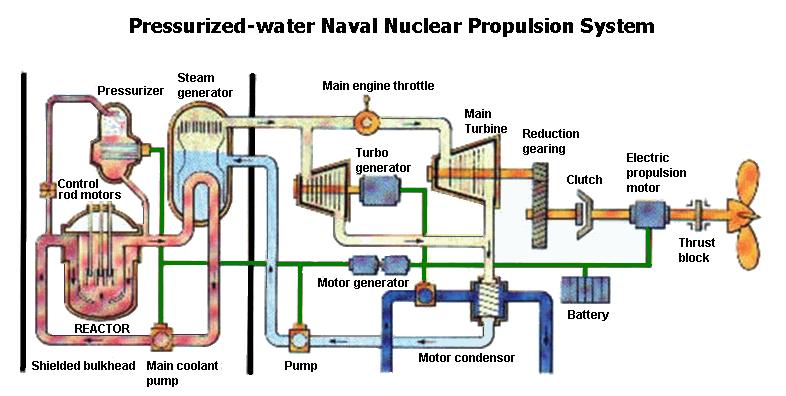
Blitzo[QUOTE=Scooter;2102071][QUOTE]
Endless sources available on the limitation of Ski Jumps vs Catapults…………
The Problem with Ski-Jump Aircraft Carriers
Written by admin on Friday, October 4th, 2013China currently has one aircraft carrier, the Liaoning, which was purchased from Russia and is being converted into an operational aircraft carrier. Perhaps the Russians knew what they were doing when they sold the Liaoning to the Chinese as the Chinese are now discovering that ski-jump aircraft carriers have limitations regarding how much ordnance can be loaded on an aircraft when launched.
The Chinese military has been testing their new ski-jump aircraft carrier over the past three months and have conducted over 100 sorties with various aircraft to include the J-15 carrier fighter aircraft. The J-15 carrier fighter is a copied version of the Russian SU-33 that was intended to be used on aircraft carriers but was eventually cancelled due to weight problems. Like the Russians, the Chinese are beginning to understand the limitations of the J-15 and the weight restrictions of operating from ski-jump aircraft carriers. The weight restriction issue is caused by a minimum airspeed requirement for flight from an aircraft carrier. Ski-jump aircraft carriers generate their airspeed from the run-up distance on the deck of the aircraft carrier and an assist from the ski-jump while catapult aircraft carriers use a steam piston system that accelerates a shuttle attached to the aircraft to produce a much higher end speed. Because the weight of the aircraft impacts the end speed, the higher the weight of the aircraft the less end speed can be generated. For example, the J-15 when launched from the Liaoning can only carry 4,000 pounds of ordnance before it reaches its minimum airspeed requirement, conversely, the FA-18E/F Super Hornet can carry over 12,000 pounds of ordnance on a catapult aircraft carrier. The large differences between the two aircraft carriers can certainly have impacts to tactical considerations for mission planning and sortie generation rates.
The Liaoning represents a significant leap in capability for the Chinese Navy and although it has some limitations regarding aircraft weight restrictions, the Chinese are actively building more carriers and it’s a good bet that they’ll take their lessons learned from the Liaoning and develop a shuttle based catapult system. The significance of the Chinese entry into carrier aviation is that they have the industrial might, technological base, engineering support and revenue to eventually rival any fleet in the world.
… And they don’t have a source to back up any of their claims, and repeats the same old story without any evidence, not even an attempt to look at the physics behind it, or consider even headwind.
There are endless claims that a ski jump can’t launch heavily loaded fighters, but no one provides evidence or even a study.
BlitzoThe Brits wrote the book on carriers with several innovations that make modern carriers possible. And the US Navy with its extensive experience of operating nuclear surface ships were right there with what it meant to operate an electric ship. The PLAN will have to demonstrate that they CAN operate an electric ship and so far there is little evidence that they are pursuing the line of thinking.
Let me know when they get there.
What has operating carriers got to do with expertise in IEPS? Oh that’s right, nothing.
And why specify only “nuclear surface ships”? If nuclear surface ships are supposed to support expertise or technology in developing IEPS, then why not nuclear submarines as well? Do they operate on different principles, or are you simply choosing categories which the US has experience in and that China doesn’t to buttress your untenable position?
—
And actually the chinese shipbuilding industry (note, not the PLAN, but rather the builders the PLAN buy their ships from) are already well on their way to IEPS.
Note, the chinese rarely “report” on their new technologies unless they are well past the testing stage. Anyone with experience watching China knows this.
Further, the Chinese rarely report on technologies that may have military use, unless there is also a dual use capability, and in this case, IEPS also has a civilian utility.
The chinese pla watching community speculate the 055 large destroyer will be the first PLAN ship with IEPS. We’ll know within two or three years, I expect.
http://news.xinhuanet.com/english/china/2013-08/20/c_132646180.htm
Chinese shipbuilder reveals breakthrough technology
English.news.cn 2013-08-20 10:52:52 [RSS] [Feedback] [Print] [Copy URL] [More]
By Zhao Lei
BEIJING, Aug. 20 (Xinhuanet) — One of China’s major shipbuilders said it has developed cutting-edge propulsion technology that will bring the nation closer to its goal of modernizing its shipping and naval fleets.
China Shipbuilding Industry Corp said its Wuhan Institute of Marine Electric Propulsion finalized its integrated electric propulsion technology in mid-July. It said the in-house development will help the nation wean itself off the longstanding dependence on imported parts in manufacturing ships.
Most surface vessels in China use mechanical transmissions and are propelled by a motor or an engine spinning a propeller. Many Western countries have adopted integrated electric propulsion, in which gas turbines or diesel generators produce electricity that powers electric motors.
“Chinese ships usually use steam engines, multiple-stroke diesel engines or gas turbine engines,” said Wang Dan, deputy editor-in-chief of Modern Ships magazine. “Chinese navy ships that need to reach fast speeds would have ‘combined diesel or gas’ propulsion systems.”
The development of integrated electric propulsion may resolve engine problems that have long haunted the nation and its navy. One of the major issues has been a lack of domestic companies who can make gas turbine engines to support long distance voyages.
Without domestically developed gas turbine engines, the Chinese navy has been forced to import foreign engines for its ships, said a military expert who did not want to be named. And until an electric propulsion engine is more widely available in China, most ships must run on an engine fueled by diesel and gas.
“Compared with other drive methods, integrated electric propulsion has many advantages. It can save more space and is easier to control. It helps reduce a ship’s weight and noise,” Wang said. “It also enables ships to cruise at a faster speed and for a longer time.”
The new technology is also easier to operate and maintain, he said.
“Now with the achievement made by our technicians, we are seeing an opportunity to narrow the gap with Western naval powers. The British navy’s HMS Queen Elizabeth aircraft carrier and the United States navy’s Zumwalt-class destroyers, which are all under construction, will use the new electric propulsion technology, which means we must accelerate our development (of the technology) if we don’t want to fall behind in building advanced ships.”
The HMS Queen Elizabeth, which is scheduled to commence sea trials in 2017, will be the first carrier in the world to adopt integrated electric propulsion.
Wang said it is important for China to improve its vessels’ propulsion systems and invest more to develop reliable gas turbine engines for battleships before integrated electric propulsion can be put into wide use.
China in recent years has made a great deal of effort to modernize its naval and shipping fleet and to design new propulsion engines.
China Shipbuilding Industry Corp said in February that one of its research institutions received State approval and funding to formally begin research on core technologies for nuclear-powered ships.
(Source: China Daily)
Editor: Zhu Ningzhu
BlitzoLooking at this oil chart tell me how long Chinese society could function if oil from the Sudan AND Angola were interrupted? And Angola is even further away than the Sudan. China would have a terrible time making up shipments from just those two countries. And the weak link is that these shipments have to travel by sea through several choke points to get to China
A few mines placed by who-knows-who could spoil China’s whole day Suppose some state-sponsored group posing as “pirates” and using a few mines obtained on the international arms black market from Libya stocks, or even WW2 German mines stocks were planted in straits Chinese oil had to transit in times of tension. Or off the coast of Angola to bottle up Chinese oil traffic. What would China do? What could they do? They would have to deploy naval assets immediately to keep their vital oil lifeline open. Its a fascinating scenario.
[ATTACH=CONFIG]224286[/ATTACH]
It is a fascinating scenario for military techno-thrillers, but unfortunately we are far from such a situation in the real world, and even if a scenario were to arise that may threaten China’s energy lines (keeping in mind they are massively diversifying their energy imports as well), China isn’t going to march into a sovereign country of their own accord and start ordering people about.
By the way, there is a vast difference between your original statement of “Any disruption in the Chinese oil lifeline would spell disaster for China,” and actually saying how vast a disruption would be, e.g.: interrupting the entire oil flow from an entire country. Obviously if you were to cut an entire country like Angola or Saudi Arabia out of China’s energy pie then yeah, things are gonna get awkward, but you don’t simply do that overnight and there are obviously contingencies in place to both prevent and to recover from such situations.
Your wording of “any disruption” spelling disaster for China is a massive generalization and it can range from losing one barrel’s worth from a tanker leak, to losing half of its energy suppliers overnight. by using such a vague statement you avoid the fact that a disruption large enough to spell disaster for China is simply unlikely to occur.
It almost seems like you’re more interested in expounding on the scenario of a disastrous situation for China that would force it into a rash decision rather than thinking about just how realistic that scenario is.
Blitzook, but it can use to anti ship role ?
Iskander K probably could, it’s really just a cruise missile at the end of the day, and if you really want you can give it mid course correction and terminal guidance to strike at ships. It’ll basically be a Tomahawk Anti Ship Missile, but not offer any drastically new capability.
Iskander M, the ballistic missile variant, probably could be modified to be an AShBM like DF-21D, as long as you give it midcoruse correction and MaRV. But its range is far shorter than DF-21D, whose range has actually be estimated to be anywhere from 1,400km to 2,700 km, so the Iskander M’s 400km range is not very impressive as an anti ship weapon.
Blitzo1- That would be operating carriers
2- Agreed building ship is building a ship
The PLAN is building a STOBAR carrier first for the same reason the Russians built one first. They lack knowledge on how to run catapults and of course running a large warship like a carrier.
First of all the PLAN is not building a STOBAR carrier first. I said there was a rumour, but rumours about the PLAN’s indigenous carrier plans constantly oscillate between STOBAR and CATOBAR every half year.
Secondly, experience and knowledge about how to run a carrier would not drastically influence the decision between whether a navy would go for catapults or not because operating a catapult on a carrier doesn’t add significant complexity on top of operating the rest of the ship.
Furthermore, it is the difficulty of operating a flight deck and its airwing which is so difficult about carriers, not operating large ships per se, because both the PLAN and Soviet Navy had operated large ships before they started operating carriers (or pseudo carriers in the case of the Kiev class). Ultimately, using a catapult rather than a ski jump doesn’t add much more difficulty to the actual deck crew’s job, and certainly not enough to dissuade the use of catapults.
So, the conclusion can only be that either the PLAN (if they choose to go for STOBAR first) and the Soviet Navy chose to go for a ski jump over catapults, because A, the technology for catapults simply wasn’t there yet, or B, ski jumps offered some advantages of their own, namely never breaking down and possibly less vulnerable to icy conditions.
But whatever the case, if the PLAN do decide to go for a STOBAR carrier first, it won’t be because they realized “operating a carrier isn’t as easy as it looks”.
Lets talk when the PLAN builds an electric ship. Even a test ship.
Well that’s the entire point. I doubt they’ll need an entire ship dedicated to it, the entire architecture should be able to be tested on land before being fitted onto the final ship. I don’t think the RN developed a test ship before building Type 45 or the USN did before building Zumwalt.
BlitzoThe Russian carriers starting with the Moskva class helicopter class and ending with the Kuznetsov were dead ends and for various reasons considered failures. The Russians realized this and were moving to US Navy style carriers such as the Ulyanovsk when the Soviet Union collapsed. See below. Note the cats on the angle
[ATTACH=CONFIG]224285[/ATTACH]
US Navy carriers are efficient. This is for various reasons. And both the PLAN and the Russians have come to that realization.
Everyone in this friggin thread seems to love talking in absolutes.
The correct term should be “USN carriers are more efficient”. The Forrestals were more efficient than USS Midway, the Kitty Hawks and Enterprise were more efficient than the Forrestals, the Nimitz is more efficient than the Kitty Hawks and Enterprise, and god willing, Ford will be more efficient than Nimitz.
And way to be vague as well, are you suggesting that catapults contribute to greater efficiency? I personally agree with you, but some of the Ulyvanosk’s designs do feature a ski jump like that picture, so one has to wonder just why they’d want to retain a ski jump if they had the technology for catapults.
But efficiency/sortie rate is also dependent on other factors, like elevator size and placement, deck size and geometry, island size and placement. If anything it is those aspects which makes USN carriers so good, and catapults have a lesser weighting than you think.
By the way you still haven’t acknolwedged the whole “ski jump unable to launch fighters at MTOW” deal. If you don’t acknowledge it I’m just going to continue our discussions under the impression that you’ve understood and accepted the fact that ski jumps can launch fighters at MTOW.
BlitzoWith requirements all over the globe China must make global commitments in order for Chinese society to continue to function. Just looking at the oil China MUST ship via sea from Africa tells the story. Any disruption in the Chinese oil lifeline would spell disaster for China. And your statement about “Chinese capital spread around the world” shows that you are aware of these vital commitments for China
You overemphasize the importance of individual strands to China’s greater economic interests in Africa.
Pictures remember you saying South Sudans crisis was something china simply couldn’t stomach and it would have to send in troops or something.
While I agree that china will definitely seek to expand its capabilities to defend its interests in Africa, it isn’t like a rebellion or uprising is making them tremble in their boots and make them deploy a naval fleet to restore order.
BlitzoJust because you can launch a fully loaded fighter doesn’t mean you can launch a large strike package in a timely manner consisting of EW, tanker, AEW aircraft, that’s necessary to overwhelm enemy’s defenses. and more importantly to maintain that high tempo of operation over an extend period of time. American style imperial carriers can have four aircraft in ready to launch positions vs two on Liaoning. unless someone can figure out how to have two ski jumps on a reasonable size ship. now when it comes to recovering a large number of aircraft, USN can cram the landed aircraft forward leaving the landing strip clear. Liaoning have far less space forward due to the curve part of the ski ramp. I think these are the operational advantages of a cat equipped large carrier, which may be important to some navy. Inability to launch MTOW has nothing to do with it, no matter how many time that lie has been repeated.
I have my hypothesis why PLAN decided to operate the Liaoning according the USN doctrine rather than the Soviet doctrine, even though the operational requirements of PLAN is clearly still very different from the USN at this time. I’ll post that later.
Err I never said the liaoning or any other STOBAR carrier will be as effective as a USN super carrier in power projection, I said it is wrong to simply equate all STOBAR carriers (or hell, all CATOBAR carriers) together in their power projection capability on basis of whether they have a ski jump or catapults.
For instance, the Charles de Gaulle and São Paulo both have catapults, but how would they compare in terms of power projection compared to a fully operational liaoning.
I thought MTOW came into it because you brought in the soviet doctrine of loading large anti ship missiles on their carriers, but I suppose I misinterpreted it.
Btw, the kuznetsov class actually has three ready to launch positions, not two. There is one on the waist.
It would actually be interesting to see how a more refined STOBAR carrier might perform, but with a more sensible deck layout, larger and more elevators, smaller island etc.
BlitzoI wouldn’t say cat launch is inherently superior to ski jump. cat launch is certainly not the “gold standard” (you are not one of those gold bullion hoarder are you Roovialk?) It depends on your operational requirements. For small sea control aviation carriers, whose mainly mission is ASW and limited air defense, ski jump is the logical choice without the cost and complexity of cat system. Soviets designed the Kiev and Kuznetsov classes mainly to defend SSBN bastions. The Russian aviation ships are essentially sea control ship combined with the armaments of missile cruiser in one hull. Ski jump is also the logical choice for their operational requirements. Large American strike carriers on the other hand are instruments of global imperialism. The typical missions of American carriers in today’s environment follow the pattern of aggressions against smaller weaker nations such as Iraq and Libya. For that kind of power projection operations, large cat equipped carriers are essential in order to generate large strike packages and sustain sortie rate. Without the heavies anti-ship batteries of Russian aviation ships, American style carriers also need the cat to quickly launch large anti-shipping strike package.
I respectfully disagree, because you yourself has shown how a ski jump launch fighters at full load.
I think the problem is you are looking at this on a categorical scale, that is to say, catapults=power projection, and ski jump=ASW and air defence.
It is actually more of a continuous spectrum in power projection capability partially determined by whether a carrier is ski jump or CATOBAR, but arguably more influenced by the navy’s own doctrine.
For instance, the liaoning will be used in a more USN style manner than the kuznetsov was for the soviet navy, even though both are technically the same class of ship.
BlitzoYour answer is simplistic. One key aspect of catapults over ski jumps or ramps as I refer to them is tempo. With cats you can install up to four and quickly launch four aircraft into the air. That is tempo. With the ramp you can only launch from the bow. I have never seen multiple ski jumps / ramps installed on any carrier. Have you?
But you have seen multiple cats. Thus you get more aircraft in the air faster. That helps when you are managing a strike against a high value target. See Alpha Strike for more (http://en.wikipedia.org/wiki/Alpha_strike_(United_States_Navy)
I never said a ski jump had a faster launch tempo than a carrier, I was merely refuting your claim that a ski jump couldn’t launch fighters at MTOW, and that the advantages of catapults lay in other domains.
By the way, tempo is more of a relationship between the number of launch positions a carrier has rather than whether it has a catapult or a ski jump. The São Paulo has one catapult, the vikramditya has two launch positions, which one has the higher launch tempo?
A USN super carrier might be able to launch four planes within a few seconds of each other, but they will have to wait a minute and more for other fighters to taxi ready and for the catapult to reposition. A ski jump carrier might only be able to launch fighters one every eight seconds, but they don’t have to wait for a catapult to reposition, drastically cutting down overall wait time.
But I do agree that overall launch/surge tempo is definitely a plus for catapult carriers, but a smaller one than the advantage of launching non-fighter fixed wing aircraft and a smaller dependence on headwind which I had previously pointed out.
This is all a sideshow to the larger discussion anyway, which is that ski jumps cans launch fighters at full load.
Secondly there are no instances of other aircraft such as CODs or AWACS being launched by ramps.
Yes that was one of my points for why catapults are superior to ski jumps.
So if the PLAN wants to be a second tier force then let them build future carriers with ramps. Those in the know will use cats.
… What are you talking about, the PLAN are obviously going to end up with catapult aircraft carriers.
There is a difference between maturity of a technology and demand for a carrier meaning a navy must produce a STOBAR carrier and another matter entirely if a navy deliberately chooses STOBAR even if they have the technology for CATOBAR…
That’s because the PLAN is finding out that this carrier business is not as easy as it looks
There is so much ignorance in this single sentence I’m not sure where to begin, but I’ll give it a shot.
1: what does “carrier business” mean, does it mean building carriers or operating carriers??
2: because if you mean building carriers, then there is very little difference between STOBAR and CATOBAR design and construction apart from the complexities of the internal work necessary for a catapult of course, and that added complexity is far from enough to tip the balance between STOBAR vs CATOBAR, especially if they’ve already mastered catapults. If you’re saying they are choosing STOBAR because they haven’t mastered catapult technology yet, then that’s the statement you should have said instead of a generalizing vague statement like “carrier business is not as easy as it looks”
3: if you mean operating carriers, then I assume you are implying they are using the “lessons” from operating the liaoning over the year to facilitate their next generation carrier configuration choice.
3A: this statement might make sense, if it were realistic that they could make such a significant decision between CATOBAR and STOBAR in the space of a year contingent on the liaoning crew’s response.
3B: this statement also implies that operating a CATOBAR carrier must be more difficult than a STOBAR carrier of similar size, which is obviously ridiculous because the only difference is that of the crew maintaining catapults and the entire process of launching an aircraft, which, while it adds a layer or two of complexity on top of a STOBAR carrier’s overall operating complexity, is obviously not so great enough to suggest the PLAN would go for STOBAR rather than CATOBAR on the basis of “operating difficulty,” especially not when a catapult offers so many advantages over a ski jump as we’ve already discussed
4: I take exception to the part “not as easy as it looks,” because this implies the PLAN thought operating carriers was easy and frankly everything they’ve been doing from towing varyags hulk to dalian to now, have shown that they have respected how difficult operating a carrier is.
So ultimately, if your statement is ill informed, then what may be the reason for the PLAN desiring a STOBAR carrier first?
Well it may have to do with the maturity of their catapult technology. We know they’ve been pursuing EMALS for years, but chances are it isn’t ready yet. And the PLAN aren’t bothering with steam catapults, so possibly their only option is STOBAR for the foreseeable future, depending on when they want a carrier and how desperate they are for catapult capability.
Further, depending on the propulsion of their carrier, they will have the option to develop a carrier akin to the QE class which can be easily modified for future EMALS once the technology is ready. The benefit of EMALS is it requires less internal piping and other such nonsense compared to a steam catapult, and it draws energy directly from generators/IEPS.
But all this is academic because at this stage we have no idea what kind of carrier the first one actually is.
BlitzoViraat really looks its age next to viky…and that is saying something given Vicky itself looks late soviet :love-struck:
Does anyone know if Vicky made its journey with any fixed wing aircraft at all?


 Sign In







