Blitzo
I don’t think he is blowing up anything. As safety is such an environment is always first! The lack of such basic rules shows an extreme lack of professionalism.
Of course he’s blowing it up.
The landing of a single helicopter with a flight deck clear of anything. If you want to seriously accuse them of non professionalism, show me pictures of that kind of lack of gear once they spool up to a full airwing with a flight deck launching, recovering and spotting aircraft.
I suppose if we’re going to take one circumstance as evidence of extreme lack of profesisonalism, I suppose the marine nationale and the USN are both unprofessional too.


,_2000_lbs_GBU-31_Joint_Direct_Attack_Munitions_(JDAM)_are_transported_to_the_flight_deck.jpg)
—-
I hope you realize just how ridiculous your claim is.
You see three deck crew not wearing helmets for the landing cycle of a single helicopter on an otherwise spotless flight deck, and you have the gall to instantly accuse the sailors of extreme unprofessionalism and disregard of safety as if it is endemic.
BlitzoBut useful for herding away USN CGs that get less than 30NM from the Chinese carrier (sorry… scientific research vessel).
It was an LST that intercepted the Cowpens, not the 071 in the photo, I certainly wouldn’t risk such a large ship against a cruiser armed to the teeth with possibly dubious intentions.
(Chances are, there were a couple of LSTs or smaller ships on the outer edges of their training ground, while the actual “task force” could do their exercise without bother)
And this isn’t a CBG, this would be called a task force rather than a dedicated “CSG” or “CVBG” per se.
BlitzoSince there are posts showing photos from the recent deployment of the PLAN carrier task force to the South China Sea, details from these photos and frame grabs from videos taken during the deployment deserve a more detailed examination of PLAN deck procedures. Namely gross safety violations that invite death and injury to the crew.
What I am seeing is a complete disregard for crew safety issues that are standard to the US Navy model that the PLAN is attempting to emulate. My question is that how can the PLAN overlook such basic safety violations? At some point this lack of attention to detail will return to bite the PLAN in the behind. Further the PLAN is making a big mistake by having their deck crew practice the wrong set of procedures only to have them unlearn these procedures in the future.
[ATTACH=CONFIG]224124[/ATTACH][ATTACH=CONFIG]224125[/ATTACH]
Omg lol dude, they’re signalling a single helicopter down with nothing else on deck. While I think it’s not the most responsible thing to do by ignoring a helmet, let’s not blow it up and think this is reflective of either normal operations on a truly busy and cluttered flight deck or generalizing this to somehow having to unlearn the wrong set of procedures?
I mean sure we can harp on about how standards should always be upheld which I agree with, but I think this is the first only “gear malfunction” we’ve seen since the first J-15s landed on the deck in late 2011, you gotta give them some leeway, you know?
I think you’re drawing a few too many conclusions too quickly (including your other post about the helicopter landing sequence), not to mention your predictions are a bit grandiose and picking at details which may be irrelevant once the flight deck is in full swing.
It’s like trying to predict the decades of life of a great oak from its sapling…
Give them a year or two to get the first airwing equipped first, and then talk about progress.
BlitzoJust for the record please outline examples that support your views. It does not have to be an exhaustive list, but one that touches on the highlights of recent Chinese innovating and adapting foreign aviation technologies to their needs
Gosh that’s an awfully vague category.
Everything from adapting the Mig-19 to become the Q-5, or the original Mig-21 to the J-8, to re engineering the An-12 through the Y-8 variants to become the modern Y-9 it is today, from taking the flanker platform and using the airframe and producing it using modern methods with modern and indigenous subsystems…
For the most recent and high profile example, take the Liaoning, an ancient hulk of an incomplete soviet aircraft carrier rebuilt with 21st century subsystems and living amenities.
So what constitutes “innovate” and “adapt” in this case, and do those examples accurately reflect on the actual innovation or competence of the chinese military industrial complex? And just how important are examples of “innovation” to the actual progress of the entire industry, as well? Does it reflect a fundamental structural limitation or is it a product of fiscal, time, technological limitations, maybe simply form following function, or perhaps a mixture, and just how severe are those factors in predicting future development?
I’m not pretending to know the answers, but I’m only portraying how much of a fruitless exercise it is to reduce the prc military industrial complex’s competency on the basis of a few examples. It’s like saying they build their own HMMVWs and making some kind of wild claim about their inability to develop “indigenous” land vehicles.
BlitzoSo here’s the question: Suppose in the next few months China is in the position of abandoning its decades old investment in Sudan and has to pull its citizens out of the oil fields that Chinese investment has built. Will China just shrug its shoulders and walk away from all the billions of development dollars it has invested in Sudan? See below:
“…China is continuing its massive investment project in Africa with an $8 billion injection of funds into Africa’s newest country, the South Sudan. Recent fighting has deprived China of about 260,000 barrels a day….”
Who does China have waiting in the wings to make up that 260,000 barrel a day short fall?
And with turmoil all over Sudan how will China safely evacuate its citizens? When America attempted to evacuate Americans from the area their V-22s came under heavy fire and were driven off. Could the Chinese anti-piracy task force in the area become the staging base for Chinese forces to fight their way into the Sudan to evacuate Chinese citizens?
“…Like elsewhere in Africa, China’s engagement with South Sudan is not simply about multibillion-dollar investment deals. It also plays out in smaller ways on the streets of Juba and other towns where Chinese expats have opened “Chinese Friendship” clinics and schools, as well as hotels, restaurants, and other small businesses…”
Suppose the warring factions turn on the Chinese. Would China in desperation appeal to the only country capable of helping pull Chinese citizens out of the country: The United States?
Well, the Chinese aren’t the only non locals there. If there was evidence of attacks against foreigners China wouldn’t be the only one urging an international intervention of some sort.
As for Chinese investments and oil — while it would hurt to lose them, it would hurt far more to unilaterally invade South Sudan.
I don’t know if China can “safely” evacuate its citizens, but I presume they would use a combination of military assets (Il-76s and escorting naval ships) with civilian/neighbouring nations who China will “lease” assets and accommodation from, to house or ferry its citizens. So basically not very different from Libya.
Also, if South Sudan really does hit the fan, the US will be as interested in restoring stability as anyone, considering they were one of the greatest advocates for South Sudan to begin with.
But alas, the latest news seems to suggest things have somewhat stabilized.
—
China simply isn’t audacious (or indeed, arrogant) enough to unilaterally invade another country. It’s definitely looking to build another navy that it can call upon to defend its interests in coming decades as its interests become more deeply rooted, but at the moment a quiet withdrawal of its citizens and even loss of money is preferable.
They’re definitely not going to invade South Sudan.
BlitzoNo the profits would be held in an escrow account to be released after China stopped hostile action. No body loses.
I see. I might be a cynical fart, but for some reason I don’t think the US would be that generous. More importantly, the impact on global trade will still be immense.
Allow China to have access to certain import markets. All you, the Americans are trying to do is to have China cool the hostilities and return to square one.
…
Tough choices for sure. But it would beat using nuclear weapons to solve the crisis
Nukes are obviously out of the question. The question in this case, is just how extensively the US wants to react to a potential conflict in the region, what are its goals? Is it to force a unconditional surrender out of China, or merely a ceasefire between China and the opfor, or what? that will determine the extent to which the US is willing to deploy its military assets, and in turn, how much of the world economy it’s willing to risk.
The way in which a conflict is sparked also will determine what “square one” is. The biggest risk imo, is a shooting war where nobody knows which side is properly “right” — for instance, an accidental shooting by one side or the other in a PLAAF or JASDF encounter in the overlapping ADIZ may lead to a medium sized air war that in turn leads to a full blown air-naval conflict around the area. What is “square one” in that case?
Or, let’s talk about Taiwan. If Taiwan one day has a president that decides to announce independence after continued PRC warnings, and the PLA uses military action to either invade Taiwan or force a reversion back to the status quo, what will be square one after that? Will it be the PLA sending its troops off taiwan back home, and allowing Taiwan to continue holding the status of independence, or will Taiwan revert to the “status quo”?
The ends will determine the means, and unfortunately the ends in many scenarios of a conflict involving the PRC are very ambiguous.
Probably only if the US decides to intervene in the region itself.
Right, in that case, we should look at just how likely it will be for the US to intervene itself directly, head on against China.
Every year that passes, the risk — both economic and military — to a US intervention in the region in a local conflict incrementally increases as PRC military and economic prowess grows.
Fortunately the Taiwan issue seems relatively benign at the moment, now the problem is the dispute islands with Japan.
Like it or now the US has been a pretty fair protector or controller of the sealanes up to this point
I’m not disputing that, rather I’m pointing out that it certainly has the power to place a SLOC stranglehold on any country that it effectively wants.
The fact that they haven’t done so yet is because there hasn’t been a competitor which it needs to use such a method on yet (i.e.: either an enemy has no SLOCs to cut off such as the viet cong during the war, or the enemy can simply be annhilated with conventional military force, such as Iraq in desert storm)
Maybe. But in the event of dire circumstances the US and her allies must have an option that from their point of view contains China. And this option should be well known and what triggers it by the world.
The Air-Sea Battle strategy could directly trigger a nuclear exchange. You don’t want that. I sure don’t.
But the strategy of OC also advocates ASB strikes against the chinese mainland as far as I can see.
BlitzoGood question to ask. So how would you answer that?
I can only make estimates based around China’s navy, not America’s.
However, by, let’s say 2030, the PLAN will be very different from today. Even the 2020 PLAN will be very different from the PLAN in 2010.
One only needs to count the number of existing old destroyers and frigates they have in service today, and look at the 1:1 ratio of replacement of those ships by modern blue water capable vessels in the last few years to get a fix on how many ships the PLAN will be aiming for.
For example, the PLAN’s current “front line”/blue water force is made up of six destroyer flotillas divided among three fleets. Each flotilla has four destroyers and four frigates each. With the rate of construction that we’ve seen and that we are seeing to begin, there 6×8=48 blue water capable destroyers and frigates by 2020+, and there have even been suggestions of increasing flotilla sizes to 12 rather than 8, meaning 6×12= 72 blue water capable destroyers and frigates, which would probably mean continued production of vessels until the mid 2020s (which would put us close to the 2030 time zone).
Such vessels would naturally include the current 4000+ ton 054A (of which ~16 are in service and 4 are in various stages of construction and/or fitting out or seatrials) and 7000 ton 052C (of which 6 total are produced). There are anywhere up to 12 7500 ton 052Ds in the pipeline, with about one new 052D launched every six months. Then there is the 055 12,000 ton large destroyer, which has been rumoured for a few years but which we may only see launched late next year. Of course, there is also the next generation frigate which will replace 054A production, which we will probably see the first signs of within the next few years.
This only includes the front line units, of which there we can expect anywhere from 48-72 by 2030, and will be a combination of older 054As, 052Cs, and newer 052Ds, 055s, and the tentatively named 057 next generation frigates. Now, while these ships may not pack the full punch of a burke, they are all blue water capable, and at the very least 054As and 052Cs have what we consider modern combat systems for today. I won’t seek to quantify the capability the PLAN’s front line blue water vessels against the USN’s burkes because that will be far too complex and will require many an assumption.
Not included in this projection are the dozens and hundreds of smaller FACs, corvettes, and older frigates and destroyers relegated to coastal and regional duties, freeing the modern blue water ships for longer range missions or missions against more formidable adversaries.
I won’t go into how many carriers, LPDs, and LHAs or SSNs/SSBNs the PLAN may have by 2030, but we can expect those to grow in proportion to the PLAN’s surface combatant fleet.
I think, if we don’t see a conflict or major economic upheaval before 2030 (and assuming the USN maintains its ship size from today), I expect the PLAN will have 2/3rds of the number of modern blue water capable surface combatants of the USN by then, and possibly 1/3 to 1/2 of the power projection assets available to the USN by then (note I don’t say capability, but only assets in terms of ships. That is to say, a USN supercarrier of 2030 might be more capable than a PLAN supercarrier of 2030 because the USN will still have more carrier experience by then, or maybe they’ll have a better carrierborne fighter, etc).
Again, this PLAN fleet will not include its regional and coastal forces, which I expect will still be great, and consist of dozens upon dozens of 056 corvettes, 022 FACs, and older frigates and destroyers.
The question is whether the USN will shrink its fleet or not, and what kind of carrier fleet will it seek to retain, etc.
China imports 30% of its oil from Africa. It can hardly afford to have that much oil interrupted without feeling it. Regarding Libya China was forced to abandon post haste Libya because they backed Kaddiffi. Leaving Libya in such a rush caused China to lost billions
They abandoned Libya because the civil war was threatening its citizens working there.
China never supported Gaddhafi in any material way (although china definitely didn’t call for gaddhafi to **** off either — but that’s different to “supporting” it). If memory serves, Gaddhafi actually made some hostile remarks to Chinese investment in his country before, so it’s not like China liked gaddhafi at all.
“China counting financial losses in Libya”
In the wake of thousands of workers being pulled to safety from Libya, Chinese authorities are scratching their heads to put a cash value on the amount of business being lost in the North African country.Government figures released Thursday showed that 35,860 Chinese have left Libya, leaving behind construction materials, machines, vehicles and project contracts totaling in the billions of dollars.
According to China’s Ministry of Commerce (MoC), there were 75 Chinese enterprises with investments in Libya, operating 50 joint projects and employing more than 36,000 workers. And 13 of those firms are State-owned.”
Oh don’t get me wrong, I’m not saying leaving investments there is the optimal route to go, but they’re certainly not going to invade a country riddled with either secular or ethnic strife and poke their head into a situation that it knows nothing about.
That would be what you’d call overreaching.
With so much money and oil at stake I do not know what China will do. But they will have to do something. And fast
Do you even know how much money and oil is “at stake,” relative to China’s wider investments and other oil sources in the region never mind the globe?
It’s not going to freaking invade a country for something like that.
BlitzoOne aspect of this OC control is to board ships loaded with Chinese export cargo and after seizing the cargo sell the cargo on the open market and give the profit to the destination buyers. In this way only China is cut out of the profits and pressure is brought to bear upon China to cease whatever action they were performing that prompted the action. And action such as proposed for OC would be happening in the times of extraordinary events. The world would be balanced on a knife’s edge.
Wait, so they would seize ships with chinese exports… and sell them to the buyers… and the profit I suppose would go to… who, the US and its allies?
But what about Chinese imports? You’re cutting out dozens of countries from a major export market (china).
Not to mention the massive instability even a half successful implementation of “taking Chinese ships and selling them” would bring, along with the world’s judgement of the US essentially closing off sea lanes to chinese traffic.
Not since the second world war has there been any such interruption to sea traffic, and certainly not such a potential economic blowback that would arise. I’m not saying the US don’t have the assets to conduct such missions if it has to, but rather the consequences will be immensely far reaching. So the US will have to balance whether they want to use such a dangerous tactic, in the enormous array of potential regional conflicts that may arise.
For example, would it be used only in a limited, brief conflict between China and Japan, say over the disputed islands?
Would it be used in event of a scenario of Taiwan independence?
Or will it only be used once the US decides to intervene in the region itself?
The p
Your statement is true. Because currently the USN is the protector of the world’s sealanes. And will be for some time.
Protector is another word for controller. Because currently the USN currently controls the world’s major sealanes, it can close them off at will. That has been the major premise of seapower the first boats took to the ocean.
Whether china will have a navy capable of securing its own sealanes in future is an entirely different matter. My statement was merely illustrating the illusion that the US’s dedication to “freedom of navigation” is only staunch when it suits its purposes.
If it has gotten to the point where sealanes are threatened I don’t think being looked at as “the bad guy'” will figure into the equation. But in my humble opinion OC offers an attractive non-nuclear alternative to enforce your will on a nuclear armed opponent. It is an interesting bridge between conventional and nuclear war.
I think you are giving this strategy a little too much credit — this is simply a mahanian tactic. What it is, is simply interdiction of shipping using seapower.
And faced with a crisis between two power blocs to where nuclear weapons are part of the conversation, I think the rest of the world will do everything it can to keep the conversation confined to conventional combat
I think nuclear weapons will be less important in such a conflict, than the economic equivalents of thermonuclear detonations.
Having the world’s second largest and largest economies (depending on the timescale, it may be either China or US in either of those two places) go to large scale war using “only” conventional weapons, would simply be unacceptable to the world. Everyone depends on the US and China too much to allow even one of them to go down. Indeed, intertwined economies and a globalized world may be the biggest buffer against direct conflict we have.
BlitzoWhat ever happened to the Chinese strategy nick named “String of Pearls’?
Not sure, what did happen?
Or rather, what did you expect to happen? I think China is still funding development of a series of ports in that region. If you’re suggesting China should be making them into military ports, I believe you are mistaken because that was never their intention.
Right now I am carefully watching the events unfolding in the Sudan.
You can rest your sharp eagle eye, because the events unfolding in Sudan aren’t that vital to China’s interests in the larger scheme of things. Imports from Sudan are only a small fraction of China’s total. More importantly, China will not deploy military assets in another country even if that country asked it to without strong international (i.e.: UN resolution) backing.
BlitzoLets see: Using your timetable it would take at least 20 years for China to overcome the structural weaknesses it suffers today. But since China’s opponents will not be sitting still wouldn’t the same gap China suffers today still largely be in effect 20 years later? What key areas do you see that China needs to make up ground in 20 years to achieve parity with the west?
Actually I think what we said was that it would take 20 years to catch up to the west… that is including the fact that the west would also be advancing forwards.
But reaching technological parity obviously doesn’t mean reaching overall military parity.
The question we should ask is how capable will the USN remain from now to 2030-2040, and how capable will the PLAN be in that same time?
If something in a distant land kicked off in the next five years China would be hard pressed to influence the course of events.
Well the SCO exists to counter such contingencies in central asia. Of course, if we’re talking Chinese interests in Africa, then obviously they can’t project much meaningful power for at least the next ten years.
For one I am watching the events unfolding in the Sudan in Africa to see how China responds to a serious threat to its oil lifeline. If China is to avoid a debacle like it experienced in Libya after the overthrow of Kaddafi they may have to put ‘boots on the ground’ to protect their interests in Sudan. Can China project power like that? Is the PLAN ready to step up to the plate and respond for the good of China? Or more importantly does it even have the stomach for the projection of power into a highly unstable situation like Sudan?
I think you’re making making a bit of a mountain from a molehill.
China has interests in those regions, just as it did in Libya, however the situation in Sudan and certainly in Libya, were not worth going in guns blazing by any stretch of the imagination.
China has interests in South Sudan but it also has interests in the whole of sub saharan africa. Calling South Sudan China’s “oil lifeline” is massively hyping up its importance.
As for the Libyan scenario, what debacle are we talking about? It evacuated its citizens using a combination of military and economic-political means, and it was quite successful.
In the next few weeks may see what the future of modern China is really all about.
… Do you seriously think the situation in South Sudan is one which China is willing to enact unilateral military action against a foreign nation?
“What the future of modern China is really all about” — give me a break…
BlitzoOR intense diplomatic pressure for countries to take sides.
If I were them I’d prefer to stay neutral lol…
BlitzoThe interesting part about this OC strategy is the seizing of export cargo ships and their cargo as war prizes to be sold with the profits going to America and her allies. And remember the secret to this OC strategy doesn’t just take into account the first island chain but involves chokepoints far away from the normal area of operations of the PLAN.
Let’s not get carried away, because the implications of such an act or the implications of the environment having reached a stage where such acts are necessary, means it has probably reached world war three.
I don’t think any country has openly attacked another country’s shipping at such distances between port and port as you suggest, certainly not since World War Two.
—
The so called secret to this so called strategy is no different to ASB because the end result of both strategies will include cutting china off from its SLOCs (freedom of navigation anyone? Lol), it isn’t like ASB will mean the US will keep China’s trade routes open…
—
The big problem I see with such a large scale conflict,not merely confined to a region, is that it will effect other countries very much as well. There will be immense diplomatic pressure for china and the US to resolve quarrels peacefully, and whoever starts attacking shipping or cutting off trade routes will look like the bad guy.
Of course, if you have the worlds most capable military and biggest fleet of SSBNs I suppose you will always look like the good guy.
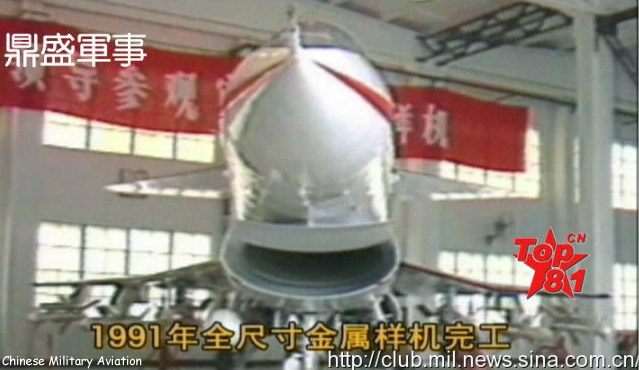
BlitzoOkay so here is an interesting photo I just happened to come across…it appears to be an early J-10 mockup or something…according to the website it was linked to. My question is directed at those who are adamant that the J-10 is not related to the Lavi in any way…I’ve always believed it was, but people seem to get quite offended by that assertion. How can the J-10 and Lavi not be related (by related I mean much more than just general configuration). Any idea of the dimensions of this mock-up? Was it as big as the J-10A now in service with the PLAAF? (Pardon the ignorance on this particular photo…I had just never seen it before.)
I don’t think anyone who has done their research would think there is no connection with Lavi. How big of a connection there is is an entirely different matter.
And the J-10 went through quite a few different inlet designs before settling on the J-10As. Using an F-16 style round intake would naturally invoke thoughts of Lavi given how similar J-10A superficially looks like Lavi.
—-
Latenlazy, I suppose you mean Tu-160?
BlitzoOffshore control OC is a much more enlightened strategy than A2D2. In a nutshell OC seeks to interdict China in arenas where China is weak and America and her allies are strong.
I think you’re getting a little hyped up over nothing.
So called “off shore control” is not very different to ASB — it still advocates strikes against China’s mainland, only it includes the additional component of a naval blockade of China’s SLOCs along with an area denial campaign based out of the first island chain, using Japan’s circle of small and vulnerable islands.
And so looking at “offshore control” one has to think “no duh??” because do we think the US will keep China’s SLOCs open during a campaign of “only” ASB anyway?
The only significantly new component is that of a first island chain based containment apparatus, and I think I’ve already concluded how flimsy such a strategy will be. Not to mention how costly.
We should have read enough military and academic papers to recognize when phrases like
provides a strategic context for an operational approach that goes beyond Air-Sea Battle to use the U.S. geographical advantage to maximize the effectiveness of a campaign using our air, sea, and land assets
use fluffy and deliberately vague words to boost the premise of a paper’s proposal to make it more game changing or revolutionary when it actually doesn’t differ from previous proposals dramatically at all.
BlitzoI really do not think that America would start a war with China. What would be the gain in that? If a war gets started it would be because China feels the need to flex its muscles to demonstrate it is an emerging superpower and then over reaches.
I doubt China would be interested in starting a war given its primary concern is domestic stability. Of course, its interests also includes security and sovereignty, and if either of those are threatened without a course to back down, military action will inevitably occur.
Of course, opinions will naturally differ on whether it is “muscle flexing” or a justified response — we just need to look at how the ADIZ was reported by differing parties. Some saw it as a justified and reasonable action and in line with international norms, others saw it as a unilateral act of deliberate provocation, or more disturbingly, some deliberately portrayed it as a sort of no fly zone which it obviously is not.
Unfortunately, the satisfaction to pin China down on a hubris driven war that it starts seeking to gain respect for its superpower status will remain in the realms of badly written techno-military thrillers.
And regarding this idea that China will eventually overtake America in the economic and technological arena there is an old saying that goes like this: There’s many a slip twixt the cup and the lip. Are you familiar with it?
http://en.wikipedia.org/wiki/There’s_many_a_slip_twixt_the_cup_and_the_lip
Are we really going to resort to slinging proverbs?
You realize, of course, I could just as easily turn it back around on the notion that America will remain economically and technologically ahead of the rest of the world.
Maybe its a start. China is hemmed in by geographical factors to where a relatively weak force can bottle her up. The key point to take away from all this is that China can reach her critical mass of enemies and then be faced with being between a rock and a hard place. The fact that people are discussing advanced strategies that contain China without resorting to nuclear weapons should be of great concern to China.
I think you misunderstand.
By sheer geography, implementing a comprehensive containment strategy on the first island chain would be immensely vulnerable. Not to mention expensive.
What we like to call “A2AD” systems, are usually deployed against an enemy who is leaving his turf to fight on yours — and your turf is larger, with more places to hide and place offensive and defensive assets. You are able to concentrate your firepower while simultaneously dispersing your assets among a wide geography connected by overlapping and well defended logistics routes.
On the other hand, developing an A2AD system on islands with limited geography, makes your assets and infrastructure many degrees more vulnerable simply because the lack of real estate compared with a larger land mass makes it easier to spot and identify you. Putting it another way, each island, or indeed, all the islands together, simply won’t have much strategic depth. Even if each island offers supporting protection for each other, current technology (particularly in air defense) makes cooperative defense at such distances impractical. That is to say, it will be next to impossible to defend the chain of islands together, say like a ring of “fixed” escorts for a CVBG.
Sure, you could add more defensive and offensive units to each island, but that in turn requires more infrastructure and basing if you want any kind of permanent presence, which in turn makes your assets all the more vulnerable due to the high profile and thus vulnerability, of such infrastructure.
Not to mention resupplying such bases will have to be done by air or sea, both presenting inherent sites of vulnerability in the form of highly soft airports and naval ports. Not to mention the sheer cost of forward deploying a permanent presence on a scale necessary to achieve what we are suggesting.
Now, that isn’t to say a containment strategy could not work, and it may stretch the PLA and present it challenges, especially if the US can get other countries apart from Japan to invest in such a risky proposition (that proposition is unlikely to say the least; remember, most countries in the region, even those which are “US allies” are careful about pissing China off as well given its economic importance, and also because the region’s geopolitics aren’t as black and white as the US thinks — even South Korea is leaning more with china than japan these days, partly because of China’s willingness to cooperate with the South on North Korea, and partly because of Abe going off spouting his nationalistic historical revisionism).
However, geography itself will hinder any anti China A2AD based upon Japan’s outlying islands. It’ll be a challenge to the PLA no doubt, but such a venture will also be immensely vulnerable during once the brown smelly stuff starts flying.


 Sign In