 Blitzo
In your nationalistic rant, ecology does not play a part of the issue, the real reason is not historical reason but economic reasons since they are fighting for oil and fishing grounds, people like you go try to justify an aggression by China to Japan under “historical reasons” forgetting the issue is economic.
I’d prefer it if you stopped generalizing 🙂
If the real reason was economics then China and Japan wouldn’t be brushing so closely to war. It is a combination of history, economics, and now national pride.
If it were only economics their squabble would not be so close to starting a war.
And I’ve already said the cause of this dispute is largely irrelevant to the thread topic. Maybe you could suggest how Japan can react to the ADIZ instead of complaining about how it’s economics and not history and making vague reasons towards nationalism.
You are just a pawn who does not even think a real solution, and the solution is not pandering nationalism as you do, but find ways to lower the ecological foot print of China so their is a lower need for resources and less conflict, cooperation in the creation of Eco-friendly technologies, so the countries in the area find solution by peace.
Look. Even if Japan decided to administer the islands and give China all the oil and gas rights and fishing rights to the islands, that won’t placate China, because it isn’t economics which is causing this dispute, it is history.
You’re really avoiding my replies by the way, simply by accusing me of being a nationalistic pawn. Come on, man up and challenge my points.
Japan has all the rights to arrest those Chinese fishermen, since the Islands are not administered by China they were administered by a Japanese and as such Japanese decided who comes and who does not come.
Yes but in the Chinese view the islands are still disputed territory so asserting your “administrative rights” is an escalation.
We can only agree to disagree. If we could come to terms on this issue then there’d be no reason for China and Japan to have this dispute in the first place.
So now you and your nationalistic friends who do not even live in China but in the west go claiming foul play, ignorant of a real solution and supporting the use of J-10s and J-11s.
Peace my friend is what i like and Japan does not want to be another Tibet
Haha oh wow that’s rich.
BlitzoFor an guy like you who only panders nationalism, has no ecological background and does not care for the ecology yes they are irrelevant, for people who see the link between ecologyc lack of resources, a history of territorial disputes of course it makes sense.
For Chinese who live in the west complaining how evil is the western world but still live there just waving the flag yes you are right my post is irrelevant.
But for people who live in Japan like me who want peace and have a family and do not want war yes this dispute has nothing to do with the rise of China but for a war of resources.
Cut me the self righteous BS. I don’t want to see war anymore than you do. If Japan didn’t want to escalate tensions they shouldn’t have declared the islands were “undisputed territory” and shouldn’t have arrested the Chinese fisherman in 2010 and shouldn’t have nationalized the islands in 2012.
Thankfully both sides seem to realize they can’t push each other anymore without coming to blows so talk of war is premature.
Whether the dispute is a result of history or resources is largely irrelevant to this thread because the islands are only one part of the ADIZ topic, and what both sides want is control over the islands. Reasons why is indifferent
BlitzoYou know, Mig, not responding to replies and posting irrelevant divergent topics is exactly the reason you were banned on SDF.
In this case, neither of your last two posts aren’t particularly relevant to the ADIZ.
And bolding and increasing font size don’t make them any more relevant, alrighty?
BlitzoA bit of History
Lol the longer an internet discussion about China continues, the more likely it is to feature tibet ot 1989.
Hey Mig, let’s stick this discussion to the ADIZ, yeah?
The ADIZ is quite a separate issue to the SCS territorial disputes too.
BlitzoWith all my respect (and I am sure you’d be able to understand that I did not comment your assertions around the disputed island (Yes, I did read all!) as I feel like I won’t be able to fully apprehend fully the motives of the dispute after a simple week of researching due to my lack of cultural background – And, pls, don’t take me wrong we have separatist movement in continental France in which I even don’t understand nothing).
Yes I can appreciate your possible unfamiliarity to the nature of this dispute, and I hope my response wasn’t too harsh.
However what I stated in my last three or four posts is basically a summary of the motivations of China, which I draw from the last few years of observing the crisis reach the point we are at now.
If so, the best move would hve been to move your H6 close to the coast of California, sail that aircraft carrier down-to the Gulf of mexico and put a protest in front of the ONU.
Well, let’s just say that if China did present a credible striking capability very close to the US then we might see something not too different to the Cuban missile crisis. Everyone knows the Soviets deployed missiles to cuba in response to a similar US deployment of missiles to turkey, and history has shown that the US has some rather double standards in regards to asserting its right to threaten other countries while being very bellicose if the continental US is threatened even by a much smaller force.
I was more pointing out why China would need an ADIZ in the first place.
—-
Stephanie Kleine-Ahlbrandt, Asia-Pacific director at the US Institute of Peace, said the creation of its zone had its own momentum. “The danger in the announcement is that it empowers the People’s Liberation Army, maritime agencies and netizens [internet users] to hold the government to account,” she said. “Now people are transgressing the zone, they have to make it look to the domestic audience like they are serious. They have given birth to internal pressures.”
Interesting, so if China didn’t intercept the aircraft then apparently it’s Chinese weakness, but if China does then apparently they are just playing to the domestic audience.
I want to point out that the claims of nationalism are wildly overstated. Quoting a few extremely nationalistic weibo (chinese twitter) posts doesn’t reflect the average mindset, and media often like to choose the most extreme weibo posts from “netizens” as if that reflects underlying common thinking.
Specifically, even if the government “mishandles” a situation such as not intercepting a specific foreign aircraft or something, it’s not like the populace is going to riot against the government. It’s amazing that the media are construing the ADIZ somehow as a threat to the government’s legitimacy which is why China is now patrolling the ADIZ.
I mean, China surely couldn’t be patrolling the ADIZ now because… wait for it… because they proclaimed an ADIZ??? Surely not! They must have declared an ADIZ being unprepared for the consequences of foreign military aircraft not adhering to its rules and now are “forced” to live up to their claims! Oh silly china, you painted yourself in a corner, clearly your ADIZ was a bad move and you didn’t think it out and now they have to live up to the expectations they created!
Lol.
(The last paragraph was sarcasm in case anyone didn’t get it)
BlitzoYou’ll have to be more explicit. What air threat? Who is going to violate China’s airspace and why? Bombing? Spying? Please, do elaborate.
More explicit? You’ve read my posts surely.
However by merely outlining their right to perform such actions, it gives greater pseud-legal scope for the PLAAF and PLANAF to defend China’s security against forward based USAF strike fighters, bombers, and USN carrier based aircraft that operate in the ECS.
Even a neutral observer would understand that China faces a massive air threat from forward based US combat aircraft, and an ADIZ is the least China should have in place to defend the mainland from potential air attacks.
Even before Air Sea Battle, America held a massive air power stationed right outside China’s door in its asian bases, with many of the aircraft capable of launching stand off weapons against the Chinese mainland.
With Air Sea Battle, the US has all but said they want to attack the Chinese mainland. The US would not accept a similar disposition of forces near its borders from China or Russia if ever nation could field such a force, so I’m sure you can comprehend why China at the very minimal least needs an ADIZ.
BlitzoI’m going to cross post a rather elaborate summary of the ADIZ’s intentions and goals and roadmap which I posted on SDF a few days ago.
Feel free to respond to it.
The end game is simple. I will elaborate.
In my opinion China has two main goals for the ADIZ.
One of them is related to the disputed islands, the second is related to the overall security needs of the country.
Let’s look at the first.
Japan has repeatedly stated in the last couple of years that there is “no” territorial dispute over the islands. The government has maintained that line. It has escalated various acts since 2010, including the arresting of a Chinese fisherman in the waters around the islands, ramping up coast guard patrols, using its own ADIZ as an extension of its alarmist view of Chinese aircraft that near the islands, and threatening to shoot down foreign drones that enter its airspace with a pointed view to the islands.
China until now has only responded with also sending its own coast guard and CMS patrols in the waters of the islands alongside Japanese coast guard vessels, and the single flight account where a CMS Y-12 briefly entered the disputed airspace. More recently they have done more extensive aerial surveillance of the first island chain including the disputed islands, but all in international airspace.
The announcement of the ADIZ encompassing the islands allows China to directly challenge Japan’s claim that there is “no” territorial dispute, because if Japan is so insistent that on its sovereignty over the islands, then if China sends military aircraft over the islands then by association Japan must shoot them down, correct? If they do not shoot down PLAAF or PLANAF aircraft then they’d effectively be conceding there is a dispute and their control is not uncontested.
That is a major victory for China because the strategy these last few years was always to deny Japan’s claims that their sovereignty is uncontested.
Of course this idea may unravel if Japan decides to shoot at Chinese aircraft — but do we think Japan is willing to start a war? I personally doubt it. So the other only option is to not shoot and only observe, possibly engage in aggressive maneuvering with Chinese aircraft. That constitutes a victory.
Now, the other achievement of this ADIZ is security related.
ADIZs are meant to give a nation the right to intercept and ID potentially threatening aircraft in an airspace beyond its borders. In an age of high speed bombers and fighter jets, this is natural. The US, Japan, and a myriad of other nations all have had extensive ADIZs for decades.
In this case, it gives China the right to do more interceptions at longer range.
If China had conducted more interceptions at longer range without the cover of an ADIZ, then there would be even more international “condemnation” and “concern” than there is now.
We should clarify, that China never said they would intercept every single noncompliant aircraft within its ADIZ. Indeed, while the wording of the original ADIZ statement was “we will deal with noncompliant aircraft with emergency military maneuvers” (or something to that effect), it has since been clarified that it’s meaning is more “we reserve the right to deal with noncompliant aircraft with emergency military maneuvers”.
So China doesn’t have to intercept every single noncompliant aircraft or shoot them down.
That would be ridiculous.
However by merely outlining their right to perform such actions, it gives greater pseud-legal scope for the PLAAF and PLANAF to defend China’s security against forward based USAF strike fighters, bombers, and USN carrier based aircraft that operate in the ECS.
Even a neutral observer would understand that China faces a massive air threat from forward based US combat aircraft, and an ADIZ is the least China should have in place to defend the mainland from potential air attacks.
So, if Japan and the US wants China to back down, what can they do?
Well, Japan may be be able to make China agree to rescind part of its ADIZ over the disputed islands if Japan too retracts its ADIZ a couple of hundred kilometers to make the islansd “de militarized” and also if Japan agrees that the islands are indeed under dispute and begins bilateral negotiations. Frankly I believe this was one of the main goals of including the ADIZ over the islands.
But if Japan or the US wants China to abolish its ADIZ completely, they are very much mistaken.
Like I said, China faces massive air threats — perhaps the most any single large nation in the world faces, aside from Iran and North Korea. US carrier battle groups and airbases hold a good fraction of the US war machine’s airstrike capability, and it is flexible, competent and dangerous — and aimed at China. Until such a threat is far from China’s doorstep, China has a need to secure its peripheral airspace with an ADIZ.
Hell, the continental US faces virtually no air threat from any nation, yet its ADIZ is still one of the most massive in the world.
So in that sense, don’t expect China to abolish its ADIZ.
BlitzoThe question I would like to pose it what will happen if a PLAAF aircraft damages a Japanese airforce aircraft? Any ideas? Will it this be J-10s vs F-15s? And another factor to consider:Tanker support: China does not have a fully developed tanker force capable of supporting prolonged operations in an area so far from home where as Japan with their KC-767s does. How will the PLAAF adjust for that? Will this be decided by who can bring the most resources to the party?
An ADIZ is not a NFZ.
The chances of an aggressive encounter in the ADIZ is very very low. The EP-3 event was an anomaly.
And yes, China has about 20 H-6Us each with about a third of a KC-767’s tanking capability. One could argue the H-6Us have lower fuel capacity and lower range than a KC-767 which I agree with, but PLAAF also has more H-6Us than Japan has KC-767s, further H-6Us are dispersed at airbases closer to the Chinese ADIZ whereas I believe JASDF KC-767s are primarily based in the home islands.
In any case, I doubt either side would need to bring tankers into play, it’s not like F-15Js, flankers, and J-10s don’t have enough range to do an interceptio in that flight path
We should note geography allows China to sortie fighters and other aircraft at shorter ranges to its ADIZ than Japan. Japan I believe only has one airbase in okinawa that can support fighter sorties without refuelling, Naha airbase I believe. F-15Js.
China by contrast has about 4 airbases with J-11s, Su-30s, J-10s and JH-7As, all with the range to conduct sorties in the ADIZ. in this case, China has quite a significant advantage in the numbers they can allocate to that airspace.
Buckle your seat belts as this is going to be a bumpy ride.
I doubt it.
BlitzoNations are asking their commercial carriers to comply with China’s demands to avoid the risk of a trigger happy PLAAF pilot shooting down a civilian aircraft like what happened to that Korean 747 a few years back. But in my opinion there is going to be an incident anyway. China does not have the experience of controlling a distant ADIZ and is trying to learn as they go along. With warplanes mixed in with commercial traffic it is only a matter of time before an accident will occur.
KAL 007 was a tragedy and a terrible accident, and to suggest it was a case of “trigger happiness” is insulting to everyone.
Why do you think China does not have the experience of “controlling” a distant ADIZ?
They’ve operated in airspace from its borders over the crowded east china sea for years before the last week. Did the ADIZ suddenly make all the civilian airliners appear or become potential threats? No, not really. Further, almost all airliners have submitted flight plans, and any half decent AEWC will be able to discern a military aircraft from a civilian one if not from their radar return then from their flight path.
Add to this that China has painted itself into a corner with the establishment of this ADIZ with such rigid restrictions, the opportunity for misunderstandings are just waiting to happen. Just like what happened to that collision between that Chinese J-8 and that EP-3E off of Hainan island a replay is bound to happen sooner or later.
The PLAAF of today and the PLAAF of early 2000s are quite a bit different.
Finally consider the fact that Japan has shown no inclination to honor the Chinese ADIZ and has in the last few days sent aloft F-15s supported by tankers and an AWACS some clash will happen.
An ADIZ is not a NFZ, Japan and US and martians can operate as they want, China merely reserves the right to track, ID and intercept them at greater ranges and frequency which the ADIZ allows.
My question is how will the end game play out? China at this point cannot back down. They have placed their national pride on the table. On the other hand Japan and others have decided that they also will not back down due to their own policy reasons which leads to the two scorpions in a bottle scenario.
An ADIZ is not a NFZ, China has no reason to “clash” with the military aircraft of Japan or the US. The EP-3 incident was very much an anomaly and standards would be much tighter now.
If you want a prediction, I have two:
Military: China will not dismantle the ADIZ. It will be another ADIZ in addition to the many which other countries in the world have. They will reserve the right to use “emergency defensive measures” but they will rarely exercise it (just like most air forces with their ADIZs). This ADIZ has been planned for a little while, and would have passed the same equivalent think tanks and policy tests that an equivalent US move would have endured. China hasn’t painted itself in a corner, because its ADIZ doesn’t obligate it to intercept and shoot down every non compliant aircraft. The ADIZ rules technically requires military aircraft to comply with it, but does anyone seriously think China expected that? The military portion of the ADIZ was simply meant to allow China to ID and intercept potentially hostile aircraft at longer ranges. Don’t make a straw man and presume that china means to shoot down every “noncompliant” aircraft that enters the ADIZ. That’s ridiculous.
Territory dispute: More importantly is how Japan will react to the fact that the ADIZ covers the islands. Japan’s stance on the island’s sovereignty is that it is undisputed. They’ve effectively said they will shoot down foreign military aircraft that enters its “undisputed airspace”. So the question is, if Chinese military aircraft enter the airspace of the islands, will Japanese start a war? If they do, then they’ve managed to uphold their “undisputed airspace” in exchange for a potential conflict between the world’s second and third largest economies. If they don’t, then they’ve effectively conceded the sovereignty of the islands is in dispute.
BlitzoActually the consensus is that the indigenous non-afterburning engine (probably WS-13) isn’t ready so they’re just going with the afterburning RD-93 first.
I seriously doubt they’re going to light afterburners on the ucav
BlitzoBlitzo
I said: The Sukhoi fighter was always going to have enough thrust, with WoD, to get up with a light air-air load.
I didnt say it couldnt take off at full MTOW from the ramp. There would be conditions where that would be more or less achievable, but, the fact remains that the important role for the carriers designed airwing was to generate high endurance air-air sorties…and it could do that without catapults.
The UlYanovsk was designed to the same doctrine as the preceeding Soviet designs…and this where you have it a little out with your idea that all carriers are offensive power projection platforms. Sergei Gorshkov had a VERY specific role for carriers in his anti-NATO planning. The carrier was there to provide escort for the real striking arm of the Soviet fleet…its submarines. Gorshkov learned the lesson of what allied airpower and light escort ASW hunter-killer surface groups did to the U-boat wolfpacks in WW2. He planned to split America from Europe just as Raeder did but decided he could support and screen the submarines in their hunting zones by putting fighters over them, off carriers, and targetting any significant ASW units that came close with heavy antiship missiles.
Yes, I agree that the Soviet Navy was to use their carriers in a different way to the USN did and does, and there are certain design choices that make the Soviet built carriers of today (Liaoning, Vikram, and Kuznetsov) less than ideal for power projection, but I believe they can still generate good sorties and can definitely take off with tactically relevant weights.
They would serve the dual role of bait to draw in major NATO units to the waiting SSN’s and SSGN’s below as well. With Legenda and Uspekh surveillance systems and powerful air search radar on the carriers themselves (ultimately see Mars-Passat) the carrier was effectively meant to sit astride the NATO reforger routes and dare anyone to shift them…or try to get past. So rather than offensive power projection these ships were set up for defensive power projection. This appears to be quite similar to the PLANs intentions with regard exploitation of its AShBM technology…a system that makes little sense without a surviveable cueing platform.
Yes, AShBM definitely needs an extensive ISR network to support it, but in the literature I’ve read both Chinese and english, I’ve never seen aircraft carriers mentioned.
And it wouldn’t make much sense to use such a large obvious ship to try and cue a long range land based missile anyway, when surprise is key to the weapon’s success.
You’ll see then, from this, why MTOW limits and all the rest of your lovely stats are less relevent. Academically yes x aircraft will get off the deck with y load. Are there enough ordnance magazines/sufficient capacity weapons hoists to arm up a strike with heavy weapons and sustain a campaign of that type though?. Are enough fuelling pits there to generate a strike package without having heavily armed and fuelled fighters sat at idle on deck waiting for the remainder of the strike to be readied?. In marginal conditions, or if one fighter has an engine blowout and has to emergency recover, do you have enough cabs in the airgroup to put up a couple of buddy-stores to top off the first cabs in the strike package while the rest wait to get up?. Does this interfere with your CAP slots or DLI ‘Alert5’ pair if you do?.
When you design a ship to do one job…then ask it to do another entirely theres usually a handicap somewhere.
Yes, I totally agree with all your points above, however we don’t know whether these Russian carriers are limited in that regard, further, we cannot exclude the possibility that the various limitations you mentioned, if they exist, may have been modified to more power projection designs in refit.
For instance the PLAN removed the AShM cells in the Liaoning. Their shipborne ciws complement, while among the heaviest in the world, is far lighter than the Kuznetsov’s. Pictures in the hangar suggest they have extended it somewhat.
Recall Kuznetsov: http://en.wikipedia.org/wiki/Russian_aircraft_carrier_Admiral_Kuznetsov
Fixed Wing; 14 × Su-33 fighters (current) or 28 × MiG-29K fighters (planned after refit)
Rotary Wing; 17 x
4 × Kamov Ka-27LD32 helicopters
11 × Kamov Ka-27PLO helicopters
2 × Kamov Ka-27S helicoptersThat is 14 jets (maybe 18 if you throw in some SU25 for training) + 17 heli’s . A far cry from 24 plus 26
I doubt Liaoning is magically capable of carrying much more than Kuz….From CDF: captain Liaoning recently stated aircraft total on board is 36, which suggest 24 jets and 8 ASW heli’s and 4 AEW heli’s. http://www.china-defense.com/smf/index.php?topic=6582.msg224794#msg224794
I’ve seen various places saying different things, but the most consistent I’ve seen was about 50 aircraft 24 fixed wing, 26 rotary. That wikipedia link is definitely the lowest I’ve seen — but I think that’s reflective of just how many Su-33s the Russian Navy has in working order rather than capacity.
BlitzoNo STOBAR is there because, for Kuznetsov, they didnt quite have a service ready steam cat and for the mission that the ship was designed for it was unnecessary anyway. The Sukhoi fighter was always going to have enough thrust, with WoD, to get up with a light air-air load. Antiship was sitting under the flight deck in angled silo’s and the ship wasnt intended to get close enough to land to send off strike sorties. STOBAR combines the worst aspects of STOVL in the short payload/range and CATOBAR in operational difficulty of arrested landings, weather constraints and lower sortie rates. STOBAR is a compromise choice when you have no other…the IN were never in the position of having no other choice…they just acted as if they were.
Okay, I have to call out the whole “not able to take off with full load” thing.
Here are some very detailed explanations of the Su-33’s take off loadouts. They can take off from the Kuznetsov’s two forward positions with full load at 25 knots of headwind. I expect the Mig-29K would be similar
There are Russian documents and books which state the Su-33 was tested with full load weights from the ski jump. They are mostly in Russian and I’ve only seen scans/pics of them from my time frequenting various forums, but they are there.
The Ulyvanosk CVN was displayed in various incarnations to have a ski jump with waist cats. Why would they not replace the ski jump with two forward cats if the ski jump couldn’t launch fighters at MTOW?
And here is a very exhaustive list of various flight profiles along with munition load, fuel load, range, take off positions, and headwind, which I translated briefly over on CDF ages ago.
http://www.sinodefenceforum.com/navy/plan-aircraft-carrier-programme-news-views-44-6479.html#post247737
Blitzoit means real things haven’t been integrated and launched from platform.
Or maybe they think there’s no reason to fly with real weapons when you’re just testing the plane’s flight characteristics with simulated munitions?
the mockup you shown is very lightly loaded anyway. It is not strike certified plane.
The only singular reason to fly with a bomb or missile mockup on a test aircraft is to simulate the munition’s full weight.
BlitzoThis is still mockups not real weights of fuel tanks or missiles.
The point of a plane flying with mockups is to simulate the real weight.
BlitzoMIG-29K thrust is 20k lbs each. F-18C/D limited to 17k lbs thrust. MIG-29K is intermediate fighter between F-18C and F-18E. Also nose of MIG-29K can have much bigger radar than F-18C and Rafale. we haven’t seen any strike weopon qualifications on J-15 or external fuel tanks.
We’ve got state media saying J-15 will have guided Air to ground capability and we’ve seen mock ups of missiles on the ship with the J-15 mock up years ago.
And they’ve flown off and onto the ship with AShM mock ups too.
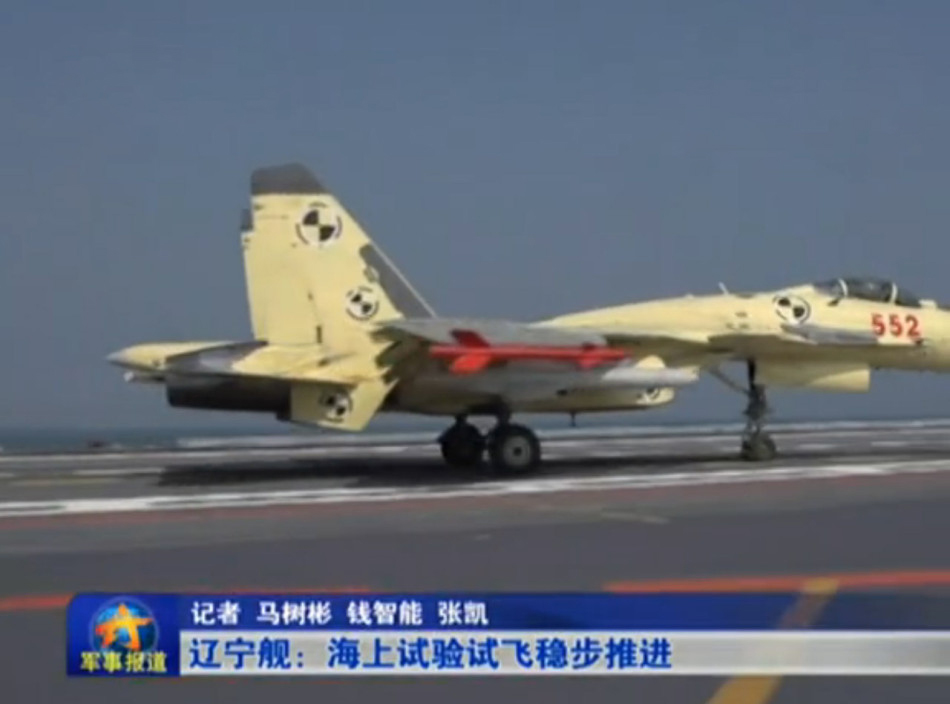
And we both know J-15 doesn’t need external fuel tanks, it’s internal fuel is more than enough for the kind of missions it will undertake.


 Sign In







