 Blitzo
In the long run PLA wins regardless of whether it’s fighters are J-6s or J-10s or J-20s or it’s ships are Type 053s or Type 054s.
But amphibious assaults are very risky affairs and even when you have 100% air superiority, defence, terrain and even the weather etc can make it a real slog for the attacker. Not to mention breaking out of a beachhead is in itself a difficult affair – e.g. Normandy, Anzio, Salerno.
Interesting article on Taiwanese defence options:
http://offshorebalancer.wordpress.com/2013/08/23/ham-omelettes-and-taiwans-defence/
That is a very interesting article.
I think both ROC and PLA will have some advantages they can bring to bear on the other.
PLA:
-SRBMs, long range MLRS, cruise missiles etc, can be used to saturate taiwan’s air defences and strike at a variety of high value targets (air bases, naval ports, C4, depots, etc) at relatively short notice. I personally think the whole “1500+” SRBM estimate or whatever it is that China is pointing at Taiwan is a little bit overstated, but I don’t think anyone will deny that it is probably a big number and can be deployed and fired, reloaded, fired again, etc, with little warning given the small profile of TELs, their mobility, etc etc
-Air power, while only flankers can only operate at second island chain without tanker support, almost all of the PLA’s 4th generation fleet (and some of their 3rd generation fighters i.e.: J-8IIs) can operate over taiwan from bases with some level of endurance and persistence, even from less vulnerable inland bases (e.g.: flankers and JH-7As, or J-10s with tanker support). PLAAF will have a bit of a fight on their hands if ROCAF is fully operational by the start of hostilties, but assuming a bombardment of SRBMs, LACMs, and MLRS on relevant sites preceding an air war, I expect the scales to be tipped heavily on PLAAF’s side, even if the air force can only bring to bear a fraction of its overall fleet to the taiwanese theatre
-Naval power+air power (again): ROCN will not survive long in the taiwan strait. Fairly straight forward. Taiwanese FACs may try to negate the PLAN’s inevitable amphibious operation, but the strait will probably be surveyed constantly by PLA AEW, and amphibious groups will be heavily defended by PLAN pickets, and if I were planners I’d stick in a few Z-9Ws and Z-19s equipped with ATGMs to counter ROCN FACs, and TY-90s in case any cobras or apaches decide to stick their nose in.
-Newer amphibious assault options: PLAN will shortly have in operation multiple zubrs (say in three years time), and already have three 071s in service, along with many fairly large LSTs. Zubrs open up many more regions as beachheads, 071s can threaten the eastern side of taiwan, and all in all it makes the defenders spread their defence thinner
-decapitation/SOF: one of the more unrealistic ideas, is where the PLA manage to strike at the political and military heads of the taiwanese government/independence leaning wing, which would put much of the taiwanese defensive strategy in disarray. Given the lack of strategic depth in taiwan, and expected PRC espionage, this may be very possible
ROC:
-Beachhead defence — javelin equipped teams, surviving apaches, etc could do very potent damage against landing parties, not to mention their greater familiarity with the lay of the land. Some of the A2AD techniques PLA favours, especially coastal AshM batteries, could be used against them.
-forewarning — chances are there will be a build up to hostilities, and they can try to disperse targets as such. Land power may be relatively easily dispersed and hidden. Fighters, E-2s, frigates and destroyers, less so. Still, it will make PLA SRBM and air strikes, SEAD more difficult
-SAMs — patriot, and their taiwanese clones, are not to be underestimated, and any that survive an initial SRBM and LACM bombardment could make PLA air power operating over Taiwan hazardous, and at least make them relegate fighters for SEAD, and lack of complete air superiority may further delay a PLA strait crossing.
-urban warfare — could be bloody and drawn out, allowing for a US response. but given the urban density of taiwan and the inevitable blockade/no fly zone that PLA will try to impose, I doubt many people will be able to flee the cities to safe zones for the military to fight it out. They’ll be trapped on this island with a war going on around them, and collateral damage caused by PLA and ROC militayr may be high if urban warfare occurs.
Unknown factors:
-Taiwanese morale/support for independence. 3rd Taiwan strait crisis saw most people relatively high support for the dude PRC hated. Depending on the economic and political circumstances of the new guy who calls for independence, this may or may not change the resistance PLA experiences
-Taiwanese support for the military/military health. There was that recent article mentioning an amount of public disillusionment/skepticism towards the ROC military, and also some big problems in recruiting.
All in all, I think both sides have some obvious military advantages they can leverage,
BlitzoWhat I will claim is the “odds” are very much in favor of the F-35 over both the Naval PAK-FA and the J-31.
As a matter of fact I don’t believe Russia has even funded the development of a Naval PAK-FA. Plus, it’s having it’s far share of issues with the landbased PAK-FA. Then don’t even get me started with China and the J-31. As it’s way behind the US in almost every important aspect of Military Aerospace Technology.
Well that’s a slightly better phrased prediction, if you are somewhat underestimating the capabilities of US competitors.
I know this has been posted before. Yet, it directly relates to the subject at hand……
Various Obstacles Confront Russia’s T-50 Project
AIN Defense Perspective » September 20, 2013
by Reuben Johnson
September 20, 2013, 11:25 AM
There is no shortage of uncertainty about the future of Russia’s Sukhoi Perspektivniy Aviatsonnoi Kompleks-Frontovoi Aviatsii (PAK-FA)/T-50 fifth-generation fighter project. These doubts are driven by problems with major subsystems, delays with the aircraft’s introduction into service, and plans to defray some of the R&D cost by making India a developmental partner on the aircraft.
Russia’s NIIP radar design bureau, the traditional supplier for Sukhoi-design aircraft, has developed prototype models of the N050 active electronically scanning array (AESA) radar set. “The results of the flight-test of the radar installed in one of the four T-50 flight-test aircraft are very impressive,” according to a Russian aerospace analyst familiar with the program. However, the N050 is a hand-assembled product and “currently the industrial base capacity to series produce the N050 does not exist,” said the same analyst. Furthermore, “the PPMs [transmit/receive modules] are produced at the Istok military electronics enterprise on a limited scale, which has made the radar’s cost prohibitive.”
In the same vein, the T-50’s composite panels are also handmade using the same basic technology as the well known Sukhoi range of all-composite aerobatic sports aircraft.
The fifth-generation engine that is to power later versions of the T-50 is still mostly on paper, say Russian industry experts. The flight-test aircraft are powered by the same Saturn 117S engine that is installed in the Su-35, and this will also be the engine for the initial production batches of the T-50.
Above all, without changes to the aircraft it is questionable whether or not the T-50 will actually be a low-observable design. Several aspects of the aircraft as currently configured will produce unacceptably high RCS, as well as IR, signatures, according to U.S. industry experts who spoke to AIN.
Another factor is that the T-50 program was considered to be economically viable only if India stepped up to purchase at least 250 of the aircraft, and also would share in the R&D effort. But India is planning to procure only around half that number of fifth-generation fighter aircraft. Sources in the Indian MoD state they cannot afford both the T-50 and the Dassault Rafale that was selected as the winner in the MRCA competition. If the situation becomes an “either or” proposition the T-50 may be jettisoned in favor of the French fighter so India does not place all of its eggs in the Russian basket
I’m really wondering how much of that article is accurate. I’ve heard nothing about MRCA and PAK FA competing for funding or the Indian MoD not being able to afford both.
And I wonder what credentials this reuben johnson has to make these very bold claims. We’ve seen non-specialist news outlets spewing all kinds of misleading articles about other nation’s military projects before, all shoddily researched.
BlitzoNonetheless, the odds are very much against either the J-31 or Naval PAK-FA being superior to the F-35C. As a matter of fact both are many years behind the F-35C in development and not just it time. As for the F/A-XX (NGAD) is 30 years off at least. (if it happens)
I think that is making a few too many assumptions and relies on a belief that china and Russia won’t be able to deliver a competitive product. I’m not claiming a chinese or Russian naval fighter will be vastly superior than F-35C I would never claim that considering how little we know and how formative such projects would be, but based on that same information, you cannot confidently claim F-35C will be the best carrier based fighter for the next two or three decades.
30 years is a long time for one plane to hold the mantle of being “best” in its particular class, and it will also be hard to compare the aircraft based off their virtues given air combat and strike capability may only further evolve in coming decades.
Wil EW play a bigger role? Will kinematic performance grow more or less important? Will range and endurance still be as all influencing? Will networking and next generation data links make the individual platform less relevant, where two warring sides should be considered in a systems approach involving off board sensors and mutual fire support?
My point is less about how good F-35C is or how good a chinese or Russian product ends up being, but rather that it’s infeasible to make such a statement enveloping such a long timespan.
BlitzoWe’ve seen nothing to suggest that either Russia nor China has closed the gap sufficiently to match let alone over take the US in Composites, AESA Radars, Avionics, Weapons, etc. etc. etc. In addition we know so little about the J-31. To claim it’s going to be the Best Naval Fighter for the next couple of decades. Is well laughable………..:stupid:
I never said that X Y or Z would be the best naval fighter for the next couple of decades, but rather that it is premature to say F-35C will be the best naval fighter for the next few decades, because any naval J-21, PAK FA or J-20 (or even a USN FA-XX!!) that goes into service within that time scale could give it a run for its money.
Basically, what I’m saying to you is the statement:
LOL The Best Naval Fighter for the next 20-30 year will be the F-35C.
FLY NAVY😎
Is just as BS as palembang saying J-31 will be the best naval fighter etc etc.
BlitzoFellas, can we just leave goldlust to his devices? It’s not like anyone takes him seriously. Better, where are the mods? :confused:
BlitzoAnd I don’t think we’ve heard anything about India being unable to afford both MRCA and FGFA (the state’s pockets seem very deep for all manner of defense related purchases). Even if IAF were forced to choose between MRCA and FGFA, I think they’d rather scrap the former, given FGFA is their only medium term bet for a fifth generation fighter which they so covet.
Flipside of course, is that FGFA will only deliver its goods many years into the future whereas MRCA can start deliver of Rafales fairly quicker
BlitzoLOL The Best Naval Fighter for the next 20-30 year will be the F-35C.
FLY NAVY😎
If we are actually going to humour this, I think there is a chance that any naval T-50, J-20 could conceivably perform better than F-35C, especially considering F-35Cs relatively smaller airframe, limiting payload and range etc.
But I suspect F-35C will definitely be the most mass produced 5th generation carrier borne fighter, which no naval J-21, J-20 or PAK FA will be able to fully match in terms of numbers.
BlitzoBut thobbes you have lots of controversial threads, they are magnets.
It’s mostly because of users like goldlust, who I’m still not sure is either a real fanboy or an impersonation
the subject itself is very interesting and deserving of discussion (even if it should be appropriately be retitled as “A2AD vs ASB”).
BlitzoThis is basically China’s A2AD vs USN and USAF’s ASB
Such an outbreak of hostilities won’t be instant. There will inevitably be a buildup of some weeks or even months of increased indicators towards independence for taiwan.
Depending on how diplomacy goes between the PRC and USA, the US may either choose to have forward deployed assets or may be further back.
If assets are forward deployed, then you have WWIII effectively, because taiwan declares independence –> china declares war on taiwan –> US inevitably drawn in –> all USN targets in region are potential targets + any continental chinese targets will also be targets due to the doctrine of ASB.
If assets aren’t forward deployed, the PLA will seek to enable a quick invasion of taiwan, likely involving a large LACM and ballistic missile strike on every IDed high priority target (air bases, C and C, air defence etc) with follow on airstrikes coinciding with a large amphibious invasion (with multiple 071s, zubrs, and likelya few LHA’s supported by a carrier or two, this will be a strong force to be noted of). PLA will also likely to strike at US bases in the region (again depending on the US’s diplomatic stance before this crisis boils and pops), and probably use of anti satellite weapons. These will likely co occur with strong chinese diplomatic warnings to any US intervention.
If PLA can shut down taiwanese independence within a week (which would rely on good PLA planning and logistics, aggressive strikes, and US hesitance) then the crisis may end very quickly and US will have to check whether they want to expand the scope of the conflict.
If US are determined to follow their treaty with Taiwan, then who knows. We’ll probably get WWIII.
IF Chinese continental targets are fair play, then we may end up seeing many chinese diaspora in US and other countries starting to form third column movements and you’ll really end up with a much bigger social problem alongside the military, political, economic challenge too.
I suspect Chinese SSKs will be used not in an active way but rather a passive way to linger slowly and quietly and strike at USN taskgroups, so I think it will be quite difficult to neutralize PLAN SSKs.
OTOH, USN SSNs and SSGNs will be the most deadly weapon against PLAN ships, subs, and many land based bases as well.
Timing and political maneuvers leading up to war will be essential in seeing how such a situation plays out.
Clear and present threats for both sides exist though:
For US + Taiwan: SRBM/IRBM/LACM, AShBM, ASAT, entire A2AD system including less exotic weapons such as very quiet and slow SSKs that may strike at USN taskforces or at least dilute their capability
For PLA: SSGNs and SSNs for both surface and land based targets, along with sheer quantity and quality of USN assets. Forward bases in Japan are also a potential threat for a preemptive strike. US ASAT weapons also come into play.
cyberwarfare will hinder both sides. China may try to play the economic card, selling of US reserves etc. US will likely counter by blockading chinese shipping around the world, and would probably be able to overwhelm any forward deployed PLAN presence in indian ocean as well, as by 2025 PLAN still probably won’t be deploying CVBGs on a permanent basis with multiple supporting overseas bases.
So the subject isn’t how an air war in north asia will fare, but rather how will China’s A2AD system fare against US’s ASB in the western pacific at large.
One thing is certain though — PLA capabilities among all domains will rise qualitatively and quantitatively and gain new tactical capabilities like more AEWC, stealth fighters, some air to air refuellers, and also more strategic assets through the form of carriers, a potent amphibious ready group style taskforce, cruisers, a few quiet SSNs and SSBNs, and more importantly, a mature and capable C4ISR system linked to an array of area denial assets.
And US military will continue its modernization as well without a massive surge in quantity — replace F-16s and F-18s with F-35s, more virginias to replace LA, more fords to replace nimitz, more P-8s to replace P-3s — but will have more contingency plans for a westpac war and more assets in region at any one time compared to now.
Again, big factor depends on if inland PRC targets are seen as “fair game”. If they are, all bets are off.
PS: I will be surprised if 200+ J-20s and J-21s are in service by 2025. At any rate, J-21 probably won’t become an in service fighter.
BlitzoLOLOL,
yeah sure..
if you went by that logic even the Russians can’t help the Indians because they barely have any experience operating a 37,000 ton carrier because they only operated a 60,000 ton one.
but nah, you gotta make it specifically STOBAR and specifically a certain weight to bring down the Indian Navy experience down to the Chinese right?
oh yeah, they were also used in combat too.PLAN’s experience before Liaonng?
Zip, Nada, None, Nein, 没有, никто
Wow I think you’re drawing some errant conclusions there.
No s**t the Indians have more experience than China in operating aircraft carriers because they have operated the viraat for the last few decades, and I’m not denying that and it was never relevant to the original question if you paid attention. Maybe you should stop witch hunting?
The fact is Viraat is a much smaller carrier the vikramditya and it was many years since IN pilots had landed using arrestor wires on the old vikrant (although there is obviously more to operating a carrier than simply taking off and landing), and the original question was asking what additional procedures or experience the Russians could have lent to the Indians to extend their proficiency, if any. I believe similar challenges will exist when the RN builds on experience on Invincibles to the QEs, but that’s somewhat mitigated due to a view that the RN is a more professional force than the IN overall (which may be true or false, but that US naval officer account of his time on INS delhi still comes to mind).
And you’re being purposefully disingenuous — obviously it is more difficult for a navy to downgrade from a 65k ton ship to a 45k ton one than upgrade from 28k tons to 45k tons (and just to appease you, because you seem to care so much — it is also much more difficult for a navy to upgrade from Zip, Nada, None, Nein, 没有, никто carriers to a 65k ton one)
If you want my opinion on whatever PLAN — IN “carrier race” you perceive, go and call me out on it instead of extrapolating accusations.
BlitzoIndians operated ex-UK carriers and would have modeled their operations on those lines.
Quite a bit of difference in operating a 20,000 ton VSTOL carrier and a much larger 37,000 ton STOBAR carrier, methinks.
BlitzoSince the Chinese and the Indians both use the same Russian designed hold back chock system to allow aircraft to build up thrust before launching via deck ski jump it will be interesting if they both continue to use the Russian method as their respective carrier operations continue.
Interesting you mention that, because we’ve seen with videos that liaoning deck crew still have a “shooter”. Some have questioned whether this was just a theatrical act, as clearly liaoning doesn’t have catapults.
But USMC harriers also have shooters when they launch from decks of LHDs.
I suspect the shooters on liaoning may shoot to have the controllers lower the chocks, serving a similar purpose to shooting a catapult on a cvn.
And there’s no reason the Indians and Chinese can’t pick and choose various practices from what they know about USN and RN carrier ops to suit what works for them. In any case I wonder what level of deck operating the Russians have taught the Indians.
BlitzoTo return this thread from this Su-35 fiasco…
AVIC are developing a number of new helicopter concepts, with them stated on their website (anyone who follows PLA developments know how rare such examples of openness occur):
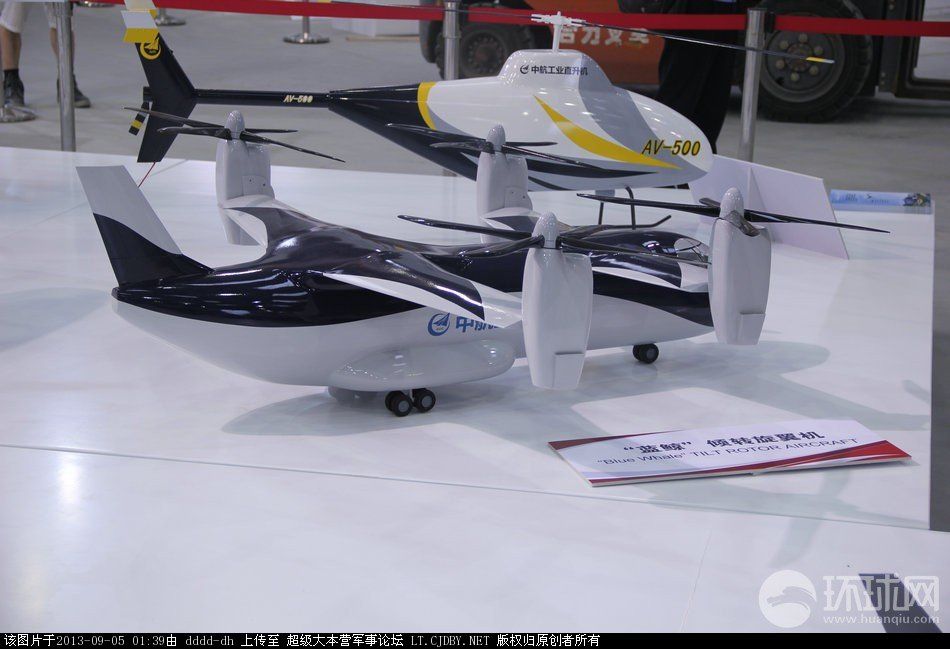
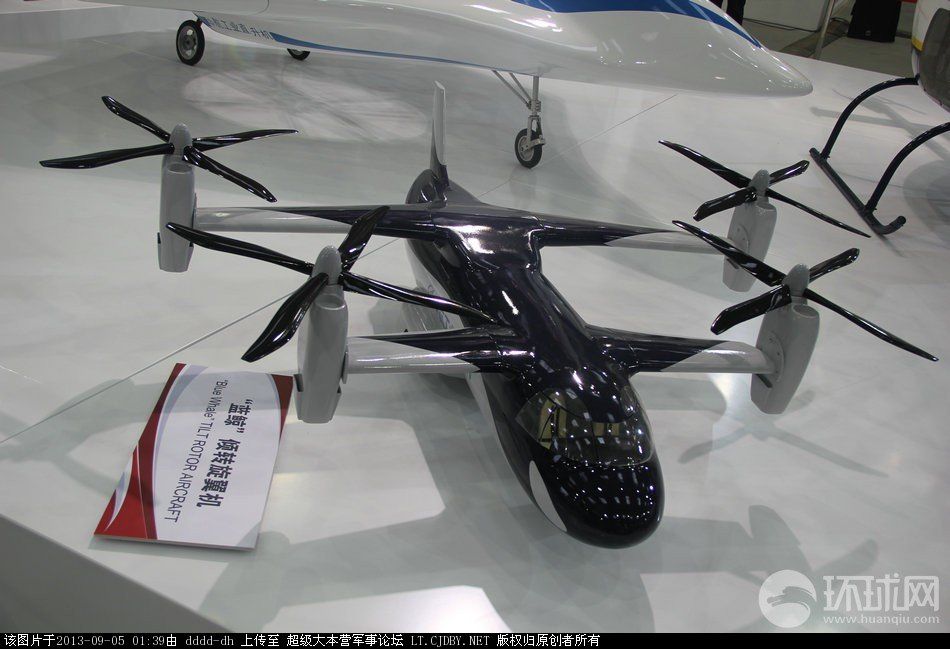
There’s the “blue whale” a 20 ton payload, quad tilt rotor that is very similar to the now suspended bell boeing QTR. 800 km combat radii, 8000 km range, and a max speed of 538 km/h. Should be a good Mi-26 replacement, and a supplement to the Y-9.
There is also the K800 demonstrator UAV, which has a coaxial and double pusher propeller orientation not dissimilar to sikorsky x2, for the purposes of demonstration only. 800 kg, designed to reach 450 km/h, with a first flight around 2015.
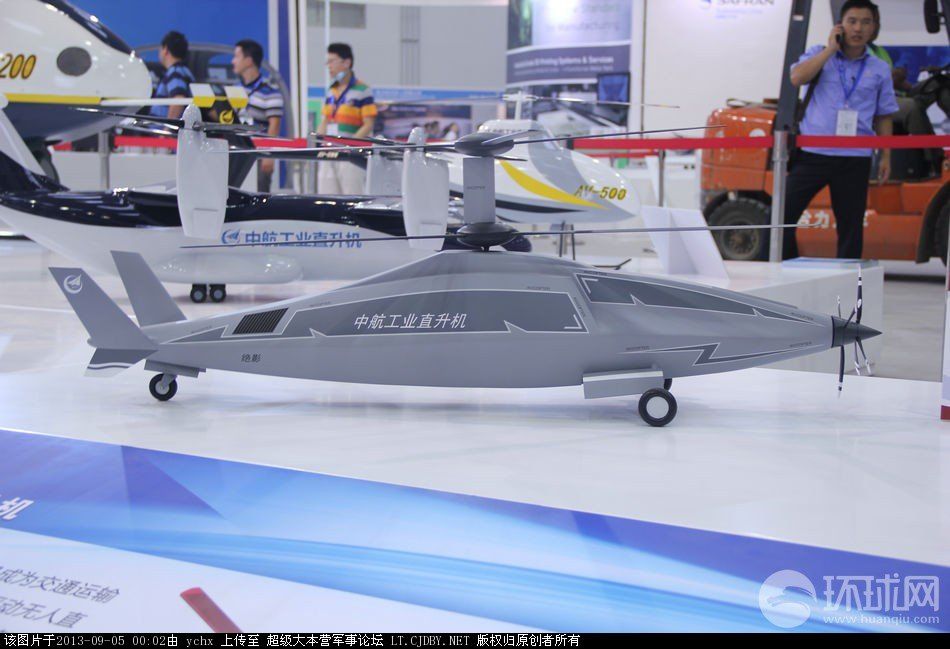
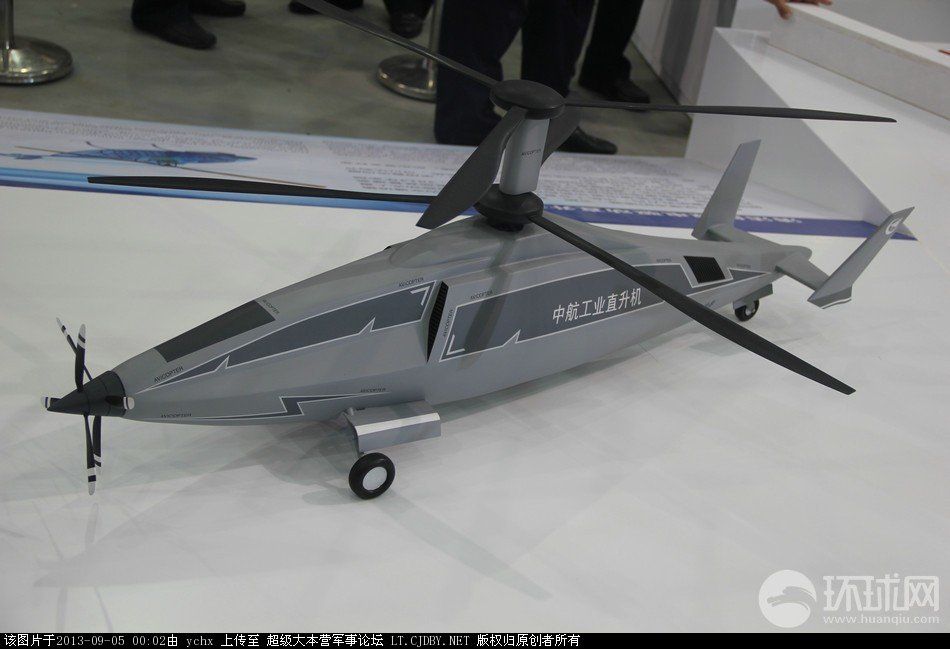
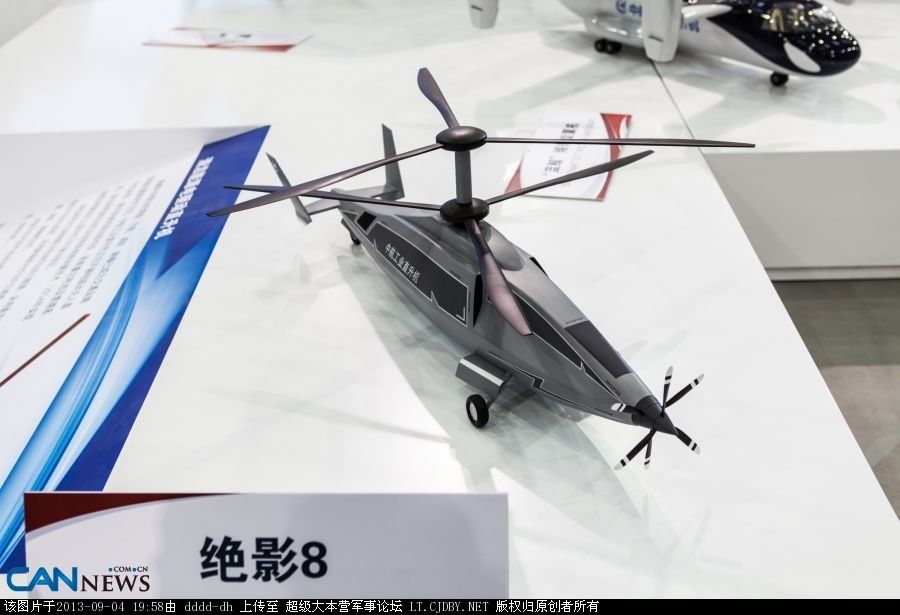
There are also various rotorcraft, one clean energy type running on batteries, another which resembles the eurocopter x3.
If these models were unsubstantiated we might have been more able to dismiss them (but even then, we should recall how J-21/31 and sharp sword UAV both first emerged as models as well, without any official statement), but the fact that the AVIC website has published such projects, means we may have a chance to actually see at least a couple of prototypes of each.
At the very least, I am glad at least one country in the world is willing to develop a quad tiltrotor.
Janes has a more comprehensive detail of the PLA’s overall rotorcraft developments here,
http://www.janes.com/article/26593/chinese-rotary-wing-plans-spur-rise-in-stature-of-pla-army-aviation-forces
BlitzoSorry, the latter was a suggestion that’s been floated around the forums, certainly no substantive evidence (but not quite out of the realm of possibility and I wouldn’t be surprised if that had happened).
Also, isn’t the entire USN carrier flight deck operating book available in the public domain in some form?
BlitzoAh I was mainly talking about Air Force. Agreed on other factors, particularly navy.
I think that by 2050 the PLA will be able to match the US military qualitatively in terms of individual types of assets, but will still lack the numbers, even in the air force.
PLAAF’s lack of force multipliers (tankers specifically) and strategic transports is a large hinderance to the PLA overall, and will take many years to turn around. Their AEWC fleet looks decent, and in a few years may be the world number 2 (how does the VVS’s current A-50 fleet number, and what are its plans for the successor?), but considering Y-20 airframes will be needed between strategic transport, tanker, and AEWC, PLAAF have to decide which capability is more important.
I tend to look at Air Defense as extension of the AF when judging strength, and the Chinese have built up one of the strongest networks in the world. That factors into the equation against a hypothetical westpac opponent, while the US faces large scale force solution in any conflict in the area. Further how much of US defense spending relative to China will be aimed at insurgency wars and the kind of conflicts it has realistically been fighting for the past decade? Much more in all likeliness.
If the Chinese do a decent job of integrating their S-300s and other strategic SAMs with Nebo-M like VHF sets (and especially if these sets can be used for missile guidance input) and pursue longer ranged missiles, the US “stealth” advantage becomes far far more manageable.
SAMs certainly do play a role in their A2AD capability, and I suspect the navy may seek to set up defensive air defense lines using their excellent new APAR equipped destroyers and surface combatants to limit enemy action as well.
But one may argue that if a US stealth threat has reached the mainland in a constant way, then the conflict is already lost.
You mention something interesting with US defense spending. If uncle sam decides to wind back its ME adventurism, will its defense spending decrease overall? Probably not, instead the cash that would have gone to facilitating middle eastern wars may be used to develop and produce weapons that will be more useful against an opponent like china, which may counteract the larger effects of an economic decline.
OTOH, I think a global military power like which the US currently holds is unsustainable, and china probably won’t seek to have ten aircraft carriers in service at one time with ten more mini flattops, or 80 aegis style surface combatants, and I think the US is spending too much on its military, which will be a waste in the long term if no war with another power like China or Russia erupts. So if US discovers common sense and reduces its overall military capability, PLA may reach quantitative parity sooner rather than later. Vice versa if US goes full crazy on its military industrial complex too.
—-
That’s absurd.
China and Russia bring vastly more to the table than anyone save the US.
Hell, when was the last time any Europeans operated without a coalition or with the US doing the majority of the work? I don’t say that as an insult, btw.
Their AD is miserable for the most part as well. Sure, they can strike Libya with America doing 50%+ of the work. That makes them 1st rate?
We have different criteria clearly. Flight hours and advanced training gets you only so far when you operate a miserable (in comparison) total force/
Also, the definition of “long range deployment” necessarily involve foreign basing, and one may argue whether that is an air force issue or foreign relations issue.


 Sign In







