 Kramer
Interesting, quite rare to see 29s with wing tanks.
Is this something specific for IAF 29s or are there any other versions out there by different 29 operators with wing tanks?
Do the IAF 29s also use the large belly tanks?
yes they do use the belly tanks as well..
KramerYou mean one press report?
One press report that states that the Il-76 fleet is having maintainability problems..
the Pakistani guy who is arguing about the brand new Il-78 based A-50EI with PS-90A engines having these troubles (which is not mentioned anywhere directly as being on the AWACS, but those are his own conclusion) apparently has forgotten that the IAF operates a large fleet of much older Il-76s that are the likelier aircraft that are having maintenance issues as they grow older.
KramerAkash missile system users and DRDO meet
By Anantha Krishnan M.
India’s Defense Research and Development Organization (DRDO) had the opportunity to listen to Akash missile system users at a recent high-profile meeting in New Delhi.
A senior defense ministry official tells AVIATION WEEK that the deputy chiefs of the Indian army and air force, industry partners, representatives from Bharat Electronics Ltd. (BEL) and Bharat Dynamics Ltd. (BDL) all shared their concerns and expectations with DRDO on the missile system. BEL and BDL are the principal integrators for the Akash.
“The objective of this input session was to capture the aspirations, concerns and demands of the users,” the official says. “It also gave us an up-close [look] as to how the Indian industries were gearing up to meet the growing demand for the Akash. We discussed the current orders, production schedules, quality issues and cost-effectiveness.”
India also answered questions put forth by the services. “We went into the details of the number of missiles that would be produced in phases and the supply-chain management philosophies,” the official adds. “The Missile System Quality Assurance Agency explained how they would play the role of quality keepers.”
DRDO explained the design aspects of the missile system, documentation procedures and technology transfer processes. The air force already has placed orders for two squadrons of these systems, and six more are in the final stages. The army also has placed orders for two regiments.
The missile system and radars are worth Rs 23,000 core ($4-5 billion) — the biggest orders in recent times for a DRDO product. “It is the first time a home-grown tactical missile system is being ordered in large numbers by Indian users,” the official says.
KramerMore news on the indigenous EMB-145 mounted AEWACS. the first of the modified EMB-145 jets is about to begin testing soon.
India’s domestically developed airborne early warning and control system is taking a big step forward with the first of three modified Brazilian EMB-145s headed for flight trials.The preliminary testing, due to kick off in the next two months, will be carried out in Brazil by Embraer and a team from the Indian air force’s Aircraft & Systems Testing Establishment (ASTE) in association with Brazil’s Agência Nacional de Aviação Civil and its Indian counterpart, the Center for Military Airthworthiness and Certification (CEMILAC).
Defense Research and Development Organization sources reveal that the first platform will be equipped with a dorsal radar unit containing dummy electronics, an in-flight refueling probe, environmental controls, auxiliary power units, internal fuel tanks, satellite communications and antennae.
India’s Bangalore-based Center for Airborne Systems (CABS) — the laboratory spearheading the AEW&C sensor program — already has supplied Embraer with a dorsal unit (with dummy electronics) and a Ku-band SATCOM dome, while the Defense Avionics Research Establishment (DARE), CABS and the Defense Electronics Research Laboratory (DLRL) have shipped in antenna units for electronic support measures, communications support measures (CSM) and U/VHF. The aircraft will undergo flight tests until July 2011.
While the EMB-145 in the AEW&C configuration undergoes flight tests in Brazil, the configuration to be ferried to India in August 2011 will include only the aircraft with the dorsal pylon but not the antenna unit or other features, such as the extra auxiliary power unit or internal fuel tanks. Once the first aircraft reaches India, it will undergo a flight testing regime with CABS, ASTE and CEMILAC in association with an embedded Embraer team.
After a series of checkout flights in India, the aircraft will be integrated with a dorsal unit containing real electronics and other mission system equipment, including five operator workstations, avionics racks, crew rest seating, seats and cabling. Program sources indicate that the aircraft will be tested in three different locations in the country, Yelahanka in the South, Bareilly in the North and either Bagdogra or Tezpur in the East.On June 23, EADS Cassidian (the former Defense & Security unit) announced that it has been awarded a contract to supply consultancy services to CABS for developing the AEW&C’s system architecture with particular regard to certification and mission equipment optimization, giving the European company its third big aerospace consultancy in India, following advisory contracts in the Tejas Light Combat Aircraft program.
The first Indian AEW&C aircraft is slated to achieve full operational capability in 2014, with inductions of three aircraft the same year. While numbers remain unofficial, the Indian air force has hinted at a need for at least eight of the indigenous AEW&C aircraft.The air force also recently decided to exercise options with Israel for two more Phalcon AWACS, though the platform is likely to be a business jet rather than the Ilyushin-76, a platform that remains plagued by maintainability, availability and spares problems at its home base in Agra. The air force will achieve final operational capability on the Phalcon in November of this year, with the third aircraft to arrive shortly thereafter.
KramerThanks for the correction !
Kramerpics courtesy of Livefist, from the IAF flypast to commemorate the IAF’s 78th anniversary.
MiG-29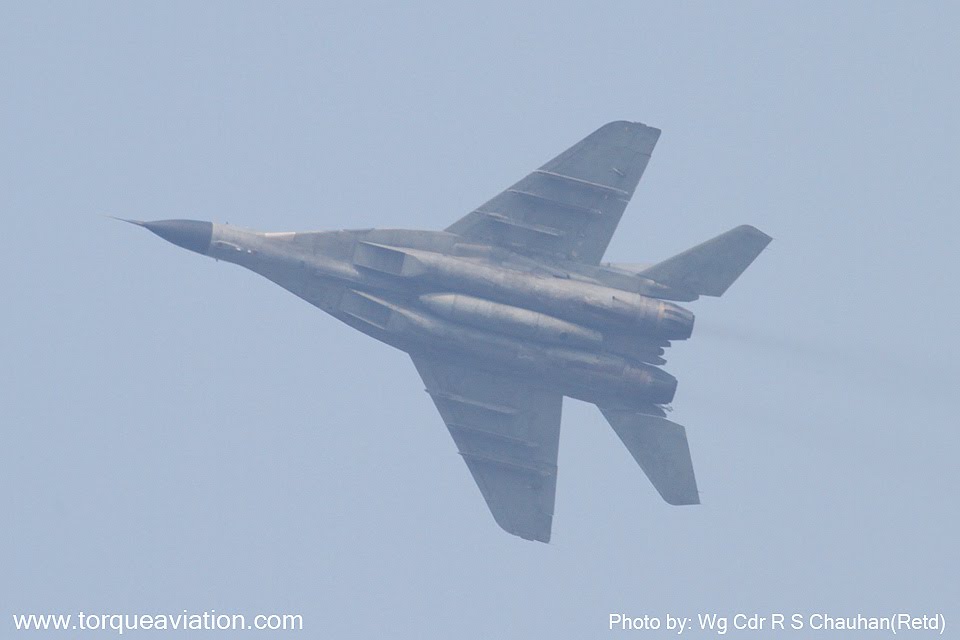
Mirage-20000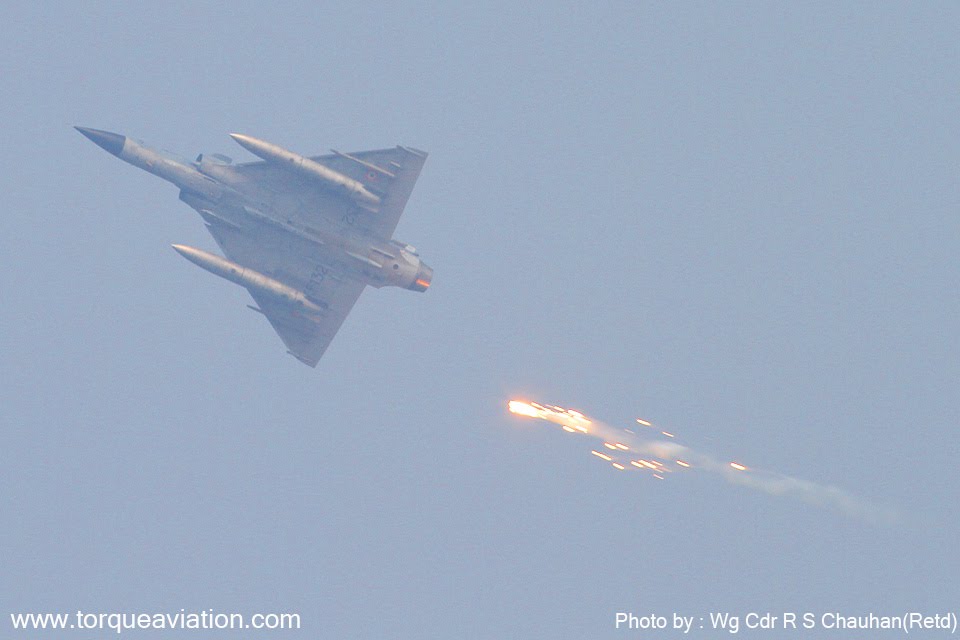
Jaguar
Mi-25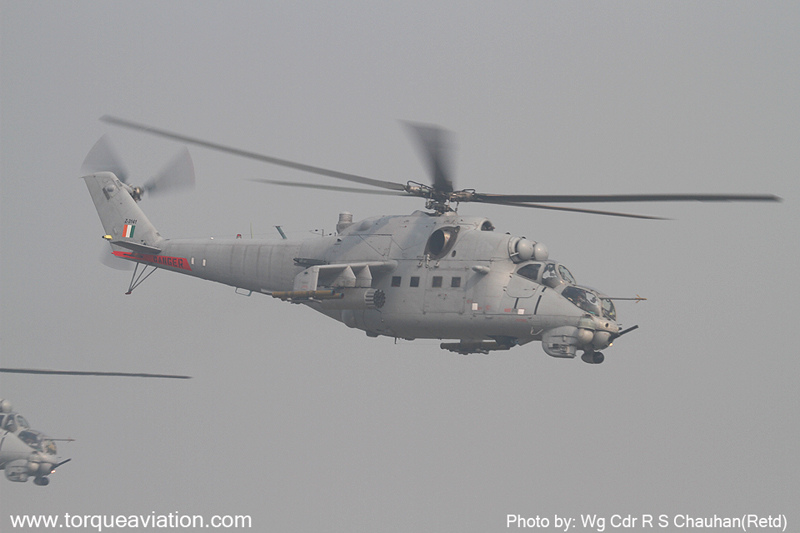
Kramerthat web page of Wg Cdr R S Chauhan is a true find ! I’ve seen his pictures on official IAF calendars for years now ! Its got some great pictures that are truly rare and not seen on the web before.
Kramerreported earlier as well, that the IAF is getting its Mi-25/35s and Mi-17s back from UN missions.
Chandigarh, October 8
With the IAF being roped in to provide air support for the anti-Naxal operations, it has completed the withdrawal of its combat helicopters that were deployed overseas on the United Nations peacekeeping missions. Withdrawal of transport and utility helicopters is expected to begin shortly. The IAF had delployed its Mi25/35 helicopter gunships in Congo besides Mi-8 and Mi-17 choppers in Congo and Sudan. The de-induction of the gunships began in mid-September and the last batch was airlifted to Chandigarh from Congo on Wednesday, the IAF sources said. These would be serviced and refurbished at No 3. Base Repair Depot here.Sources revealed that nine Mi-25/35 gunships have been ferried to Chandigarh by the giant Russian built AN-124 freighter, the largest aircraft in regular service in the world, with a payload capacity of 120 tonnes. It has taken six sorties to bring in the helicopters, along with their associated ground support equipment and related paraphernalia. The Mi25/35 gunships are heavily armed and armoured helicopters that are used to provide close air support to ground troops during assaults. Besides the pilot and the weapon systems operator, these also have the capability to carry up to eight fully equipped troops.
KramerOK, it can carry Soviet-designed tanks, but not anything heavier.
More than 95% of the IA’s tanks are of Soviet origin. Even with the new order for Arjuns (which are wider than the T-90s and as wide as western MBTs), the number is around 248.
But there is little doubt that the C-17 will be a huge relief for crew that will need to load the tanks onto the transports. Gp. Cpt Bewoor had written a great article describing just how much skill and patience it took on the part of the tank driver and loaders to load the T-72s onto the Il-76 to be transported to Thoise, in Ladakh region of Kashmir. One mistake could’ve meant the Il-76 would be badly damaged and require major repair.
KramerThat’s the chief disadvantage of any model of Il-76. It’s not just tanks it can’t carry (too heavy for it, anyway), but many lighter but bulky things, including many AFVs. The A400M, An-70 & Japanese C-2 all have higher & wider cargo boxes, & that’s not accidental.
The Il-76 has and can carry the IAF’s T-72 Ajeya tanks. With similiar dimensions but slightly heavier weight, the T-90s may fit in as well. But it is a very tight fit and from IAF experience, not something done with any ease or quickly.
KramerIndia Defence reports that the IAF Chief ACM PV Naik hopes that the MRCA deal will be signed by July 2011, “if everything goes off well”.
2010-10-08 India, which is racing to upgrade its military, is likely to hand out a 12-billion-dollar contract for 126 fighter jets by July 2011, the country’s air force chief said on Friday. Six global aeronautical companies are in a dogfight to grab the deal to sell 126 Medium Multi-Role Combat Aircraft (MMRCA) to the Indian Air Force, which is also shopping for up to 270 Russian-designed Sukhoi war jets .
“We had submitted the MMRCA report with the defence ministry on July 30 and if everything goes off well, then the contract should be signed by July 30 next year,” Air Chief Marshal P.V. Naik said, the Press Trust of India reported. India issued the request for proposals to the six short-listed firms in August 2007 and the long-awaited trials of the aircraft competing for the world’s most lucrative fighter jet contract began last year.
Air Chief Marshal Naik’s announcement came a day after Moscow and New Delhi unveiled plans to co-develop 250-300 advanced stealth fighter jets for military technology-hungry India.
KramerHe did not accuse him of taking bribes……
He said this
Thursday, April 23, 2009
By Ansar Abbasi
ISLAMABAD: Former chief of the Pakistan Air Force Air Chief Marshal Saadat Kaleem has accused the ousted dictator, General Pervez Musharraf, of ruining the PAF’s $1.2 billion Saab Surveillance System deal for possible kickbacks.Kaleem said that despite the PAF’s opposition, Musharraf put pressure on the air force to modify the contract to the extent that the number of systems to be purchased from Sweden was reduced from six to four to include two Chinese systems. The $1.2 billion contract was originally meant to acquire six surveillance systems and one Saab 2000 aircraft as VIP version from the Swedish company.
Talking to The News from his residence on phone, he said General Musharraf personally exerted pressure on him to modify the contract but he, as the PAF chief, was opposed to this because of the objections raised by the PAF experts purely on technical grounds.He, however, said that after he retired in March 2006, the contract with the Swedish company was modified to include two Chinese systems. ‘It was done with mala fide intentions,’ the former PAF chief said, adding such modifications were usually made due to some motivation factor.
He said the Pakistan Air Force had cautioned in advance that the Chinese system was inferior to the Swedish system and the two systems were incompatible. Also, one of the systems was superfluous.
This mix-up of the two different technologies, he said, was bound to create more problems instead of serving the purpose for which the project was conceived. He explained that the two systems could not be integrated so it was better to cancel the Swedish contract altogether and go for the Chinese option.
He explained that the Swedish system contained electronically scanned antenna while the Chinese system had rotating dome antenna. The former, he said, is far superior to the latter. He said that the Pakistan Air Force had initially decided to buy the Swedish system following the recommendations of its operation’s branch, which was not in favour of the modification of the Swedish contract for including the Chinese technology due to technical objections.
He recalled that once General Musharraf called him to the Army House and directed to modify the contract to include two Chinese surveillance systems but when he opposed it, Musharraf snubbed him by saying, ‘What is the problem with you?’
Kaleem said he had told Musharraf that it would be a disadvantage to have two technologies but Musharraf wanted to give a $250m contract to a Chinese company, citing ‘strategic relations’ with the friendly country. He said he had also pointed out that the PAF was already procuring defence equipment worth $6 to 7 billion from the Chinese firms, so another contract of $250 million would not make much difference.
He said that he had also argued that even if the Chinese system was provided free of cost, it would be a burden on the Pakistan Air Force because it had to train its pilots, give technical training to others and create a separate specialised team of experts to deal with it. The former air chief said that he was prepared to appear before any commission to submit what he had gone through on the issue.
The PAF had been looking for a surveillance system since long. The project called ‘Project Horizon’ by the PAF and negotiated between the Saab/Ericsson MW team and the Pakistani authorities continued for over two and a half years. On Oct 15, 2005, the $1.2 billion contract for six surveillance systems and one Saab 2000 aircraft as VIP version was signed. The Government of Pakistan also negotiated and signed a loan agreement with the Swedish government agency, SEK, to finance this project.
But later the number of systems to be purchased from the Swedish company were reduced from six to four following Musharrafís orders. According to a source, Saadat Kaleem favoured the Swedish company, a charge Kaleem flatly denied and insisted that the Swedish systems were the best available choice for the Pakistan Air Force.
He, however, admitted that the Saab office, situated in Islamabad, was housed in his house, rented out to the Swedish company after his retirement for $5,000 per month. When asked if this was not a clear case of conflict of interest, Kaleem said it was not, insisting that another house in his neighbourhood was rented out to a foreigner for $4,500 per month.
According to a source, a PAF officer, who was a member of the PAF’s project team, was offered a lucrative salary package after his retirement by the same company, which had also created an office for the officer but the PAF refused to give the officer NoC to take up this job. Kaleem said that he was not aware of this case.
KramerThere was some ex-PAF Air Marshal or so who accused Musharraf of having taken bribes and forced the PAF to buy the Chinese AWACS when they wanted more Erieyes in its place.
KramerIAF has had the greatest attrition of pilots from its transport stream, since they are in a lot of demand from the booming civil airline sector. The total will be inclusive of the fighter, transport and helicopter streams, not just fighter. the IAF doesn’t just include fighter squadrons after all.


 Sign In








