 Kramer
BRS Aerospace of South St. Paul, manufacturer of whole-airplane parachutes, announced it has been contracted to integrate and help certify its parachute recovery systems for the Hindustan Aeronautics Limited (HAL) HPT-32 basic training aircraft used by the Indian Air Force.
Frank Hoffmann, BRS Aerospace VP of Engineering, will travel to India immediately with a team of engineers to begin the process of adding the ballistic recovery system to the HPT-32 aircraft. “I anticipate being able to have a design ready this Fall,” he says. Once BRS has completed their installation design, Hoffmann will work closely with HAL, the aircraft’s manufacturer, and the Indian Air Force, to test and certify the customized whole-airframe parachute system. “The whole program is expected to be completed in a very short period of time,” Hoffmann adds.
BRS Aerospace claims that its recovery systems have saved the lives of more than 255 people.
“This is a very significant milestone for not only BRS but for aviation safety as well,” said Boris Popov, BRS founder and current VP of Public Affairs. “While BRS products have been successfully introduced into the civilian aviation markets for years, this is the first usage of the BRS system for the military trainer aircraft market.”
KramerUnless one’s foes have HOBS weapons, then the -9M is perfectly fine. It’s still a very capable weapon in the forward sector.
the IAF uses R-73Es but the PAF ordered AIM-9Ms with their recent Block 52 purchase.
KramerIAF to withdraw 20 helicopters currently being used for UN ops
24/9/2010 The Indian Air Force is to withdraw its 20 helicopters from the UN peace-keeping missions beginning November this year in a phased manner.
Defence Ministry sources said in New Delhi today, the de-induction decision was taken after the IAF found itself hard-pressed for choppers while extending logistical help to paramilitary forces in anti-maoist operations. The withdrawal will be completed by June 2011.
AIR correspondent reports IAF’s medium-lift MI-17 and MI-8 choppers are deployed in three African countries including Congo and Sudan and help in transportation of UN troops and equipment there.
The Home Ministry has been seeking enhanced logistical support from the IAF in terms of movement of personnel and casualty evacuation particularly in inhospitable areas.
The IAF has a fleet of around 150 medium-lift Mi-17 and Mi-8 helicopters, which are used for maintenance of troops in high altitude areas of Jammu and Kashmir and North East and to carry out relief and rescue missions during natural disasters.
KramerI was taken aback last week to receive an invitation from BAE Systems, the world’s third-richest arms corporation, for a four-day media tour to the UK. What surprised me was not the invitation. The rate at which India is buying up foreign weaponry, global arms merchants, eager for publicity, would happily pay for our small defence journalist community to globetrot through the year. What was remarkable in the BAE invitation was the company’s proposal to fly us to Glasgow for the launch of a new Royal Navy destroyer and a tour of other warships. Why, I wondered, was British shipbuilding being showcased to India in the absence of a plan to buy a warship from the UK?
Ah, so Ajai Shukla is being called to Glasgow on a paid visit by BAE to cover a British warship’s induction into the RN and for a tour of its ship-building facilities because Indian readers are interested in it ? Yeah right..Even if one of the CVF was not going to be offered, there HAS to be a good reason why an Indian defence journo would be invited for such a tour.
Anyway, time will tell what the true story behind this is.
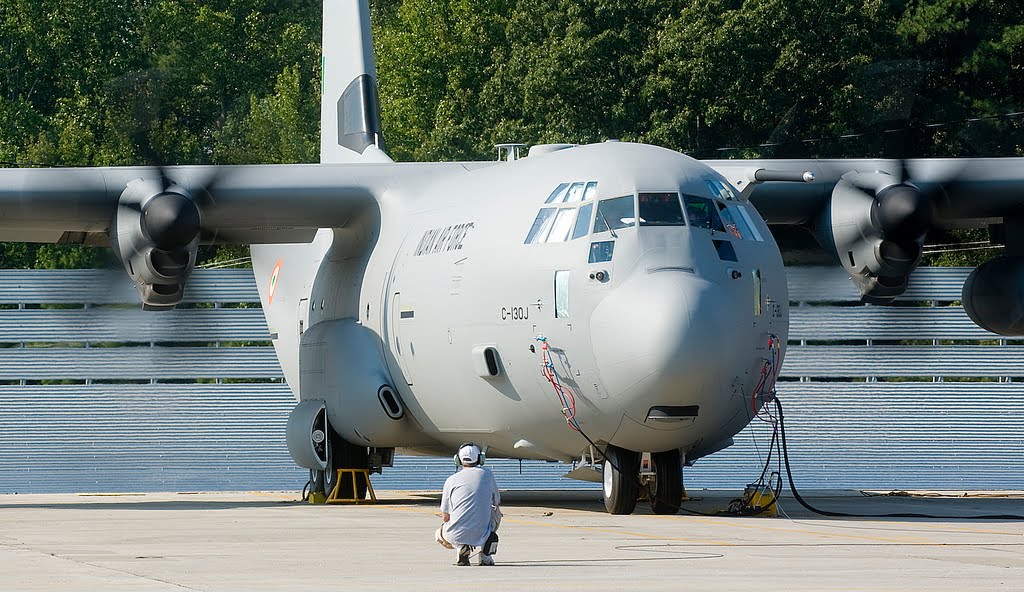
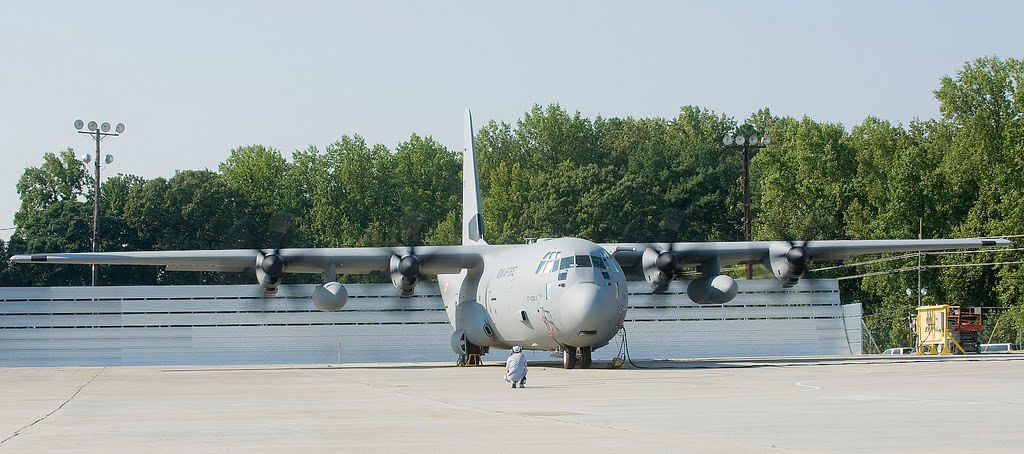
KramerIAF Super Hercules C-130J begins engine tests
The first C-130J for India ran engines for the first time yesterday, with its maiden flight scheduled for early next month. That’s the aircraft’s distinctive air-to-air refueling probe over the left side of the cockpit.
KramerInteresting article that puts into perspective how useful the IAF’s recent purchase of additional 57 Mi-17Vs will be, primarily the Mi-17’s performance in hot and high conditions which have earned it a lot of popularity in Afghanistan’s conditions.
By Maxim Pyadushkin
MOSCOW — The popularity of the Mil Mi-17 Hip helicopter for operations in Afghanistan is driving up prices for used versions and has created an order surge for manufacturer Russian Helicopters.About 300 Mil Mi-8MTs (known as Mi-17s in the export market) are deployed in Afghanistan with international coalition forces, private contractors or under U.N. contracts, according to Russian experts. Some Russian companies, such as UTair Aviation, operate Mi-8MTs under U.N. contracts in many other regions.
UTair, which is the largest Russian helo carrier, recently increased its Hip fleet with an order for 40 Mi-171s. Deliveries should be completed this year.
The effect has to been to put pressure on the Russian market, where the Mi-8 remains the most widely used rotorcraft.
HIgh demand
The high demand affects only the latest version of the family, the Mi-8MT, because of its ability to operate in hot and high conditions. Compared with the earlier Mi-8T, the Mi-8MT has more powerful TV3-117 turboshaft engines, a new gearbox, improved tail rotor and control linkage, and extended fuel tanks. These upgrades increased Mi-8MT payload capacity by 1 metric ton as well as the operational ceiling. Production of this version was launched in 1977, but the design received an update in the late 1980s (the Mi-8MTV) for high-altitude operations.“It is impossible to buy this modification on the pre-owned market,” one Russian helicopter dealer tells AVIATION WEEK.
Two years ago, a pre-owned Mi-8MT could be bought on the Russian market for $4-4.2 million, but now the average price for such rotorcraft is around $6.5 million, he says.The high demand for Mi-8MTs on the pre-owned market is amplified by the shortage and high price tag for the new rotorcraft. Russian Helicopters, a holding that controls the national helicopter industry, rolled out 139 Hip versions in 2009, and CEO Andrei Shibitov says his production facilities are booked with orders until 2012. For the last three years, the price of the newly assembled Mi-8 rose to $9-10 million from $3.5 million.
However, the price increases could level off as demand in Afghanistan slows. “They will hardly grow further as the current price levels already raise questions about the operational profitability” of using the Mi-17, says Dmitry Ermilov, deputy head of Soyuzavia, a Moscow-based aircraft dealer.Nevertheless, the market is unlikely to collapse if the Afghan conflict ends. Boris Bychkov, director general of Airclaims CIS, projects that demand inside Russia from the oil and gas sector will help ensure long-term demand.
At the beginning of 2010, there were more than 1,159 Mi-8 family helos registered in Russia, comprising almost 55% of the country’s commercial rotorcraft fleet.
Of those, 770 were operational and logged 87% of total flight time of all Russian-made helicopters on the local market during the mid-2008 to mid-2009 period.
Russia has an ample supply of earlier Mi-8 versions, but they have limited applications in Afghanistan and operate mostly in Russia owing to the low power provided by the TV2-117A engines.
Local pre-owned market demand is not large, but Ermilov notes that a rotorcraft assembled in the late 1980s or early 1990s in good condition can be purchased for $1.2-2 million. The operational life of this version is limited to 35 years, although the Mil design bureau can extend it to 40 years in some cases.
KramerIndia is not being offered a UK carrier. It has been made very clear.
One invite to see a warship launch and we come up with this hypothesis!?
not “we” :rolleyes: as much as you’d like to ridicule “fanboys”..”he” as in “Ajai Shukla” came up with this article and “he” claims that his sources indicate that the UK offered a carrier to the GoI. If you don’t like what’s written, so be it.
KramerA cautious note sounded by a MoD official to Ananth Krishnan regarding the Ej200 having won the tender to supply 99 engines + options for the Tejas Mk2. Considering the kind of political push that the US has and with the impending visit of Barrack Hussein Obama, this is not yet over.
After months of extended analysis, comparison studies, and calculations, the hunt for a suitable engine for Tejas Mk-II seems to have reached the final phase. The contenders — GE F-414 and EJ-200 — are equally confident that they would make it to India’s Tejas.
MoD sources confirm that the negotiations have now shifted to Delhi (from Bangalore) and there are couple of issues need to be sorted out. All top officials associated with the project have now reached Delhi on Sunday night and the next two days might be crucial. The Tejas is currently undergoing sea-trials in Goa.
A section of Indian media have been reporting for the last one month that EJ-200 is/will be the likely choice, but MoD sources refuse to say anything official yet. “We are continuing the talks from today,” an official said.
KramerThe news is great and also worrying..I hope that the US doesn’t manage to scuttle this deal with pressure on MMS and his govt. If they fail to award Eurojet this deal even after they won it fair and square on an L1 basis, then no European entity will want to bid on any Indian defence deals.
if the deal with Eurojet goes through, it will mean that the Tejas Mk2 and the N-LCA will have a real chance of being exported to nations that are not so cozy with the US but are ok with the EU..most importantly, it will mean a Tejas Mk2 that will be almost surely, sanction free.
Europe has an edge over the US in the tightly-fought contest to sell India a next-generation engine for the homegrown Tejas light combat aircraft (LCA). Informed sources have told Business Standard that when the bids were opened last week, European consortium Eurojet bid $666 million for 99 EJ200 engines, against US rival General Electric, which quoted $822 million.Both engines had been earlier adjudged technically suitable to power the Tejas Mark-II. Therefore, according to the ministry of defence’s procurement rules, the vendor offering the lower price is to be handed the contract.
But the champagne corks aren’t popping yet at Eurojet. Both engine-makers have been asked for certain clarifications by Wednesday, and senior Eurojet executives are worried that Washington could pressure New Delhi to opt for the US engine in the interregnum.
At stake here is far more than a few hundred million dollars. Industry experts say India’s choice of engine for the Tejas would significantly shape the choice of a medium multi-role combat aircraft (MMRCA), an $11-billion contract for which the Indian Air Force is evaluating six fighters. Of these, the Eurofighter has twin EJ-200 engines, while GE F-414 engines power the US-built F/A-18 and Sweden’s Gripen NG fighters.
Says Air Vice Marshall (Retd) Kapil Kak of the Centre for Air Power Studies, the IAF’s official think tank, “It is as clear as daylight. Selecting the EJ200 for the Tejas would boost the Eurofighter’s prospects in the MMRCA contest.”
“Its engines, which form about 15-20 per cent of the cost of a modern fighter, would be already manufactured in India for the Tejas. For the same reason, rejecting the GE F-414 would diminish the chances of the two fighters that fly with that engine,” he added.
In its tender for the Tejas engine, the defence ministry has specified that only ten engines could be built abroad. All subsequent engines must be built in India, with the vendor transferring technology for their manufacture. If the EJ200 were built in India for the Tejas, Eurofighter would benefit from a fully amortised engine line and also be entitled to offset credits for the ‘made-in-India’ Eurofighter EJ200 engines. This would lower the price of the Eurofighter — a huge advantage for an aircraft regarded as high performance, but expensive. Logistically, too, the IAF would prefer an MMRCA with engines that were already in its inventory.Selection of the GE F-414 engine, on the other hand, would provide all these advantages to the vendors of the F/A-18 and the Gripen NG fighters. This is a key reason why Eurojet and GE have conducted their Tejas engine campaign so competitively.
Furthermore, the order for 99 engines for the Tejas Mark-II is just a foot in the door to the Indian market. Given that each fighter goes through two to three engines during its operational lifetime, the four to five planned squadrons (84-105 fighters) of the Tejas Mark-II would actually need 200-300 new engines. The 126 MMRCAs could use several hundred more.
Business Standard had earlier reported on the European aerospace industry’s plan to enhance its presence in India’s military programmes through Eurofighter and the MMRCA contest. The first move by EADS was to provide consultancy to accelerate flight-testing of the Tejas; now comes the second move: bidding aggressively to win the Tejas engine contract.
Defence ministry sources have expressed surprise that Eurojet bid 20 per cent cheaper than rival General Electric, which is widely regarded as a cost-effective manufacturer. In fact, conversations with EADS executives reveal that this is a well-considered business strategy.
Sources in the Aeronautical Development Agency confirm that both GE and Eurojet engines fully met the technical requirements to power the Tejas Mark-II. The EJ200 — which IAF favours — is the more modern, lighter and flexible engine with greater potential for growth. The GE F-414 is heavier, but provides a little more power.
Eurojet is a consortium between Avio (Italy), ITP (Spain), MTU Aero Engines (Germany) and Rolls-Royce (UK), which was set up to develop the EJ200 engine for the Eurofighter. It is headquartered in Hallbergmoos, Germany.
KramerIAF to get 2 more Phalcons and other ground based as well as Aerostat radars to improve radar coverage..earlier the reports indicated that 3-5 Phalcons will be ordered..
India will go in for two more AWACS (airborne warning and control systems), the “formidable eyes in the sky”, after the last of the three Israeli Phalcons already ordered is inducted in December.
IAF is also on course to induct a wide array of radars, from 19 LLTRs (low-level transportable radars) and four MPRs (medium-power radars) to four Aerostat and 30 indigenous medium-range Rohini systems, towards making Indian airspace as impregnable as possible.All this is in tune with the crucial plan underway to set up five nodes of IACCS (integrated air command and control system) across the country, with the first one coming up in the western sector facing Pakistan, to plug existing gaps in the country’s air defence coverage.
Seamless data transfer from civilian and military radars as well as AWACS, all networked under IACCS, will make it possible to get the “air situation picture” at a central place in realtime. This will ensure that swift counter-measures can be mounted to thwart aerial threats soon after they are detected.
“We have already moved the case for two more AWACS,” IAF chief Air Chief Marshal P V Naik told TOI.
These will be in addition to the three Phalcon AWACS already contracted under the $1.1 billion project finalised with Israel and Russia in March 2004.
The complex project, under which the Israeli 360-degree Phalcon early-warning radar and communication suites were mounted on Russian IL-76 heavy-lift military aircraft was hit by several technical delays.
Consequently, the first AWACS arrived in India only in May 2009 and the second in March 2010. The third is slated to be inducted by this year-end.
“Phalcon AWACS are tremendous force-multipliers. We are having an excellent experience with them. They will get their final operational clearance by October-November,” said ACM Naik.IAF’s capabilities to detect and track troop build-ups or aircraft movements even deep inside enemy territory, much further than ground-based radars, have certainly registered a quantum jump with AWACS.
Apart from detection of incoming cruise missiles and aircraft from over 400-km away in all-weather conditions, AWACS are also used to direct air defence fighters during combat operations against enemy jets.
Moreover, IAF and Navy are also on course to induct nine more Aerostat radars after getting two Israeli EL/M-2083 radars in 2004-2005 for $145 million. Similarly, IAF is slated to begin inducting 19 LLTRs from October 2011 onwards, while deliveries of light-weight LLTRs will commence soon. Four MPRs are expected to be delivered by December 2011.Incidentally, India is also pursuing a Rs 1,800 crore mini-AWACS project indigenously. Under this, the indigenous AEW&C systems developed by DRDO will be mounted on three Embraer-145 jets, being obtained from Brazil for $210 million.
KramerLet me guess: Five of the contenders will make it to a “second round” where they will be re-evaluated again?
No re-evaluation but rather a long hard look at their offsets offers. after that it will be politics which will decide who gets into the final 3 or so. Expect an American contender and 1 European one at least..Russian one I’m not so sure about, maybe the third spot may also go to the Europeans..
KramerSo will they really decide soon?
my guess is that with the levels of bureaucracy in India, it won’t. No shortlist has been announced as yet, so a selection is not even close, IMO.
KramerSo, the HAF hopes to sell 32 F-16 Block 30s to Romania and replace them with 32 Mirage-2000-9s from UAEAF ?
The benefit being that the existing Mirage-2000s wouldn’t have to be upgraded and that the Block 30 F-16s wouldn’t need to be upgraded to Block 50 standard either and thus save money ? Aspis, can you possibly elaborate more on the costs that may be involved in an F-16 MLU (Falcon Star?) upgrade and the Mirage-2000EGM to Mirage-2000-5Mk2 upgrade and the possible costs for purchasing 32 relatively new Mirage-2000-9s ? I don’t suppose that the UAE (or Dassault if it is the eventual seller in a buy-back deal with UAE)would want to sell the most capable Mirages in the world for anything lesser than the cost of upgrading, with SLEP, existing Mirages.although the UAE’s oldest Mirages that were upgraded to -9 standard will be available for cheaper than the newest ones, and those may be quite affordable maybe..
And what does this plan say to those who were questioning how good the Mirage-2000 is or what the opinion of the HAF on the Mirage is ? Clearly they wouldn’t even be contemplating such a move unless it was cost-feasible and capability wise, didn’t affect the HAF, or even helped to improve it..
KramerAlmost free – just a few tens of millions each for the refurb.
IMO better to wait then ask for HAL’s phone no. Wouldn’t HAL be happy to supply 20 or so Tejas Mk1’s 3 or 4 years down the line?
India’s DRDO has apparently decided to form a commercial division, similar to Antrix of the Indian Space Research Org (ISRO) to market its products especially for exports..the Brahmos, Sitara IJT, ALH Dhruv, LCH, Tejas etc. are on the list of products that they plan on offering for export eventually.
Kramerthe IAF wants 20 of the indigenous AEWACS as per this report..one of the senior people I worked with was part of the investigation into the tragic crash of the HS-748 Airavat platform that killed several DRDO scientists and engineers and derailed the program for more than a decade..as he said, it was apparently a fatigue issue with the design of the fittings that were used to attach the rotodome to the airframe..they failed and the rotodome impacted with the tail causing loss of longitudinal control and the crash resulted.
India’s Defense Research and Development Organization (DRDO) says its homegrown Airborne Early Warning & Control System (AEW&CS), integrated on a modified Brazilian Embraer EMB-145, will fly by the end of 2011.
Dr. Prahlada, head of DRDO, tells AVIATION WEEK the first EMB-145 will land in India by January 2011, and the integration work is set to begin by the middle of next year.
“Once operational, the indigenous AEW&CS will be a very cost-effective one and in many ways it will be the cheapest in the world. We are monitoring its progress very closely,” he says.
The Bengaluru-based Center for Airborne Systems (CABS) is handling development, with the program’s total cost pegged at Rs 1,800-2,000 crore ($389.3 million-$432.6 million).
India and Brazil signed a deal in 2008 under which Embraer will modify its EMB-145 to carry the Active Array Antenna Unit on the aircraft’s fuselage.
“Three modified EMB-145s would be developed under the agreement and will be delivered in phases,” Prahlada adds. “The indigenous AEW&CS would detect, identify and classify threats present in the surveillance area and act as a command-and-control center to support air operations.”
The first Indo-Brazil joint defense committee met in New Delhi on Aug. 25 to expand its existing bilateral defense cooperation accord. A high-level delegation from Brazil also visited CABS on Aug. 27 as part of Joint Defense Committee proceedings. “The visit was to familiarize with the indigenous Embraer EMB-145-based AWE&CS program of DRDO, with CABS being the nodal agency for the Indian air force [IAF],” a source says. The IAF wants 20 more such platforms.
In 2002, India signed an Rs 727-crore pact with Brazil to buy five Embraer 135-BT Legacy executive jets for VIP travel. They are now operational in India.
The AWE&CS program should restore some of CABS’s prestige. During Project Guardian/Airawat in 1999, an HS-748 turboprop AWACS testbed crashed, killing several DRDO engineers and scientists.


 Sign In







