 Kramer
AviationWeek interview with PS Subramanyam
Tejas, India’s light combat aircraft (LCA), is finally giving goose bumps to thousands of engineers, designers, scientists and technocrats. The limited series production (LSP) platforms are hitting the sky like nobody’s business. There’s excitement in the air. There’s hope. And there’s a goal that’s just within their reach. Amidst all the news of the initial operational clearance (IOC) within sight and the near-services version configuration (LSP-4) flying recently, one man is calm and composed, for he knows the end of one journey is just the beginning of another.
In a one-on-one with Aviation Week’s Senior Aerospace and Defense Correspondent (India) Anantha Krishnan M., as part of the interview series India Thought Leaders (ITL), Program Director (Combat Aircraft) and Aeronautical Development Agency (ADA) Director P.S. Subramanyam (known among close peers as P.S.), says the technological knowledge gained through the Tejas program is sure to make India a force to be reckoned with in all future military plane-making missions.
A.W.: What will be the power plant for Tejas Mark-II? Is it GE-414 or EJ-200?P.S.: You are in an aggressive mode with the first question itself! OK, we are working toward having the Tejas Mk-II rollout by September 2013 and the Indian Air Force (IAF) would probably want to form five squadrons and the program will then go on to 8-10 years. Apart from structural and certain electronics equipment upgradation, the main change will be the power plant. Both engines (GE-414 and EJ-200) qualify our requirements and now there’s a process to be followed. [The] technical evaluation committee has seen it. One engine will be chosen. Both engines have 10%-20% faster acceleration than the current power plant (GE -404). It is not about the Mach number in operations that matter, but how fast you reach the target. By December 2014 Tejas Mk-II with the new engine will fly.
A.W.: What are the value additions on offer for the Indian Air Force (IAF) when Tejas Mark-II comes out?
P.S.: We are adopting a very holistic approach. Minor alterations are required on the platform due to the new engine and we hope to strike a balance. While the new platforms (Mk-I) will be integrated as per the series production plans, parallel work on the manufacturing of ground support equipment would begin. We shall maintain the IAF standards of ground support (go-no-go). We will evolve entire ground support tools, training facilities, publications for Mk-I by the end of this year. To start with, we will have the IAF and HAL (Hindustan Aeronautics Limited) technicians trained in Bangalore. By 2012, when the first squadron shifts to Sulur, IAF technicians will be ready to tackle things. I have been to Sulur and have given some suggestions for runway extension.
A.W.: What are the numbers we are looking at?
P.S.: Once we choose the new engine and after it gets certified by the agencies, we would initially want eight engines for IAF and the Navy. A total of 100 engines is what is currently envisaged.
A.W.: No other program has received so much media bashing in addition to genuine concerns from your users. What was the motivational thread you adopted during these difficult times?P.S.: I don’t want to comment on the media, though at times we did think of putting [in] a firefighting plan to counter one-sided remarks in the press. Later, we decided against it, knowing that it would divert our focus from the main goal. Yes, we had difficulties as we were attempting to do something that has never been done in this country. Yes, we slipped because we had to face many challenges from different quarters while mastering technologies. But don’t forget the fact that my team took the blow but finally delivered. Now, to the users. We understand their concerns and even they, too, are aware of our constraints. The project has definitely received a huge push after a project management team from IAF started functioning from ADA. They are the pacemakers for the program now and involved in every bit. This has also increased the ownership feeling among the users.
A.W.: So far LSP-4 has flown and what is the road ahead?
P.S.: The next one in line is LSP-5 and it will fly in the first week of August this year with slight modifications to the cockpit. We are confident of flying LSP-7 in September 2010 and the final LSP-8 in December 2010, paving way for the initial operational clearance (IOC). We are making LSP-6 a complete experimental platform. LSP-7 and LSP-8 will be flown by user pilots for user evaluation and feedback. HAL will begin the series production by the first quarter of 2011.
A.W.: Can you elaborate on the cockpit modification?
P.S.: It will be [a] rearranged and modified cockpit to increase the comfort levels of the pilot. The layout changes will make the glass cockpit more pilot-friendly and even enhance its night-flying capabilities. The pilots are happy as they are also doubling up as designers. Our efforts are to bring down the workload of pilots during the mission. All the 12 pilots who were part of the Tejas program from the beginning have contributed their bit to the cockpit modifications. Several design elements you see today are based on the ideas given by the pilots. The pilot is the man in action and our role is to ensure that we give him everything he needs while flying. The new cockpit will be a pilot’s delight.
A.W.: Finally, how is the relationship with your principle partner HAL?
P.S.: All is well. I don’t know anything more or less than what you know or don’t.
(This interview primarily focused on Tejas Mk-1 and Mk-11 versions and other developmental issues related to the program only. Aviation Week at a later stage will provide more extensive reports on Tejas technologies, composites, weapons and the Tejas Navy version.
KramerThat gives the IAF a total of 280 Su-30MKIs, a nice round figure which is enough for around 15 squadrons. These additional 42 Su-30MKIs will be at the Super-30 level that the IAF has been talking to Russia about for its MKI MLU. One thing to note is that they’re not that cheap anymore..at Rs 15,000 crores, that is nearly $75 million per unit, and that too built at HAL facilities. Probably the deal includes other things we don’t know about that have raised the price. This news is being released now, after reports that the MKI did very well in counter-air missions at Exercise Garuda 2010 and some bogus report about Dassault offering 40 “interim” Rafales for the IAF.
The other good thing about that report is that it has finally given the exact number of HAL built Su-30MKIs and that can be used to estimate the total number in IAF service at 124, which is nearly 7 squadrons, but the currently known MKI squadrons are 6, viz.No.20 Lightnings, No.24 Hawks, No.30 Rhinos, No.31 Lions, No.8 Pursoots and No.2 Winged Arrows..maybe the IAF will raise another squadron on the MKI soon.
Kramersome images of an Indian developed AESA radar for the Tejas Mk2..
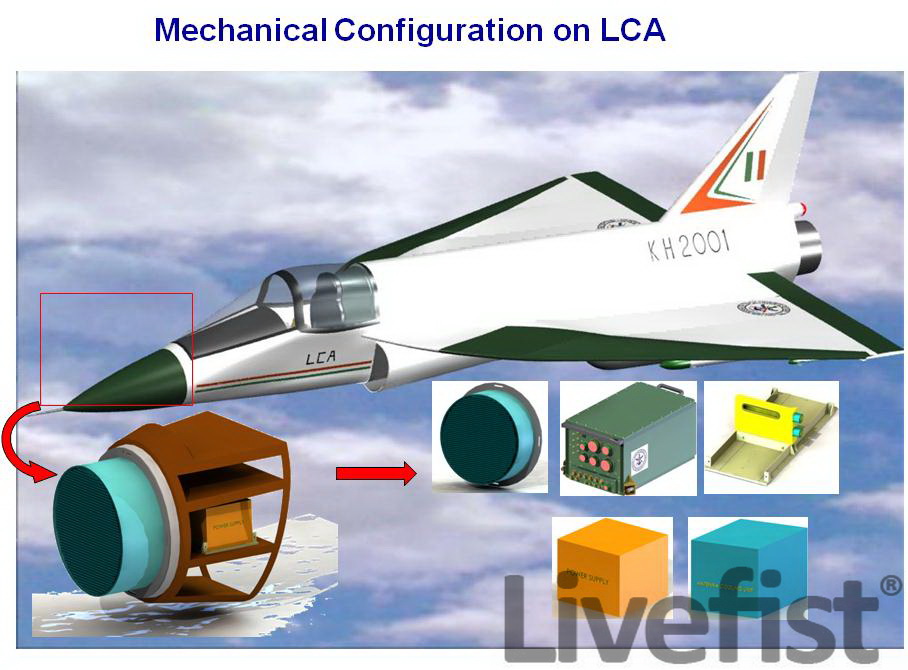
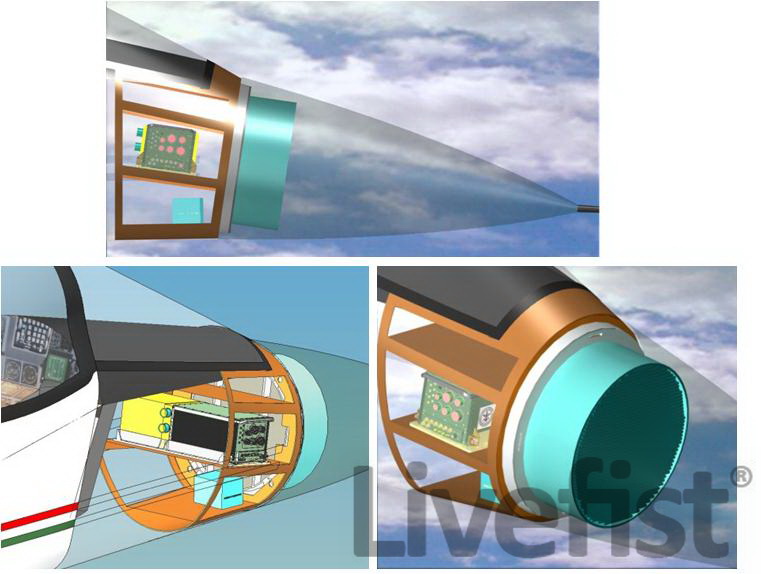
The images above, seen here for the first time, are from official material on the Indian AESA radar project for the LCA Tejas, shared with LiveFist. Indian state-owned radar developer Electronics R&D Establishment (LRDE) is in the process of identifying a development partner (DP) for an indigenous AESA radar for future tranches of the Tejas and the Advanced Medium Combat Aircraft (AMCA) and is likely to make a final decision shortly. The radar has begun development in the country. According to official updated material made available to LiveFist, the fully solid-state X-band radar is being developed with the following modes:
Air-to-Air: Multi-target detection and tracking / Multi target ACM (Air-to-Air combat mode) / High resolution raid assessment
Air-to-Ground: High Resolution mapping (SAR mode) / AGR – Air to Ground Ranging / RBM – Real Beam Mapping / DBS – Doppler Beam Sharpening / Ground Moving Target Indication (GMTI) / Ground Moving Target Tracking (GMTT) / Terrain Avoidance (TA)
Air-to-Sea: Sea search and multi target tracking / Range Signature (RS) / Inverse Synthetic Aperture Radar (ISAR)
As I’ve reported here before, the development partner that LRDE identifies will be responsible for “detailed design, development and realisation” of (a) antenna panel constisting of main antenna, guard antenna and sidelobe cancellation antenna, (b) transmit/receive modules/groups, (c) RF distribution network consisting of RF manifold/combiners, RF interface, (d) antenna/beam control chain consisting of T/R control and T/R group control, and (e) array calibration/BITE among other areas.
KramerIndia establishing Shore Based Test Facility for testing Naval Tejas variant
By Anantha Krishnan M.
BENGALURU, IndiaIndia is setting up its first shore-based test facility (SBTF) to flight test the naval version of its homegrown Tejas Light Combat Aircraft (LCA).
The SBTF will be established at the naval air station in Goa and will be the third such facility in the world along with those of the U.S. and Ukranian navies. The Aeronautical Development Agency (ADA) and Hindustan Aeronautics Limited’s (HAL) Aircraft Research and Development Center are concluding last-minute, end-to-end tests in Bengaluru leading up to the aircraft’s July 6 rollout (Aerospace DAILY, June 23).“It’s a near-perfect recreation of a ship on the shore,” a naval source tells AVIATION WEEK. “The SBTF at Goa is based on India’s Indigenous Aircraft Carrier [IAC] that’s being built at Cochin Shipyard, with the same measurements. The facility simulates an aircraft carrier with ski jump and arrested recovery.”
SBTF’s steel structure is being constructed by Goa Shipyard, while all civil engineering activities are being conducted by Research & Development Establishment (Engineers), Pune.
“The integration and installation work of all the specialized equipment for the facility will be done by the Russians,” an official says. “This facility is a major boost to the Tejas naval program, as the Indian government had included all the necessary funding for the SBTF program [which] was cleared in 2003. We have been very keenly following this program right from the word go.”
The naval test pilots attached to the National Flight Test Center will carry out all the initial flights of the NP-1 and NP-2 naval Tejas prototypes at HAL’s military airport in Bangalore leading up to the carrier-suitability test (CST). The unit will then move from CST to SBTF. The takeoff area ramp will be ready by the last quarter of 2011 and the landing area will be complete in 2012. A full-fledged telemetry unit also is coming to Goa.Sources also confirmed that in addition to training Tejas naval pilots, the SBTF will have the ability to train MiG-29K pilots prior to carrier operations.
The SBTF is being established under the guidance of the Naval Project team operating from ADA in Bangalore.
KramerFirst Naval Tejas prototype to roll out on July 6th
By Anantha Krishnan M.
BENGALURU, India
The Tejas Light Combat Aircraft’s (LCA) naval prototype (NP-1) will be rolled out for the first time on July 6 here in Bengaluru, with Chief of Naval Staff Adm. Nirmal Verma on hand, sources tell AVIATION WEEK.The Aeronautical Development Agency (ADA), which is in charge of the design and development of Tejas variants, and Hindustan Aeronautics Ltd. (HAL), ADA’s principal partner and main manufacturer, are currently giving the aircraft a final structural fine-tuning at HAL’s Aircraft Research and Development Center.
“The rollout of the aircraft signals that the platform is structurally complete, equipment installed, and plumbing and wiring completed,” a source says. “It will be on its wheels and can be moved by assisted power. A rollout is also a precursor to the next phase of ground-based system integration testing, engine ground run, taxi trials and the first flight.”The NP-1 will have almost the same system architecture as the Tejas Indian Air Force trainer version.
The NP-1 trainer is scheduled to make its first flight by the end of this year and the NP-2 fighter one year after that. Both can operate from an aircraft carrier with the ski-jump takeoff and arrested recovery concept.
“The aircraft will get airborne in about 200 meters over the ski jump on the ship, [versus] a land-based takeoff run of about 800 meters,” a source says. “Landing on the ship is with an arrester hook on the aircraft engaging an arrester wire on the ship. The aircraft then stops in 90 meters, which is about 1/10th of land-based stopping distance. This makes the Tejas naval program extremely challenging, and we are happy with what the Naval Project Team based out of Bangalore has done so far.”The 14-member NPT is headed by Cmd. C.D. Balaji (ret.), program director for LCA Navy, operating out of ADA.
The Cabinet Committee on Security (CCS) sanctioned development of LCA Navy in April 2003, and in December 2009 the CCS also approved a Mark-II version with a new engine. NP-1 will fly with a GE-404 power-plant, with 40% of the funding coming from the Indian navy and 60% from the Defense Research and Development Organization. The Tejas naval variant will replace the aging fleet of Sea Harriers, and the navy is said to have made an initial commitment to 50 Tejas after the platform proves its mettle.
KramerLSP-5 to fly in first week of August..what does “completely experimental aircraft” mean ?
By Anantha Krishnan M.
BENGALURU, IndiaIndia’s fifth limited series production (LSP-5) Tejas Light Combat Aircraft (LCA) will fly in the first week of August.
P.S. Subramanyam, program director for combat aircraft and director of the Bengaluru-based Aeronautical Development Agency (ADA), tells AVIATION WEEK that designers, engineers and scientists from ADA and Hindustan Aeronautics Ltd. are working together to make the LSP-5 a complete, final configuration platform.
“We are aiming for an August first week flight, and slight modifications to the cockpit are being done now in mutual consultations with the test pilots from National Flight Test Center. These modifications will make Tejas a complete services version,” Subramanyam says.Air Marshal P.K. Barbora, vice chief of the Indian Air Force (IAF), says it is important for any fighter jet program to develop cockpits that fulfill pilots’ growing needs.
“It’s all about how fast you can execute a mission,” Barbora says. “Here the hand-eye coordination becomes crucial and you should also be able to move around your hands the way you normally do.”
LSP-5 will be the 11th platform to join the flight line, and ADA is planning to make LSP-6 a completely experimental aircraft.“We are confident of LSP-7 in September 2010 and the final LSP-8 in December 2010, paving [the] way for the initial operational clearance,” Subramanyam says.
The Tejas program received a major boost following ADA’s establishment of a project monitoring team consisting of IAF experts, headed by Air Vice Marshal Shankar Mani. “These people are the pacemakers, and there’s a definite boost to [the] program after their involvement two-and-a-half years back,” Subramanyam says.
The Ministry of Defense, which recently announced a series of reforms in the Defense Research and Development Organization, is also planning a Mk-II version of Tejas, which features an engine with more thrust. ADA is hoping to fly the Tejas Mk-II by December 2014.
KramerNo, buy evaluationprograms and economy.
depends on what the aims of the nation buying the fighters is and how diverse its sources of weapons can be..some nations might need a small force but cannot afford a costly fighter like the Gripen or they are nations that no one else wants to sell to, so they’d prefer a cheaper option like a Chinese F-7 so in that case economy matters..some nations can afford a small purchase of moderately priced fighters and can source them from a diverse variety of nations, but they themselves lack political clout..for eg. Thailand.
Generally, for smaller purchases with a tight budget, politics will still be involved, but a large scale competition may be unlikely because the companies do not want to spend too much time and money on marketing and other “activities” when the pay off is small…Then that nation may go with the cheapest fighter based on costs and large scale international politics may take a back-seat, but small scale political influence and bribery will still be there in the background.
but when a larger purchase worth several billion $ is made, politics is always involved..one can cite some recent competitions or sales to see that politics matters and in many of these cases, they didn’t even take Russian offerings into account or take them seriously due to politics-
– South Korea’s selection of the F-15K over the Rafale which was attributed to US pressure. 40 units purchased It was so intensely political that South Korea got no responses other than Boeing to its RFI for the second round of 20 FXs that it wanted..eventually the deal went to Boeing’s F-15K with no competition
– Singapore’s selection of the F-15SG over the Rafale and Typhoon. Singapore’s trials were considered to be an unbiased and professionally done affair but many said US pressure was applied. truth is that the F-15SG was more mature and available with the capabilities that RSAF wanted in time, and as an added benefit, it strengthened ties with the US even more. 12 bought with options for 8 more.
– Saudi Arabia’s selection of the Typhoon Tranche 2 from the UK was a mostly govt. to govt. deal with no fly-off even being conducted. 72 units purchased
– Norway’s evaluation of the Gripen NG proposal and final selection of the F-35 which all Swedes will claim was unfair and politically motivated
– Brazil’s evaluation which is highly political with the President announcing a winner in public and then retracting
– Australia’s purchase of 24 SHornets from the US directly without holding a competition..timeline for induction and familiarity with Hornets were no doubt big factors but close political ties with the US are just as big a factor
– Japan’s FX and FX-2 programs which are believed to most likely go to US with the F-35 with Typhoon standing an outside chance only
– Pakistan’s likely purchase of 36-40 J-10 fighters from China..other reasons like easy credit are also a criteria in this case
– UAE’s interest in the Rafale may also be driven mostly by politics..after all one hardly heard much about a competition otherwise both Typhoon and Gripen NG would’ve been involved, as would the SHornet.
– Oman’s likely purchase of 24 Typhoons is mostly because of long standing defence ties with Britain and the resulting political influence. No mention of a big competition
Problem for Saab is that while it has a good product which is in a weight class that many nations will like, it is competing against companies that have far more influential govt’s backing them and its not like those companies’ products are inferior or anything of that sort. And large sized defence deals have a large political cloud hanging over them always since the final purse strings lie in the politician’s hands and politicians will want such huge money transactions to involve some strategic bargaining chips as well. Rarely will one see competition like that in Switzerland where political criteria will be the least important as compared to cost and other factors that were evaluated. And even then, its not totally unbiased, otherwise the Swiss would’ve asked the Russians to be involved as well and surely evaluated the Su-30MK or Su-35..but no, they only evaluated European products with Boeing pulling out unilaterally.
KramerDecision on new engine for Tejas Mk2 is advancing..close to commercial negotiations.
Ajay Sukumaran
Posted: Saturday, Jun 19, 2010 at 0104 hrs IST
Bangalore: The Aeronautical Development Agency (ADA) is set to start commercial negotiations with aircraft engine makers Eurojet Turbo GmbH and General Electric Aviation for 99 aircraft engines for the Light Combat Aircraft (LCA) Tejas.The two engine manufacturers had been shortlisted after expressions of interest for an alternate engine for the LCA were issued last year. Eurojet, a European consortium, is offering its EJ200 engine, which powers the Eurofighter Typhoon fighter plane while the American firm has put in bids for its GE F414 engine used in the Boeing F/A-18 E/F Superhornet. The new engine will power the Mark II variant of the Tejas, which currently runs on F-404 engines made by GE.
“Soon, we should be starting commercial negotiations, probably in a couple of weeks,” said PS Subramanyam, director, ADA. “The technical evaluation is over. I think both of them (companies) are good candidates.” The Tejas aircraft ,with its current engine and configuration, is expected to be inducted into the Indian Air Force (IAF) from March next year with state-run military plane maker Hindustan Aeronautics Ltd supplying 20 planes initially. The proposal for a second batch of 20 planes has been cleared by the defence ministry and negotiations are on, Subramanyam said.
The IAF has indicated the need for five squadrons of the Mark-II, which will feature the alternate, more powerful engine and upgraded electronics. “Wherever there is obsolescence setting in, in terms of advancement of electronics, we are going for state-of-the-art electronics in the Mark-II,” said Subramanyam. Even as the process of procurement of engines is on, ADA has begun two tracks of design based on the shortlisted engines so as to not lose time, he added. Meanwhile, a proposal by the Defence Research and Development Organisation (DRDO) to co-develop the indigenous Kaveri engine with French engine house Snecma, is under consideration.
An upgraded and more powerful Kaveri engine is being seen initially as a replacement engine for the first batch of Tejas aircraft, Subramanyam added.
“Every aircraft in its lifetime needs two replacements. Some of those engines are already looking for that. By the time Kaveri gets developed and demonstrated, those engines can start coming as replacement engines for the first 20, 40 (aircraft),” he said. “There is full scope of what their profile is. It is very clear in our mind. The Kaveri engine profile for the next 30 years has a very strong dovetailing into the LCA programme,” he added.
Kramer5 t load over Afganistan ? :rolleyes:
gimme a break, you’ll need a few SDB these days, but preferably even smaller.OTOH i’d imagine conditions in Afganistan is quite similar to Leh, where the Indians made some tough tests.
IIRC Gripen passed that test, while Rafale didn’t, despite being bigger n’ all that…
Gripen D and NG flew with 2 IRIS-Ts and 2 drop tanks so it wasn’t carrying some huge load. even the Tejas did that same test with 2 R-73s and 2 drop tanks, flew in to Leh, had all systems exposed to overnight cold soak and then had to fly in the morning and it passed as well. I’d wait to hear some better confirmation about whether or not Rafale didn’t clear this test.
Kramerpics from Exercise Garuda

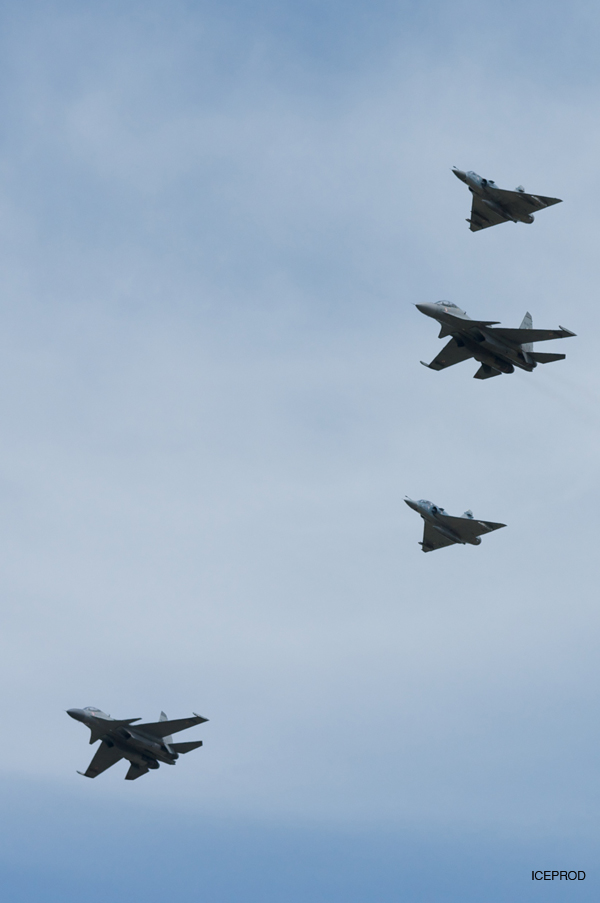
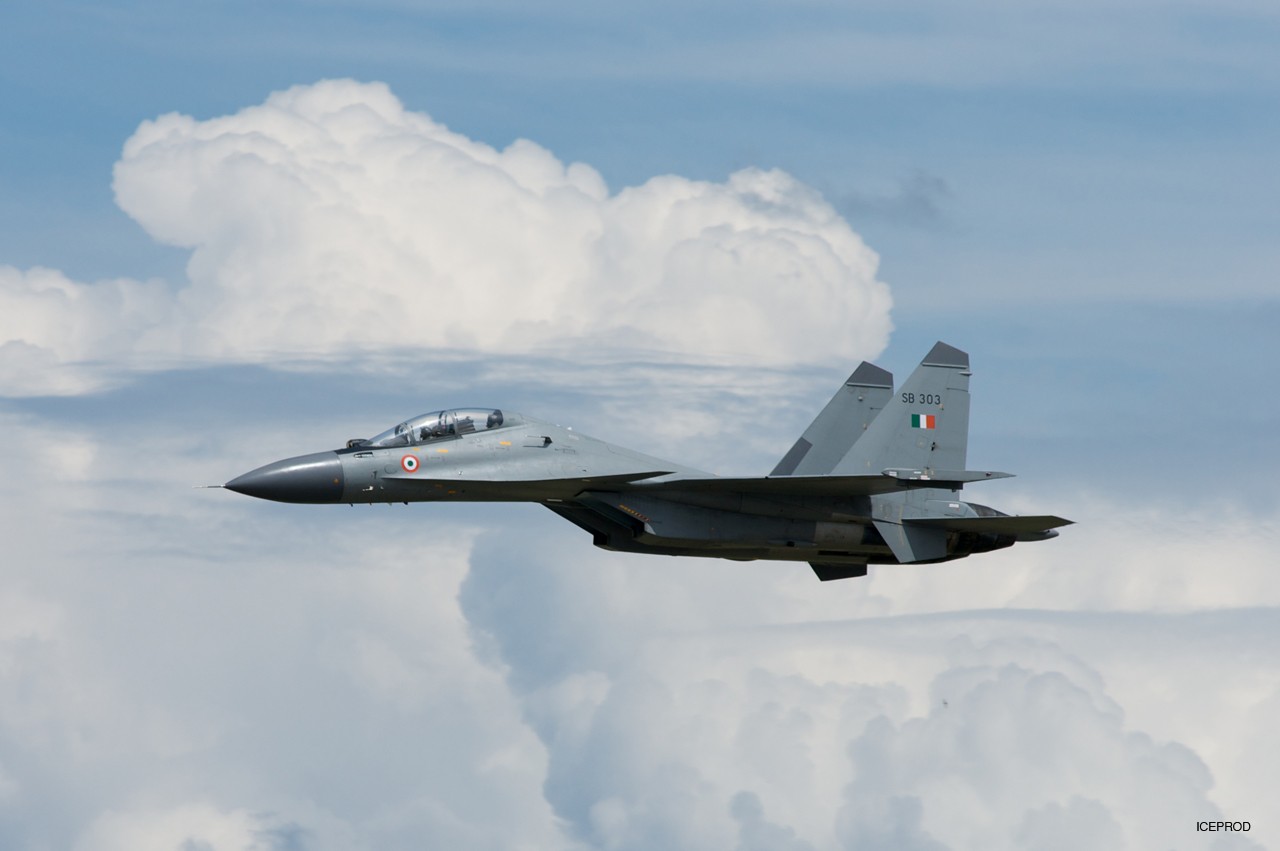
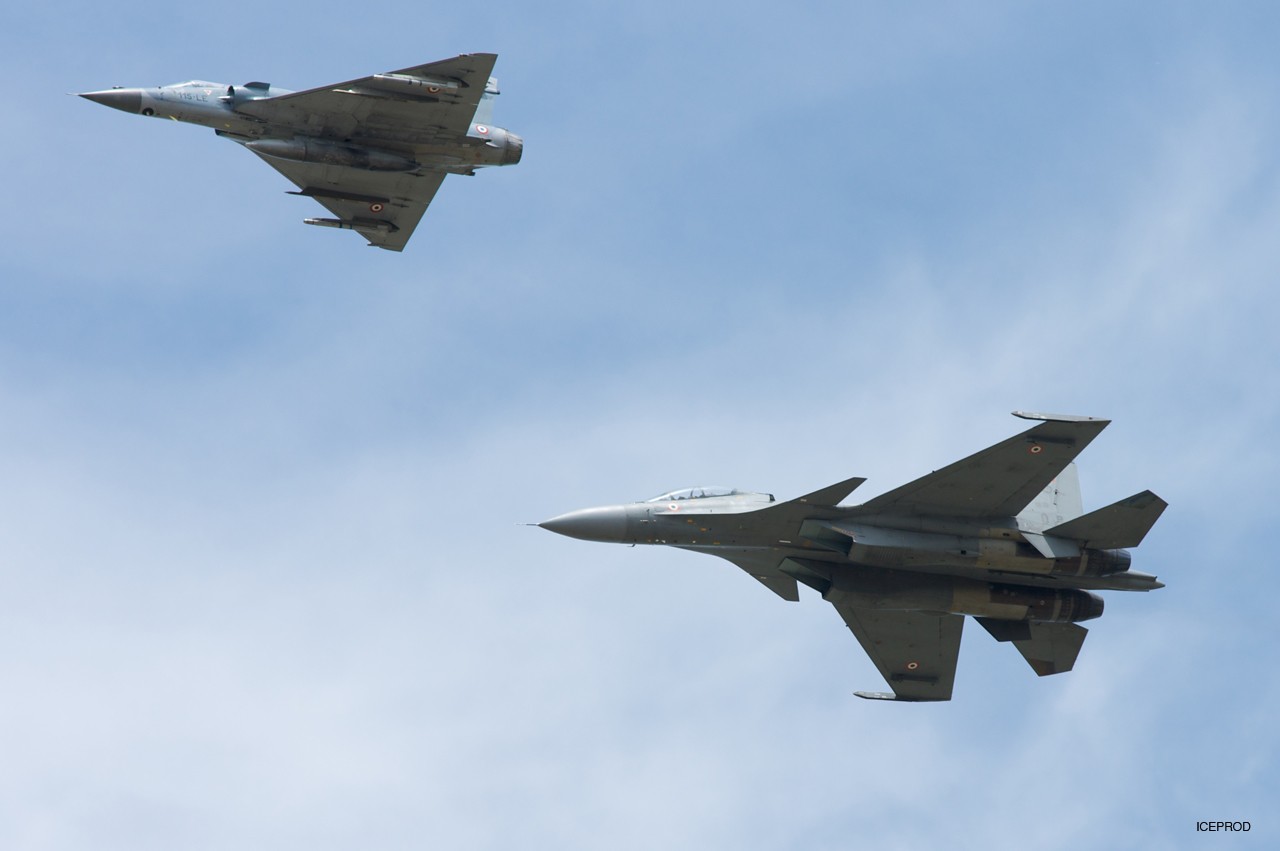

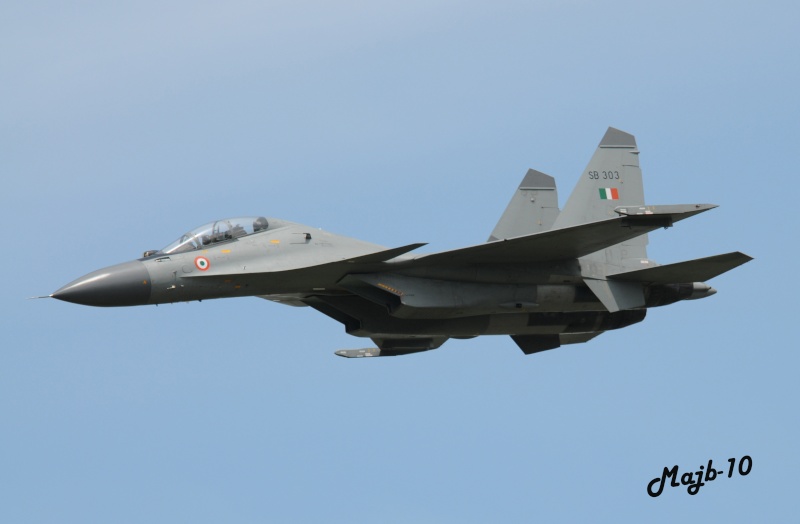
KramerAlready known, that the first LCA squadron will be based in Sulur, but in fact it will be first raised in Bangalore itself
By Anantha Krishnan M.
BENGALURU, IndiaThe Indian Air Force (IAF) will form the first squadron of the light combat aircraft (LCA) Tejas in Bangalore next year before it is moved to Sulur, IAF Vice Chief Air Marshal P.K. Barbora tells AVIATION WEEK.
Sulur is located near Coimbatore, Tamil Nadu.
The initial formation of the LCA squadron in Bangalore is primarily due to IAF’s proximity to the aircraft’s designer, the Aeronautical Development Agency; its manufacturer, Hindustan Aeronautics Ltd. (HAL); and IAF’s test pilots’ unit, the Aircraft System Testing Establishment. In addition, the National Flight Test Center (NFTC), which is monitoring all LCA-related flying activities, is also within HAL’s military airport.
“Training becomes easier in Bangalore for the IAF pilots on the new platform. In addition, any teething problems that the pilots might face while getting accustomed to Tejas can be sorted out before they move to Sulur,” an NFTC source says.
Barbora says, “The LCA Mk-II will have a new engine and we are hopeful that the product will be superior. Support is the key and we are hopeful that the Defense Research Development Organization and HAL will ensure that.”
IAF is willing to support indigenous programs as long as the products arrive on time, Barbora says. “We are not asking for the Moon. We are willing to wait, but give us what has been promised as per the deadline. We understand it’s not easy to make an aircraft.”
The IAF is currently in a transition phase, with new weapon systems and flying platforms set to be incorporated.
“In the next 10 years, IAF will change. Rapid technological changes pose a huge challenge, and even we need to change. There are no shortcuts in technology and we need to do things [the] right way,” Barbora says.
Meanwhile, Tejas crossed a significant hurdle when two LCAs successfully performed in hot-weather trials (HWTs) at Nagpur last week. Sources told AVIATION WEEK that the week-long HWTs were part of Tejas’ phase II schedule. The first phase was completed in 2008.
“All new systems onboard and avionics were tested with temperatures varying from 40 to 45 degrees Celsius (104 to 114 deg. F.). We had absolutely no issues with these flights, and both platforms rose to the occasion and performed as expected. We had close to 10 flights as part of the trials,” a source says.
The 11th test vehicle in the Tejas flight line is expected to fly soon as the program heads toward initial operational clearance in December. Weapons trials also are on the horizon.
“All the software will have to go into the final configuration of Tejas along with the flight control system and sensors. LSP-5 will be next. From LSP-3 flight, the multi-mode radar is onboard and this is clearly an indication as to our rapid progress in the program,” the source says. “We will be testing beyond-visual range missiles first and at a later stage the air-to-ground missiles which will take Tejas closer to the final operational clearance.”
Confirming the successful HWTs, P.S. Subramanyam, program director for combat aircraft and director of the Aeronautics Development Agency, says that one limited series production-3 aircraft and another prototype vehicle-3 from the Tejas fleet were part of the HWTs at Nagpur.
“Both aircraft are back in Bangalore and we are happy with what we have achieved. We are analyzing the data and will now move toward our next mission,” Subramanyam says.
KramerExercise Garuda begins in Istres, France.
By Frontier India | June 14th, 2010
The Indo-French Air Exercise began today at Istres Air Base in Southern France. The fourth round of Air Exercise ‘GARUDA’ which began today would conclude on 25 of Jun 2010.
During the Ex Garuda, the Indian Air Force and French Air Force would be engaged in various missions ranging from close combat, engagement of large forces, slow mover protection, and protecting and engagement of High Value Aerial Assets. According to the contingent commander of IAF, Gp Capt J Mishra, “The focus of the Air Exercise is learning from each other’s best practices. The Air Defence Operations would be central to our various maneuvers. These would take place in AWACS and non-AWACS environment. The intensity of the exercise would be gradually increased throughout its duration so that we learn and absorb maximum from the exercise”.
During the exercise the IAF’s Special Forces ‘Garuds’ would also be proactively participating and shall be carrying out jumps along with the French Special Forces. The IL-76 aircraft which is an integral part of the exercise flying missions, would practise static line drops with the French Special Forces. It may be recalled that the IAF is participating with Six SU-30 MKIs, Three IL-78s and one IL-76 Aircraft.
The entire IAF contingent arrived at the Istres Air Force Base on 12 Jun 2010 by 1215 hrs local time. The Istres Air Base is a large base located near Istres, North of Marseille in the Bouches-du-Rhone department, France. The base houses some of the world’s finest fighters and helicopters and serves multiple functions, including a repair facility and training grounds. The landing strip of this airbase is said to be the longest in Europe. The Istres Air Base was built before the world War II and has been of immense historical and operational importance.
The Republic of Singapore Air Force is also participating in the Ex-Garuda for the first time with the F-16 Aircraft. The French Air Force assets such as the mid air refueller, Mirage 2000s and Rafale Aircraft have commenced their participation in the exercise.
Kramergorgeous pics Rumcajs !
KramerInterview with PS Subramanyam of ADA
Ajay Sukumaran
Posted: Wednesday, Jun 09, 2010 at 2127 hrs IST
Updated: Wednesday, Jun 09, 2010 at 2127 hrs ISTIndia’s home-grown fighter aircraft programme crossed another milestone last week when the Light Combat Aircraft (LCA) Tejas flew for the first time, in the configuration in which it would be delivered to the Indian Air Force (IAF). However, an enormous amount of flight testing remains. The fighter aircraft, long criticised for the delay in development, may finally enter IAF squadrons by the first quarter of 2011, says PS Subramanyam, director of the Aeronautical Development Agency (ADA) which heads the programme. Still, at a time when ADA is embarking on newer, more ambitious projects like the Unmanned Combat Aircraft and the Advanced Medium Combat Aircraft besides the upgraded LCA Mark-II, Subramanyam tells FE’s Ajay Sukumaran he is confident the growth of the domestic aerospace industry will change the way such programmes are run. Excerpts:
The LCA programme has been a trigger for the growth of the domestic private industry in the aerospace sector. Now, the national civil aircraft project envisages private partnership from design to production. How do you see the industry’s capability now?The return on investment is enormous. Today, the volume of investment the industry is getting because of our nurturing is huge. Because of the programme, today we have people in the the industry to absorb the defence offsets.
About 70-80% of the avionics equipment (on the LCA) are made outside defence PSUs. The cabling, piping, everything is done outside. I would say more than 50-60% of the effort and materials are coming from the private industry. Today, you name any class of avionics equipment for fighter aircraft, the private industry is fully capable of design, development, certification, qualification and production. This is the capability that today I can claim India has.
In your opinion, what’s the next step for the private industry?My vision is that Defence Research and Development Organisation (DRDO) labs and ADA should work on niche technologies like the Active Electronically Scanned Array radar technology. The PSUs should be able to convert that technology into some kind of production process. Once that is done, it should go into the private industry. The first level of productionisation has a lot of uncertainty and defence PSUs have the resilience to absorb that. No private firm is ready to get into this because it has to incur losses. Once it is productionised, everybody can get into it. This should be our chain of activity.
Q-But most of the design and development expertise is still in the public sector domain? How will that change?Coming to deep design, the private firms will say they are responsible to their shareholders and that the user has not fully defined his requirements because it is not possible to define requirements in full terms.
The strategy is we become the systems specifiers. We will carry out the first 20% of a design job and detail it for them. Again, when the parts come, the integration and testing of the aircraft is our responsibility. Now, I would say 30% we have to do, 70% they can. That kind of capacity exists and we are tapping that.
When do you see that happening?LCA Mark-II may see this 30-70 operationalisation because we don’t have so many resources. The Advanced Medium Combat Aircraft programme is coming, as is the Unmanned Combat Aircraft. There are not enough people and the project directors are talking to the private industry to work in that kind of a 30-70 mode. The 30% basically constitutes the part I have to design—a flying machine, an aerodynamic configuration to match the user requirement. This technology is still held between some of the defence PSUs and government institutions. This is not there with the private industry.
But let me tell you one thing. There is a thinking that these government people are hesitant to take the private industry into confidence. But there are so many gaps in the way they understand airworthy requirements.
When we started with a private company for total software development of an electronic equipment, the multifunctional display, in the first phase my people did 80% of the job. Every time the work was given to them, it was brought back with mistakes. Our team was fed up. In phase two, for the development of software for a higher version, it was 50-50. Today, it is almost 10-90. We have to go through this.
What is the status of the Unmanned Combat Aircraft and the advanced Medium Combat Aircraft?(The Indian) Air Force is now working on the refinement of the user requirements and we are doing all the technology studies. Probably, in another 6 months to one year, realisable technological specifications could evolve. With the MCA too, our proposal is to catch up with fifth-generation technologies. Probably, within 12 months, we should be able to give a proposal to the government to get the full-fledged funding for the advanced AMCA.
KramerEurojet offers Ej-200 engine for both Tejas Mk2 and N-Tejas. Article also gives some idea as to how many Tejas Mk2’s may be ordered when it is ready..
Eurojet offers dual-use engine for LCA
K. V. Prasad
Eager to join hands with the Defence Research and Development Organisation (DRDO) and its associates in the development of India’s Light Combat Aircraft ‘Tejas-Mark II,’ the Eurojet consortium is offering its engine that could be tweaked to work on its naval version.“We are offering two variants of the EJ200, bidding for the India’s LCA Mark-II which can be altered through a software change to suit the requirements for the naval version of the LCA,” Eurojet Vice-President Sales Paul Hermann told a group of journalists here.
The Aeronautical Defence Agency (ADA), the nodal agency for the design and development of the LCA under the overall supervision of the DRDO, had sought a proposal from the EJ200 and the American GE414 engine. The order will be initially for 99 engines with 10 of these in ready-to-use condition. There is an option for additional 49 engines order.
Eurojet Chief Engineer Wolfgang Sterr said there were over 1,500 EJ200 engines for the 700-plus Eurofighter Typhoon aircraft under contract to six nations. He said the engine was suitable for the LCA and could be used for the naval variant that the ADA was working on.
The Eurofighter is in the race for the 126 Medium Multi-Role Combat Aircraft that the IAF is acquiring.
The naval version requirement of greater thrust for take-off from an aircraft carrier can be met without altering the hardware of the engine. With a switch of software the EJ200 can be used for the naval variant and vice-versa.
While the company preferred not to make any direct comment on the price tag, EJ Sales Director Adrian Johnson, said it would be competitive in many aspects through low life cycle costs, transfer of technology and offering partnership to India for future development and enhancement of the engine and its systems.
The officials said, “If the Eurojet makes the grade, the organisation could also share its expertise in India’s quest to develop indigenous Kaveri engine. We have experienced the challenge India is facing, At Rolls-Royce, it took us 100 years to get where we are…,”Mr. Johnson said.


 Sign In







