Kramer
IAF officer’s comments on the recent “road landing” by PAF Mirage and F-7 fighters. When you look at what the Gripen can do, then you realise what the Dispersed Base Operations concept used by the Flygvapnet for decades really means in terms of flexibility and aircraft design to allow for such extreme STOL operations. And in that Samaa TV report from Pakistan, they kept referring to the Mirages as “Meraj”..:D DDMitis
StratPost
April 2, 2010
By Saurabh JoshiThe Pakistan Air Force (PAF) today claimed to have landed two of its fighter aircraft on a public road, taking-off again, after refueling and rearming. The Associated Press of Pakistan said the PAF ’successfully validated its concept of fighter operations from the motorways and highways when its two fighter aircraft landed at a point on motorway’.
Samaa TV reported that the aircraft in question were the Meraj (sic) and the F-7P (Chinese version of the MiG-21). From the photograph carried, the Meraj looks like a Mirage III or possibly its later variant, the Mirage 5.
Image: Samaa TV
The report also says ‘9,000 feet (2743.2 meters) long and 103 feet (31.3944 meters) wide piece of Islamabad-Lahore motorway was used as runway’ also adding, ‘blocks dividing the motorway were removed and tops of trees grown on an area of 3,000 ft on both sides of motorway were trimmed’.
While this may appear to be of use for the PAF in times of emergency, the Indian Air Force (IAF) is not very impressed.“They’ve converted the road into an airfield and are using the length of a normal runway. What’s the big deal about landing and taking off from that?” asks one IAF officer. “In any case,” he explains, “IAF pilots train for landing and taking from Parallel Taxi Tracks that are around 75 feet wide – half the width of a normal runway.
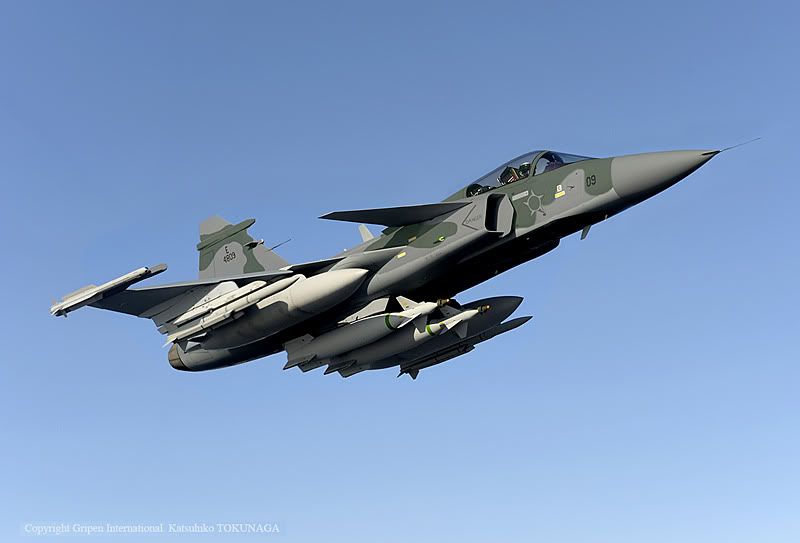
Edvard de la Motte, former Head of Design, Saab Military Aircraft and now a Director at Gripen puts things into perspective. He says that because of its Electrical Flight Control system, the Gripen can land and take-off on a strip with a length of 800 meters (2625 feet) and a width of 9 meters (30 feet). “The earlier Saab aircraft, the Viggen and the Draken were also designed to operate from public roads with a length of 800 meters and a width of 17 meters (56 feet),” says de la Motte.
Kramer“size” has absolutely nothing to do with RCS. The Tejas is a lot smaller than the F22 is the RCS smaller?
nonsense. Size is a big contributing factor to RCS. The fact that you’re using a comparison of the F-22’s size and Tejas to say that it doesn’t matter shows how much you understand about RCS and how it is computed. If the Tejas was simply scaled up to F-22 size and then its RCS was computed and compared with that of a regular Tejas, it will be nearly twice the RCS of a regular Tejas.
KramerDassault did not want to bid in india at some point because they considered it a waste of time.. brasil seems to be something along that way too… a big waste of time
nobody twisted their arms to bid in India or Brazil nor did they do either country a favour by bidding. :rolleyes:If they didn’t want to they were free to withdraw and someone else would win. No skin off India’s or Brazil’s back but billions could possibly be at stake for Dassault.
KramerHow about a Brazilian Gripen?:)
Or an Indian Gripen?
If not, perhaps a SAAF Gripen? 🙂
http://www.airliners.net/photo/South-Africa–/Saab-JAS39D-Gripen/1405168/L/
Goodness gracious Robban !! that Gripen in IAF scheme looks exotic beyond belief after having seen the plain-jane schemes that are oh-so-common except for the SAAF’s diamondback pattern..I now seriously wish that we could see a Gripen IN and in those colours..absolutely awesome !
KramerMaybe they are scared of the jets HAL produces…or the timelines they promise to have them flying by.
yeah scared of HAL produced airplanes huh ? That would be a very large portion of what the IAF operates then..maybe they’re scared of nearly 90-95% of their jets which also get overhauled at HAL ? then maybe the IAF ought to stop flying itself if they’re so scared ?
This whole basic trainer issue was the fault of the IAF and their lack of foresight and planning. HAL had been presenting to them on the HTT-40 for a long time (start of the 1990s) as a replacement for the HPT-32, but the IAF never took any real interest, nor did it take any initiative to start a program, get itself involved from the beginning and get a replacement for the HPT-32 Deepak. If they were so worried about HAL’s timeline’s then they could have asked HAL to tie up with a foreign company to build the HTT-40 or whatever design HAL final came up with. Instead they simply kept going on till they finally realised that the engine seizing issue wasn’t going away and that the Deepak was proving to be unreliable.
What stops the IAF from doing what the IN does for its warships, sonars and torpedo programs and depute its personnel to take active part in design/development so it knows from the beginning about the status of programs and so that there is close collaboration between customer and designer ? Do you think its a coincidence that a retd. Rear Admiral is the head of Mazagaon Docks ? Read up on the LCA experience as written by AM Philip Rajkumar and you’ll see how much of interest the IAF took in the LCA’s development program. They deputed him and they thought that was about enough. In fact there are some facts he mentions that would be considered as criminal neglect on the part of the IAF considering how important the LCA program was to their own projected force plans.
When HAL was able to roll out the first IJT-36 prototype within 36 months of design freeze, it proved that they had the design capability to design a basic trainer and get it ready in time. They got it in the air in record time too, but then they wanted to replace the Larzac and the AL-55I was chosen (mind you it didn’t even exist) after a tender between 2 sources. Plenty of time was lost in that phase, and the Russians delayed the AL-55I by a couple of years which delayed the entire IJT program. Is that HAL’s fault ?
And if the IAF didn’t have faith in HAL to build a basic trainer, then what on earth did they approve the more important IJT for ?
and while I don’t agree with Abhimanyu on the IAF using the NAL Hansa for Stage 1 training of military pilots (only because it was designed to FAR 23, Category “Utility” specifications and not FAR 23, Category “Acrobatic” specs), I do believe that had the IAF shown far sight, they’d have contracted NAL to tie up with HAL and build a basic military trainer on the lines of the Hansa, but designed to FAR 23 Category “Acrobatic” and “Utility” specs. That way, HAL’s work load would have been reduced and NAL would’ve been able to better utilise its experience from the Hansa.
Anyway, its all water under the bridge and now the best option is to import the best available trainer and licence produce it. HAL, if it starts a HTT-XX project, will end up splitting up design teams that currently/or in the future are/will be working on LCA-Mk2, MTA and PAK-FA projects. All those programs are of vital importance and none should suffer the way the LCA did when HAL meted out some step-motherly treatment to it (under Chairman R Sharma, because he had ego problems and was unhappy that ADA controlled the LCA project) and instead concentrated on the IJT.
KramerIt is unclear why IAF refused the help from local flying clubs to help train their Stage-I pilots. If at all, they could’ve asked for NAL Hansa trainers to be exclusively manufactured for the IAF. Instead, another mega global tender was launched, as usual with a circus of competitors vying with each other, joyrides, arms agents etc.
Indeed, Strange are the ways of the IAF !
please. the NAL Hansa was designed to be a club trainer, not a military spec basic trainer. there are different specifications for designing civilian and military trainers, for instance the g limits are different. I see that you’re not aware of that.
KramerKramer, persnal ego mixed with blind nationalism is a major problem on these fora. People from all sides do it in one way or another & it leads to all sorts of things. And at the end of the day most people keep believing what they want to. Nothing achieved. Nothing proven cos who are they trying to prove it to. Just pure time wastage. And i guess that is one reason i keep talking about respecting others’ opinions whether they r similar to mine or not.
This whole debate arose because I said to Abhimanyu that I don’t believe the JF-17 is a 4th generation fighter and you said that you were surprised that I said it. Do you have any points that counter mine on why the JF-17 should not be considered a 4th gen fighter ?
If not, we’ll just agree to end the debate here because while you see my point and I see your point on blind nationalism, it won’t do us both any good to write any more about it.
KramerKramer, thanks for that detailed response. I would only comment on the v last paragraph though. You say that its not right to paint the entire aircraft with the same brush generalising….. I guess we just lost each other somewhere down the line, but i have been trying to say exactly the same thing througout our discussion. 🙂
Having said the above, when people-even experts-write about an aircraft and its gen, normally all we get to see is 2nd, 3rd, 4th gen etc. This + concept is not too old either & at present is not applied universallz. No one hardly talks about these fighters & their gen in as much detail as you have done so in your post above & frankly no one has time for that. We just make up our minds & call it that. If i asked you to re-classify the above aircraft, you might call lets say Bison a 2nd gen machine cos it doesnt meet all the requirements of a 3rd gen. But then there would be those who would argue…but it has a 3rd gen this and 4th gen this, so it should be reclassified as a 3rd gen-as a compromise. To an expert like yourself you might reclassify it as 2+, ++, +++ etc. But if someone calls it a 3rd gen cos it incorporates many 4th gen elements, to many it would be an acceptable compromise, though it might not meet all the requirements of a 3rd gen & hence shouldnt get that title strictly speaking. I hope its clear now.
ok Vikas, I understand how tedious it would be to classify aircraft per the different important domains..but when you don’t take that into account, these generation titles can be very misleading.
For instance the capability of a Bison from a pilot’s point of view is such that it falls in the 3rd generation category but the airframe and engine which is the headache of maintenance technicians is such that its still a Bis (meaning 2nd generation). Its fatigue issues will be more severe, its engine requires more frequent removal, checks and overhauls.
To say the JF-17 with its conventional alloy/metallic construction and RD-93 engine is in the same generation as a Typhoon or Rafale with their heavy usage of composites and modern EJ200 and M-88-2 engines is a stretch by any imagination. The RD-93 is an updated RD-33 with relocated gear box, meant basically to power single engined fighters and allow for in-flight restarts as a mandatory requirement. The EJ200 and M-88-2 are the result of more than a decade of work from ground up and are considered cutting edge as far as military turbofans go. Is it fair to call them in the same technology generation as the RD-93 ? I don’t think so.
The only major thing about the JF-17 that appears to be on technological par with these 4th gen fighters is its cockpit instrumentation which appears to be quite good with good clarity, size and resolution. Regarding other avionics, it seems that the PAF understood this deficiency with Chinese avionics and took the approach of integrating French systems and weaponry to bring it up to 4th gen standards.
This is the same logic that some people have been asking to be applied to the Tejas LCA when it is compared to the Gripen C/D. On paper, their specifications match up nicely with similar sizes, similar composite construction (LCA actually exceeds here), similar engines of similar technology levels. Obviously there is a lack of some performance data on the LCA because its not provided in the public space, but their known data matches up. Yet, both Swedish and Pakistani posters go to great lengths to say that such a comparison is futile.
So then if we use a JF-17 and a Gripen C/D comparison to decide which gen a JF-17 belongs to, what happens ? In technology used for its construction, engine MTBF and MTBO (both of which show the attention paid to design, fatigue and high quality manufacturing), in terms of avionics, in terms of pure performance, in all these aspects the Gripen C/D will be ahead.
Do you think its fair to rank both as 4th gen fighters on the basis of their technology levels ?
Capability is a separate question (and as I pointed out in the Bison example above, it can differ for different roles, pilots and technicians) and its relation to which gen a fighter belongs to cannot be addressed easily nor accurately without going into the depth of the question. on that basis, many would claim that the Bison is a JF-17 equivalent and as of now capable of more than the JF-17. But to claim that they’re hence of the same gen would be a stretch of the imagination too.
KramerKramer..will the 12 Sitara’s ordered enter service this year or are they delayed because of the crash last year?
The situation IMO is not as dire as Col Shukla makes it out to be. Basic prop trainers can be procured from the no of flying clubs in the country as and when required…or am I missing something.
the first Sitaras are due to enter service this year. they were delayed by the Russian Al-55I engine being provided to HAL late. They integrated it and now its flying with the AL-55I but flight tests should be completed by this year.
But the prop trainers that you are talking of do not happen to be military prop trainers which are designed per military specs. they have different ‘g’ level requirements.
Kramer^^^ The IN is quite happy with Mig-29K as seen from various statement that came out from IN , considering as one pilot compared SHAR with Amby and 29K as driving the Merc.
lol ! where did you hear that ? By the way for the people who don’t know what an Amby is, its a Hindustan Motors Ambassador car (licenced Morris Oxford model)..check it out here
KramerI disagree. the MiG-29K will probably be better than the Naval LCA when it comes out. There are no Flankers, just one flanker, the Su-33 that can take off carriers (and the KUB version), and seeing as they have not been upgraded in decades, they will also be inferior to the MiG-29K. Thats why the Russians are moving on to the 29K as well. lets see what the Chinese clone for their carriers, it’ll be interesting.
but behind the Rafale, Super Hornet, F-35? definitely yes!
Well, the Chinese have been desperately trying to get some Su-33s from Russia but they reportedly were turned down unless they placed a substantial order..Russians said that the Chinese wanted to buy 2 Su-33s for evaluation purposes..;)
The Russians in the past may have agreed but the J-11B copy (oops “ToT and licence production” as Tphuang put it) case made them say no to this request. So the only way out for the PLAN now is to either convert the J-11B into the Su-33 on their own, or build a naval J-10 or buy 24 or so Su-33s from Russia..but that line is closing so that option may close.
Kramerposting a reply to Vikas’s post on the PAF thread. I guess we can continue with this discussion when a new PAF thread opens up.
Kramer, i understand your perspective. Just out of interest though how would you classify some of the following,
Mig-21 bis & bison
Mig-29 C, SMT, K & 35
SU-27, SM, -30, MKK, MKI
M2K & -5/9
F-16 Block 15, 40, 52. 60
F-15 C & E
Gripen A & NG.PS.i really didnt mean to sound sarcastic or meant any insult by making those mki/lca remarks. It was just to highlight the overall capabilities of mki despite its structure containing relatively fewer composites.
MiG-21 Bis – 2nd generation airframe wise, weapons wise, avionics wise and engine wise. No FCS
MiG-21 Bison – 2nd generation airframe despite strengthening for increased payload, increased nose length, conformal chaff/flare dispensers, 2nd gen engine (unupgraded from Bis), 3rd generation avionics (Kopyo), 4th gen RWR (Tarang, a follow on to the DRDO’s Tranquil RWR used on MiG-23s) ability to use 4th gen weapons (R-73, R-77, PGMs). No FCS
MiG-29C – 3rd gen airframe (chem milling processes, better alloys, metallic composites, etc.) and early 3rd gen avionics (no modern cockpit displays, lots of analog instruments), 3rd gen engine (RD-33 with smoky exhaust) and could use 3rd gen weapons (R-60, R-27) and 4th gen R-73. Analog mechanical/hydraulic FCS
MiG-29SMT – 3+ gen airframe (additional fuel, payload added) and 3+ gen avionics (early Zhuk MEh radar, better cockpit displays but same view from cockpit), 3+ gen engine (RD-33 Series 3 which dealt partly with smoky exhaust from combustor). . Could use the triplex redundant digital FCS that was developed for the MiG-29M.
MiG-29K – 3++ gen airframe due to much greater composites usage as seen from aircraft in primer, completely reworked forward fuselage derived from MiG-29M2 prototype work, 3++ gen engine (RD-33MK Sea Wasp, higher thrust and clean exhaust) and has 4th gen avionics (modernised Zhuk ME with new modes, modern cockpit displays, good view from cockpit, new OLS, Thales TopSight integration, other French and Indian avionics like the Tarang RWR, etc. Plus it can use 4th gen weapons like the R-77 and R-73, Kh-31A and Kh-35 anti-ship missiles, Kh-31P anti-radiation missiles, KAB-500KR TV-guided bombs, KAB-500OD/KAB-500L laser-guided bombs.
uses Quadruplex redundant digital FCS.
MiG-35 – 3++ gen airframe similar to MiG-29K (no evidence of any new hardpoints except for dorsal pod nor any evidence that it will use any more composites than the MiG-29K) and 4+ gen avionics (new Zhuk AE, newest OLS, Italian RWJ, etc.) and 4th and 4+ gen weapons (newer R-77 variants as well as later on K-74 close combat missile and other PGMs)
Su-27 – 3rd gen airframe, early 3rd gen avionics (N001 Cassegrain radar)
Su-30MKK – 3+ gen airframe (some similarity with Su-35 and used some composites as well as newer Al alloys, higher MTOW leading to strengthening, new landing gear, etc.), 3+ gen slotted array radar (initially N-001VEP then Zhuk MS and finally Zhuk MSE) and 3+ gen Russian MFDs and avionics with ability to use 4th gen weapons (R-77, R-73, PGMs, anti-radar weapons) and 3++ gen cockpit displays. 3++ gen digital FCS and 3+ gen AL-31F engine
Su-30MKI – 3+ gen airframe, 4+ gen Bars passive electronically scanned array radar, 4 gen OLS-30, 4+ gen Israeli (El/M-8222 SPJ) EW and Indian ECM equipment (Tarang RWR), satellite nav system INS/ GPS Sigma 95 from SAGEM and early 4th gen Thales cockpit displays. 4th gen digital FCS that ties the TVC to controls alongwith canards. Ability to use a huge array of 4th and 4+ gen weapons (Brahmos, soon to be integrated as well as KS-172 and Astra as per reports), Litening LDP, etc. 4th gen Al-31FP engine with TVC.
Mirage-2000C – 3rd gen airframe using Al and Ti alloys and early 3rd gen avionics (RDM and later on RDI radars), 3rd gen analog cockpit displays but with better MMI than on the MiG-29s of that period. Used 3rd gen SPJ, 3rd gen Atlis LDP (and now uses 4th gen Litening LDP). Ability to use 3rd gen weapons like Magic II and Matra R-530D and Paveway LGBs. Now also carries Israeli Crystal Maze missiles as well as Griffin LGBs. 3rd gen Snecma M-53P2 “bleeding turbojet” engine.
Mirage-2000-5/-9 – 3rd gen airframe and early 4th gen avionics (RDY-2 radar, known to be one of the best mech scanned units in the world) and 4th gen cockpit displays, MMI, data-links, EW equipment, ECM equipment. 4th gen MICA missiles, PGMs, LGBs, 4+ gen AASM, as well as Black Shaheen cruise missile. kept the same 3rd gen Snecma M-53P2 engine.
The F-16s have had such a lot of comprehensive work done on them that it would way too long to detail them out so I’ll be a little general here.
F-16 Block 15 – 3rd gen airframe and 3rd gen radar (AN/APG-66) and 3rd gen avionics
F-16 Block 40 – 3rd gen airframe and late 3++ gen radar (APG-68(V)5), 3++ gen avionics including (LANTIRN pod and its related holographic HUD, the GPS navigation receiver, and ALE-47 decoy launchers. In addition it got quadruplex digital flight controls (replacing the old analog ones), automatic terrain following, and a new HUD, full provision for internal ECM, an enhanced envelope gun sight, and a capability for bombing moving ground targets.
3++ gen airframe with added strength (9G capability was maintained at 28,500 lbs) and MTOW was increased as was landing gear strength.
F-16 Block 50/52 – 4th gen airframe (substantially beefed up and includes CFTs) and 4th gen radar (APG-68(V)9 is the latest version offered), 4th gen avionics (including colour MFDs among other things) and can use 4 and 4+ gen weapons and the JHMCS. Mind you that this version first came out in 1991 so its been continuously improved over time.
F-16 Block 60 – 4th gen airframe (different from Block 50 as well and further strengthened to have the highest MTOW of all F-16 variants) and 4+ gen avionics, primarily due to AESA APG-80, AN/ASQ-28 IFTS (Internal FLIR and Targeting System) that replaces the pods in earlier F-16s, an Integrated EW suite from Northrop Grumman ‘Falcon Edge’ internal ECM system, EW management system, fiber-optic avionics data bus and increased chaff/flare dispensers, as well as advanced IFF. The Block 60’s advanced avionics suite has room available for future improvements and it also has a new and faster modular mission computer. The Block 60 F-16 can accommodate both active and passive MAWS currently under development. plus newer colour MFDs, sensor data-fusion, etc. and the JHMCS
The Block 60’s basic design and weapon interfaces are compatible with 4+ gen weapons such as the AIM-132 Advanced Short Range Air-to-Air Missile (ASRAAM). The aircraft will also support all-weather standoff weapons, such as the AGM-154 Joint Standoff Weapon (JSOW), and AGM-84E Standoff Land Attack Missile (SLAM).
Gripen A/C – 4th gen airframe (composites from design initiation), 3+ gen avionics (monochrome MFDs, HOTAS controls, and now 4th gen colour MFDs on the C/D alongwith Cobra HMDS), 4th gen radar (PS-05A a follow on to the Viggen’s PS-46/A radar, but 40% smaller volume and weight. The PS-05/A has all-altitude look-down capability, resistance to jamming, and provides a number of operating modes), 4th gen engine (GE/Volvo RM-12 derivative of the F-404). 4th gen triplex redundant digital FCS.
4th gen EW suite from Saab Avionics (AR830) radar-warning receiver (RWR), with receiving antennas on the front and back of the wingtip missile launch rails. The EW system controls a set of chaff-flare dispensers, all of which are built by Saab Avionics. BOL dispensers are built into the end of the missile launch rails while BOP/C dispensers are built into the fuselage, while BOP/B dispensers are built into the end of the wing pylons. The BOP/B dispenser can trail a “BO2D” towed repeater RF decoy, which can be deployed at supersonic speed and programmed to operate in several different modes.
And of course, the most famous aspect, its data-link. the 4th gen TIDLS, which has four high-bandwidth, two-way datalinks with a range of about 500 kilometers (310 miles) and very high resistance to jamming. 4th gen sensor fusion technology to make sense of all the threats, targets, waypoints, fuel, wingman’s status, etc. Ability to carry 4th gen weapons and flexible architecture that allows for even 4+ (Meteor, ASRAAM, IRIS-T, Kongsberg NSM, etc.)
Gripen NG – airframe strengthened, increased volume to add fuel tanks, so 4+ gen. Its basically a case of better use of real estate by relocating the landing gear. Landing gear beefed up and so will be the wing-body joint to allow for higher payload. Additional hardpoints added which are each able to carry more payload than the C/D.
4+ gen radar (swashplate mounted Selex ES-05A Raven with PS-05A backend processors) and other 4+ gen avionics including new 4+ gen IRST (Skyward-G from Selex Galileo), new SATCOM, new EW suite, new electro-optical MAWS.
So you see Vikas, its not right to simply “paint” the entire aircraft with one brush generalizing its generation unless it can really show itself to be up there in terms of radar, avionics, airframe, engine, weapons, etc. Certain mods affect capability but from a total technology point of view, it may not catapult the entire aircraft into a new generational category.
KramerKramer, i might b wrong but i think those comments by rimmer were in MMRCA context?
yes I know. I was simply stating it because he never uses the same “deep” perspective he appears to show here on the IAF thread when talking about PAF.
As for your comments about J-10/JF-17, why would PAF seek either when more F-16 block 52 can meet their requirements? Why would IAF seek same gen MKI/MMRCA/LCA when theres a massive price difference? To me the answer lies in different roles they are envisaged for, the capabilities they can offer to respective AFs, & to some extent the geopolitical situation.
exactly. The same thing I was saying about the variety in the IAF’s fighter orbat. they each serve a different role, and offer a hedge in the scenario where relations going sour with any one nation would completely ground the IAF.
I said the same about Pakistan’s heli orbat as well (that they each serve a purpose so it doesn’t matter who you buy from as long as you can maintain them), but the point went over the head of Mr. Rimmer.
As for china vs french avionics, simplest answer would be cos the latter provide better bang for the buck. Period.
French avionics provide better bang for the buck ? What does that say for Chinese avionics considering how much lighter they are on the wallet ?
KramerIt would be funy though. Indian pilots trained by Egyptians in Pakistani/Chinese originated planes. Since the plane are not fighterjets it would not make any difference. I even thought about India being offered production if thy buy 100+ K8. It is cheap and rugged trainer that suits their need better then anything available.
It wouldn’t be funny because it would never happen. Its just the case of a concerned Egyptian diplomat offering to help without understanding the case fully.
first of all, the IAF has a problem with its basic trainer which is a turbo-prop. the K-8 is not a basic prop trainer, so it doesn’t solve that problem.
Secondly, the IAF has no need for a K-8 type jet intermediate trainer to replace Kirans because it will get the HJT-36 Sitara which will enter service in 2010 that can perform the role of the K-8. And as per Ajai Shukla’s report the IAF is pleased with the IJT and aims to acquire 73 or so in addition to the first batch of 12 LSP IJTs.
For anything more than that it has the Hawk and a new tender for additional Hawks, both of which are more capable than the K-8.
KramerSomeone- may be Teer?- made a valid point earlier in that indian defence establishment should not b directly compared with the west. The latter with its decades of experience has great reserves of expertise to replace the lost talent from. Indian defence industry in its teeage years yet does not enjoy that luxury for the time being.
This, however, raises some other questions. While i agree that IAF might be perfectly happy with LSP3 delay or any other delays- n hence no public complaints- I wonder if IAF as an end user has anything to gain by making a hoo haa about it? Whether they get LCA tomorrow or 10 years down the line, their requirements will be met. Right? LCA is not exactly the end of line for them-is it? IAF started with x number of MKI, which was later increased by y & even later by z. Everyone talked of 120 odd MMRCA at start & then we hear that it might go up to 200-& if it does, there shouldnt be any surprise. So LCA is not a question of life or death for IAF the way lets say F-35 is for USAF.
No, the LCA is no more a matter of life or death for the IAF. But for the IAF to be able to achieve the size it wants, the number of squadrons it wants, the LCA is its best option. Every single one of the MRCA candidates is nearly twice or more the cost of a single LCA (works out to $30 million or so including tooling costs for the first 20 for the IAF).
IA made some hoo haa about Arjun trials a while ago which resulted in gross accusations including the possibility of internal sabotage. But even their tank requirements are being met in one way or another.
the accusation of sabotage was raised by none other than the Union Minister of State for Defence Rao Inderjit Singh. The claim by IA that the Arjun failed its winter trials due to engine issues led the DRDO to install a blackbox that would let them know what was tampered with in the engine. Promptly, the engine issues vanished. Quite a coincidence, isn’t it ?
Take a look at Indian BM programme. Didnt really have any foreign alternatives, yet it has been smooth-er. What if IAF/IA didnt have foreign substitutes for products like LCA, Arjun etc, could the outcome have been any different?
absolutely valid comparison. the Armed forces had no option but to support the Prithvi, Agni and other missile programs, so initial failures didn’t lead to complaining and bitching because which country would sell them Ballistic missiles ? They supported the DRDO, and they in turn licked the issues and now they have enough experience to come up with variant after variant.
On a final note, is this- what some term indian inaction over such delays- affecting Indian self reliance programme? While India does a lot more in-house stuff than before, does anyone have some figures for comparison reason, i.e. The targets, what percentage of armed force needs were met through imports say couple of decades back wrt to the situation now?
I think that if you read the Request for Grants made to Parliamentary Committees or the Standing Committee reports you’ll find some answers.


 Sign In