Kramer
Ive read that EL-2052 for MiG29 nose cone (it is modular design so number of TR modules vary from fighter to fighter) has between 1300-1500 modules? True this was of ELTA brochure but I am assuming they would not print missinformation. Numbers given are up to 150Km detection range for a “small fighter” , simultaneous tracking of 64 targets and engaging up to 8… and this was back in 2005.
So I am curious since India chose Israel to supply EW suite in their K, why not go for EL2052. Not only does it outprefrom ME, but from numbers its better than AE too.. and more mature design considering Elta was in 2003 where Zhuk is now development vise.
the question is how mature is it ? Its not in production for any nation, its not in production even for any Israeli fighter. India being the customer would have to pay for integrating all the weapons that would be needed to be integrated with the Elta 2052. And how comfortable would Russia be with allowing such a thing on its MiG-29K ? And how comfy would Israel be with parting with source codes for the Elta 2052 to allow Russia to integrate Russian anti-ship missiles with it ?
As it stands, the Zhuk-ME has a large array of weapons it can guide and its range and performance is as good as that of the APG-68(V)9 of the F-16 Block 50.
We’ve already seen how going the tri-partite way ended up delaying the IAF’s Phalcons by some years as the Il-76 was modified in Tashkent and then handed over to the Israelis..differences between them delayed it for the IAF. If there is no major performance gain, its better to keep the radar from the OEM’s national sources as it’ll keep your future upgrades, weapons integration headaches smaller.
KramerAnyone got any information about the LCH specification? What is it supposed to and able to achieve?
What a 5.5 ton all-up weight gunship should achieve. Being derived from the Dhruv means somewhat similar performance, but obviously drag, weight distribution are different and so the Auto FCS will be different as well. Also was supposed to be able to fly 25 kmph faster than a Dhruv and the streamlined shape will go towards helping it reach that goal due to reduced drag.
And the added requirement (and very important) of being able to carry a useful weapons payload at high altitudes where the current crop of gunships will struggle. Having read a test pilot’s report on how well the Dhruv did at Siachen, and how much control margins he had and how much reserve power he had even at that altitude, its clear that the LCH will inherit much of that performance.
Mission roles will include recon, scout, escort of convoys, escort of transport, CSAR and support helicopters, COIN, anti-tank, anti-personnel and anti-UAV operations. For which it has a 20 mm Nexter cannon and will be equipped with Mistral AAM, rocket pods, and an as yet undecided anti-tank weapon. Given that it has an all-up weight of 5.5 tonnes, when it does reach its design intent empty weight of 2500 kgs, it should be able to carry around 2.8 tonnes including fuel and crew. Excluding fuel I’m guessing its payload will be around 1000-1200 kgs or so depending on how much fuel it can carry.
KramerAs already pointed out, India is offering France more money. Seems like India is buying big from everyone to put in place their plan. Purchases from USA, Russia, France, Isreal, next Germany?. Then buying token purchases from domestic industry: LCA and Arjun.
The way you make it sound the logical thing next would be start importing from China as well..:rolleyes:
India doesn’t import from countries so that they won’t sell to Pakistan. That is a type of conspiracy theory thinking that shows a lack of understanding of how much more complex it is to select the sources of any particular acquisition.
KramerKramer, i was a little surprised wrt your comments about 4th gen fighters & composites. I mean what sort of % composite material do fighters like J-11, J-10, Mig-29 constitute, & what gen do these belong to? MKI is def considered to be a 4++ gen…right?…& comp % is? What is the standard requirement in terms of % for re-classification? Should JF-17 make use of some composites-& i believe there are plans for this at some timepoint in future-would that turn it into a 4th gen?
I think that you’re looking at it as generations representing capability. I’m not- here when I talk about classification, its simply about what technologies have been incorporated in its design. the original F-16 and Mirage-2000 were 3rd generation through and through due to the materials (conventional metals and alloys) used in their construction. The F-18 was more advanced in some regards.
And unfortunately, either due to a lack of airframe engineers writing about it, most people on web-forums under-estimate the level of technology that goes into the airframe and how it influences factors from drag and aerodynamic performance down to maintenance, repair and airframe life.
I don’t consider the J-11 as a 4th generation fighter either..Its a re-worked Su-27 with Chinese avionics and weapons replacing Russian, and an eventual plan to replace the engines with a Chinese turbofan. No major changes have been made to the airframe or at least none that I know of which would make me think that its airframe also represents that technology jump that its avionics and weapons got. However, it is a capable 3+ gen (3 because its a Su-27 derivative and + because its obviously more capable than a vanilla Su-27) fighter due to its updated avionics. Already the Su-27’s airframe is mature, and well designed. We also know that the original Su-27’s airframe fatigue life is not quite so high and I don’t suppose the J-11’s will be either unless the Chinese did do some work on that. OTOH they may have done some work on that to increase its service life. I don’t know.
Regarding the J-10, I thought that I did read somewhere that it did have some composites used in its airframe. Which is what marks the difference technologically speaking between one generation’s airframe and the other generation’s airframe.
I mean why is the B 787 so touted ? Just because its a new aircraft that has a newer cockpit and newer avionics ? No. Its because its airframe is so fundamentally different from that of the legacy designs. Even the B 777 was a revolutionary design due to the large-scale usage of composites. It represents a new generation of technology both from the design as well as manufacturing side and in some ways will bring with it a new set of maintenance and repair technology. i.e a newer generation than what already exists for the 777 which also uses a fair bit of composites. A B 787 built using similar technology as the 777 was possible, but it would then not represent a new generation of aircraft from design/materials/manufacturing view point.
Now would you compare the ARJ-21 (the new Chinese aircraft) to the B 787 in technology ? No way. The ARJ-21 is a through and through reworking of a legacy design. Which is fine for the knowledge and experience that China gains, but its not a step ahead or even a step in tandem with what is going to become existing technology with the B 787. That is the difference between generations in terms of airframe.
Now that composite technology is so advanced and in many ways mature, there is no more the concern that its an unknown quantity in the long run and even Airbus is coming around to that view, despite having been more conservative initially.
And to answer your question, yes I do think that as the JF-17’s airframe gets more of composites, it will progress towards becoming a fighter of a different generation (4th in this case). Maintenance, repair, fatigue, damage tolerance all those factors will change and so will how its airframe is manufactured. All of which represent a move towards the newer generation in airframe materials and manufacturing technology. Currently, I don’t think that manufacturing wise or maintenance wise there will be any difference between a JF-17 and an earlier model F-16A that the PAF has.
I do agree about JF-17 & highway landings though. I dont think F-7 & Mirages were designed for this purpose & yet they are doing so. Shorter TO/LAND requirements for the former was more likely a general requirement for obvious reasons. As for the use of highways, its an old idea within PAF due to the lack of Pak strategic depth & no! of bases, & hence these highways were built keeping in mind PAF needs.
if the older gen Mirage can do it anyone can do it. The reason I say that is because the older Mirages have a very high landing speed, a result of its delta wing design. Same with the F-7, after all its only a MiG-21 variant..and I know that MiG-21s had a very high approach and landing speed.
Regarding the french, well just wait & see. Remember how many times we heard such stories about RD-93 & so on? Even if true, i think it might have more to do with MMRCA than anything else. & if Rafale is kicked out in first stage, we’ll likely hear something different. As for the 6 bil figure that might be to do with the optional extras, i.e. The whole lot over the years.
What this is going to do if it does come through is to make the JF-17’s cost go up by more than 100% of what is being quoted as its unit price as of now.
I mean a Mirage-2000 upgrade for the IAF to the -5 standard is quoted as being around the $40 million mark..unless the JF-17’s French avionics and weapons are substantially lower in specs than the Mirage-2000-5’s I can’t see how such an avionics/weapons fit will cost less than $40 million..even at $30-35 million per unit that is more than what people have been quoting as the unit price of a JF-17.
Does Pakistan have the funds to pay for this ? And what will such a French fit do to the price of the JF-17 and how many the PAF wanted to induct eventually ? And how will French concerns over technology transfer to Pakistan due to its Chinese relations be addressed ?
And the argument that this French fit is to make it more exportable is also sounding specious when one considers how expensive the FC-1 will suddenly become with the French fit.
Kramerswitzerland? seemed to me that the typhoon wasn’t even on the final list (Gripen, SH and Rafale being the three contenders remaining)
SH was pulled out by Boeing who cited that the requirements for this F-5 replacement were too easy and they felt that the SH was overkill and consequently wouldn’t be chosen. The 3 contenders who were evaluated were the Typhoon, Rafale and Gripen D.
KramerI suppose they’re to be taken from UK’s planned orders? Good thing anyways. Every deal like that will make it more probable that eventually all initially planned orders are to be fulfilled. Hopefully something similar can be achieved with Switzerland.
Are there any news on MRCA yet? The threads about Indian AF are a bit difficult to follow. 😉
as per some insider reports (one from a very reliable poster on BRF), the Typhoon and MiG-35 did well in the Leh leg of the trials, the one part of the trials that seemingly tested all the contenders quite a bit..Another insider report by a generally reliable defence blogger said that 2 of 6 MRCA candidates passed all parameters during the Leh leg, but he didn’t mention who failed (and I suspect he meant 2 out of 5 passed as the Gripen D had not yet been tested at Leh at that time). So the MiG-35 and Typhoon seem to have done well.
And a third report by Vishnu Som, a national level journalist with NDTV said that the Gripen D did very well during the Leh leg managing to carry 2.6 tonnes including air-to-air missiles and underwing fuel tanks. So it seems that 3 aircraft did well during this leg, but what is not known is the weightage for this part of the trials.
They involved operating from Leh airbase, situated 10,600 ft ASL, and doing the following:
– familiarisation flights to get used to the routes, mountains surrounding the airbase and approach to the airbase (which is considered quite difficult, as the approach is very steep to avoid mountains)
– multiple sorties to test the payload capacity of the fighter operating from Leh
– “cold soak” tests that involved leaving the fighter in open pens overnight exposed to -18 to -25 deg C and then starting them up early in the morning and checking all systems if they’re working or not. This was the test that would have been the most severe because most Western fighters are not left exposed to the elements in this way and their systems may not have been designed for such exposure over several hours
Anyway, it seems from the insider reports that both the US Teens did not do too well during this phase of the trials.
–
KramerIt was a PG and a Mirage 5. I have seen the pics.
About JF17 and short runway. Just do a research. The landing is short. The turnaround time is superb. And it was all said by the current ACM. I hope he does know what he says, don’t you think?
Could you post those pics ?
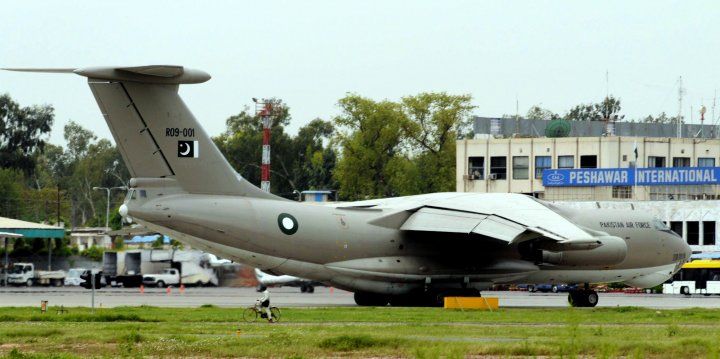
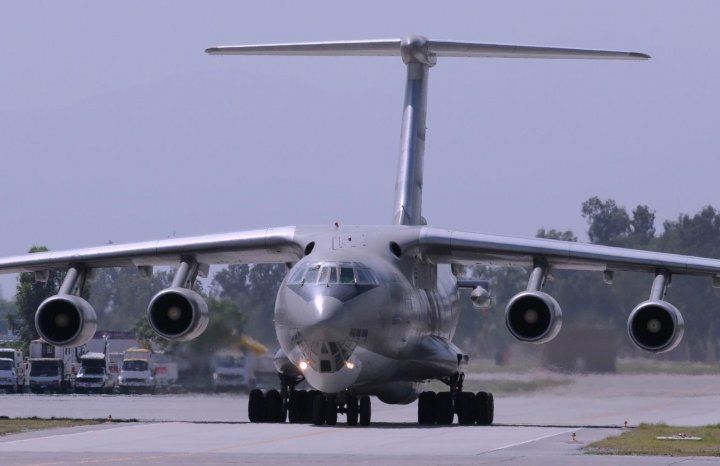
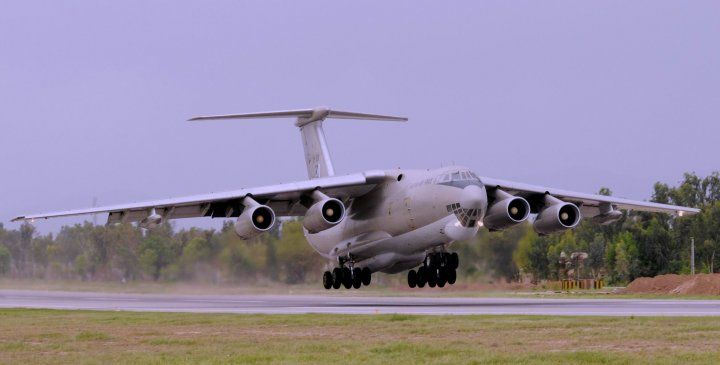
KramerIt looks like it has the older Soloviev D-30KP engines and not the newer PS-90A engines.
KramerSee, it is a decent 4th gen. fighter, so it WILL eventualy have BVR capability. How does it matter whether now or a year later ? Anyways, Chinese missile transfers to Pak have always been clandestine and covert (remember ballistic missile transfers and the mysterious Bakhtar Shikan ATGM). So, one fine day the SD-10 too will be seen fitted on the JF-17. It’s just a question of [I][U]when.
I don’t think its a 4th generation fighter because it doesn’t fulfill what is considered standard on 4th generation fighters. That is use of advanced composites in the airframe. It is a 3rd or at best 3+ generation fighter. All the 4th generation fighters were built with large percentage of composites from the design stage itself- or else if they were 3rd generation airframes (like the F-16, MiG-29, etc.) they were suitably upgraded with composites added to lighten their airframe and increase fatigue life.
Similarly, landing on highways shouldn’t be seen as a cutting-edge capability. Yes, it is advantageous no doubt, but not something that our jets can’t attempt. I’m sure Tejas too can attempt it.
well of course its not cutting edge capability (Sweden has been doing it for decades) but its a tactical requirement for the PAF. If F-7s and Mirages can land on a highway, surely the JF-17 can as well in the future. The key portion that defines the Short Landing capability is not described because nothing is said about exactly how short is the landing distance when landing on highways.
Rimmer was going on about how the JF-17 can land on a highway, re-arm and re-fuel and it may as fast as the Gripen when in fact it was the F-7 and Mirages that landed and did a turn around.
Besides, not all roads can be used for such landing. Some stretches of highways will be reinforced to take such heavy punishment,
KramerIt was a PG and a Mirage 5. I have seen the pics.
About JF17 and short runway. Just do a research. The landing is short. The turnaround time is superb. And it was all said by the current ACM. I hope he does know what he says, don’t you think?
any links to show that ?
KramerWill India get their hands on those 1000 T/R + module Zhuk-AE with their future Mig-29Ks?
Or are those destined for the RuAF?Thanks
It’s not clear whether the IN ordered the Zhuk-AE developed for the MiG-35 or the current Zhuk-ME for the next batch of 29 MiG-29Ks. The IN has only just recieved its first 6 MiG-29K/KUBs and the remainder of its first batch of 16 will be delivered by this year end.
They have been developing and testing the Zhuk-AE for a while now and its been demonstrated to the IAF first when the MiG-35 prototype arrived in India for AI-09 and then for the MRCA trials.
There may not be enough time for MiG and Phazotron to develop the Zhuk-AE fully, test it and have it ready for serial production by the time it needs to start delivering the second batch of 29 MiG-29Ks. So it could very well be that all 45 MiG-29Ks of the IN may use the Zhuk-ME till they’re due for a MLU in another 15 years.
KramerNot able to figure out, an inducted JF-17 is still BVRless?
No big deal about that. even the LCA will only get the BVR capability during the period between its IOC (currently scheduled for sometime around December 2010) and its FOC. So when the first LCA squadron is inducted it will not have any BVR weapon but the R-73 will be its primary weapon.
KramerIt was F-7s & ROSE Mirages Rimmer not JF-17s. And these dispersal exercises are held every two years and cover the whole gamut from landing to refeuling to rearming to relaunching. The first was held back in 99.
Thanks. Kind of makes it clear how seriously we should take Rimmer’s claims.
KramerNo offence, but no one knows how long it took JF-17 to rearm and refuel and takeoff again. It could have matched or exceeded Gripen, or taken longer. We dont know.
what makes you say that those 2 aircraft were JF-17s ? the article doesn’t mention which aircraft landed on the highway, re-armed and re-fuelled. As for matching or exceeding the Gripen in this regard, I highly doubt it. Sweden has decades of experience in dispersed operations and has had the Viggen design before the Gripen which also excelled at STOL operations from motorways and very austere basing and low turn-around times. Nothing to date has indicated that the JF-17 is designed for such operations.
KramerJF-17 was designed to operate like this from outset.
proof ?


 Sign In