 danrh
danrhThe Raptor carries around 20,500lbs of internal fuel compared to about 18,500lbs for the Lightning.
The Raptor doesn’t carry that much more fuel … but has a bigger airframe and two big thirsty engines.
Hmm this is the first time I’ve seen the F-22/F-35 comparison expressed this way and its interesting to note how little dissent there has been. Especially around here. My only concern is that this same line of reasoning has never been used by the Australian government when explaining why the F-35 is a better choice for the RAAF than the F-22. Perhaps its just considered too technical for the unwashed masses, it does seem logical though.
Daniel
danrhIf the later does happen, then the RAAF starts to move out of the regional support role into the Regional Police role taking over from the Americans who are pulling back after operations in both Iraq and Afghanistan have started to really bite in the defence budget of late. This also concerns our neighbours who have been approached by the current government about strikes on their homeland in support of anti terrorism activities, Malaysia has expressed concern over this stance and has stated that if the Austtralian government breaches MAlaysian airspace without authority it will retaliate and declare war (probably why they bought the Su-30MKM’s).
All that because a few possible MH-47s? Aircraft that would be operated by the Army not the RAAF, are not really suitable for operations from our current or future Amphibious warfare vessels and which even in extended range versions lack anywhere near the range to approach Malaysia unless we are planning to conduct unsanctioned operations within that country from RAAF Butterworth which would be just downright stupid.
Daniel
danrhHas anyone had a go yet at comparing the pig with the superbug?
Radius of Operation?
Payload?
terrain hugging?
EW and self-defence suits?
Operation envelope? ( I think the pig wins this one flaps down, but no harm asking)
Ugliness factor (sorry, pig wins again. but avago anyways)These super bugs are costing an arm and a leg plus a few kangaroos droppings. They better be able to keep up with the ugly hog. 😡
Oh please I beg of you, don’t start it again. Check out the Super Hornet odds thread linked to above and do a search for RAAF and Super Hornet. You’ll turn up enough reading to keep you going until the Super bugs have been replaced by F-35s.
Daniel
danrhWow that one came out of nowhere. This selection has been put off so many times I thought my grandkids would still be listening to the old Gravel Trucks toiling into the air. Good to see.
Daniel
danrhSimilar ‘marketing terms’ pop up ever so often nowadays. Take the much vaunted electronic attack capability on AESA radars for example – until they manage to actually fry enemy electronics (and by the sound of things, that capability is still a ways off) it’s nothing more than a glorified jammer IMHO.
Sometimes I’m willing to bet it wasn’t an engineer who came up with it…
Are you suggesting it was one of these guys:)


danrhFor the next 20 years nobody will attack Australia. What would an air campaign of Indonesia against Australia be good for? Not realistic. And given demographics and various social factors China using Indonesia as a proxy in a war against Australia is also not realistic.
What Australia might have to worry about is its maritime approaches. For that anti-ship and anti-sub capabilities are needed, together with wide-area ISR assets. (And a cooperation with Singapore and the USN). And as I said in another thread it will be 20 years till the Chinese fleet comes steaming down the Makassar strait…
Super Hornets will do the job nicely, and if Australia decides to go play war abroad (aka UN-actions, peace keeping, …) the RAAF will be compatible and interoperable with NavAir. Also good.
Pretty much agreed although hopefully JSF’s will have fully replaced all Hornets within 15 years. I’ve long considered the Super Bug to be a good fit for the RAAF if it was decided an interim type was required. I must admit to some issues with this particular deal though. Personally I would have prefered to see some used (but low hours) USN models procured either, perhaps even under lease. These earlier aircraft have the maximum commonality with our upgraded classics while still providing plenty of capability to cover the loss of the Pigs. The six billion dollar price tag for this deal does seem exorbitant. I mean after all thats $A250million per aircraft. The Singaporeans and Koreans deal for their F-15s indicate a cost about $A4billion for 24 F-15s would be reasonable albeit with a much longer lead time (which would rather make such a purchase redundant). Going by the projected costs of the Saudi Typhoon deal we could probably get two dozen of those and still have enough change out of our $6bllion to get all the weapons we want cleared for the plane. Unless this deal includes some extended life of type maintenance provisions or some other such value adding component it does look like we are being fleeced. The JSF acquisition program is for a stated total of 100 aircraft and projected cost of $A16billion. This deal is for 25% that number but is going to cost 37.5% of the money.
Daniel
danrhI said in that thread and I say again: AWACS stands for AWAC System. it is not the radar by itself, but the integration into a working system. A big part of the equation is processing capability and software. Both require maintenance. So, although this question is interesting and actually of much higher relevance than questions concerning turn rates, nobody here is possibly able (or willing) to answer them.
This is the AWACS

While all of these aircraft are classified under the generic term AEW&C


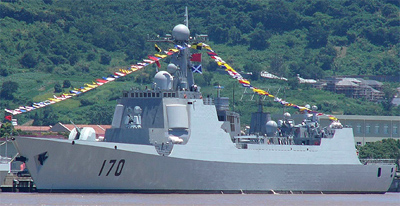
Just as this is an AEGIS vessel
_at_sea.jpg/300px-USS_Arleigh_Burke_(DDG-51)_at_sea.jpg)
and this is just another AAW DDG with a phased array radar system
danrhUnfortunately the threat to be concerned about isn’t a legacy Hornet user.
Sell it to a big SU that flat out can refuse to engage an F-18F and drive right on by. Unless it comes across your engagement path, good luck.
And these big SU’s will be coming from where exactly? Malaysia and Indonesia may have or will acquire a small number of these aircraft but both air arms have maintenance issues and with only small number to start with the likelihood of seeing meaningful numbers in the air low. Both air arms also lack support capabilities such as AEW&C. Malaysia is investigating the acquisition of aircraft in the class of the SAAB or Embraer offings in the AEW&C field but who knows when and if that will come to fruition. The RAAF on the other hand backs its fighters (this would be classic Bugs btw since the Supers are going to the F-111 squadrons) up with Wedgetail and JORN as well as being able draw upon support from a Navy that actually manages to get its ships to sea on a regular basis. The RAAF will have raid warning and C&C well beyond anything available to the half dozen Flanker drivers our neighbours might manage to get airborne. Of course maybe you’re suggesting the Chinese, Indians or Vietnamese will be the OPFOR? Or maybe we are considering a coalition effort where we operate within the US machine with all of its support systems?
Daniel
danrhWhen did the CFE treaty become a strategic nuclear treaty?
The CFE treaty was a treaty to balance the forces of Europe between East and west to prevent potential conflict. Now that everyone that was in the warsaw pact plus most of the former soivet republics are either in NATO and wanting to get into NATO it is now a nonsense.
That was the question I was asking you, you were the one who dragged the CFE into this.
If this is true then the INF treaty is dead, adn the CFE treaty not far behind it.
This clause allows the Russians to withdraw if necessary, but as it clearly states that the two parties this treaty applies to are quote It really doesn’t need to withdraw from anything as Russia is not the Soviet Union, and vice versa.
From http://dosfan.lib.uic.edu/acda/treaties/inf1.htm
Following the December 25, 1991, dissolution of the Soviet Union, the United States sought to secure continuation of full implementation of the INF Treaty regime and to multilateralize the INF Treaty with twelve former Soviet republics which the United States considers INF Treaty successors.2 Of the twelve successor states, six — Belarus, Kazakstan, Russia, Turkmenistan, Ukraine, and Uzbekistan — have inspectable INF facilities on their territory. Of these six, four — Belarus, Kazakstan, Russia, and Ukraine — are active participants in the process of implementing the Treaty. With the agreement of the other Parties, Turkmenistan and Uzbekistan, each with only one inspectable site on its territory, while participants, have assumed a less active role, foregoing attendance at sessions of the SVC and participation in inspections.
The multilateralizing of what was previously a bilateral U.S.-Soviet INF Treaty required establishing agreements between the United States and the governments of the relevant Soviet successor states on numerous issues. In the SVC and through diplomatic contacts with the actively participating successor states, the United States worked to secure agreements to ensure continuation of the viability of the Treaty regime and to assure the exercise by the United States of its rights under the Treaty. Among the tasks undertaken were: arrangements for the settlement of costs connected with implementation activities in the new, multilateral Treaty context; the establishment of new points of entry (POE’s) in Belarus, Kazakstan, and Ukraine through which to conduct inspections of the former INF facilities in those countries; and the establishment of communications links between the United States and those countries for transmission of various Treaty-related notifications. Other issues that have been discussed in the SVC include multilateral operating procedures for the SVC’s concurrent continuous monitoring under the START I and INF Treaties, and inspection procedures for new missiles exiting from the Votkinsk Machine Building Plant in Russia.
To answer your point however the INF treaty was signed when the ABM treaty was in force and also at a time when it was seen as not likely to be withdrawn from. Withdrawl from the ABM treaty could be considered extraordinary reason enough for the Soviets to withdraw from the INF treaty… if the ABM treaty is obsolete and a cold war dinosaur, then so is the INF, and even more so the CFE treaty, which borders on the rediculous.
So we are talking assumptions and opinions here then, no actual fact? As far as I can see there is no mention anywhere in the INF documents of the ABM. No suggestion that withdrawal from one will trigger the same for the other. Similarly there seems to be no similar clauses contained within the CFE. There are also no clauses in either treaty’s dealing with any other missile defence systems. I am trying to understand your earlier statement that if the US goes ahead with a facility in Eastern Europe then the INF and the CFE treaty’s will collapse.
Daniel
danrhThe ABM treaty is mentioned as part of the basis for all strategic nuclear treaties. You don’t negotiate arms control and ban having more than one magazine of rifle ammo and then let the other guy build an APC.
I had a look through the INF and CFE treaty’s the other day but didn’t really see anything along the lines of what you are saying. Perhaps you could illuminate the relevant passages?
http://www.fas.org/nuke/control/inf/text/index.html
http://www.fas.org/nuke/control/cfe/text/index.html
cheers
Daniel
danrhAs far as I can see the only way the ABM program violates the INF treaty is with the HERA target rocket. Not sure how it affects the CFE treaty.
Daniel
danrhSpanish destroyer impresses Minchin
Spanish destroyer impresses Minchin
* Jeremy Roberts
* March 08, 2007A VISITING Spanish frigate competing to be Australia’s next air warfare destroyer was yesterday dubbed “a great ship” by a key federal minister who will help make the $7 billion decision in July.
Finance Minister Nick Minchin made the comment as he toured the Alvaro De Bazan, a 147m, 6000-tonne Spanish frigate which docked in Adelaide’s outer harbour yesterday.The Government will choose between the Spanish F100 design, of which Alvaro De Bazan is an example, and an as-yet-unbuilt warship being designed by US company Gibbs and Cox.
The “evolved design” will be a larger ship, based on the US navy’s Arleigh Burke-class guided missile destroyer, which is 155m long and weighs more than 9000 tonnes.
As an untested warship, the evolved design is thought to carry higher risks of budget and equipment problems.
Yesterday, Senator Minchin said he appreciated the opportunity to board the ship. “It is a great opportunity to see one of the two possible designs in the flesh,” he said.
“As one of the decision-makers, I’m personally pleased to see this vessel in real life.”
Since the Alvaro De Bazan was commissioned in 2002, Spain’s navy has added another three F100 frigates to its fleet.
Built by Spanish shipbuilders Navantia, the F100 has long been regarded as a stalking horse for the Gibbs & Cox option.
But with $7 billion at stake, an Australianised F100 is now thought to be an even-money bet to win the contract.
The winning design will then be built by Adelaide-based ASC Shipbuilding for delivery of the first of three air warfare destroyers to the Australian navy between 2013 and 2015.
The final cost estimate of the F100 design option is reportedly $500 million cheaper than the Gibbs & Cox design.
Senator Minchin said “value for money will be a primary consideration in that choice” along with capability.
The Alvaro De Bazan and its crew of 200 men and women, including 20 heavily armed marines, will stay in Adelaide until Saturday. The ship will visit Sydney from next Monday for a week and will arrive back in Spain on May 19.
Daniel
danrhSix Billion Dollar Flight of Fancy
Six billion flight of fancy
* The Government’s Super Hornet purchase is an expensive and unnecessary triumph of politics over strategic knowledge. Patrick Walters and Cameron Stewart report
* March 08, 2007IT’S Brendan Nelson’s $6 billion bonanza. On Tuesday afternoon as a stiff breeze rippled across the tarmac at Canberra’s Fairbairn airbase, the Defence Minister proudly announced the RAAF’s latest multi-billion-dollar purchase, 24 F/A-18 F Super Hornets.
F/A-18F Block II Super Hornet multi-role aircraft
# Total cost for 24 aircraft: $6 billion over 10 years, which includes weapons and supporting infrastructure.
# What they can do: Function as a fighter and a strike bomber.
# What weapons they carry: Precision-guided missiles. In the US they carry AMRAAM and Sidewinder missiles.
# Top speed: Mach 1.6.
# Combat ceiling: 15000m+.
# History: Block II version being bought by Australia was first built in April 2005.
# Who uses them: Flown by US Navy, operate from aircraft carriers.
# Training: Australian personnel will begin training in US Navy aircraft in 2009.
# Delivery date: First four will arrive in early 2010, the rest by the end of 2011.
# Based: RAAF base Amberley, outside Brisbane.Source: http://www.defence.gov.au
“The only reason we are in a position to do this is because we have had solid economic management for over a decade,” Nelson said, standing in front of one of the air force’s ageing F-111 bombers.
The Super Hornet is another huge political victory for Nelson who has single-handedly won billions of extra taxpayers dollars for defence since he took over the portfolio a year ago. Like last year’s purchase of four giant C-17 transport planes, the defence budget will be fully supplemented for the cost of the Super Hornets, meaning it will be paid for from the Government’s general budget surplus rather than deducted from the defence budget.
But the $6 billion deal has perplexed defence experts, leaving them pondering Nelson’s decision-making style and questioning the strategic wisdom of the Super Hornet buy. “This is pure Nelson, no one else. It was him and him alone,” observed one senior government source yesterday. “It’s a needless and expensive decision. It makes no operational sense and it makes no sense in terms of value for money,” commented another senior defence source.
So how did Nelson manage to stand up his own department’s carefully considered advice and ram through the Super Hornet purchase? Four months ago the $6 billion acquisition of 24 F/A 18F Super Hornets was not on defence’s radar other than as a fall-back option should serious problems arise with the RAAF’s planned purchase of the F-35 joint strike fighter.
Air force chief Geoff Shepherd told a parliamentary committee in early November that there were no indications the joint strike fighter program was blowing out. “The Government has announced that, if the JSF were to slide substantially – and once again, I stress we are seeing no indications of that – the purchase of a bridging fighter would be a last resort,” he said.
When Cabinet’s National Security Committee met only three weeks later it considered a defence submission that reviewed the timeframe for key decisions on Australia’s future air combat capability, including the $14 billion F-35 joint strike fighter purchase. This came at a time of swirling public debate about the possibility of a gap opening in air combat capability early next decade and the Government’s choice of the F-35.
There is a risk this could occur following the planned retirement of the F-111 strike force from 2010 and if the planned introduction of the F-35 from 2012 is hit by unforeseen production delays or budget cuts.
The defence submission advised that any decision on a fall-back option would not need to be made before 2008 when the key decision on a go-ahead for the $14 billion purchase of up to 100 F-35s is due to be made.
It advised that there would be risks and additional costs associated with any extension of the F-111’s operational life beyond 2010.
But the bottom line for the Defence Department was that the Government did not have to make an immediate decision on buying another fighter aircraft to bridge the gap between the retirement of the F-111 strike force and the arrival of the F-35.
The defence chiefs judged that the transition risks were manageable but had determined that the Super Hornet would be the best fall-back option for the RAAF in the event of trouble.
But for Nelson any uncertainty about a possible gap in Australia’s air combat force next decade posed an unacceptable political risk for the Government.
According to senior Government sources, Nelson seized on a classified assessment by defence scientists at the November NSC meeting outlining the risks of keeping the F-111s in service beyond 2010. He then proceeded to hammer home the political consequences for the Government should any of the nearly 40-year old planes fall out of the sky. John Howard agreed with Nelson and cabinet ministers made an in-principle decision to go for the Super Hornet was made.
Nelson’s political message on Australia’s future air combat power has been strong and consistent: the F-111s are old and must be retired in 2010 and, however many assurances Lockheed Martin gives the Government about the progress on the F-35 fighter, the possibility of a gap in Australia’s front-line air power early next decade remained.
“Under no circumstances is the Government prepared to accept any kind of risk to our air combat capability, one part of which requires in the not too distant future the retirement … of the F-111 … We are determined that under no circumstances will we take the risk of an aircraft having an engineering failure at low level,” Nelson said on Tuesday.
The solution for Nelson is the F/A 18 F model Super Hornet, a fourth-generation fighter now in service with the US Navy. The Super Hornet is considered a fine warplane. It is more than 25 per cent larger than the RAAF’s existing F/A-18s, with a powerful radar, good networking abilities and some stealth features.
According to Nelson, the Super Hornets will provide advanced capabilities giving it a more flexible operational capability than at present exists with the F-111.
Inside defence headquarters on Canberra’s Russell Hill, Nelson’s U-turn on the Super Hornets was greeted with stunned silence. No one is complaining aloud. After all, the RAAF will have an extra 24 capable fighters. But it is the triumph of raw politics over strategic logic that has left defence planners shaking their heads in amazement.
It is not as if the defence chiefs had not carefully worked through the issue of the nation’s future air power needs: it is arguably the single most important aspect of Australia’s defence. It is also the most expensive.
Up until Nelson intervened, the firm conclusion inside defence was that Australia did not need a new fighter jet to plug any gap between the retirement of the F-111 strike bombers in 2010 and the arrival of the F-35s from 2013.
The intensively worked defence plan would see the F-111s retire in 2010. Its existing
71 F/A-18 fighters would be upgraded and equipped with long-range missiles, extra stealth, making them a more all-round potent weapon when operated in conjunction with the new Wedgetail airborne early warning and control aircraft and new air-to-air refueling tankers.
What’s more, Australia’s best strategic analysts concur that Australia faces no forseeable threat early next decade and US fighters could be leased at short notice if any crisis eventuated.
But Nelson perceived a looming political problem, not just with the Opposition but with his own backbench, a number of whom have been highly critical of the decision to choose the F-35 fighter ahead of the F-22 Raptor plane.
Labor was already seeking to accuse the Government of playing with Australia’s security. In an election year such claims – no matter how unfounded – could have the potential to hurt Nelson and undermine the Government’s long-held electoral lead on matters of national security.
Early last year, the F-35 program looked as if it may be in trouble. There were rumours of cost overruns and threatened delays with the fifth generation fighter as designers struggled to meet weight restrictions and successfully integrate the F-35’s highly sophisticated avionics.
What’s more, US Congress was making growling noises about the F-35 budget. Australia was unhappy with Washington’s reluctance to guarantee full stealth capabilities on the export model of the plane that Australia was planning to purchase.
If Nelson was genuinely concerned that the F-35 program would be delayed, his decision to buy the Super Hornets would make more sense. But by the time he decided to bring forward the Super Hornet purchase, the F-35 program had largely recovered and appeared to be well on track.
The plane’s manufacturer, Texas-based Lockheed Martin, said this week that the F-35 is on target to be delivered to the RAAF from 2012. It is also adamant that media reporting of cost blow-outs have been greatly exaggerated and the average cost of the F-35 model that Australia plans to buy is still about $US47 million ($60.5 million).
This is higher than originally anticipated but is still one-third of the cost of the Australia’s only other serious warplane option, the F-22 Raptor.
The Government remains fully committed to the F-35 and has accepted defence’s advice that the F-22, despite its acknowledged performance, is not the right plane for Australia. Nelson says the F-22 is ill-suited to Australia’s needs because it is primarily an air superiority fighter rather than plane capable of striking land-based targets.
In any case it costs too much and the US won’t sell it to anyone, even close allies.
But the Super Hornet decision suggests that while Nelson has faith in the F-35, he does not have faith that it will be delivered on time.
By choosing to buy 24 Super Hornets, the Government has killed one of the key reasons for originally choosing the F-35: to allow the RAAF to operate a single model of fighter.
Andrew Davies of the Australian Strategic Policy Institute says the Super Hornet is primarily designed to operate off US aircraft carriers and as such carries extra weight and a wing design optimised for low rather than high speeds. “It is therefore behind the performance curve from the beginning when compared to land-based aircraft,” he says.
The Government disputes this saying that the Super Hornets will be more potent than anything in the region, including the Russian SU-30 fighters entering service with several regional air forces.
But the debate about the Super Hornet is not so much about its capabilities but about whether it is required at all.
Davies argues that the Government should have delayed any decision on a fall-back option given the confidence in the F-35 program expressed by both the RAAF project team and Lockheed Martin.
“Either that is not actually the case and the JSF is having problems, or we have rushed into a back-up plan costing almost 50 per cent of the F-35 acquisition for no compelling reason,” says Davies.
Nelson’s critics say the rushed Super Hornet decision flows from a short-term political judgment rather than sustained, rigorous analysis of Australia’s future air defence needs. They also contend that the purchase is simply storing up problems for future defence budgets, possibly undermining the eventual planned purchase of up to 100 joint strike fighters.
Australia’s leading defence budget expert Mark Thomson finds that over the past 12 months the Government has committed more than $31 billion of additional funding to defence, exceeding the $28.5 billion announced with great fanfare at the time of the 2000 White Paper.
“The question has to be asked: are the Government’s plans for defence affordable?” says Thomson.
“Even if our 14-year streak of continuous economic growth continues, intergenerational factors will begin to bite sometime next decade, placing steadily growing pressure on whoever is treasurer to find savings.
“Defence cannot expect to be immune from being asked to help balance the books. Let’s hope that this has been taken into account amidst the haste with which many of these recent decisions have been taken.”
Patrick Walters is The Australian’s national security editor. Cameron Stewart is the associate editor
danrhDear oh dear. This is going to keep on until the 2020s isn’t it.
The Super Hornet is an interim buy. It will serve from 2010 until 2020 or a little beyond. Lets consider what its replacing, the opposition and the alternatives.
The Old – The F-111
The F-111 has speed and range. Unfortunately it is become harder to maintain and requires further modernisation to carry it through to 2020. Of course this would cost less than $6billion but then again given recent history the ADF and the Government would be loathe to possibly throw away more money on old airframes. On top of that if the F-111 is to face the vaunted Flanker then it is horribly vulnerable unless escorted. In that case its speed and range are irrelevant since they are limited buy the need to have Hornets along for the ride. The Super Bug at least has its own quite capable self defence capability, far in excess of a Pig with Snake. The strike capability of the Super Bug with JASSM and JDAM is formidable, given the issues that have been experience with AGM-142 and the fact that the new weapons given real precision strike capability in all weather, it probably exceeds that of the Pig.
The Opposition
Seriously what is the opposition? Indonesia has 2 (two, deux, zwei, II etc) Flankers and are struggling to get another pair. Suggesting that the RAAF will be going up against the bulk of the foreces of the PRC or India in the 2010-20 period is a tactic used by a certain Doctor but is as close to reality as suggesting the US will seek to annex Australia and make it the 51st state. At worst the RAAF could be facing a single foreign CV with dozen or so Flankers or Fulcrums. Lets not forget that the Super Bugs are replacing the F-111s. While I doubt the RAAF will employ them as they did the F-4Es in the 70s I still expect them to major in strike with the classic Bugs continuing as the main AtoA warfighters. Similiarly the once the Lightning starts to come on line they will go first to the classic squadrons and have the job of handling AtoA opposition.
The Alternatives
F-15, Typhoon and Rafale etc I’ve already written all wish to on this in post #132.
Daniel
danrhhttp://www.theaustralian.news.com.au/story/0,20867,21334515-2702,00.html
Australia to spend $6bn on fighter jets
* Patrick Walters
* March 06, 2007AUSTRALIA will spend $6 billion over the next 10 years to acquire 24 F/A 18 Super Hornets to coincide with the retirement of the F-111 strike force.
Defence Minister Brendan Nelson announced the purchase yesterday saying the Government would not take the risk that a gap could develop in Australia’s frontline air combat force after the F-111’s are retired from 2010 and before the introduction of the fifth-generation joint strike fighter.
He said the government remained fully committed to the introduction of the $14 billion JSF which is due to enter service from 2013.
Defence will receive full budget supplementation for the $6 billion buy eliminating any risk of big cuts to the 10-year defence capability plan to help pay for the new aircraft.
“The F/A-18F Super Hornet is a highly capable, battle proven, multi-role aircraft that is currently in service with the US navy through to 2030,” Dr Nelson said yesterday.
“The next generation Block 11 Super Hornets will provide a more flexible operational capability than currently exists with the F-111.”
The new planes will be delivered at the time the F-111’s are retired in 2010 and will be based at RAAF Amberley in Queensland.
The F/A-18F Super Hornet is around 25 per cent bigger and flies further than the RAAF’s existing Hornet fleet. It also has a more advanced radar and weapons fit.
“The JSF is the most suitable aircraft for Australia’s future combat and strike needs,” Dr Nelson told reporters.
“Australia remains fully committed to the JSF. But the Government is not prepared to accept any risk to air combat and strike capability during the transition to the JSF.”
with AAP


 Sign In







