 shadowpuppet
There are fan boys on both sides.
I’m really only interested in filtering out the din they create and getting a technical/operational discussion based on the very little we know.
What irks me is that so many of the contributers to the thread offer skepticism on the other sides capabilities, yet have what appears to be almost blind faith in their own chosen aircrafts abilities.
jessmo, on the one hand you declare the PAK-FA needs saw tooth edges to be an equal to the F-22/35, yet on the other you state the F-35 doesn’t because it uses RF wizardry to negate the effects on RCS. Therefore, you are declaring, without any knowledge, that Sukhoi aren’t using a similar technology, or even an entirely different, yet practical solution on the PAK-FA.
How can you do that? Because Sukhoi haven’t declared that they’re doing it? They’ve never been great at advertising the minute details of projects vital to guarding their nations security really though, have they?
The current flying example of the PAK-FA strikes me as being mostly an aerodynamic and weapons system test bed. I think we’ll see quite fundamental changes between it and later prototypes.
To that end – I don’t think the PAK-FA, if it’s introduced to service in 2015 will be the finished article, but I expect them to be continually updated from that point – somewhat akin to the Gripen C -> Gripen NG upgrade path.
A shout out to djcross and his sober analysis, I like reading his posts.
I also agree with Otaku that not all is what it seems with the T-50’s inlets, but am open to being proved wrong 🙂
For me, the PAK-FA represents Russia’s effort to regain its position as at the sharp end of fighter design, it also represents a wider push by Russia to put itself at the forefront of at least some areas of R&D.
If it doesn’t go down this road, if it doesn’t push itself, it will be overtaken and become just another consumer of foreign aircraft.
It’s the same for every country. The financial cost is a huge burden – but compare that to the cost of losing R&D expertise.
With that reality, I see them pulling out all the stops to make this an aircraft worthy of the RuAF and a worthy adversary of the F-22/F-35 and I believe, in time, it will be.
Claims of ultimate superiority of a mature T-50, versus a mature F-22/35, should be taken with a grain of salt – each will have weaknesses, each will have strengths. Quite a few of these probably wont be public knowledge until they’re in museums and we’re old men.
Meet you all back here for a trolling session in 60 years.
shadowpuppetOne thing I wonder about the PAK-FA is the effect of the multiple large moving surfaces on its RCS.
I wonder, whether, in a BVR high threat environment – the pilot will have an option to reign in the range of motion of the surfaces.
In other words – where s/he’s trying to remain invisible, the maneuverability will be sacrificed to improve RCS – and within VR, it’s set for full motion, sacrificing RCS for full maneuverability.
Basically a button on the stick used to engage different FCS settings, for normal ops – full motion, for stealth, limited motion.
Thoughts?
shadowpuppetAh, the beautiful Bucc.
http://www.youtube.com/watch?v=DbGmNvvxNJo
I’ll have to get across to Brunti some day and spend the day drooling over Victors, Buccs and Lightnings 🙂
Just have to say I really admire the people who maintain these aircraft, you do a great job.
shadowpuppetHi Phantom,
To the best of my knowledge the 172’s were armed for a rather short period of time – I believe there were issues with the additional weight on the wings.
The firing mechanism was designed and built in house by the Air Corps.
Before the PC-9’s came into service, the Marchetti’s had a secondary “light strike” role and the Fouga Magisters also formed the “Light Strike Squadron”.
The arming of the 172’s was really a sign of the deteriorating security situation on the island and the poor finances of the Defence Forces during the period. You’ll notice from the thread I linked to, that Air Corps members had pistols for self protection.
shadowpuppetThanks for the photo and the info! I assumed their mission was as basic trainers, but it seems I was quite wrong. Quite a variety of missions they are tasked with it seems. Nice to see of an operator that utilizes the good, sound design of the Cessna 172 for a variety of mission types.
That’s the kinda stuff I was looking for when I started the thread….I just think it would be interesting to discuss all the various roles that these aircraft are put through by operators all over the world.
Keep it coming!
I believe this thread will be of interest to you:
http://www.worldairpics.com/forum/index.php?topic=2160.0
🙂
shadowpuppetshadowpuppetYeah that was sloppy messing around, here you go MadRat:
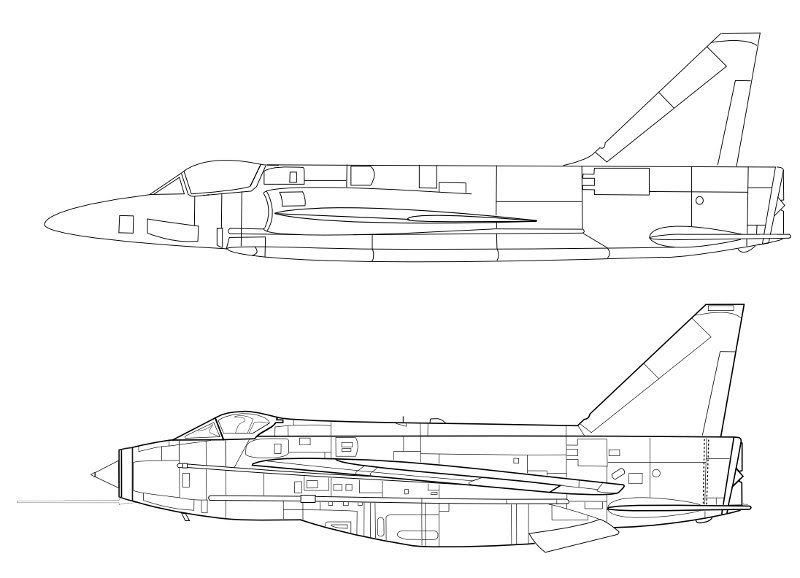
Dorsal spine removed, lengthed fuselage for more fuel and to redistribute weight, reprofiled belly (wish I could do that with mine)
Undercarriage moved from wings to underside
And before anyone starts – I’m not suggesting this was ever: practical, logical or desirable, it’s just an exercise in distraction 🙂
Original lightning profile taken from Wikipedia
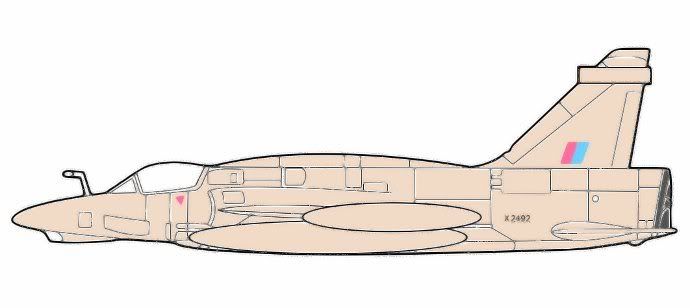
Her last hurrah – Desert Storm, new hump, in flight refueling probe – heavily laden with fuel, acting as laser designator 😉
shadowpuppethad a very stressful day, needed a little escapism so i started doodling, here’s where i decided to give up:

the bac thunder; britain opts out of the sepecat consortium in 1964 and decides to build a lightning mk. 6 derived strike aircraft, using buccaneer derived main wings
air intakes moved to sides, cockpit lowered, optional fuel tanks on wing tips
shadowpuppetHere’s my rushed and very poorly drawn fighter offering, well, interceptor… of sorts.
It’s 1955 and the RAF is concerned that it will be unable to sufficiently defend against a mass Soviet bomber attack on Britain. It decides to marry the under development Blue Steel nuclear missile with a dedicated air defence/early warning airframe, with the aim of destroying vast formations far from the mainland.
An airframe between the size of the Canberra and Valiant and based on their technology, is hurriedly designed, giving us the EE Vigilant :p

shadowpuppetI’m convinced the intakes curve up into the body, not only that, but that the curve itself contains multiple s-ducts which completely obfuscate the compressor face.
But who cares, even if I’m right, the trolls will pick on something else.
DEY USE VACUUM TOOOBS!
shadowpuppetare we likely to see the T-50 get some kind of thermal coating over the engine section?
shadowpuppetStunningly beautiful aircraft, those lines are just glorious – a real next generation fighter (like the F-22)
Oh and the engines are clearly canted inwards ala > not straight ala = but don’t let that get in the way of trolling.
shadowpuppetHere’s a very ugly and basic 2d representation of my earlier idea:
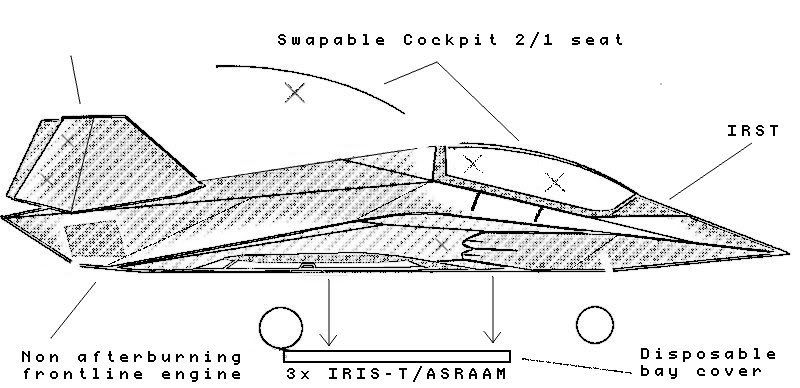
Again, sharing avionics/systems developed for existing aircraft for economies of scale.
Optimised for low level scooting around home airspace, passive detection.
Simplified weapons bay: recessed, with drop shield
Can double as Advanced/LIFT
But probably an outdated concept in this day and age
shadowpuppetAdding an inlet blocker is never a more viable solution than one without a blocker. Inlet blockers degrade inlet pressure recovery (key to overall propulsion system efficiency) which degrades engine thrust and increases fuel consumption.
Plus, inlet blockers introduce a source of FOD during icing conditions. Blocker de-icing technologies add maintenance complexity and can add parasitic loss to engine performance depending on the de-icing technology that is used.
djcross – I was wondering if I could get your opinion on a potential solution to the PAK-FA blocking its blades from view.
Firstly, no your eyes are not deceiving you, it’s a borked IAC insignia – it was the first thing that came to mind to use to illustrate the idea:

Basically what I’m trying (poorly) to display, is a relatively simple shallow ( bracket duct.
For example, the right intake ducts up and to the left to feed the engine. Obviously this alone wouldn’t completely hide the engine blades from view.
So there’s 2 or 3 or more internal ducts within the ( bracket duct. I haven’t illustrated it properly yet – but essentially, each segment at the front would twist around.
Green segment to white segment, orange to green, white to orange.
I was just wondering, firstly, do you believe such a design is practical?
And if so – what sort of penalties would it introduce?
It seems relatively straightforward, but then again I’m a lurker on a forum who has never worked with a jet.
shadowpuppet

 Sign In







