crgritchie
What about Jaguars? Those were built for carrier ops. And India builds a pretty advanced version.
Nope – there was a proposed marinised version in the 1970s for the French Navy that resulted in a prototype and deck trials – but it was rejected in favour of the Super Etendard. It would not be possible or worth the effort to convert old 2nd-hand land versions.
Similarly, the A7 is too heavy (only it’s fighter sister the F8 could make it onto the Clemenceau class), and the F/A-18, whilst a possibility, would only be as a fighter and not the super Hornet version, again due to mass. The ship is limited by its catapult capacity.
In reality, the only viable options are Harriers, A4s or, most likely, purchasing ex-AeroNavale Super Etendards as they are replaced by Rafales – France might even provide them free as an incentive for Brasil to purchase the Rafale for its Air Force.
crgritchie‘Through Deck Cruiser’ all over again.
I’m sorry to shift the mood here a little, but, this is, in part, brilliant news. The words there that the contracts are too far advanced for the carriers to be scrapped – and that placed clearly in the public domain is fantastic news. The hulls are definitely going to be completed even in the worst case and thats all that matters at this point.
The issue with the second carrier being ‘chopper only’ is absolute bunk. The ship will easily be able to operate F-35B if it is called on to do so. 50 F-35B will mean a full airgroup for the duty carrier available and, as we all knew, the RN was going to have issues manning 2 CVF’s simultaneously anyway. In point of fact then, provided that the second vessel is built with the air ordnance magazines and handling system (that has already been contracted for) the change to ‘commando carrier’ is emminently reversible.
If the finances are shaping up better by the end of the next decade the argument to have the 2nd carrier re-roled to provide cover while QE is in refit is the simplest one for the MoD to put forward. Throw in a 2nd order for an additional 40 F-35B somewhere around 2020 and we have virtually all the capability we are ‘losing’ here back as well – if the global situation warrants it!. If EMALS is proven tech by then, and we have some end product from Taranis/Mantis, it might even be that the carrier airwing could be more efficiently augmented with UCAV’s than manned fighters anyway by that time!.
The other interesting thing here is the RAF dynamic. With only 50 JSF’s does that end the story for ‘Joint Force Harrier’. IF the RAF are to become a single type fastjet service does that put JSF solely back in the hands of the Fleet Air Arm?. We’ve seen that RN squadrons can deploy ashore and work just fine so what is the real need to have official RAF involvement in the F-35B force?.
Totally agree with all of that, just a bit gutted you made all my points before me, but hey-ho. Think this is a good bit of posturing by the Navy, along the through deck cruiser lines, and obviously learning from the CVA01 fiasco where the Navy refused to contemplate the cancellation of the CVA01, the F4, or the Type 82 – so got the latter 2 which are pointless without the flat-tops. Provided this is either just a re-role by name only, or that the ship is fitted “for but not with” the remaining equipment to make it fully CVF then great news, and agree that the news they can’t be cancelled is super aswell.
Funnily enough I’d made the case for axeing almost all the JSFs in a different thread, just keeping c.16-17 and extending the AV8B lifespan, and running a mixed group.
http://forum.keypublishing.co.uk/showthread.php?p=1467972#post1467972
crgritchieMany thanks Obi Wan & 90in FIRST.
another query. If the 3 big carriers went ahead (informed opinions please) would the air group most likely be Phantoms & Buccaneers continuing up to date or a possibility of Sea Jaguars/ Sea Harriers or other types?
Sea Jaguar would’ve been more of an option if:
i) we’d built 3 Hermes-sized ships instead of the CVA01 class or the Invincible class, and
ii) if the French had adopted it, though they strangely opted for the inferior Super Etendard, showing the British that they don’t have a monopoly on crazy defence decisions.
A Sea Jaguar would have been akin to the Sea Harrier and Tornado ADV conversions, making an interceptor from a strike aircraft (though retaining that capability aswell). Hermes would in all likelihood have been able to embark around 20 of these, assuming they replaced both the Sea Vixen and the Buccaneer.
crgritchiePrimarily from Neil McCart’s book on HMS Centaur, plus a few other refence books. I believe Nieil got his info from the RN and from ex crew members. I’d regard those sources as more reliable than most online sources (ie people who were there). Hermes operated 9 Sea Vixens for most of the sixties alongside 8 Scimitars, then post 66 she swapped the scimitars for 6 Buccaneers (she had a bigger hangar deck courtesy of the deck edge lift and more deck parking space than Centaur). Having re checked my sources, Centaur is listed as operating 8 Sea Vixens and 8 Scimitars from 1960-62, thereafter 12 Sea Vixens. Photos of the period seem to confirm these numbers. Hermes appears to have increased her fighter complement to 11 aircraft by 1970, though the extra aircraft may have been just for trials/ excercises. I’ll have a dig around for info on Victorious’ air group.
Thanks for that, so Hermes was 11 Sea Vixen plus 6 Buccaneers from 1970?
How many Helos & Gannets did Centaur embark with 12 sea vixens?
crgritchieIt could be (though a tenuous suggestion) that Robin in HMS Victorious context could have that the Robin was England’s national bird, until the currency changes when our Farthing (which had a Robin on it) was withdrawn. Still, I’ll leave it at that- Trivial Pursuits…
Hi, VICTORIOUS spent a period on secondment with the USN in the Pacific theatre of WWII when they were short on flattops after Pearl Harbour, the ship was called USS Robin by the USN.
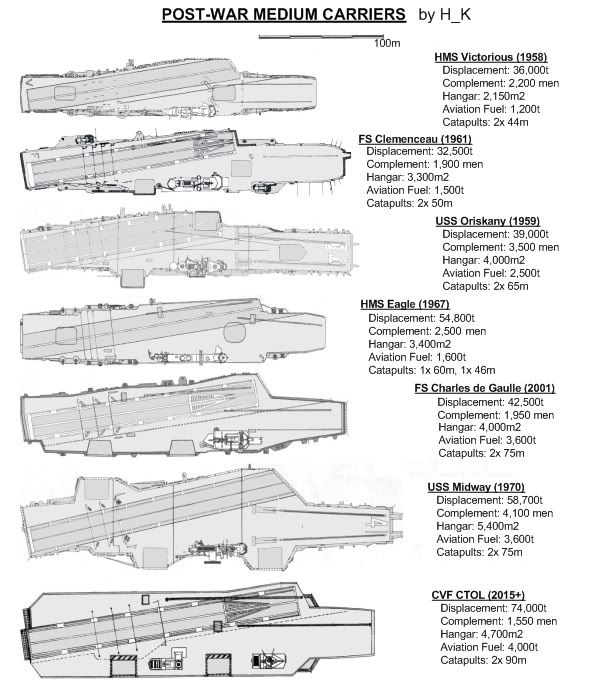
crgritchieI’m launching a thread to discuss medium carriers. We tend to focus a lot on individual designs or light STOVL carriers, but there have been quite a few medium carriers post-WWII that are worth comparing. All are pretty sexy designs.
My definition of a medium carrier is one that can operate supersonic conventional jet fighters, with an airwing of 25-50 aircraft (i.e. Colussus & Majestic class don’t count). The range of medium carriers goes from HMS Victorious and FS Clemenceau at the small end of the scale to USS Midway and CVF/PA2 at the high end of the scale. Here’s a graphical comparison, with some key statistics:
A superb graphic, thanks v.much for posting this. But I’d include CVF & Midway at the bottom of the Supercarrier group.
crgritchieThe balance between fighters and strike aircraft is dependant on the type of mission the carrier is sent on, and to be sure the RN in the 60s showed flexibility when required. With only two commando carriers in service, strike carriers were occassionally pressed into service as makeshift commando ships eg Centaur transporting troops to quell a mutiny by the Tangayikan rifles in the early 60s, squeezing the troops into the hangar deck on camp beds and gingerly moving the ship’s air group around them. At the time Centaur operated a unique air group, composed of 12 Sea Vixens for both Air defence and strike, four Gannets for AEW and six Wessex for ASW/SAR. Previously she had operared with six Vixens and eight Scimitars, but the cramped conditions aboard (and a high attrition rate for the scimitars) lead to the Scimitars being withdrawn and the Vixen sqn being brought up to full strength.
If Victorious is retained through the 70s unmodified and the Vixens are withdrawn anyway she could carry a completely strike oriented air group of up to 20 Buccaneers, with the usual complement of Gannets and Sea Kings and sailed in company with Eagle or Ark Royal providing fighter cover with their Phantoms, though this would be unlikley given the normal independent nature of peacetime ship deployments.
Hi – where did you get your info for Centaur’s airgroup from? I’ve trawled the web and only found 2 sources thus far:
http://www.btinternet.com/~a.c.walton/navy/rn-cv3.html
http://www.warfaresims.com/?page_id=228
Whilst they differ slightly on helo complement, they seem to agree that Centaur mounted 9 Sea Vixen + 8 Scimitar, and when the Scimitars were withdrawn they were not replaced.
Also, any info on Vic’s airgroups from the Scimitar era onwards would be much appreciated, have seen even less for that (just harpoon).
crgritchieIf we remain in the programme, it makes sense to buy as many as possible. Cancelling aircraft with a large British component in favour of an entirely imported aircraft would not protect jobs here in the UK.
The reasons for leaving the A400M programme are:
1) late
2) overweight
3) underpowered
4) cost
Reasons for staying in:
1) Protected skilled UK jobs on the A400M programme
2) Possible export prospects
3) Retaining Airbus wing manufacturing in the UK for the future.
My suggestion was to buy the minimum to achieve the aims for staying in, whilst shifting the remaining units to C130J to achieve those aims aswell. Say, for example 6 C130Js were ordered, this’d provide short-term relief to the stretched and ageing RAF fleet whilst the A400Ms were being built and their problems resolved, it would also hedge against the failure of that type, and save a few quid with a bit of luck.
crgritchieActually, the plan is the opposite. 801NAS is due to stand up next year and future deployments aboard the carriers are scheduled to be with 10+ aircraft. 8 aircraft is fine for carriers like Principe de Asturias or Garibaldi, perhaps even Cavour, but the CVFs will look empty with just eight aircraft on deck. The Spanish and Italian Navies have for a long time only operated a single carrier each as well, but this is changing. Italy now has two carriers, which alternate but share a single air group. That is goint to put a strain on the pilots and ground crew, ideally it should be one air group per carrier so that when the carrier is in refit, the air group can recuperate, rest, train and prepare. Spain will soon have two flat tops in service as well, but only one sqn of Harriers. Careful planning will be needed to avoid straining the aircrew.
It’s great news the Navy is reinstating its other Harrier squadron, but my comment wasn’t about what is happening or going to happen, but rather what I believe the MoD should do as the ‘least worst’ scenario. Yes, CVFs will look empty with only 8 JSFs (don’t forget I was suggesting that the airgroup would also have 12-16 Harriers and 10-12 Helos aswell, so it wouldn’t look THAT empty) but better a CVF force with an empty-looking deck than having 1 or both CVFs cancelled in the forthcoming cuts.
Incidentally, for a ship of it’s size the CVF would look rather empty anyway, the old USS Midway and USS Coral Sea were comparable size and fielded 76 aircraft, inc 48 F/A-18s.
crgritchieAgreed for the most part, though on the last point, keeping the Harriers running isn’t a viable option, after 2018 they will start running out of fatigue life, which has already been extended as far as practically possible. The F-35s don’t have to be ordered all in one go though, and this is a program that will be spread over many years. An initial purchase of up to 60 aircraft will give an initial operational capability (30 is too few to be of practical value, not enough for one carrier air group let alone an OCU or attrtion reserve) and then more batches can be ordered later, as the production lines will be open well into the 2020s. During the transition period from Harrier to F-35, they will be operated side by side for s few years, with the FAA scheduled to recieve them first. This should free up a large number of Harrier airframes for the RAF, so they can pick and choose the best airframes from a larger pool to eke out the fatigue life of the remaining aircraft.
Both the Italian and Spanish navies operate fleets of around 15 AV-8Bs and this is sufficient for them to operate a small squadron of around 8 aircraft off their carriers’ decks – so this is a feasible number for an IOC for the Navy. We could draw heavily on the US for training aswell. I’d suggest retiring a squadron of RAF/RN Harriers ASAP, in order to rotate the airframes and keep that type in service for as long as possible, eventually to be replaced in a follow-on F35B order.
crgritchiethank god for penalty clauses.
The only way it seems to keep a british government doing what they said they would do!.
Im all for the A400M cancellation. Buy more C-130’s and C-17s
Leave the euro fighter and carriers alone.
I know though knowing our policitians they will scrap the JSF deal and say we can make do with Harriers. Or only buy 30.
IMHO, this is exactly what we should do to trim the budget. Just buy an initial small batch of around 15 JSFs to provide an air defense squadron for the operational carrier, and have the Harriers soldier on for several more years as mud movers, much as the French Navy did initially with the Rafale/Modified Super Etendard combo. So HMS Queen Elizabeth may have 7 F35B, 12-14 GR.9s, 4 SeaKing AEW and 6-8 Merlins for ASW to start with.
In the 1960s the Navy tried to order carriers (CVA-01 programme), escorting destroyers (Type 82 class) and fighter aircraft for them (Phantom FG.1) and the most important component, the carriers, was cancelled. They should learn from their mistakes – yet have Type 45, CVF and JSF programmes running concurrently again!. Can’t do anything more about the 45s (and 1/2 were cancelled anyways) but we need to ensure the carriers get built, so what if they have a small and/or outmoded strike wing initially? We could also encourage european allies who are taking the JSF to get a few F35Bs to operate off our decks, the Italian and Spanish Navies and the USMC may provide airframes from time to time aswell.
BTW, agree A400M represents poor value, but think we should instead look to make a smaller purchase, just big enough to protect jobs here in UK, and make up the rest with extra C130J purchases.
crgritchieHi there, the planned bases would either have been:
Major base at RAF Tengah (Singapore ), with staging posts at RAF Gan (Maldives), RAF Muharraq (Bahrain) and RAF Masirah (Oman)
Or:
Major base in Darwin (N.Australia), with staging posts at Cocos Islands, RAF Gan (Maldives), RAF Muharraq (Bahrain) and RAF Masirah (Oman)
However, there was a major flaw in the plan due to the 1000nm combat range of the F111K, that had to be resolved by moving Australia 280nm to the west!
Check out http://hansard.millbanksystems.com/commons/1967/mar/14/defence-air-estimates-1967-68-vote-a


 Sign In