 blackadam
What do you mean ?
blackadamC-802 vs Aegis
The US Navy had 90 seconds to defend itself when Iranian-backed militants fired on them off Yemen
At about 6 p.m. local time on Wednesday in the Bab-al-Mandab Strait between Yemen and Eritrea, the USS Mason, a guided missile destroyer, detected an incoming missile.
The ship’s Aegis Combat System, an advanced radar and fire control system spotted the thread as it zoomed towards the ship.
“You have about 90 seconds from saying ‘yes, that’s a missile” to launching an interceptor missile, one US official told Stars and Stripes.
And that’s exactly what the commanding officer of the Mason did.
“We actually saw an explosion,” an official involved with the operation told Stars and Stripes.
For decades now Aegis radar and fire control systems have protected US ships and citizens by keeping a close eye on the skies.
uss masonUSS Mason (DDG-87) fires an SM-2 during a March 2016 exercise.US Navy
However, the sight of massive US Navy destroyers equipped with the powerful radar has always been enough to deter such attacks in the past. The SM-2 interceptor missile fired by the Mason on Wednesday was likely the first combat use seen by the US Navy ever.
That night, the US responded to the missile fire from Houthi-controlled Yemen, and fired a salvo of Tomahawk cruise missiles that obliterated the radar sites that had been
active during the attempt on the USS Mason.
The incident, while highly dangerous and destabilizing, proves that the Navy can trust their systems, equipment, and commanders to make the right choice.
http://www.businessinsider.com/us-navy-had-90-seconds-to-defend-itself-yemen-houthi-2016-10
On 12 October 2016 Mason was again targeted by missiles fired from Yemeni territory while operating in the Bab el-Mandeb strait.[14] Mason was not hit by the two missiles, which were fired from near the city of Al Hudaydah.[14] While the Navy is not certain whether the first incoming missile was intercepted or it just fell into the sea, officials claim Mason successfully intercepted the second missile at a distance of about 8 miles (13 km).[15] On 13 October 2016, the US attacked three radar sites in Houthi-held territory which had been involved in the earlier missile attacks with cruise missiles launched from USS Nitze.[16] The Pentagon assessed that all three sites were destroyed.[17]
blackadamRussia Claims its Zircon Hypersonic Missile Hits Mach 8

BraHmos II, the export version of Zircon. (Photo : BrahMos Aerospace)
Russia claims its new hypersonic 3M22 Zircon anti-ship missile hit Mach 8 (9,900 km/h) in a recent test, which makes this weapon the fastest hypersonic missile on Earth — if the unverified results of this test are true.
“During the tests of the missile, it was confirmed that its speed on the march reaches eight Mach,” said Russian state-owned media. Russia didn’t specify which submarine, surface ship or land installation launched the Mach 8 Zircon, nor did it specify when.
Like Us on Facebook
Western experts doubt the Russian claim as Russia in December 2016 admitted that Zircon (or Tsirkon) is capable only of Mach 5 or 6,200 km/h. Hypersonic weapons such as missiles and aircraft can reach speeds in excess of Mach 5.
Russian state-run media, however, confirmed previous reports the first operational Zircon will be installed on the Kirov-class heavy missile cruisers, RFS Admiral Nakhimov (080) and RFS Pyotr Velikiy (099).
Zircon has a range of 450 kilometers. The weight of 3M22 Zircon remains unknown but will likely be heavier than the 200 kg warhead on India’s BrahMos supersonic cruise missile.
It’s widely believed BrahMos II is the export version of the 3M22 Zircon. BrahMos II, which will have a speed of Mach 7 (8,600 km/h), will be the world’s fastest cruise missile when it enters service with the Indian Armed Forces some eight years from now.
Production of the 3M22 Zircon is expected to begin in 2017. Tests of this warhead began in March 2016.
The 3M22 Zircon is scheduled to be added to the missile armament of the RFS Admiral Nakhimov,which has been undergoing extensive refitting since 2015. The Nakhimov should re-enter service in 2018 at the earliest.
The RFS Pyotr Velikiy will be outfitted with the 3M22 Zircon in late 2019 as part of a large scale refit. She was commissioned into the Soviet Navy in 1998 and is part of the fleet that escorted the Russian aircraft carrier, RFS Admiral Kuznetsov (063), to the Mediterranean Sea in October.
The Russians say their hypersonic weapons can defeat all existing types of U.S. anti-ballistic missiles (ABMs), which are designed to intercept Russian ICBMs with more predictable ballistic trajectories.
blackadamECM pod can jamming radar AESA
The poor reliability of the ALQ-99 and frequent failures of the Built-In Test (BIT) have caused crew to fly missions with real faults; the ALQ-99 also interferes with the aircraft’s AESA radar, reduces the top speed of the aircraft and imposes a high workload on the two man crew when employed in the EA-18G Growler
https://en.wikipedia.org/wiki/AN/ALQ-99
https://en.wikipedia.org/wiki/Next_Generation_Jammer
EA18G use ALQ-99 jamming pod and radar APG-79 AESA
blackadamBecause that’s all their manfacturers can produce with incredibly obsolete foundry equipment purchased from European countries 10-15 years ago (Russia doesn’t produce its own mmic production equipment).
Jo has already shown us proof with the photos of the equipment from inside the foundries.
Cute, that “gun” is a truck sized, poor man’s laser. 6km range… impressive… back in the 80s.
Russia has two type of Zhuk-A radar
Zhuk-A (FGA-35) = AESA GaAs
Zhuk-A (FGA-35 3D) = AESA GaN
Japan similar
J/APG-1 = AESA GaAs
J/APG-2 = AESA GaN
And China
KLJ-10 = AESA GaAs
KLJ-7A = AESA GaN
APG-80 vs APG-83

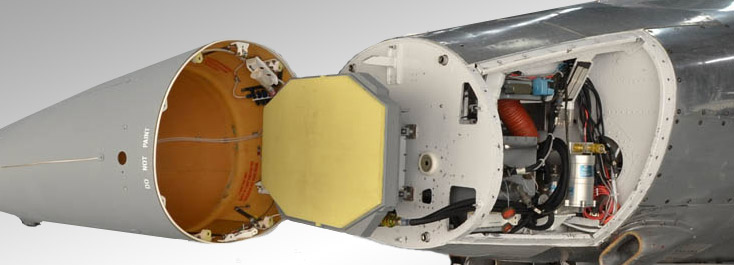
APG-63V2 vs APG-63V3
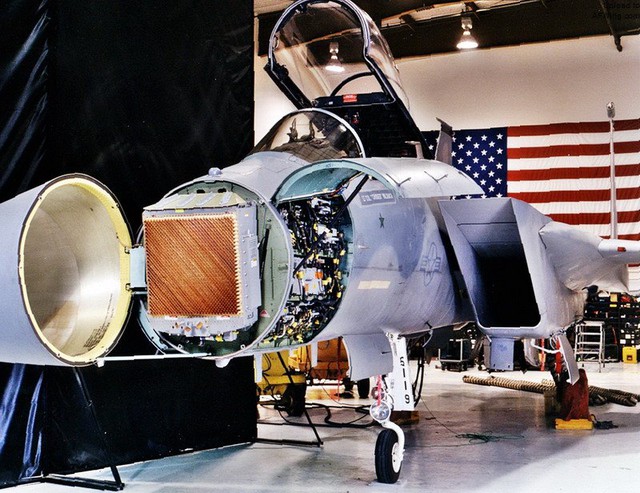

Distinctively through its appearance, AESA GaAs has a number of striking microchips on its surface, while AESA GaN is a flat surface.
both of APG-77/81 are GaAs tech ?


blackadamChina offers export version of YJ-12 supersonic anti-ship missile

The CM-302 missile exhibited at Airshow China 2016 is being marketed for export as “the world’s best anti-ship missile”, according to Chinese news media.
The missile’s manufacturer, state-owned China Aerospace Science and Industry Corporation (CASIC), reportedly justifies the claim on the grounds that the missile is supersonic throughout its flight, can be launched from air, land, and naval platforms, and used in a land attack role.
A report published by the China Daily newspaper also confirmed that the CM-302, which was allegedly one of the exhibits to have attracted the most enquiries at this year’s air show in Zhuhai, is closely related to the YJ-12 supersonic anti-ship missile (ASM), which is in service with China’s armed forces.
The report states that the CM-302 has a range of 280 km, a warhead of 250 kg, and a 90% probability of hitting its target. CASIC claims that the missile is effective against large warships, such as aircraft carriers and destroyers, with a single missile having the capacity to disable a 5,000-tonne warship.
While the news report provides few details about the CM-302’s propulsion and flight profile, it said that the missile sea-skims for most of the flight and manoeuvres during the terminal phase to defeat the defensive weapons of ships.
Previously published reports about the YJ-12 indicate that the ramjet-powered missile achieves a mid-course speed of Mach 1.5-2, accelerating to Mach 3 or higher during the terminal phase of the flight.
The missile is guided by satellite navigation – specifically by China’s BeiDou Navigation Satellite System – to a target location, which can be updated by data link. Terminal homing is driven by an active radar seeker.
Assuming the missile’s physical characteristics are similar to those of the YJ-12, the CM-302 is likely to be a large missile of around 7 m in length, 0.6 m diameter, and with an estimated weight of around 2,000-2,500 kg.
http://www.janes.com/article/65364/china-offers-export-version-of-yj-12-supersonic-anti-ship-missile
blackadamThe U.S. Navy’s Next Hawkeye Plane Can Detect Stealth Fighters
The E-2D is the Navy’s primary means of defending against low-observable cruise missiles, ballistic missiles and enemy aircraft. And, indeed, given the capabilities of its UHF-band radar, the E-2D may be the Navy’s trump card against future Russian and Chinese stealth aircraft.
The E-2D’s Lockheed Martin AN/APY-9 UHF-band radar is the central feature of the Advanced Hawkeye.
Both friend and foe alike have touted UHF radars as an effective countermeasure to stealth technology. One early public example of that is a paper prepared by Arend Westra that appeared in the National Defense University’s Joint Forces Quarterly academic journal in the fourth-quarter issue of 2009.
blackadamRevealed: Russian-Built Kilo Submarine ‘Kills’ American Nuclear Sub
The Indian media is claiming that one of New Delhi’s Russian-built Kilo-class diesel-electric attack submarines managed to “sink” a nuclear-powered U.S. Navy Los Angeles-class attack submarine during exercises in October.
The Indian submarine INS Sindhudhvaj (S56) allegedly “killed” USS City of Corpus Christi (SSN 705) during an exercise called Malabar that is held annually between India, Japan and the United States. According to the Indians, the submarines were assigned to track each other down in the Bay of Bengal. “The way it happens is that the Sindhudhvaj recorded the Hydrophonic Effect (HE) – simply put, underwater noise – of the nuclear powered submarine and managed to positively identify it before locking on to it. Being an exercise what did not happen was the firing,” an Indian naval officer told India Today. The Indian vessel then “sank” USS City of Corpus Christi using 533mm torpedoes.
If the Indian description of the events is correct, it would be a bright spot in an otherwise dismal record for New Delhi’s undersea force. In recent years, the woefully neglected Indian submarine fleet has suffered numerous calamities. Submarines have run aground, caught fire and even sunk due to a combination of underinvestment, negligence and corruption. Perhaps the worst incident was when INS Sindhurakshak sank when at harbor in Mumbai after a series of explosions in the forward torpedo bay, killing eighteen sailors.
Nonetheless, it’s not a huge surprise that a Russian-built Kilo would be able to defeat a Los Angeles-class attack boat. The Los Angeles-class is a dated design that is slowly being replaced by the newer and exponentially quieter Virginia-class submarine. However, it must be noted that we do not know the rules of engagement or parameters that the sides had agreed to. Furthermore, it must be noted there is the possibility of exaggeration.
But the basic facts are that the Kilo is an extremely quiet and very capable submarine owing to its diesel-electric propulsion system. Running on electrical power while submerged, diesel-electric boats have been described as “a hole in the water” and are a vexing problem for the U.S. Navy. Developing ways to counter such vessels is a high-priority for Washington as many potential adversaries like China and Iran operate such submarines.
While diesel-electric boats are generally quieter than nuclear submarines, the U.S. Navy prefers atomic powered vessels because of their range, speed and endurance. The U.S. Navy’s global mission essentially mandates a vessel that can operate independently far from home waters for extended periods. Navies with a more localized mission can afford to operate short-range diesel-electric boats.
While the Indian report may or may not be correct, this incident highlights the need to completely replace the Los Angeles-class with Virginia-class boats as soon as possible. The Virginia-class is orders of magnitude quieter and offers far better sensors and carries more weapons. The newer vessels are far more effective against threats like the Kilo than their Los Angeles-class predecessors. Buying as many Virginias as possible becomes especially important as more and more potential adversaries procure advanced diesel-electric boats like the Kilo or the even more capable Russian-built Amur.
blackadamThe Type 055 is neutralizing armed strength and relatively good RCS reduction. Kirov upgrade has too much firepower (more than 300 new missiles), but its drawback is revealing large RCS. Zumwalt only unique advantages is stealth, combat gear too weak. Stealth is not all, it is not invisible
blackadamtealth dilemma: debates heats up over F-35’s radar-evading tech
Spiralling costs and long delays are constant gripes for many critics of the F-35 Joint Strike Fighter programme. Now, there is an added dimension to the debate as a growing number of industry experts begin to question the F-35’s stealth performance and the programme’s effect on US electronic warfare capabilities.
F35 Stealth
From the outset of its development, Lockheed Martin’s F-35 Joint Strike Fighter was designed to have a low-radar cross section, making it difficult to detect by enemy radar. Just like its stealth predecessors, such as the F-117 Stealth Fighter, it incorporates special radar absorbing materials and internally stowed weapons – helping to reduce its signature.
All this means, in theory, the F-35 can operate in airspace where there is a high threat from anti-access/area-denial (A2/AD) weapons such as surface-to-air missiles. Proponents of stealth technology point to legacy platforms such as the F-117 and B-2 bomber as proof of its success. Only one stealth aircraft has ever been shot down in the 30 years they have been flying.
But potential adversaries, such as China, are significantly upgrading their A2/AD capabilities with the development of newer radar systems which can detect stealth aircraft. Stealth secrets have also been stolen through espionage. In 2010, Noshir Gowadia, one of the creators of the B-2 bomber, was convicted of giving classified information to China and other countries.
So not only will countries such as China have upgraded radar systems, they will also know how to nullify any advantage that stealth aircraft have.
Protecting non-stealth aircraft with jamming technology
That’s not good news for the US military’s older fleet of aircraft. The US Air Force’s current ‘Teen Series’ jets such as the F-15, F-16 and F/A-18 – often designated 4.5-generation aircraft – have very limited stealth characteristics. External fuel tanks and weapons and a lack of radar-absorbing materials means they are highly visible on radar and, thus, vulnerable in A2/AD environments.
If these 4.5-generation aircraft operate in a contested environment where A2/AD weapons are deployed, they will often be supported by aircraft with electronic jamming capabilities. To protect its fleet of F/A-18 aircraft during missions, the US Navy uses Boeing’s EA-18G Growler electronic warfare (EW) aircraft kitted out with advanced radar jamming equipment.
Russian rockets: the US Government’s RD-180 conundrum
With only two years’ worth of rockets left, the US is scrambling to find a non-Russian alternative, but is it too late?
The F-35 is fitted with its own EW capabilities in the form of Northrop Grumman’s AN/APG-81 active electronically scanned array (AESA) radar system. Advocates of the F-35 programme say a separate jamming aircraft is not needed because of this technology. It can emit frequencies which can confuse and disable Russian anti-aircraft systems such as the advanced S-400, which uses radar to lock onto enemy aircraft.
There are, however, some figures in the US Navy and industry which say the F-35’s stealth and EW capabilities are simply not enough.
After a House Armed Services air and land force subcommittee hearing in March, Rear Admiral Michael Manazir, the US Navy’s director of air warfare, told reporters that the Growler emits more jamming frequencies than the F-35, making it a much more capable EW platform.
A more realistic operational scenario, he said, would be for the Growler to support F-35 missions in a complementary role.
It is an admission that the US Navy is not entirely comfortable with the F-35’s capabilities in A2/AD environments. So much so that in March it was revealed the US Navy included another 22 EA-18G Growlers on its unfunded priorities list for the 2015 fiscal year budget, costing $2.14bn. Chief of Naval Operations Admiral Jonathan Greenert said he saw a growing need for the Growler aircraft.
Growler aircraft
A ‘questionable’ capability – cancelling the F-35
For some commentators, the purchase of more Growlers is seen as the US Navy’s “escape hatch” from the unpopular F-35 programme – which has historically received a lukewarm reception from some sections of the service.
And it’s not just in the US Navy where people worry about the F-35’s performance in penetrating advanced air defences. In a May 2014 article for Air & Space Power Journal, a senior USAF officer questioned the F-35’s capabilities and said there were still good reasons to cancel the programme.
“Even if funding were unlimited,” Colonel Michael W. Pietrucha wrote, “reasons still exist for terminating the F-35.”
The former EW instructor added: “Our assumptions about the operational environment, made more than a decade ago, do not match the current reality…The mission of the aircraft – to penetrate the most advanced air defences and drop precision-guided munitions on critical targets of a peer adversary – remains questionable at best.”
An alternative, according to Pietrucha, would be to terminate the air force’s participation in the F-35 programme. Instead, the USAF would maintain a limited amount of F-35As – as a replacement for the retired F-117s – and upgrade older fourth-generation airframes with fifth-generation technology.
Like the US Navy with its Growler aircraft, Pietrucha says the US Air Force should build up its EW aircraft fleet, which has “dwindled” since the retirement of EF-111G and F-4G aircraft twenty years ago. That seems to fall on deaf ears, however, as the air force is planning to reduce its EW capabilities even further with the mothballing of several EC-130 EW aircraft.
Boeing campaigns to restore funding for Growler
Pietrucha’s article couldn’t come at a better time for Lockheed Martin’s rival Boeing. It’s no secret that, behind the scenes, Boeing has been actively lobbying defence officials in order to keep the F/A-18 production line open past 2016. An order for 50 to 100 more Growlers would do just that.
Taranis vs. nEUROn – Europe’s combat drone revolution
A new generation of experimental stealth Unmanned Combat Air Vehicle (UCAV) is under development.
But Boeing has to walk a careful line in its campaign to restore funding for its Growler aircraft, said Amy Butler, senior Pentagon editor at Aviation Week.
“The company has to make the case that without more Growlers, even the stealthiest aircraft in the Pentagon’s fleet are vulnerable to emerging air defences,” she said. “This is a thorny and challenging argument to make as it quickly veers into classified territory.”
“And its Pentagon customer is loath to acknowledge that its multibillion-dollar investment in stealth aircraft could be made vulnerable by comparatively small investment in networked air defences,” she added.
At its current production rate, Boeing’s Super Hornet and Growler production line in St Louis, Missouri, will stop in the third quarter of 2016. According to Boeing, the programme supports 60,000 jobs in the US and accounts for $3bn in annual economic impact.
In May, Boeing celebrated delivering the 100th Growler to the US Navy, a major milestone for the programme. In what may be an allusion to the F-35’s ongoing costs increases and delays, Captain Frank Morley, US Navy F/A-18 and EA-18G programme manager, said the Growler programme was “all on cost and on schedule”.
“We believe there is a compelling case to be made that the navy needs 50 to 100 more aircraft to meet future requirements,” he added.
Investing in more EW aircraft – between a rock and a hard place
Pentagon officials are in an awkward position. If the Pentagon was to invest in more EW aircraft – such as the Growler – it would signal a lack of faith in the F-35’s capability to penetrate enemy airspace. Equally, if it didn’t invest in additional EW capabilities, the lives of F-35 pilots could be at risk with the proliferation of more advanced A2/AD weapons in countries such as China.
The grounding of the entire F-35 fleet at the beginning of July, after an engine fire on an air force F-35A, will only add to concerns. Technical risk is still a significant factor in the F-35 programme and while its ability to fly in contested environments is not likely to affect the delivery schedule, it is a problem which questions the F-35’s fundamental role as a fifth-generation stealth fighter.
blackadamThe U.S. Navy’s AEGIS Missile Defense vs. Russia’s Supersonic Kh-31 Cruise Missile: Who Wins?
Dave Majumdar
December 7, 2016
TweetShareShare
Printer-friendly version
The Russian Navy will be deploying Sukhoi Su-30SM Flanker-H fighters to its Baltic Fleet in 2017.
The powerful multirole fighters will be equipped with the Kh-31 supersonic sea-skimming anti-ship cruise missiles—which would significantly boost Russian maritime anti-access/area denial capabilities in the region. In addition to the jets headed, to the Baltic Fleet, Moscow will be deploying the fighters to its Severomorsk-3 facility, where the aircraft will be able to provide air cover for Russian naval operations in the Barents Sea.
“Several more such planes will be provided for the Baltic Sea Fleet’s air group under the government defense contract in 2017,” according to a Russian defense ministry release provided to the Moscow-based TASS news agency. The first Su-30SM is expected to arrive in Chernyakhovsk in the Kaliningrad Oblast on Dec. 8.
The Russian Navy’s Su-30SM are being equipped with an anti-ship variant of the Mach 3.5-capable Kh-31 that has a range of roughly 120 miles. The Kremlin-owned Izvestia news outlet brags the even a single such weapon would be able to destroy a U.S. Navy ship. “Even one missile is guaranteed to send a Ticonderoga-class missile cruiser—currently in service with the U.S. Navy—to the to the bottom,” Izvestia columnist Alex Ramm writes.
While the Kh-31 (X-31 in Cyrillic) is a fearsome weapon, Aegis cruisers and destroyers are equipped with a formidable array of defenses to protect both themselves and the vessels they are escorting. It is not clear how the SPY-1 radar and the Aegis combat system in combination with Raytheon Standard SM-2 and SM-6 missiles would perform against the Kh-31—assuming the Su-30SM got close enough to launch a such a weapon at a U.S. Navy warship. An Aegis-equipped warship is also armed with Raytheon RIM-162 Evolved SeaSparrow missiles, RIM-116 Rolling Airframe Missiles (RAM) and Phalanx point defense systems.
ADVERTISING
inRead invented by Teads
That being said, U.S. Navy officials have expressed concerns about the capabilities of the latest Russian and Chinese supersonic anti-ship missiles—particularly the fearsome P-800 Oniks. The Mach 2.8 capable Oniks—and its Russian-Indian cousin the Brahmos—fly a particular profile that makes it difficult to intercept. However, the Navy has not been eager to share any details about exactly why that is the case for obvious reasons.
In any case, the addition of the Su-30SM and the Kh-31 to the Baltic Sea region means that that region—which was already very dangerous for allied naval forces—will become an even more challenging problem. Hopefully, cooler heads will prevail and we won’t have to find out how effective or ineffective these weapons might be.
http://nationalinterest.org/blog/the-buzz/the-us-navys-aegis-missile-defense-vs-russias-supersonic-kh-18662
blackadam3M22 Zircon Hypersonic Missile in Development Testing for Russian Navy Kirov-class Cruiser
Russian cutting-edge hypersonic missile 3M22 of the 3K22 Zircon system is in the development trials. The Project 11442 (NATO reporting name: Kirov-class) Pyotr Veliky nuclear-powered missile cruiser will carry the type following its upgrade, a shipbuilding industry source told TASS on Friday.
Russian cutting-edge hypersonic missile 3M22 of the 3K22 Zircon system is in the development trials. The Project 11442 (NATO reporting name: Kirov-class) Pyotr Veliky nuclear-powered missile cruiser will carry the type following its upgrade, a shipbuilding industry source told TASS on Friday.
According to rumors, the Indo-Russian BrahMos II hypersonic cruise missile (pictured here at Defexpo 2014) is the export variant of the Russian 3M22 Zircon missile.
“The Pyotr Veliky cruiser will start its repairs in the third or fourth quarter of 2019. Its repairs and upgrade are planned to be complete in late 2022, with the ship to be equipped with Zircon hypersonic antiship missiles. Now, the missile is in the development testing and will enter service, if it passes the tests,” the source said.
The tests of the 3K22 Zircon system are planned for completion by 2020. The system is expected to be unveiled in the air-launched and ship-based variants. Its characteristics are classified.
Navy Recognition understands that early rumors indicate the Indo-Russian BrahMos II hypersonic cruise missile may be an export variant of the Zircon (just as the BarhMos missile share many similarities with the Russian P-800 Oniks missile).
The planned operational range of the BrahMos-II is about 300 kilometers and its speed is set to be around Mach 7 thanks to a ramjet engine.
Russian cutting-edge hypersonic missile 3M22 of the 3K22 Zircon system is in the development trials. The Project 11442 (NATO reporting name: Kirov-class) Pyotr Veliky nuclear-powered missile cruiser will carry the type following its upgrade, a shipbuilding industry source told TASS on Friday.
Pyotr Veliky (Peter the Great) heavy nuclear-powered missile cruiser (TARKR), the fourth Kirov class cruiser of the Russian Navy.
Pyotr Veliky is the fourth Kirov class cruiser (and the only one operational today), a class of nuclear-powered warship of the Russian Navy. It is the largest and heaviest surface combatant warships after aircraft carriers currently in active operation in the world.
As was reported in the press, the Sevmash Shipyard and the Special Machinebuilding Design Bureau (KBSM, a subsidiary of Almaz-Antei) made a deal for 10 3S-14-11442M vertical launch systems (VLS) to equip the Project 11442M Admiral Nakhimov missile cruiser being upgraded now. The contract is valued at 2.559 billion rubles ($33.5 million). Thus, the ship’s 20 inclined below-deck launchers of P-700 Granit antiship missiles (SS-N-19 Shipwreck) will be replaced with 10 VLS modules of the UKSK versatile ship-based launch system. The VLS modules will total 80. The same solution is expected to be applied to the Pyotr Veliky cruiser.
The 3S-14 VLS can launch the missiles of the Kalibr family (SS-N-27 Sizzler). In addition, the equipment for testing the VLS using mockups of the 3M-54, 3M55 and 3M22 antiship missiles is to be ready be December 2016.
The Project 11442 Pyotr Veliky nuclear-powered guided missile cruiser is designed to sink hostile ships, destroy land targets and provide air defense for its formation. The cruiser carries the 130-mm AK-130 gun, land-attack, antiship and surface-to-air missile (SAM) systems, Kortik SAM/gun close-in weapons systems and the Vodopad antisubmarine missile/torpedo system. The ship was launched in 1989 and commissioned with the Russian Navy in 1998. It displaces 24,500 tons and measures 251 m long. It has a full power of 140,000 hp, a speed of 31 knots and a crew of 728. The cruiser carries a Kamov Ka-27 (Helix) helicopter or a derivative thereof.
blackadamSPECTRA system can help Rafale stealthy
SPECTRA ( Système de Protection et d’Évitement des Conduites de Tir du Rafale (literally: System of Protection and Avoidance of enemy Fire-Control for Rafale) or “Self-Protection Equipment Countering Threats to Rafale Aircraft”) was jointly developed by Thales Group and MBDA for the Dassault Rafale fighter aircraft, now in service with the French Air Force and Navy.
Thales Group and Dassault Aviation have mentioned stealthy jamming modes for the SPECTRA system, to reduce the aircraft’s apparent radar signature.

https://en.wikipedia.org/wiki/Thales_Spectra
If the Fighter is equipped with 360 deg sensors (as Rafale) , a powerfull bragg cell suite (as Rafale) and some active AESA antennas (as Rafale) , it can make a LPI radar think that it only scan an empty sky or an empty background…It’s mean: “Active Stealth”. With the SPECTRA, The Rafale completely stealthy around 360 degrees
blackadamRadar Jamming: “Defensive Electronic Countermeasures” May 1962 US Navy Training Film – documents proving the ECM / Jammer likely make non-stealth aircraft can be stealth
– Pulse jamming produces noise pulses with period depending on radar mast rotation speed thus creating blocked sectors from directions other than the jammer making it harder to discover the jammer location.
– Cover pulse jamming creates a short noise pulse when radar signal is received thus concealing any aircraft flying behind the EW craft with a block of noise.
blackadamRange Deception
 The most common type of deception jammer is the range deception (range-gate stealer), whose function is to pull the radar tracking gate from the target position through the introduction of a false target into the radar’s range-tracking circuits. At start, the jammer sends back an amplified version of the signal received from the radar. The deception jammer signal, being stronger than the radar’s return signal, captures the range-tracking circuits.The deception signal is then progressively delayed in the jammer by using an RF memory, thereby “walking” the range gate off the actual target (range-gate pull-off or RGPO). When the range gate is sufficiently removed from the actual target, the deception jammer is turned off, forcing the tracking radar into a target reacquisition mode.
p/s: jammer can sometimes perform Range gate pull in , which is the similar technique as Range gate pull off , the main different is the target will appear to get closer to radar instead of getting further aways
Counter-countermeasures:
PRF jitters : a radar calculate range to a target by measuring the elapsed time between pulse transmittal and target return reception.Thus, the maximum required range of the radar determines the maximum pulse repetition frequency of the radar .In Jitter mode, the time between successive pulses is allowed to vary in a totally random manner over a series of set intervals as long as the maximum range condition is met.In theory, an infinite number of PRI patterns can be generated by combining stagger and jitter. Varying pulses render the jammer incapable of anticipating when the next illuminating pulse is due to arrive.
Frequency-hopping : as the jammer need time to analyze signals and turn into it.
Leading-edge tracking : taking measurements not according to where the center of the return signal is but rather at the leading edge.All RGPO/RGPI cover pulse jamming tends to lag the target’s returns by some increment of time
ew104_fig2
Monitoring signal strength.
Double Tracking : in airborne radar, the fast Fourier transform ( FFT ) is used to process the signal on both the range and velocity axes. In this way the target produces an echo that, being characterized in both range and velocity(Doppler) allows double tracking.If the jammer attempt to open a one gate not coherent with the other, it is ignored
kl
Velocity Deception
d
In velocity deception jamming, the Doppler shift is interfered with. At the start of jammer operation, the illuminator signal is detected by the jammer and an exact false, strong Doppler-shifted signal is sent back to the radar. The radar locks on to the incorrect Doppler signal and the jammer slowly sweeps the false signal’s frequency more away from the actual Doppler frequency of the target. When the radar has been led far enough away in frequency, the jammer is turned off and the radar is once more left without a target.The basic principal of velocity deception is similar to range deception ,thus it is sometimes called Velocity Gate Pull-Off ( VGPO )
Counter-countermeasures:
PRF jitters
Frequency hoping
Leading-edge tracking
Double tracking
Guard gate: a counter techniques that entail presenting sensors around the gate in which tracking is performed so that as soon as the presence of additional echo is detected ,the tracking system switches to memory for a short time and then reacquires the old target .Accordingly , when a deception jammer tries to lure the tracking gate to a false target , as soon as the true echo and the deceptive echo separate , the true echo will enter the guard gate, thus blocking the tracking gate. When the sensors indicate that the deceptive echo has gone, the gates will again position themselves correctly .
fd
Cover Pulses
d
This is a hybrid type of jamming which incorporates some of the features of both spot or
barrage noise and deception jammers. . This type of jammer generates a noise burst which is ‘on’ before and after the actual target return thereby covering the true return. This type of jammer allows a low powered repeater to respond to a number of threat radars by time
sharing.
Counter-countermeasures:
High gain , high power radar to burn through jamming signal
HoJ missiles
Inverse Gain (Inverse Con-scan ) Jamming
liu7
Inverse gain jamming is used to capture the angle-tracking circuits of a conical scan tracking radar. This technique repeats a replica of the received signal with an induced amplitude modulation which is the inverse of the victim radar’s combined transmitting and receiving antenna scan patterns. Against a conically scanning tracking radar, an inverse gain repeater jammer has the effect of causing positive feedback, which pushes the tracking radar antenna away from the target rather than toward the target. Inverse-gain jamming and RGPO are combined in many cases to counter conical scan tracking radars.
Counter-countermeasures:
Monopulse radar
Random conical scan frequency : changing the scanning speed in a pseudorandom way within a given domain
Lobe on receive only (LORO )
Conical Scan on Receive Only ( COSRO)
Frequency hoping
PRF jitters
Cross Eye Jamming
d
kkk
Cross-eye jamming is an angle deception ECM technique that employs two spatially separated jamming sources. Each source acts as a repeater-type jammer transmitting the same signal at the same time, and if the two signals arrive at the missile monopulse antenna approximately 180° out of phase, wavefront distortion occurs. The missile seeker, presuming that the signal source lies along the normal to the wavefront, tries to re-aligns its antenna at right angles to the distorted wavefront. This antenna re-alignment results in incorrect missile tracking which in turn results in incorrect steering information being passed to the missile autopilot. This may potentially result in a substantial missile miss distance.In a cross-eye jamming system, a 180° phase relationship between the two jamming sources may be maintained by setting up a retro-reflective transmission system. In this type of system, each of the jamming antennas is acting as the signal source for a repeater- type jammer. However, the signal received by one antenna is transmitted by the other, and vice versa. In this way, the total propagation delay from seeker to receive antenna to transmit antenna and back to seeker is identical for both signal paths and, everything else being equal, the phase of the two signals arriving at the seeker will be identical. A 180° phase shifter is then added to one of the paths to create the wavefront distortion effect.Successful operation of cross-eye jamming creates an interferometric null between the jamming signals in the direction of the victims radar. The jamming signal must compete with the real target return to capture the radar angle tracker. To achieve that the angle noise caused by the real radar target must perturb the radar’s antenna off the jamming signal null by an amount sufficient for a positive jamming to signal ratio to be generated .As a result, the jamming to signal requirement of at least 20dBsm is required for successful cross-eye jamming operation.
Counter-countermeasures:
PRF jitters
Frequency hoping
High gain , high power radar to burn through jamming signal
Increase radar duty cycles
Cross-Polarized Jamming

The polarization of an electromagnetic wave is defined as the orientation of the electric field vector. As we know electric field vector is perpendicular to both the direction of travel and the magnetic field vector. The polarization is described by the geometric figure traced by the electric field vector upon a stationary plane perpendicular to the direction of propagation, as the wave travels through that plane.Reflectors type antenna response to cross-polarized signals very different from normal polarization signals , and cross-polarized jamming exploited that fact. The jammer use 2 transmitting antennas which are 90 degrees out of polarization ( for example : one can be vertical and the others horizontal ) , this cause the victims radar to react erroneously with very significant tracking error.
Counter-countermeasures:
Polarization filter
Cross-Polarized jamming cannot affect flat plate antenna (such as AESA , PESA radars) since there is no forward geometry
Cross-Polarized jamming requires very large J/S to overcome weakness of condon lobes ,thus, high gain , high power radars are possible counter to this kind of jammer.
Skirt Jamming
yyy
In skirt jamming, the jammer exploits the phase response of filters in the radar receiver by injecting a strong jamming signal into a region just above or below the filter frequency. This can cause non-linearity in the phase response across the wanted band , which can affect the radar’s tracking circuitry.
Counter-countermeasures:
Skirt frequency jamming effectiveness, depends on the unbalance between the sum and difference channels, at these frequencies where rapid phase shifts are present in each channel .Thus , it can be counter by careful design and construction of radar.
Active Cancellation
inter
Active cancellation is a theoretical military jamming technique that involves the sampling of an incoming radar signal, analyzing it, then returning the signal slightly out of phase, thus “cancelling” it out due to destructive interference. While there are no official information about jamming systems using this technique in service, it is rumored to be in use on Rafale with SPECTRA suite.
Counter-countermeasures:
Frequency hoping ( active cancellation require exact information about pulses to produce cancellation pulses , thus frequency agile radar are likely unaffected )
PRF jitters ( cancellation pulses need to be transmitted at exact moment to produce desirable interference effect , random PRF render the jammer unable to predict when the next pulse coming )
Multiple radars
Jamming Tactics:
Blinking Jamming
Blinking jamming is an effective jamming tactics against monopulse radar seeker and home on jam missiles. It causes line-of-sight angle to step continuously between the two angular positions through 2 jamming assets emitting by turns.The 2 assets can send returns to hostile radar at the rate close to servo bandwidth( typically a few Hz), this can cause resonate at radar target and result in large overshoot, if apply again HoJ missiles , it would cause missiles to yaw wildly and miss both targets.
Stand-off Jamming
Box-Spring.RU.green_side-3D-Models-Openflight-VBS2-Simthetiq
Support jamming signal is radiated from one platform and is used to protect other platforms,for stand-off jamming (SOJ) the support jamming platform is maintaining an orbit at a long range from the radar – usually beyond weapons range.The advantage of this method is that jamming platform can be safe from HoJ missiles, the disadvantages is that it much harder to maintain sufficient J/S ratio.
Stand in Jamming
aesa-radar
Support jamming signal is radiated from one platform and is used to protect other platforms.For stand in jamming (SIJ) a remotely piloted vehicle is orbiting very close to the victim radar while transmitting jamming signal .Since the jammer is closer to hostile radar , the power required to screen the same target of SIJ is much lower compared to SOJ.
Terrain Bounce Jamming:
fgs
Terrain bounce jamming is a unique jamming tactic created to deal with HoJ missiles . Normally the electromagnetic beam from jammer is transmitted toward the victim radar in a direct path thus,home-on-jam missiles will be able to track the angle(direction) of the jammer signal and fly at that direction.Terrance bounce tactic exploits the fact that ground/sea surface can reflect radio waves.Jammer operator will direct jamming beam toward these surface instead of directly at the hostile radar so the jamming beam will come from a difference direction from the actual jammer. As a result, this tactic can be used to trick HoJ into believe that the jammer located somewhere on ground.Terrance bounce tactics work best when aircraft fly at low altitude , near flat surface such as the sea. Main disadvantage of this tactics is that effective radiated power of jammer is reduced
Jamming-to-Signal Ratio:
When Jamming is factored into the radar equation,the quantities of greatest interest are Jamming to signal ratio (J/S) and Burn-Through Range.”J-to-S” is the ratio of the signal strength of the jamming signal (J) to the signal strength of the target return signal (S). It is expressed as “J/S” and often measured in dB.
aesa-radar
Jamming-signal ratio
Apart from their unique requirements of each specific jamming technique, for jamming to be effective J must exceed S by some amount , therefore , the desired result of a J/S calculation in dB is a positive number .It is a common misconception that J/S ratio required to jam any radar is a fixed value.In reality, however the required J/S varied significantly depending on jamming techniques and radar type.
aesa-radar
Burn-through range is the radar to target distance where the target return signal can first be detected through the ECM and is usually slightly farther than crossover range where J=S. It is usually the range where the J/S just equals the minimum J/S requirement.
Since jamming signal only has to travel one way, as the range get further , the jammer has more advantage than the radar because jamming power decrease at slower rate
burn-through-effect
phased_array_illus
As shown in J/S equation earlier, factors affecting burn-through range are :
ERPs = Effective radiated power of radar
ERPj =Effective radiated power of jammer
G = Antenna gain
RCS = Target radar cross section


 Sign In







