Bayar
BayarEJ-200: Maximum thrust: 60kN (13,500lbf) dry thrust; 90kN (20,250lbf) with reheat
Snecma M88: Maximum thrust: 50 kN (11,250 lbf) dry, 75 kN (16,860 lbf) wet (afterburning)
Whereas Rolls-Royce/Kale Aerospace are working on a European equivalent to the YF119-PW-100L with thrust vectoring nozzle (basically Pratt & Whitney F119 with TVN).
Europe just needs to put politics aside and pool all their resources into one engine project or they will all lag behind the US.
BayarA breakthrough in propulsion technologies is adamant for any meaningful industrial advances against concurrent non-US design. Aside from an increased efficiency, the future aero engine will have to benefit from advanced flow stream management, generate a high level of electrical power, use gas flows to increase propulsion, reduce aircraft drag or add to the level of LO. In other words, the needs are here to field a new design that can only fit the requirement. An UCAV engine is not as demanding.
I think Turkey was smart in investing billions into propulsion technology. It was even smarter to enter into a partnership with Rolls-Royce. Brexit seems to have favored Turkey alot 🙂
BayarAFAIK, Rolls-Royce has a lot of input into the EUROJET EJ200 engine for the Eurofighter Typhoon. In fact, alot of the IP is still owned by Rolls-Royce.
Does Germany-France want to use an improved version of the Snecma M88 or the Eurojet EJ-200!
BayarLooks like Washington isn’t happy. It seems as though the US-Turkey alliance is dead.
Turkey reveals secret US military locations in Syria
By Ellen Mitchell – 07/19/17 06:50 PM EDT
http://thehill.com/policy/defense/342830-turkey-reveals-secret-us-military-locations-in-syriaTurkey’s state-run news agency on Wednesday leaked the positions of 10 U.S. military posts in northern Syria, drawing swift criticism from the Pentagon.
Anadolu Agency published a map of 10 locations it said were U.S. military posts. The agency said the points are “usually hidden for security reasons,” but then listed the bases, including two airfields and eight military outposts.
The report also lists the specific districts where the U.S. military is stationed. In one case, Anadolu revealed the number of U.S. soldiers and French special forces stationed at a post in Ayn Issah.
The locations are all in an area controlled by Syrian Kurdish forces known as the Kurdish Democratic Party (PYD) and the People’s Protection Units (YPG). The U.S. supports the groups as they help combat the Islamic State in Iraq and Syria (ISIS), but Turkey considers YPG as terrorists.
Pentagon spokesman Maj. Adrian Rankine-Galloway told The Hill that the Defense Department doesn’t disclose the locations where U.S.-led coalition forces are in Syria are “for operational security reasons.”
ADVERTISEMENT
“The release of sensitive military information exposes Coalition forces to unnecessary risk and has the potential to disrupt ongoing operations to defeat ISIS,” Rankine-Galloway said.He added that Pentagon officials have expressed their concerns to the Turkish government.
“While we cannot independently verify the sources that contributed to this story, we would be very concerned if officials from a NATO ally would purposefully endanger our forces by releasing sensitive information,” Rankine-Galloway said.
The United States and Turkey have had a rocky relationship in recent months.
Turkish President Recep Tayyip Erdoğan in May strongly criticized President Trump’s decision to arm Syrian Kurds in the fight against ISIS.
“We want to believe that our allies would prefer [to] be side by side with ourselves rather than with the terror groups,” Erdoğan said.
And after the May attacks on protesters outside the Turkish ambassador’s residence in Washington, several lawmakers earlier this month proposed withholding military equipment and visas from the NATO ally in an attempt to force its government to comply with U.S. law.
BayarTurkey releases details of secret US bases in Northern Syria to the public together with their satellite imagery and HUMINT data on number of soldiers stationed there and equipment inventory list.
EXPOSED
Turkey Leaks Secret Locations of U.S. Troops in Syria
Ankara has long been angered by the alliance between Washington and Kurdish factions. But a new report exposing secret American bases is a dangerous way to strike back.http://www.thedailybeast.com/turkey-leaks-secret-locations-of-us-troops-in-syria
ROY GUTMAN
07.19.17 1:00 AM ETISTANBUL—In the latest display of Turkish anger at U.S. policy in Syria, the state news agency has divulged the locations of 10 U.S. military bases and outposts in northern Syria where the U.S. is leading an operation to destroy the so-called Islamic State in its self-styled capital of Raqqa.
The list published by the Anadolu news agency points to a U.S. presence from one end to the other of the Kurdish self-administration region—a distance of more than 200 miles. The Anadolu news agency even listed the number of U.S. troops in several locations and in two instances stipulated the presence of French special forces.
Turkey has openly criticized the Trump administration—and the Obama administration before it—for relying in the battle against ISIS on a militia led by Kurds affiliated with the Kurdistan Workers Party or PKK. A separatist movement now at war with Turkey, the PKK has been listed by the U.S., EU, and Turkey as a terror organization.
To avoid the appearance of allying with such a group, the U.S. military set up the Syrian Democratic Forces, which have a large component of Arab recruits. But they are led by officers from the People’s Protection Units (YPG), the Syrian affiliate of the PKK.Although Turkey’s powerful president, Recep Tayyip Erdoğan, regularly vents his anger at the U.S., it is still highly unusual for a NATO ally to reveal details of a U.S. military deployment during active operations in a war zone. But the U.S. operation in Syria is in many respects an unusual case. Not only is the United States acting against the express wishes of NATO ally Turkey, which says its national security is directly endangered, it’s also operating without the permission of the Assad regime.
After a meeting Monday evening, Turkey’s National Security Council charged that weapons provided to the Syrian Kurdish YPG militia had come into the possession of the PKK. “This shows that both are the same organization,” it said, adding that other countries were using a “double standard” for terror groups, an apparent reference to the U.S. alliance with the YPG militia.The U.S. has denied repeatedly that arms it is supplying to the Kurdish fighters have seeped into the PKK war against the Turkish state, and the Turkish government did not back up its allegations with evidence.
Two U.S. bases in Syria—in Rmeilan, in northern Hasaka province, and Kharab Ishq, near Kobani in Aleppo province—already were well-known before Anadolu published them. Anadolu said Rmeilan, in Syria’s oil-producing district, was set up in November 2016, and is big enough to handle transport aircraft, while the base south of Kobani, set up in March 2016, is used only by military helicopters.
The eight outposts, often hidden behind signs warning of a “prohibited area,” are being used both for active military operations, such as shelling into the city of Raqqa, and for desk jobs such as training and operational planning, the report said.
It claimed bases used for military operations house artillery batteries with high maneuverability, multi-barrel rocket launchers, various mobile equipment for intelligence, and armored vehicles for general patrols and security.
In Hasaka province, the U.S. has three outposts, all used to train Kurdish militia members, according to Turkish security officials. Anadolu even gave the number of U.S. Special Forces troops it believed were stationed at two of the three outposts.
There are three U.S. military outposts in Syria’s Raqqa province, Anadolu said. French special forces troops are stationed at two of them. It said one of the locations serves as a communication center for the International Coalition fighting ISIS and is also used to disrupt ISIS communications.
In Manbij, which the Kurdish YPG militia captured last August, the U.S. now has two outposts. The U.S. sends out patrols, the agency noted acerbically, to protect the Kurdish People’s Protection Unit (YPG) forces from Syrian rebels operating out of the Turkish controlled part of Syria known as the Jarablus pocket.
Turkish security officials confirmed the accuracy of the Anadolu list to The Daily Beast.
The publication is certain to spark ire in the U.S. military, which is leading the operation against ISIS.
Spokesmen for Operation Inherent Resolve, the U.S.-led coalition fighting ISIS, and for the U.S. Central Command in Tampa, Florida, asked The Daily Beast not to publish the detailed information reported by Anadolu.
“The discussion of specific troop numbers and locations would provide sensitive tactical information to the enemy which could endanger Coalition and partner forces,” wrote Col. Joe Scrocca, coalition director of public affairs.
“Publishing this type of information would be professionally irresponsible and we respectively [sic] request that you refrain from disseminating any information that would put Coalition lives in jeopardy.”
Col. John Thomas, spokesman at the Central Command, also asked The Daily Beast to refrain from publishing details of coalition operations, on the grounds it would be “potentially harmful to the lives of those involved.”
In fact, Anadolu had already published the information Monday on its Turkish language service and then issued it on its English language services Tuesday. In addition, some of the locations on the Anadolu list were already known in public. The Iranian Tasnim news agency, for example, last November published the names of two bases and two outposts, and the Jusour Center, a Syrian think tank, published the locations of two additional outposts in April.
—with additional reporting by special correspondent Duygu Guvenc from Ankara.
One of the Anadolu Agency reports is below:
US increases military posts supporting PKK/PYD in Syria
http://aa.com.tr/en/americas/us-increases-military-posts-supporting-pkk-pyd-in-syria/863895US increased number of military posts in PKK/PYD-held territories in Syria to ten
By Levent Tok, Mohamad Misto and Selen TemizerAl-HASAKAH/ISTANBUL
The U.S. has increased the number of military posts in the terrorist PKK/PYD-held Syrian territories to ten.
According to Anadolu Agency reporters, a U.S. military point has recently been established in PKK/PYD-held areas in northern Syria.
Washington had set up two airbases in PKK/PYD-held Rmeilan district in the northeast of Al-Hasakah province in October 2015 and Harab Isk village in southern Kobani in March 2016.
While the Rmeilan airbase is large enough for cargo planes to land, Harab Isk base is only used by military helicopters.
While a part of the U.S. military aid to PKK/PYD goes through Iraqi border by land, the other part is shipped to the region through the Rmeilan airbase.
These “field-type” military points are usually hidden for security reasons, making it hard to be detected, according to Anadolu Agency reporters.
Apart from the military points, the U.S. also uses some other places which are hard to be detected like residential areas, PKK/PYD camps, easily transformed factories as operational points.
The U.S. forces keep the construction of operational points hidden by declaring some areas as “prohibited area” in northern Syria, the reporters say.
There are contact officers for airstrikes and artillery shelling, military consultants, training officers, operational planning officers and military units to engage in active conflicts in eight military points.
The equipment in the military points includes artillery batteries with high maneuverability, multi-barrel rocket launchers, various mobile equipment for intelligence and armored vehicles such as “Stryker” for general patrols and security.
Military points in Al-Hasakah
There are also three military points in Al-Hasakah, the latest of which was established in the northern district Tal Baydar.
According to the reporters, 100 U.S. Special Forces soldiers have been deployed to Tal Baydar within the scope of the fight against the Daesh terrorist group.
There are also foreign soldiers from the U.S.-led coalition stationed in the old farm district of Tal Tamir, which is located south of Resulayn near the Syrian-Turkish border.
There are also 150 U.S. Special Forces units in Ash Shaddadi district, south of Al-Hasakah, with a view to backing PKK/PYD during anti-Daesh operations.
Military points in Manbij
The U.S. has established two operational posts in Manbij in 2016 when PKK/PYD captured the district.
One of these posts is located in Ayn Dadad town in the district, which can be used by U.S. Special Forces for patrols against the Free Syrian Army (FSA) units rescued during the Turkish Euphrates Shield Operation.
The other military unit is located in Usariye town, west of Ayn Dadad with the purpose of protecting PKK/PYD units against FSA.
Military points in Raqqah
There are also three military posts in the northern province of Raqqah.
Along with U.S. special forces units, French special forces are stationed in a military post located in Mistanur hill, south of Kobani.
Around 200 U.S. soldiers and 75 French special forces units are also stationed in the PKK/PYD base in Ayn Issah town in northern Raqqah.
A military post in the town of Sirrin in Kobani is also used for airbornes. PKK/PYD is supplied with military equipment and ammunition through this post.
This post also serves as a communication center of the anti-Daesh coalition and used for disrupting Daesh communications.
PYD, the Syria offshoot of the terrorist organization PKK, is in control of Al-Hasakah in the east, northern Raqqah, Manbij, to the east of Aleppo, Afrin and Tal Rifaat districts.
Recognized by the U.S. as an ally in the fight against Daesh, PKK/PYD militants run under the name of the Syria Democratic Forces (SDF) in the war-torn country.
Despite the fact that the militants were given SDF uniforms, some of them wear uniforms with banners of Abdullah Ocalan, jailed head of PKK terrorist organization in Turkey.
BayarInteresting…
BAE exec: We’ll have a hand in a next-gen fighter ‘one way or another’
By: Andrew Chuter, July 14, 2017 (Photo Credit: James Way/Staff)
FAIRFORD, England — BAE Systems wants a stake in any new European fighter program, says the executive running the British company’s combat air activities.
“I can’t say what it will be, and I can’t say when. … One way or another, the U.K. and BAE will have an involvement,” said Chris Boardman, managing director of BAE’s military air and information activities, told reporters at a briefing at the Royal International Air Tattoo, known as RIAT, being held here.
Industry executives at the show said it wasn’t just the British who are watching possible developments of the program. Sweden has shown an interest, as well, said one executive.
The RIAT briefing was called to announce the Typhoon jet built by BAE and others had reached another milestone in its development as a multirole aircraft with the first test firing of the Brimstone 2 ground attack missile, but the briefing was largely hijacked by questions about the British reaction to the Franco-German proposal July 13 to jointly develop a new fighter jet.
France and Germany agreed to study jointly developing a new fast jet to succeed Dassault Aviation’s Rafale in French Air Force service and the Panavia Tornado jets being used by the Germans following a joint Cabinet meeting held in Paris.
Other joint defense programs were also proposed, including an air-to-ground missile and an updated version of the Tiger attack helicopter.
The two countries want to put together a roadmap to develop a new fighter as early as the middle of next year, a timeline executives at the tattoo said was highly ambitious given the pace of agreeing European joint programs in the past.
BAE already jointly produces the Typhoon with Airbus and Leonardo of Italy and has a significant stake in the Lockheed Martin-led F-35 program that would likely be a rival to any new jet.
Boardman said that regardless of how plans for the European jet matured, BAE was already involved in a new next-generation fighter in a recently agreed deal with Turkey to help develop the TF-X jet with Turkish Aerospace Industries“We have engineers deploying to Turkey as we speak to start work,” he said.
He said BAE also had a memorandum of understanding with Japan on possible development of a new fighter.
Some executives at the show were wondering whether the Franco-German move was part of the fallout from Britain’s plans to exit the European Union. One executive said it could raise questions about the future of joint industry programs in the Lancaster House bilateral defense treaty between London and Paris.
The 2010 treaty led to BAE forming a joint project with Dassault and other leading British and French companies to develop a future unmanned combat air vehicle operational technology demonstrator in a program valued at nearly $2 billion.
Boardman dismissed suggestions the program could be compromised by the new fighter proposal. He said he had seen no letup in the pace of discussion over the next phase of the program.
A decision is expected by the end of the year to OK production of the demonstrator, said Boardman.
http://www.defensenews.com/articles/mattis-very-comfortable-with-house-senate-defense-bills
BayarLOL. At higher-resolution photo i can see T-90’s on the bottom deck.))
Cheap models 🙂
BayarI would say that Turkey has a pretty slim chance of seeing the JSF come to life with their current attitude !
The US Chief of Air Force was in Turkey this week literally begging Turkey not to pull out of JSF consortium. Unfortunately Turkish industry is so heavily involved in production of the F-35 that Turkey abandoning the program would mean a 20% price hike for other F-35 partners and more delays. Turkey just recently began exporting to the US centre fuselages for the F-35.
Had Turkey not been a Level 3 partner in the program but a mere purchaser things would be different
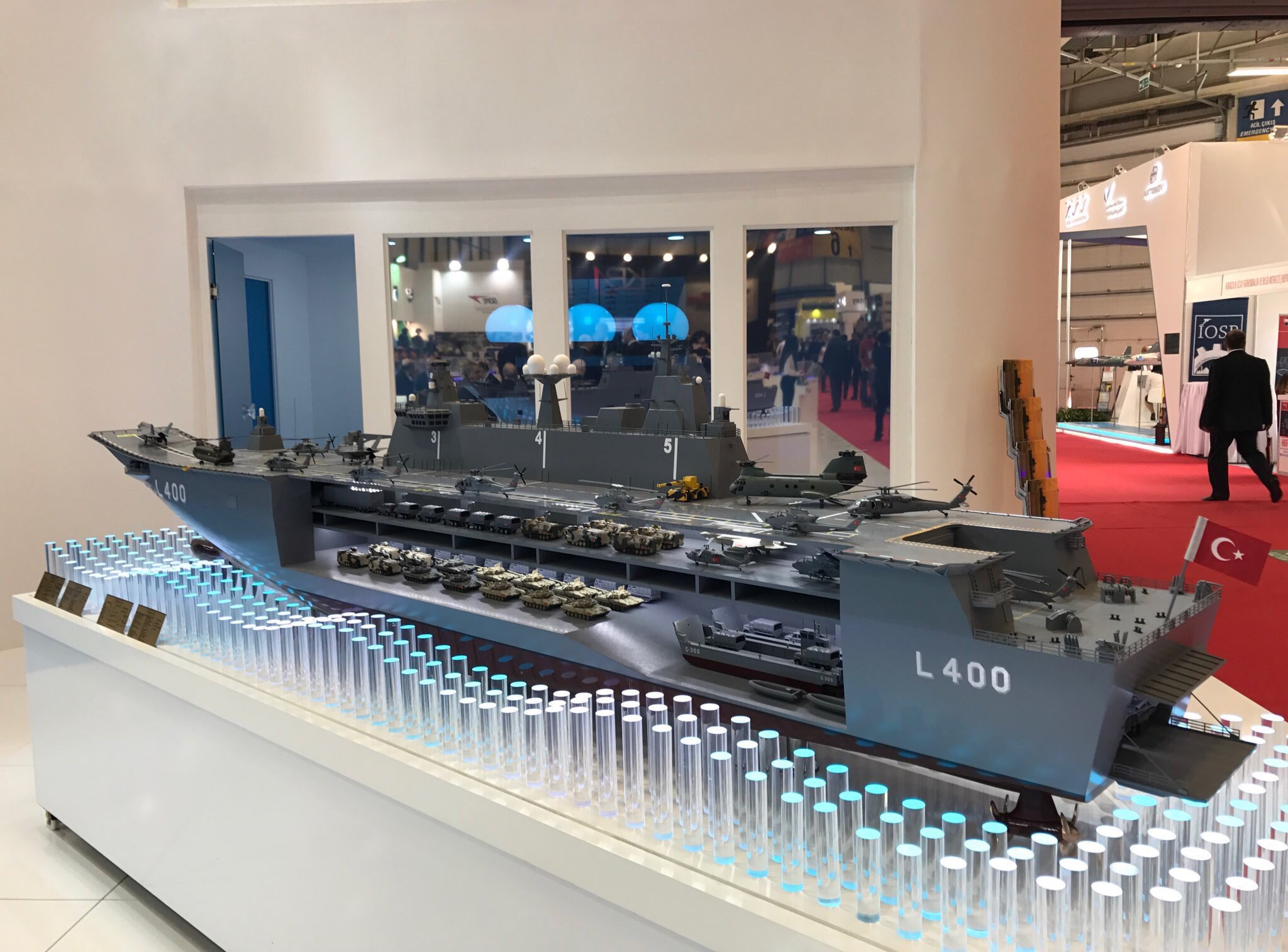
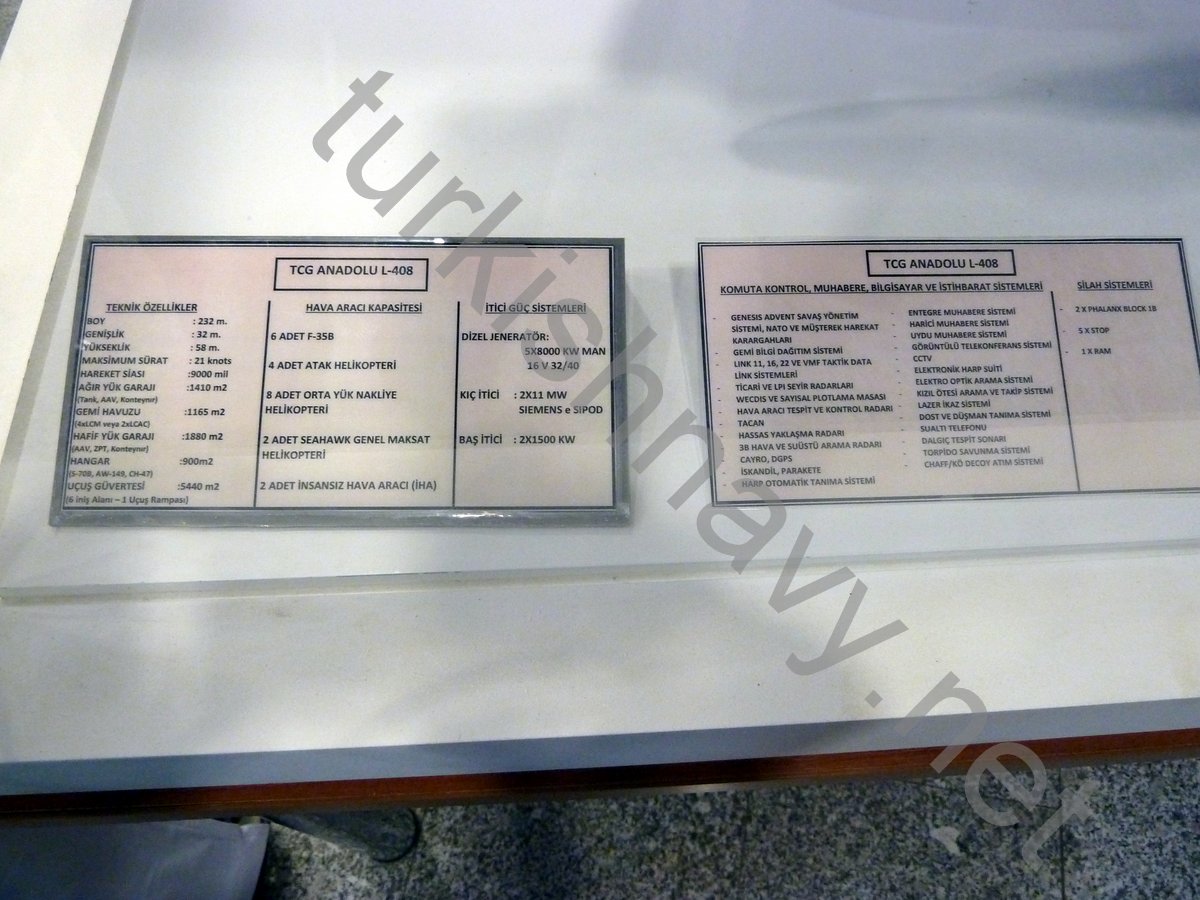
BayarTurkey’s first light aircraft carrier/ LHD will be laid onto the slipway this November. Turkish Under-secretary for Defence Industries confirms that steel cutting and fabrication is nearing completion. Turkey intends to commission 2 of these type of vessels which can carry 6 x F-35B in standard LHD mode and 16 x F-35 B in light carrier mode.


BayarGAF + FAF: 307 ~ 368 EF-2000 and Rafale need to be replaced at the time of 2040 ~ 2060.
GAF + FAF + SpAF: 380 ~ 441 EF-2000 and Rafale need to be replaced at the time of 2040 ~ 2060.
GAF + FAF + SpAF + ItAF: 448 ~ 509 EF-2000 and Rafale need to be replaced at the time of 2040 ~ 2060.
GAF + FAF + SpAF + ItAF + SwAF: 508 ~ 579 EF-2000, Rafale, and Gripen need to be replaced at the time of 2040 ~ 2060.
GAF + FAF + SpAF + ItAF + SwAF + RAF: 615 ~ 686 EF-2000, Rafale, and Gripen need to be replaced at the time of 2040 ~ 2060.
So we can assume that Europe will have one type of multi-role fighter across the board post 2040. Seamless interpolarity and cheap maintenance costs
BayarI can see Great Britain joining with ease, Typhoon willl need a replacement.
Spain will join, its “EADS” industrial base will see to that, the interesting ones will be Sweden and Italy.
I am expecting two systems, a manned and an unmanned, between Germany and France the budget is there for such an aproach. The UCAV (something directly coming directly out of FCAS) being the first to be developed.
Cheers
Turkey-Japan-UK may all join together to develop a fighter of its own
BayarAnd there goes my thread.
BayarBrett McGurk says Turkey has intentionally fired on US forces assisting the YPG in Afrin, Syria on numerous occasions: http://russia-insider.com/en/politics/turkish-onslaught-kurdish-sdf-dies-down-without-us-lifting-finger-collective-self-defense
Russia and Turkey say Syrian war will die out soon:
http://aa.com.tr/en/politics/turkeys-erdogan-russian-defense-head-discu…
Bayar@TR1
In parallel with its efforts to acquire the S-400, the Turkish Undersecretariat of Defence Industries (SSM) also commissioned the development of an indigenous long-range SAM system.
The head of the SSM, Dr. İsmail Demir stated that development of Turkey’s long-range SAM system would require “five to seven years.” Turkey also appears to be tying the purchase of S-400 systems with Russian assistance towards its homegrown system.
http://quwa.org/2017/06/30/russia-turkey-agree-s-400-contract-still-need-settle-funding/
Turkey commences Operation Euphrates Sword.
Afrin encircled by Turkish Forces and FSA.



 Sign In