 Bayar
BayarDont quite remember NATO doing a “1968 Czechoslovakia” thingy on the past, invading their own “allies” is, oh, so “Soviet”, but not particularly “Natish”… and taking into account that good old De Gaulle said “GTFU” (“G” is for get) to the Pentagon, Turkey invaded Cyprus, Portugal, Spain and Greece maintained dictatorships, etc, etc, etc, is pretty safe to assume that good old Erdogan´s is safe from a “Free World” military intervention.
NATO caused Turkey’s pivot to the East the moment they sought to overthrow Erdogan and began supporting the YPG in Syria.
All these indicate that Turkey may be entertaining a military solution to the YPG moving towards statehood.
BayarMany news outlets are reporting this:
http://www.israeldefense.co.il/en/node/27645
https://www.almasdarnews.com/article/russia-turkey-negotiations-s-400-deal/
http://quwa.org/2017/02/01/turkey-reportedly-talks-s-400-sam-russia/
Turkey does not foresee any integration issues with NATO as any long-range air defence system it procures will use the ASELSAN developed EIRS Long Range Radar. This is a condition of the T-LORAMIDS tender.


BayarIdex 2017: UAE and Russia to develop fighter jet
Sean Cronin
http://www.thenational.ae/business/economy/idex-2017-uae-and-russia-to-develop-fighter-jetRussia plans to develop a fifth generation joint light fighter aircraft with the UAE as Moscow seeks to boost its military exports to the region.
Sergey Chemezov, the chief executive of Rostec, the country’s largest military complex, said an initial agreement has been signed and work was expected to start on the “long-term project” as early as next year.
Speaking at the International Defence Exhibition (Idex) in the capital, he said it was too early to put a value on the project.
Mr Chemezov said there had been separate discussions about the potential purchase of Russia’s Sukhoi Su-35 fighter jets.
It coincides with a deal struck between the Russian Direct Investment Fund and Middle East investors to create a consortium to acquire a minority stake in Russian Helicopters, a Rostec unit.
“Today we have agreed with the Russian Direct Investment Fund and Middle Eastern investors on the final parameters of the deal and signed documents for the sale of a minority stake in Russian Helicopters, ” said Mr Chemezov.
It values the company at US$2.35 billion, the fund said in a statement.
Rostec is a sprawling conglomerate comprising 700 organisations held by 14 holding companies. Nine of these are in the military and industrial sectors – the most famous of which is assault rifle maker Kalashnikov.
The memorandum of understanding between Russia and the UAE to jointly develop the fighter aircraft follows a similar fighter jet collaboration deal agreed between Russia and India last year.
The fifth generation aircraft that is set to be developed with the UAE is expected to be a variation of the MiG-29 fighter jet.
Denis Manturov, the Russian industry and trade minister, who is also in Abu Dhabi, said yesterday that the cooperation agreement was a critical outcome.
“One of the most important results for us from the past few days is the signing of an agreement with the Emirates in the field of military and industrial cooperation.
“One of the fields of this cooperation is the creation, development and supply of the fifth-generation fighter jet.”
He said he hoped it would lead to further cooperation between the countries. “The UAE has also expressed interest in the Russian military warplane Su-35,” Mr Manturov said.
The Su-35 is a “4th ++” generation aircraft on which Sukhoi is pinning its “hopes in the near future”, according to its website.
In Abu Dhabi, Mr Manturov also met senior government officials and sovereign funds to discuss potential collaboration on other projects in Russia.
“We discussed investment in Russian Railways and we also discussed installations in the pulp and paper sector,” he told reporters.
Mubadala Development Company and the Russian Direct Investment Fund already have a $2bn co-investment vehicle in place to pursue opportunities in Russia.
The economy there has been affected in the past few years by the oil price crash, the subsequent slide of the rouble and sanctions imposed on it by the United States following the Ukraine crisis.
Mr Chemezov said the weaker oil price had not significantly affected the regional order pipeline for Russian military exports.
“Of course it impacts everybody because the main revenues here are based on oil and gas but so far we don’t feel any reduction or slowdown. The weapons market has not reduced considerably.”
The rouble has rallied with the oil price and hit a 19-month high versus the US dollar last week. Brent crude has remained fairly stable in recent weeks above $55 per barrel, spurred by optimism that an agreement by Opec and Russia to curb output is being adhered to.
[email]scronin@thenational.ae[/email]
Mainstream media in UAE is also confirming the contract.
BayarABU-DHABI, February 20. /TASS/. Russia and the United Arab Emirates will pool efforts to develop a light fifth generation jet, Russian Minister of Industry and Trade Denis Manturov said on Monday.
http://tass.com/defense/931828“We’ve signed an agreement on industrial cooperation in the field of military engineering. This will enable us to push ahead with the fifth-generation-jet project, in which the UAE will participate,” Manturov said at the 13th international weapons show IDEX-2017.
For his part the head of the United Aircraft Corporation, Yuri Slyusar, told TASS that research into a fifth generation get was in the initial phase.
“Joint work on a light fifth-generation jet with the UAE is in the initial phase. We are working on proposals addressed to the UAE. We believe it will be a good plane. We are prepared to present the results of our R&D efforts to our counterparts,” he said.
Russia will be represented in the project by the UAC as the leader organization. Sukhoi will contribute its research into fifth generation get, and MiG, its ideas regarding single-engine planes. The concept of a new aircraft is still to be determined. “We have not formulated the concept of a fifth-generation jet so far. We are still undecided if it is going to be a single-engine or twin engine plane. The agreement signed enables us to start that work,” he added.
More sources.
http://gulfnews.com/business/economy/uae-russia-to-develop-light-combat-fighter-jet-1.1981695
http://www.jewishpress.com/news/global/europe/russia/russia-uae-to-collaborate-on-fifth-generation-fighter-jet/2017/02/20/
BayarWhat are you talking about? That F-35 deal is simply part of F-35 program commitment from US side. Basically, it is just an offset agreement. Let’s do NOT go over our heads. Turkey simply does not possess skills, knowledge, or experience to succeed in advanced aircraft programs without significant foreign input. Every single significant product you listed in these posts have their roots from an outside partner. They are simply assemble work / license production. Only potential success with local sources may be with drones in coming years.
Also what is that with Turkey can produce almost everything to build an F-16? Please… :highly_amused:
Even locally designed trainer aircraft delayed by years (even though it was using all the off-the-shelf components possible) and TuAF had to buy KT-1 from Korea.
And finally, this is off-topic but good fun.
The KT-1 was a stop-gap measure.
As for Turkey not producing F-16’s I direct your attention to the following:
https://www.tai.com.tr/en/department/aircraft-group
https://www.tei.com.tr
The Turks not only produce every critical component in the TuAF F-16’s they also have many indigenous sub-systems.
The most ambitious is the Aselsan AESA
[ATTACH=CONFIG]251437[/ATTACH]
BayarPay attention it is a lot more than imported engines/transmission. I want to see you understand what I am writing. The word collaboration, alliances, free flow of skilled labor and financials etc. The weakness in engineering led to these countries to produce every thing in limited quantity any thing that is called advanced heavy engineering. they even run out of bombs after brief skirmishes.
how many tanks Israel or Turkey can produce per year and how many existing they can upgrade per year taken into current battles in the world and how many they can support across the world in active roles. New Russian tanks are every where from Algeria to Turkeminstan to India.
When country has advance capability they can upgrade the older stuff to be closer in effectiveness to the newer ones.
they are mere assembler of yesterday technology. That’s why you never see Israeli or Turks adding there own composites to F-16 or enhancing its engine or increasing its payload. I have doubt even on effectiveness of radar enhancement. it takes them ages to build few modern tanks. and I am very generous in using the word modern with imported tech.
MIG can do it. look at MIG29SMT.yup no clue.
The Turks are one of the leaders when it comes to aerospace advance composites. So much so that TAI recently upgraded its Advanced Composites Manufacturing plant to supply centre fuselages for the F-35. Turkey produces many aircraft from Advance composites including its Anka UCAV’s, Bayraktar TB-2, Vestel Karayel, T-628 Utility Helicopter, Hurkus-C etc. See http://www.defense-aerospace.com/articles-view/release/3/99515/turkey’s-tai-opens-composites-factory-for-jsf.html
BayarThere is Su-30MKI being assembled in India and there is JF17 assembled in Pakistan. What is so special about F-16 assembly in Turkey except for assembling couple of decades ago.
There is a difference between assembling aircraft provided in kits and licence production of entire aircraft and engines. Turkey now produces nearly every single part used in the F-16 in Turkey and by through various Turkish suppliers. This includes but is not limited to an indigenous mission computer. An Aselsan AESA radar is also nearing completion for the Tuaf F-16 fleet and will compete in the market for a Version V upgrade equivalent. One would note Turkish Aerospace Industries has upgraded Egyptian, Jordanian and Pakistani F-16 feets in the past. The US, Turkey (TAI & TEI) and Japan (Mitsubishi) are the only countries to licence produce F-16s. Even Israel does not licence produce them but rather Israeli is allowed to install its sub-systems in F-16’s. Turkey on the other hand has also acted as an agent for Lockheed Martin in the Middle East and produced F-16’s for third-parties such as the Egyptian Air Force.
BayarAnd you consider T-129 a Turkish project?:confused:
[ATTACH=CONFIG]251376[/ATTACH]
You can see the Turkish content in the T-129 program. Turkish Aerospace Industries was Prime Contractor with AgustaWestland as Engineering Support and Integration Partner.
The T-129 uses Turkish mission computer, avionics, radar, Flir and weapons systems.
The T-129 also has a METEKSAN of Turkey Millimetre Wave Radar similar to the Apache Longbow. One would note that AgustaWestland AW129’s did not have such a fire control radar system to transfer to Turkey.
[ATTACH=CONFIG]251377[/ATTACH]
BayarOk thanks, but that is not quite the same as developed and in serial production, though maybe I misunderstood you.
The ASELPOD has been exported to Pakistan when it won a tender against the Sniper and Litening: http://quwa.org/2016/06/23/aselsan-selling-16-aselpod-targeting-pods-pakistan/
BayarI really wonder how the Hurkus will fare on the world market.. I got some trouble discerning the Hurkus from other types like KT-1, T-6C, PC-9 or PC-7 MkII, they all look (almost) identical to me. :confused: Was there any design input from Pilatus?
That is news to me, I’ve thought that Thales predominantly used modules made by UMS.
Anyway, let’s see what the GaN radar will bring.. ELTA has shown a prototype of their EL/M-2052M AESA years ago and still nothing came out of it, sometimes just having a design is by far not enough.. Anyway, good luck..
As for the ELTA EL/M-2052M AESA radar you may find this article very interesting: http://www.defensenews.com/story/defense/air-space/isr/2015/08/23/chinese-radar-strongly-resembles-israeli-product/32108793/
BayarWell, one has to be honest here, not yet.
– TAI Anka is one of the bright achievements – but it’s still just an UCAV built in mere five examples. EAF order has been cancelled and Saudis are not that far yet.
– Hurkus-C is probably one of the more promising ones, but even THK is not certain about its future as they have pushed for the Korean KT-1C, instead.
– TAI/SNC Freedom Trainer – I would not hold my breath here
– TAI T625 – well, nice to see that the strategic coproduction leads to an indigenous design. Yet, TAI is still very far from having an operational helicopter
– licensed F-16s – with all due respect, that is not what is being discussed here. Other than that, why not include T-129, then?
– TR-Jet – adapted Dornier 328As for components, most of the stuff ASELSAN has produced thus far were licensed versions, but the new ASELFLIR/ASELPOD series is nice.
As for a GaN radar, I am not aware of any, what is its name?
TAI has orders for 97 TAI Anka’s in various configurations. 10 Systems are already in the Turkish Air Force inventory. The Egyptian Air Force cancelled the purchase because President Morsi was overthrown and President Erdogan refused to work with the dictatorship- Sisi. As for the Saudi’s they will purchase what ever they can from whoever they can. They also know that the ANKA is much more advanced than the Chinese counterparts. Also the TAI Anka does not come with export restrictions.
The Korean KT-1C was a stop-gap measure until the TAI Hurkus A and B trainer versions entered serial production. AFAIK the Korean KT-1C is not armed and used for CAS. Once again TAI has a large order for the Hurkus-C Armed Variant. Somalia and a few other African nations are also export potentials.
The TAI/SNC Freedom Fighter will most definitely end up in the Turkish Air Force inventory.
TAI T625 is a giant leap for the Turkish Aerospace Industry. This will be a Utility Helicopter with an indigenous Turbo-shaft engine. A full prototype will be displayed at the IDEF 2017 fair.
With regards to licensed production of 300 F-16’s it shows that Turkey has an aerospace industry. Not many countries can produce entire combat aircraft under licence.
The TRJ-328 is a derivative of the Dornier 328 but the other models in the TRJET family are not. The Dornier was acquired because it would reduce certification period with EASA.
As for most of ASELSAN subsystems being licensed produced. I do not dispute this BUT this was the reality 10 years ago. ASELSAN today fields one of the largest R&D facilities in the world for Radar technologies, electro-optics, Electronic Warfare and Avionic systems. Their investments in R&D have also resulted in significant technological leaps for Turkey. You would note Thales imports its T/R modules for various radars from ASELSAN. The ASELSAN MEHPOD EW Pod, IRIST etc are all noteworthy.
ASELSAN has not yet named it AESA radar however a prototype may be displayed at the next IDEF fair. Turkish Ministry of Defence officials visited ASELSAN facilities recently and obtained information on the AESA. A mockup was displayed at last years IDEF and it was said that a prototype will be displayed this year.
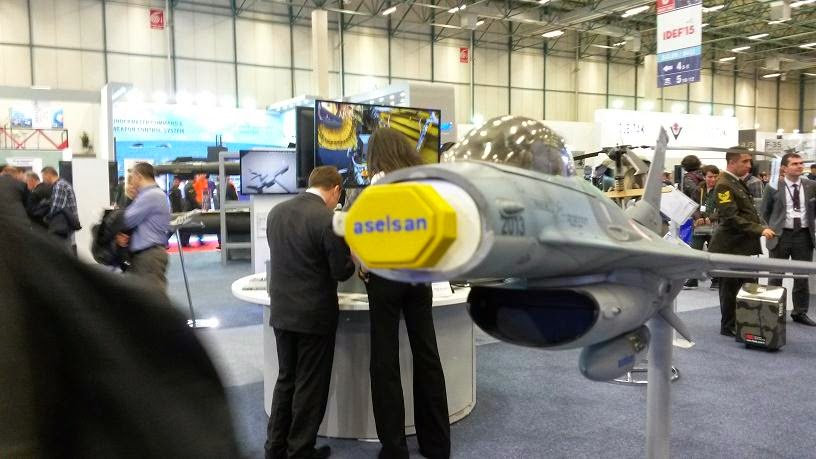
ASELSAN radar system expertise covers frequency bands L through Ka Band and encompasses advanced radar technologies such as active phased array, GaAs and GaN based Transmit/Receive Modules.
See http://www.aselsan.com.tr/en-us/capabilities/radar-systems
Please see http://www.aselsan.com.tr/en-us/press-room/Brochures/Microwave-Products/TRANSMIT_RECEIVE_MODULES_ENG_2016.pdf
for ASELSAN GaN based T/R modules.
BayarTurkish companies are already producing a fighter AESA with GaN?
ASELSAN AESA with GaN- First Prototype undergoing testing- intended to be fitted on entire F-16 fleet & TF-X
[ATTACH=CONFIG]251358[/ATTACH]
ASELSAN FALCONEYE IRIST
[ATTACH=CONFIG]251359[/ATTACH]
ASELSAN MEHPOD
[ATTACH=CONFIG]251360[/ATTACH]
[ATTACH=CONFIG]251361[/ATTACH]
ASELSAN ASELPOD Advance Targeting and Navigation Pod
AYESAS AVIONICS
See http://www.ayesas.com/en/products
BayarIsrael has lots of aerospace engineering but they have no aircraft industry to speak about. What they can do quite well are components (HUDs, helmets, radars, FLIR balls, avionics), upgrade kits and UAVs. They have never employed proper propulsion technology and I’d wager to say that the perishable skill of designing a complete airframe has also died years ago, as well..
The same for Turkey, let’s see if they can revive it with the TAI TFX and how much foreign content will the thing have..
Is this a joke? Turkey has no Aerospace industry?
TAI Anka UAS including Turkish engine and avionics, SAR radar, SatCom etc
TAI Hurkus-C COIN and Trainer
TAI/SNC Freedom Trainer (currently tendering for US T-X Trainer program)
TAI T625 Utility Helicopter including indigenous Turbo-shaft engine
Licensed Production of 300 F-16’s
TR-JET Regional Jet
As for foreign content in the TF-X you might be surprised to note that Turkish companies have designed, developed and are producing an indigenous AESA Radar with indigenous TR modules and GaN, IRIST, EW Pods, Targeting and Navigations Pods with Turkish optics!
I could go on…
BayarOh, i see, agree.
They will consider the TFX when, and if it gets into sqn´s, before no. SAAB and Dassault have an historical pedigree in this particular business, TAI no. Mind you, i will be thrilled if TAI gets that aircraft right!
When the Turkish Minister of Defence announced that Turkey was developing a new generation air superiority fighter comparable in mission profile to the F-22 I quite frankly laughed. This continued up until BAE Systems and Rolls Royce joined the TF-X program. Then I heard the British PM’s speech.
Then I was alerted to the technology coming out of Turkey in the past 10 years which made me change my mind. (Some that spring to mind is the Roketsan SOM Advanced Stand-off Missile which is now being marketed by Lockheed Martin in the US. The other is the ASELSAN AESA, IRIST and KORAL. Then you have the ASELPOD, MEHPOD, Aerial Stand-off jammers etc. All Turkish precision strike missiles also use indigenous seekers heads: IR, semi-active laser etc)
Then on top of this a $44 billion budget was announced together with a recruitment drive for engineers with experience in developing combat aircraft from abroad. Then I saw that as many as 1000 Turkish companies had already begun development of sub-systems and some even had proven prototypes being tested on F-16 Block 30’s being used as test-beds.
This to me showed the professionalism and solid intention on TAI’s part.
Now I follow the program closely because it could quite frankly turn into a European equivalent to the F-22. We will only know when the pre-detail designs are revealed.
E.g. Turkey also a few years ago stated an intention to build stealth warships. Everyone laughed. Today it is commissioning MILGEM’s in large numbers.
Bayar[QUOTE=Spitfire9;2374065]Yes, that is possible. Many would see that as risky, too, due to Turkey being somewhat unstable (got a civil war going on; recent attempted coup d’état; head of state altering constitution to something more like dictatorship). And what if the Islamic fundamentalists (no freedom except what Sharia allows) gain power in Turkey? Will agreements with infidels continue?
Thats correct. Right now no one in Europe is considering the TF-X. But I didn’t assert this. I said once BAE Systems and TAI complete the pre-design phase European nations may decide to join the TF-X program.
There is zero geopolitical risk in Turkey
No civil war in Turkey– just a war on communist terrorist groups seeking to carve out communist territories.
Coup– product of Turkey shifting to Russia and China due to Obama’s incompetence vis-a-vis Syria. Western Intelligence agencies will not make another attempt at overthrowing Erdogan as this would then solidify Turkey’s exit from NATO. He is too powerful as he enjoys popular support at home. The Trump Administration also has good relations with the current Turkish Government. Trump also has business ties with Erdogan’s business associates.
Islamic fundamentalism– Turkey is the last country to succumb to Islamic fundamentalism. The Turks hate the British created Wahhabism. They blame it for the dissolution of the Ottoman Empire (Laurence of Arabia). The Turks also practice a different form of Islam to the majority of the Islamic world. They were also an Islamic Caliphate for in excess of 700 years just only 100 years ago. Their Ottoman caliphate gave refuge to Sephardi Jews fleeing the Spanish Inquisition and were one of the first countries in the world to legalise homosexuality. Even well before the Western world.
Constitutional changes– Turkey is holding a referendum on whether Turkey should become a Presidential Republic like the USA and France or remain a Parliamentary democracy. The proposed Constitutional changes are identical word for word with the US Constitution. Hardly, akin to a dictatorship unless one asserts that the US Presidential system is also undemocratic.


 Sign In







