 mark1100
2) Luftwaffe is buying Eurofighters now, soon it will buy U(C)AS Taifun and I think that the next step will be Barracuda
The Taifun is for Ground Forces , the army ordered 936 UCAV’s of this class :diablo:
mark1100a lot of german motorways have a removable middle stripe, especially those wich were build under hitler
mark1100Check out the latest article on Janes !
Jane’s International Defense Review
Date Posted: 13-Feb-2006Barrakuda technology advances
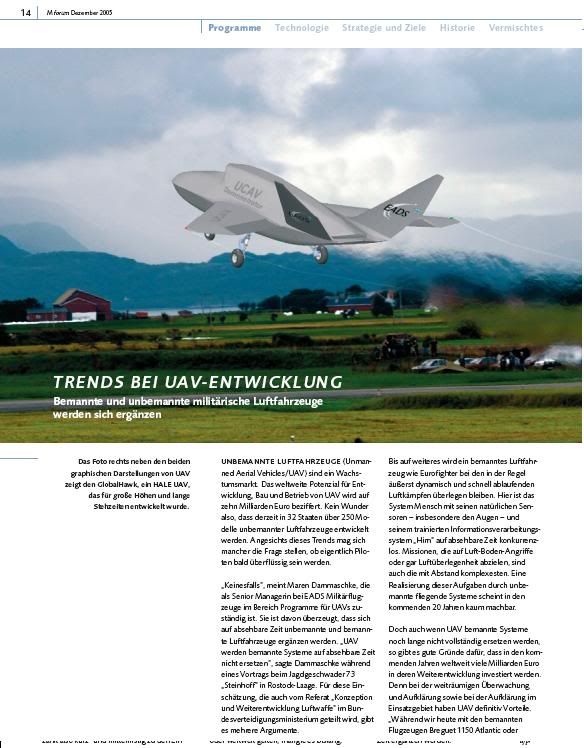
Images of the EADS Barrakuda stealth unmanned aerial vehicle (UAV) demonstrator indicate that the company’s work on stealth may have outpaced that of BAE Systems, Saab and Dassault. Barrakuda is a much larger, heavier and more sophisticated aircraft than the very small test vehicles that other European companies have unveiled to date.
Barrakuda has an estimated wingspan of 8.75 m and an overall length of 9.5 m, in the same class as the 5,500 kg Boeing X-45A demonstrator. It is reportedly powered by a Snecma/Turbomeca Larzac engine, but the size of the exhaust suggests a larger engine (such as the Honeywell F124 used on the X-45A, or a Rolls-Royce/Turbomeca Adour).
The configuration of the Barrakuda is conventional, with moderately swept wings and four tail surfaces. The inlet is top-mounted and the body has a hard chine at mid-height. The design appears to represent an unmanned combat aerial vehicle (UCAV) rather than a reconnaissance aircraft. It has a plain circular exhaust which would probably not be suited for an operational aircraft – EADS may plan to replace it with a stealthier design later in the programme.
Because of its greater size, Barrakuda could be used for more advanced tests than are possible with small-scale demonstrators. For instance, it could be fitted with an internal weapon bay, to explore the technology involved in releasing weapons from a stealthy aircraft and maintaining stealth once the doors have closed. It could also be used for realistic in-flight tests of radar-absorbent materials (RAM) – the smaller vehicles yield aerodynamic data but cannot be used for realistic tests of RAM, the effects of which are not directly scalable.
Barrakuda could also be tested on the EADS RaSigma 3 radar signature measurement facility in Manching, which unlike most outdoor radar cross-section (RCS) ranges is designed to support the weight of a real aircraft. US experience with full-scale RCS models has shown that very high fidelity between the test article and the real vehicle is essential if results are to be reliable.
EADS Germany has been involved with stealth development since the 1980s, when the company produced a full-scale mock-up of the Lampyridae (Firefly) supersonic stealth interceptor. The project caused massive concern in the US because the aircraft’s shape closely resembled that of the then-secret F-117A, and the Pentagon assigned US engineers to investigate whether the resemblance could be coincidental. They reported that it was, but the US remained concerned that Warsaw Pact intelligence could penetrate the Lampyridae project and thereby compromise the US programme, and pressured Germany to shut the programme down.
Currently, EADS is not only developing the Barrakuda but is also working on RCS-reduction modifications for conventional aircraft. Tests have been carried out on Tornados and the company believes that it is cost-effective to reduce the head-on RCS of such aircraft by 10-20 dB.
mark1100German Demonstration
In July of 2000, Northrop Grumman and the European Aeronautic Defence and Space Company (EADS) signed an agreement to develop an unmanned wide- area surveillance and reconnaissance system. The project, which brought together the companies’ respective expertise in UAV and sensor technology, was initiated to offer a replacement for the ageing fleet of Breguet Atlantique signals intelligence (SIGINT) aircraft of Marinefliegergeschwader 3 (MFG3) Graf Zeppelin based at Nordholz, Germany, due to be replaced by 2008. This cooperation was followed by a bilateral project agreement between the US Air Force and the German Ministry of Defence signed in October 2001.
On July 23, 2002, US Air Force and German Ministry of Defense officials completed preliminary compatibility testing of EADS’ electronic intelligence (ELINT) payload with Global Hawk at the Integrated Systems facility in San Diego, California. The first successful demonstration of the ELINT sensor payload aboard Global Hawk took place on November 17 and 22 at Edwards AFB. During the missions, the sensor was able, for the first time, to detect radar transmissions from emitters located at the Naval Air Warfare Center, China Lake, California. The transmissions were sent through a line-of-sight communications link to a temporary German ground support station located at the Air Force flight test center at Edwards.
With the successful integration of the EADS’ ELINT payload into Global Hawk, Northrop Grumman undertook a series of demonstration flights in Germany for the German Ministry of Defense (MoD) in Fall 2003. On October 15, the first prototype RQ-4A performed a 20-hour, 53-minute transatlantic flight from Edwards AFB, California to the naval airbase at Nordholz to demonstrate the technical feasibility of using UAVs to perform HALE wide-area surveillance (WAS) missions. Global Hawk was based at Nordholz from October 15 to November 6, 2003, during which time it performed six demonstration flights over the North Sea for a total of 29 hours flight time. The European ELINT sensor enabled Global Hawk to detect and classify electromagnetic signals from aircraft, ships and land based systems, determining the type of radar emanating from each, while relaying the information via a UHF data link to an EADS ground station. These flights represented the first successful operation of a UAV in controlled European airspace, paving the way for further developments of unmanned flight in Europe.
The test program led to a decision by the German MoD to develop and produce a Global Hawk-derived sensor platform called EuroHawk to satisfy its HALE WAS mission requirements. EuroHawk will be based on the RQ-4B model Global Hawk and carry an EADS-developed sensor package. This promising Global Hawk derivative is discussed further in the Emerging UAV Missions International Overview section below.
http://www.northropgrumman.com/unmanned/globalhawk/overview.html
http://www.northropgrumman.com/unmanned/globalhawk/images/GH-Eurohawk-Brochure.pdf
mark1100Besides i enjoy your remarks at the end of your posts I didnt say that its far superior nor that other countrys in EU can’t set up something similar.
I only said that the Global Hawk and the Predator tech gave EADS a technological advantage over the Neuron federation and others since these systems are already proven in service and battle while all other european efforts in this aerea are just in projection phase.
mark1100Size does matter. Unlike Saab EADS has a lot of experience in the aerea of UAV’s so they dont need to build mini UAV’s to learn the “basics”, last summer a global hawk landed in north germany and its pilot was somewhere in california, so when germany is buying global hawks we will get the same control abilitys wich could be copied for the Barracuda.
The whole Barracuda programm was launched arround 1995 under Kohl, so it has already 11 years passed.
And France will have an UCAV demonstrator of the Neuron in 2011, at that time Germany will have Global Hawks already in service and the Barracuda programm is almost 16 years old…
mark1100Filur and B-Sharc are little rc toys compared to barracuda wich is supposed to be a full ucav demonstrator, they look big on single pictures but look at this …
 (the Gripen is already a small Aircraft)


its just another dimension
also germany is building infrastructure for global hawk control, this systems could be modified for control of barracuda, no european state has such uav control systems today. Here is the Advantage, we can simply copy many of the Global Hawk’s systems, no need for extensive developments.
mark1100http://www.dmkn.de/1779/ruestung.nsf/C132147613AE6767C12570AC003EA77E/$…
here you can also see a complete Pzh2000 mounted on F124


The Ship has a small crew of only 110 due digitalisation and supports 50+ Special Forces + 4 Landing Crafts
Rest of the Weaponary should be quiet similar to F124 but with RBS 15 MK3 instead of Harpoons
mark1100Ok then i dont want to discuss with kids
mark1100How old are you?
mark1100LOL !
So the F100 is far superior to T45 aswell?
mark1100Well the F124 costs twice of the Spanish F100 and noone actually really knows about F124 Radar and so its idiotic to claim that the T45 is far superior (Do you know exactly about T45 Radar? NO! ) 🙂
However, German Navy will order 4 F125 Frigates in 2006 🙂 Maybe we can continue the discussion then 😉
mark1100The F124’s radar is said to be superior to the SPY-1F which is not the much more capable D version used by destroyers, it has been claimed the Sampson is superior to the D version (although this is difficult to prove as specs for both are scarce) so yes the Sampson is far superior to the F124’s radar.
So you claim something wich is better then my claim and use it as your proof that t45 is far superior to f124? :rolleyes:
In order to further his already flawed argument, he points to things that he cannot prove will in the future be fitted to the F124 (GMLRS) and if they are will only equal what the T45 will be fitted with (155mm gun, UAV’S).
Read your posts above, you added Harpoons and 24 VLS yourself and here you talk like F124’s systems are only wet dreams of future! LOL!
However…
If you want to compare current systems please…
In terms of close in air defence and anti shiping missiles the F124 Frigate is superior, because Sea Ram is much more capable than Phalanx, and the Type 45 has no anti shipping capability. In terms of ASW the type 45 probably has a better sonar suite, but the German ship does have 2 helo’s vs Type 45′ 1. The Type 45 has a bigger main gun, but the German ship has a faster firing, but much smaller gun. The main comparison is the air defence weapons, the German ship has the much more capable Mk.41 VLS, whilst the Type 45 has the very limited Syler VLS. Currently, the Type 45 has the better medium range missile Aster 30, but the Germans are getting thr latest SM2 when it’s released which will be superior to the Aster 30, at least in terms of range, and the SM3 can be used which will give the German ship missile defence capability, which the Type 45 doesnt have. The Type 45’s Aster 15 missile is probably superior to the ESSM, but the German ship can hold 4 ESSM in each cells, compared to the 1 Aster 15 in each cell on Type 45, so can hold twice the number of missiles in half the number of cells! = more long range AAM. The Type 45 has 48 cells from the start and is planned to get 16 more, so will have 64 compared to the German ships 32 cells, but the German ship can use the space much more effectively, and can carry a range of weapons such as Harpoon, or Tomahawk to give it deep strike capability.
The Type 45 will be a better escort for the carrier group, because it larger and has more cells, whereas the German ship has much more flexibility in what it can do. Although the Type 45 doesnt have super long ranged AAM, its carrier has F35 so its less of a problem, and Type 45 may be upgraded with Mk.41’s, Sea Ram’s ect in the future.
mark1100How exactly does the F124 have mor punch? it can only carry 32 VLS cells to the T45’s 72, both can carry the same ASuW missiles (both type an quantity), Both have two CIWS systems, and the T45 has a larger calibre main gun, not to metion a better radae system.
Even if the T45 qould have 72 cells F124 carries 4 ESSM in one VLS, so it can carry a mix of 64 ESSM and 16 SM2 IIIA or a maximum of 128 ESSM , plus the F124 has another 42 RAM’s for selfdefence, the T45 only has Phalanx wich are much less capable IMO
And i doubt the Radar of T45 is way superior to F124’s wich is supposed to be superior to some AEGIS Versions
Wow so an F124 temporarily had a 155mm gun mounted when she was carrying little other equipment, and it still only amounts to the same as what a T45 can carry in the future.
Read Above, there are even plans for a Navalized MLRS(GMLRS) and Naval UAV’s wich are currently under development by EMT Penzberg
mark1100Don’t forget f124 is 2000 tons lighter but it seems to have a larger arsenal.
I dont think 1-3 are irrelevant but okay.
Point 5:

http://www.rheinmetall-detec.com/product.php?lang=3&fid=2084


 Sign In







