Never, never ignore a rumour.
This was a rumour.
Mark 🙂
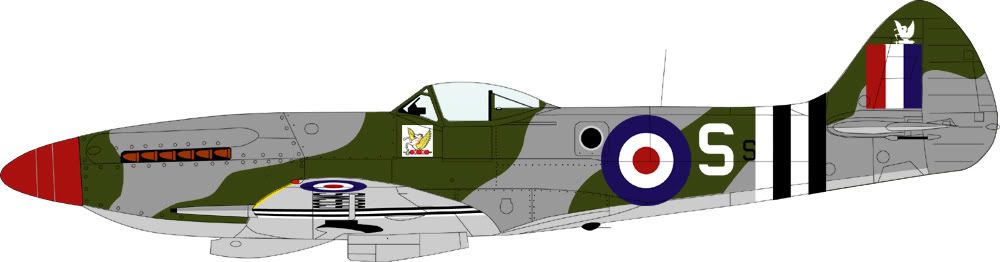
Don’t you just love the look of single stage Griffons and 4 blade props? 🙂
Dan
The tail section must be from a VIII or another retractable tail bird as it also has the later style elevator
Guessing its a Griffon VI engine from a Seafire XV with the rounded exhausts. Wings from EN199 it appears
Yep, looks like EN224 to me. I’d like it in my garage yesterday please 🙂
So what 41 squadron Spit XII was it supposed to be? I can think of a few that went into the Channel
A beautiful bird. Oh to have the money to do something like that!
Out of curiousity, anyone know why they went with the early style mirror instead of the cupped mirror?
The engine exhausts and the cannons would seem to point to 41 and a Vb.
I still think the red spinner would have looked better 🙂

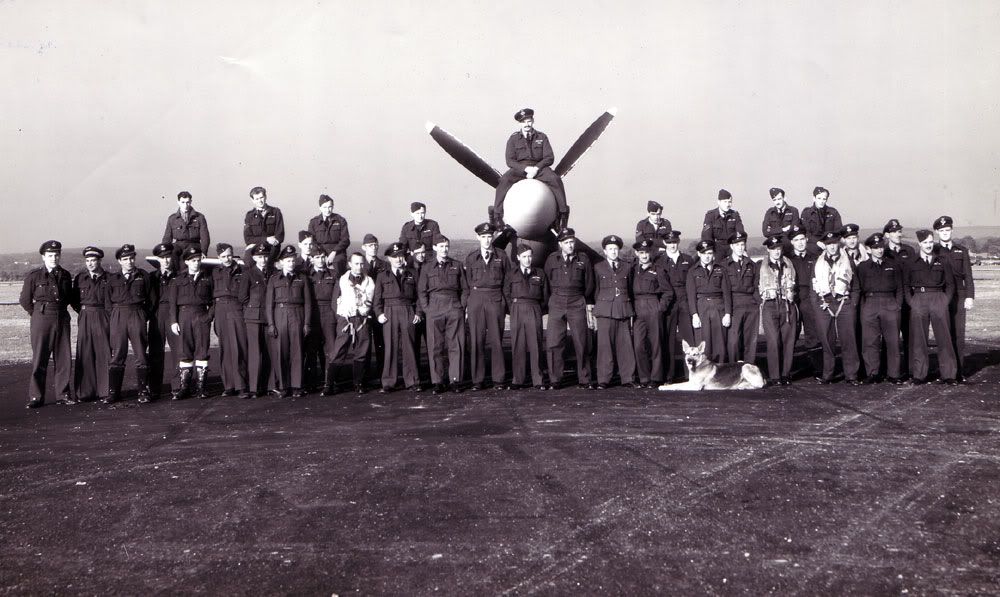
The Spit XII pilots of the Tangmere Wing, October 43. Ray Harries in the center was WingCo at the time.
I can go on and on about these guys 🙂
Any chance of someone posting a photo for those of us not near a Flypast at the moment?
I hesitate to bring it up, as it would be top of my list of Spitfires I’d like to own, but how would EN224 be classified?
Not a lot of actual Spit XII in it outside of the firewall and data plate. Lots of actual Spitfire bits, but not a lot of XII bits by the time it shows up. Probably not a Griffon III or IV in it either
Not that I’ll complain if and when she makes it back in the air of course 🙂
Quoting my reply from the other thread
I think in many ways folks are missing the essential point.
The machines are just that. What they represent are the men and women who built them, supported them and flew them.
If my grandson or daughter someday see’s a flying Spit that has been built around a ‘shaky provenence’, it will not matter one bit, as long as it might get them to look beyond the machine to the people.
How many of us out there are really that caught up in Spitfires (in this case) to the point where we know the types, serials of the survivors and all the details? I’d suggest the numbers is very few in the overall scheme of things.
Preserving the history is important, as is presenting the history as a tool for learning.
If “EN179”, real or imagined, gets one kid to learn the story or dig a bit deeper into the history, she’ll have done her job regardless of her pedigree.
When I saw P9306 as a kid at the Chicago Museum of Science and Industry, I couldn’t have told you what kind it was, if the paint was right or anything about it’s story. 40 years later I can talk Spits and then some. But it was that instance that I caught the Spitfire bug. Later it was AR501 at Duxford while I was in England for a a semester of College in 1980. Clipped winged Spit. That sent me into my Spit XII obsession. Again I knew nothing about it, but it got me going learning about the pilots and the history.
So I don’t know that I care if a flying Spit is all original, or how weak the provenence might be. The sound of that Merlin or Griffon and what that Spitfire represents in terms of the history and the people is what matters.
Otherwise it’s just bits of metal.

I think in many ways folks are missing the essential point.
The machines are just that. What they represent are the men and women who built them, supported them and flew them.
If my grandson or daughter someday see’s a flying Spit that has been built around a ‘shaky provenence’, it will not matter one bit, as long as it might get them to look beyond the machine to the people.
How many of us out there are really that caught up in Spitfires (in this case) to the point where we know the types, serials of the survivors and all the details? I’d suggest the numbers is very few in the overall scheme of things.
Preserving the history is important, as is presenting the history as a tool for learning.
If “EN179”, real or imagined, gets one kid to learn the story or dig a bit deeper into the history, she’ll have done her job regardless of her pedigree.
When I saw P9306 as a kid at the Chicago Museum of Science and Industry, I couldn’t have told you what kind it was, if the paint was right or anything about it’s story. 40 years later I can talk Spits and then some. But it was that instance that I caught the Spitfire bug. Later it was AR501 at Duxford while I was in England for a a semester of College in 1980. Clipped winged Spit. That sent me into my Spit XII obsession. Again I knew nothing about it, but it got me going learning about the pilots and the history.
So I don’t know that I care if a flying Spit is all original, or how weak the provenence might be. The sound of that Merlin or Griffon and what that Spitfire represents in terms of the history and the people is what matters.
Otherwise it’s just bits of metal.

The Spitfire is reported to be on Herzliya beach and the downed pilot as F/Lt Mahmoud Barakat.
Spares recovery for the Israeli Air Force. The port wing has been removed by technicians, as other shots show it still attached.
Mark
Any chance it was rebuilt and changed colors? I’d imagine at that point the Isreali’s would have welcomed another Spitfire into their arsenal.
Cobra’s over the Tundra by Everett Long says that Kent was declared “deceased-remains unrecoverable.”
So he didn’t make it home:(
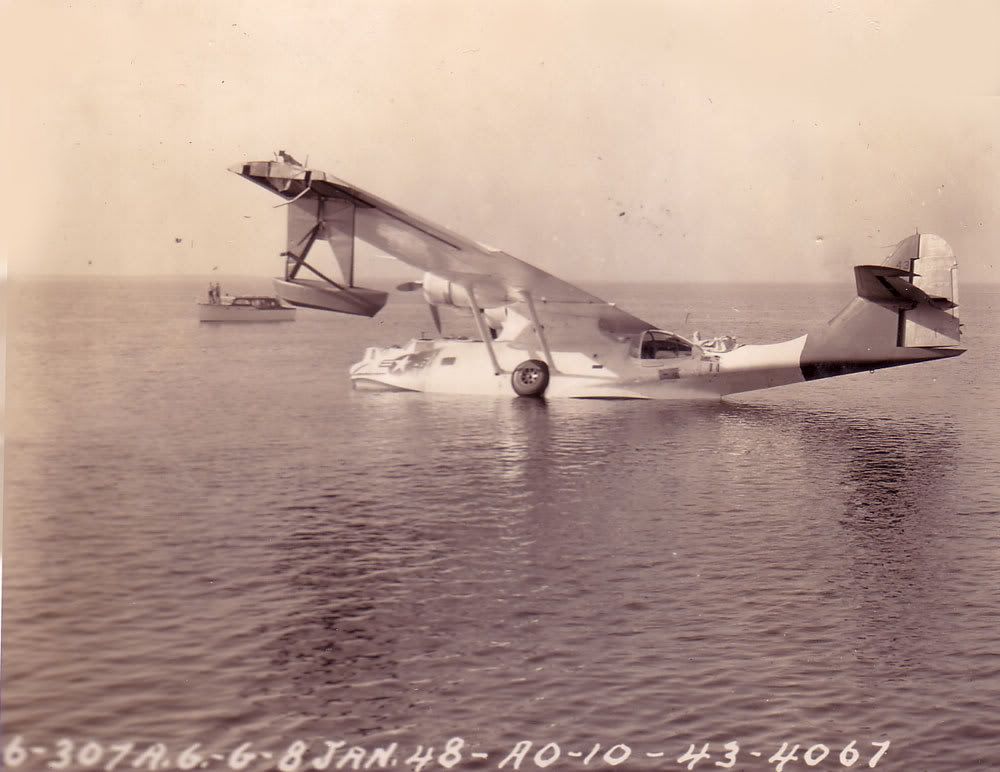
Well as long as we’re discussing Catalina’s from the late 40s.
Anyone have any idea on this bird? Found in a scrap book.

..Mucho repair work on Spits carried out by Air Service Training at Hamble during WW2. One of the largest CROs involved in this work I am led to understand.
Chumpy, can i ask where they photo is from? I can’t quite tell but is that DL-B in the middle? And is it an XIV or an XII?