 SlowMan
Inevitably the US policy of containing the PRC is likely to fail
Actually it is working out quite well, with all the countries in Southeast Asia begging to host US Navy fleets.
this is not Iran we are talking about but a true economic (and soon to be military) superpower.
China makes the US containment possible by antagonizing everyone of its bordering neighbors while supporting rogue states like Pakistan and North Korea.
Had China been “reasonable” or did nothing, the US would have found it hard to contain China. But it is none other than China’s actions that drive China’s neighbors into the arms of the US.
SlowManWith the US move towards reinforcement of the Pacific what can be done to get more counties to join the curse and ease the political pressure and cost on the US.
Sell the F-22 to countries that demand it.
Allow non-nuclear states to have 90% enriched uranium fuel to power their nuclear subs, even if they have to be refueld in the US.
Sell Growlers.
SlowManindeed it seems most of the non-Chinese fighter projects are no longer using DSI

Boeing F/A-XX uses DSI.

Lockheed F-X uses DSI.
The Gripen E/F too is using DSI.
SlowManhttp://o.canada.com/2013/02/11/defence-officials-catalogued-pros-cons-of-f-35-competitors/
Defence officials catalogued pros, cons of F-35 competitors
The Swedish-built Saab Gripen required minimal maintenance and was considered “fairly stealthy” thanks to its small size, though there were concerns whether it could operate alongside U.S. fighter aircraft.
The Dassault Rafale was fast, manoeuvrable and had above-average range, but it also featured a clunky cockpit and the French company couldn’t say whether the jet’s two engines could operate in the cold Canadian north.
The Boeing Super Hornet was a solid, proven aircraft Canadian military pilots and mechanics would have little difficulty getting used to, but it was seen as a fall-back option at best.
And the British-led Eurofighter Typhoon was a powerful fighter with sophisticated sensors and excellent flight controls, but it still had developmental issues and purchasing it would require major changes at Canadian Air Force bases.
The reports, copies of which were heavily censored before being released to Postmedia News, highlight both pros and cons for each fighter under review.
“One remarkable aspect of (the) Typhoon at first glance is the sensor fusion,” reads one section of the report on the Eurofighter aircraft, which is being used by British, German, Austrian, Italian, Spanish and Saudi militaries.
“The Typhoon is a very capable aircraft in the air-to-air arena,” another section reads. “It is a very powerful aircraft with very effective flight controls.”
But the same report notes “interoperability is a key concern for Canada,” referring to the Typhoon’s ability to fly alongside U.S. and allied aircraft without any problems.
Similar concerns were raised with Sweden’s Gripen and France’s Rafale.
“From a strategic approach, purchasing an aircraft from a nation other than the United States needs careful consideration given the potential impact on Canada’s interoperability with the (United States Air Force) — an air force along which we’ve historically operated,” one report reads
Yet the documents also note various steps were being taken to address the concerns in the coming years, which could be key as National Defence goes back to the drawing board on the F-35.
Meanwhile, the engineering design of the Swedish-built Gripen “combined with anti-stealth materiel and its small size result in a very small radar cross-section, making the Gripen a fairly stealthy platform.”
Low maintenance requirements were also a bonus.
But in addition to the aforementioned interoperability concerns, officials noted the Gripen uses a system for emergency landings and landings on short airfields different from Canada, which would require changes.
Officials also raised concerns about the cost of changing existing maintenance facilities to accommodate Gripens, Typhoons or Rafales — though the concluding report that ultimately recommended the F-35 noted similar concerns about the stealth fighter.
Not only does the F-35 have more software than the space shuttle, which will cost a lot to maintain, the concluding report reads, but security upgrades at Canadian military bases “will likely be very expensive.”
Meanwhile, Boeing’s Super Hornet was praised as a larger, stronger, more capable version of Canada’s CF-18. The fact it is an American-made aircraft that is used by many of Canada’s allies was also a bonus.
“The (Super Hornet) is a credible and proven strike fighter system with a range of integrated weapons,” one document reads. “It makes several compromises between approach speed, weight and structure.”
The post-visit report notes “the Super Hornet seems to be a leading contender as a ‘back-up fighter’ for a few countries next to the (F-35) if the (F-35) does not meet promised budget and schedule requirements, etc.”
That assessment has turned out to be true as the U.S. navy and Australia, among others, have purchased Super Hornets in the face of continuing problems with the F-35.
SlowManhttp://skiesmag.com/news/articles/18108-f-35-costs-coming-down.html
F-35 costs coming down
Lockheed Martin announced it has managed to reduce the cost of an F-35 in “combat configuration” by 50 per cent, through supply chain and production line streamlining.
Monday February 11th 2013 – by Ken PoleAs the Canadian government assesses alternatives to the Lockheed Martin F-35 for its next generation of fighters, mainly to address concerns about unit costs, Lockheed Martin announced it has managed to reduce the cost of an aircraft in “combat configuration” by 50 per cent, through supply chain and production line streamlining.
“When I hear things like the F-35 cost is increasing, nothing could be further from the truth,” said Steve O’Bryan, Lockheed Martin’s vice-president of F-35 program integration and business development, during a Feb. 8 teleconference.
He said the fifth stage of low-rate initial production (LRIP5) had yielded a unit cost 13 per cent below the $67 million, which was the official U.S. government estimate on orders placed in 2017 for aircraft to be delivered in 2020. The reduced cost worked out to just over $58 million, and includes the Pratt & Whitney F135 engine, as well as all the pods and sensors required for operations. Moreover, the LRIP5 price was some 50 per cent below LRIP1 aircraft.
I don’t know what O’Bryan’s smoking, $58 million for an F-35. Maybe in 1960’s dollar or something.
SlowManI give up,
Your problem is that you do not understand the differences between the instantaneous load(for a few seconds) and the sustained load(for a prolonged period), and think that the instantaneous load could be sustained; but think why it was named the instantaneous load in the first place!
That 15 second+ 6.5 load that the USAF listed in the preliminary KPP is cleared the sustained load, well above the sustained load limits of existing M-346s and Hawks.
I am pretty sure it must have given some inspiration to the F-16 designers at General Dynamics.
You meant the Northrop YF-17.
Surely, the F-5b or a two seat version of the F-20 must have been conisdered for T-X, and rejected for some reasons.
Existing T-38s are too costly to rebuild, and any further development of T-38/F-5/F-20 cost money and presents risks.
SlowManWhat do you think and what parts and speck would you go for as at this time most operations have no real air to air threat but a need for air support i.e Afghan- Mali – Libya
It’s the 3rd world airforces that buy low-cost jets and they cannot afford to keep separate air defense fighters and attack jets; whatever they buy must be able to do air patrols too. Accordingly, minimal A2A is a must.
As for the drones, drones require satellite links to operate beyond 200 km distance from the control center and once again most 3rd world air forces do not have military communication satellites, nor is the US selling its drones, leaving the choices to a handful of non-US drones, whose operation is once again restricted by the lack of satellite links unless the selling country is willing to open access of its own satellites. But Israel doesn’t have a global network of communication satellites either.
SlowManI am pretty sure it must have given some inspiration to the F-16 designers at General Dynamics.
You meant the Northrop YF-17.
Surely, the F-5b or a two seat version of the F-20 must have been conisdered for T-X, and rejected for some reasons.
Existing T-38s are too costly to rebuild, and any further development of T-38/F-5/F-20 cost money and presents risks.
I give up,
Your problem is that you do not understand the differences between the instantaneous load(for a few seconds) and the sustained load(for a prolonged period), and think that the instantaneous load could be sustained; but think why it was named the instantaneous load in the first place!
That 15 second+ 6.5 load that the USAF listed in the preliminary KPP is cleared the sustained load, well above the sustained load limits of existing M-346s and Hawks.
SlowManI think if China is going in to large scale air combat exercises they should get the help of the Pakistan air force who have more resent real combat time and some western jets i.e F16 and mirage 3 I know mirage 3 is going out the door as far as combat but as for training its a good radar and visual profile for mirage 2000
I don’t know about the Mirages, but the US has put a restriction on Pakistani use of the F-16s.
SlowManThere is one specific requirement for Blue Angels jets.


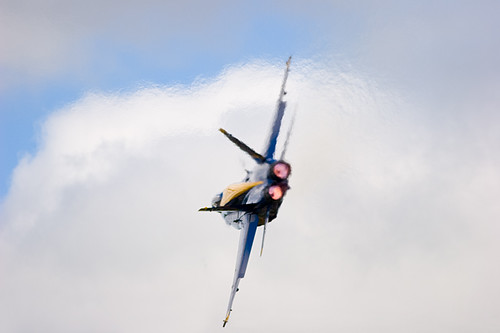
Need an afterburner to be able to make hard turns. Ditto for the Thunderbirds too.
SlowManhttp://www.philstar.com/world/2013/02/07/906033/jets-roar-us-japan-australia-drill-pacific

Jets roar as US, Japan, Australia drill in Pacific
(philstar.com) | Updated February 7, 2013 – 5:15pmANDERSEN AIR FORCE BASE, Guam (AP) — Fighter jets from the U.S. and two key allies roared into western Pacific skies Thursday in the combat phase of annual exercises that have gained importance as the region responds to the rise of China and other potential threats.
The Cope North drills — which could soon swell in participants — are aimed at preparing air forces of the U.S., Japan and Australia to fight together if a military crisis erupts. They also send a vivid reminder to Beijing that America’s regional alliances are strong, though officers leading the maneuvers say they are not looking to bait the Chinese military.
“The training is not against a specific country, like China,” Japan Air Self-Defense Force Lt. Gen. Masayuki Hironaka said. “However, I think (the fact) that our alliance with the U.S. and Australia is healthy is a strong message.”
The three allies began flying sorties together earlier in the week around the U.S. territory of Guam in a humanitarian phase of the exercises, dropping emergency assistance in packages that wafted down under parachutes to jungle airfields. On Thursday, fighter jets were joined by bombers, transport planes and tankers that refuel the fighters in midair. For the first time, Japanese tankers were joining the drills.
U.S. officials said they believe more allies, particularly New Zealand and the Philippines, will join the exercises soon.
Maneuvers like Cope North are a key element of Washington’s evolving strategy in the Pacific as the U.S. shifts its emphasis away from Afghanistan and fighting ground wars. It is now placing more attention on Asia and the possibility of an air or sea confrontation with the rapidly modernizing Chinese military, which has been briskly improving its forces and using its growing muscle to back up territorial claims that have raised regional tensions.
SlowManYou are still confused. An airframe is not designed for sustained g-load
Surely it is.
it is designed for the limit load factor of +8g.
Instantaneous load factor is for a few seconds.
Sustained load factor is for a prolonged period.
The only potential aspect is airframe fatigue in light of the T-X curriculum, this is a minor issue that can be addressed very easily at this stage (before series production rather than as a retrofit).
Except that the airframe reinforcement costs money and increases risks. The M-346 and Hawk would be going up against a competitor that doesn’t need a reinforcement.
So limit load is how strong the airframe is while sustained load is how maneuverable the aircraft is?
No, limit load is how long an airframe can take load for a few seconds without a damage. Sustained load is for a prolonged period.
More engine thrust = higher sustained load factor.
Sustained load factor is the property of the airframe design and nothing to do with the engine. If the engine thrust is strong enough to generate a load that exceeds the airframe’s design sustained load factor during a turn, then that airframe is damaged.
Another type of load factor is instantaneous load factor. This one cannot be sustained because your airspeed is bleeding off rapidly
It cannot be sustained regardless of the engine thrust because the airframe is damaged after only a few seconds.
3. Sustained load is not meaningless, it is a key air combat capability parameter. It is useful to know if you want to realistically train for air combat.
Indeed, sustained load is what matters, not instantaneous load.
SlowManThe problem of the PLA is its isolation in terms of military exchange and the lack of real modern war experience to draw on.
China’s lack of combat experience is shown in its military hardware practices. A JMSDF official who boarded a Chinese destroyer stated that that Chinese warship was built by people who never fought a naval war, since it lacked damage control capability, no water tight compartments, and doors were made out of woods. If that warship went to war and was hit, it would have gone down in minutes.
The same goes for the PLAAF, it is well-known than the PLA fighter pilots do not wear G-suits, mainly because they do not do the maneuvers that need G-suits.
Basically, China’s military is contained within its border and doesn’t have the kinds of war experience that the US and its allies have to draw upon. Two primary military forces that China faces, Japan and Korea, regularly cross exercise with US troops, and have transplanted the US style of combat and warplanning, making them essential clones of the US military. Basically, the SDF and the ROK military’s standard of excellence is much higher than that of the PLA’s.
SlowMankoreans are strange. japan kill more koreans than chinese
Well, the last foreign troops that Koreans battled was the PLA and all the misery of North Korea is due to China’s support of Kim’s regime, so the hatred lingers on.
china protect korea from foreign invasions for thousands of years.
LOL, Is that what they teach you at school?(Actually I do know they teach that stupid non-sense at Chinese schools).
Just ask the question of why China fell to Mongol and Manchurian invasion while Korea stood, and why China didn’t even try to battle the European troops on its soil during the century of humiliation while Korea battled and repelled the French troops and US marines.
korea want to make these same things but need alot of help to do it
That’s the Korean way of doing things. Koreans have a high standard of doing things, and will bring in external expertise if none is available domestically or the domestic technology cannot yet compete with the world’s best, then run a parallel program to develop the domestic replacement. This contrasts with China’s acceptance of substandard domestic technology, largely because no foreign substitute other than Russian technology is available due to western sanctions.
and mostly from Americans so it is true that they do not have industrial base but need to rely on the industrial base of others.
When that was the case the KFX went nowhere for the most of last decade.
The recent push for the KFX is because the domestic content rate reached 87%, making it economically viable to push the project forward. When the KFX project was turned down by reviews of past presidents, the domestic content rate was only 30~40%, which would have driven the cost of the KFX beyond what was available off the shelf.
This was becoming very clear during the parliamentary debate held a week ago, where all major subsystem parts, including the AESA, EO, targeting pod, full-glass cockpit, avionics computer, and radio communication equipment were on display, all that was needed was an airframe to put those parts in.
SlowManRead it again.
It’s an alternative to a turboprop. It’s seen as a successor to the A-37, as much as the F-5. That does not necessarily mean a supersonic jet fighter. It could mean something like the Hawk 100, or L-159.
And it’s a piece from an undergraduate think tank at a university. It is not an official document, & there is no reason to think it reflects official thinking.
http://www.airforcetimes.com/news/2013/01/air-force-new-trainer-jet-t-x-012813w/
“It’s a program that needs to happen, and it is by no means clear how to fund it,” said Richard Aboulafia, an analyst with the Teal Group, Fairfax, Va.
Aboulafia said it is unclear whether the Air Force will look at marketing the trainer abroad as a light combat aircraft, and is uncertain what market there would be for such a craft.
“The market is bifurcated, basically going between medium-weight combat planes [such as an F-16] and not having much of an air force,” Aboulafia said.
There really is a son-of-f-5 talk within the USAF.


 Sign In







