 SlowMan
ex-yugoslavia was a maintenance center for Migs of all sorts.
And what does that have to do with engineering and manufacturing of a fast jet?
besides, they were developing a fighter at the end of the ’80s (in collaboration with dassault).
Then which country is going to join in this UAE+Serbia venture, since neither has the technical expertise needed to build a supersonic jet?
So, if one puts it together, why not considering developing something more advanced?
Two blind men walking a mountain trail hand in hand is a disaster in the making. At least one man has to have the sight to lead the blind in the trail.
As for the question about “why UAE would develop with serbia”, why not?
1. LIFT trainer market is a saturated market, with T-50, Yak-130/M-346, L-15, and the Hawk. Doesn’t make any sense to get into a saturated market.
2. If UAE needed a technical partner, then France, UK, US, Russia, Sweden, Taiwan, and even Czech make a far better partner than Serbia.
SlowManI think you missed SAAB’s statement earlier this year in which they said Gripen E/F would have a lower price than C/D.
Saab Wins 2.2 Billion-Kronor Thai Order for Gripen Warplanes
By Ola Kinnander – Nov 23, 2010 9:12 AM ETSaab AB said it received an order for six Gripen fighter planes worth 2.2 billion kronor ($316 million) from the Royal Thai Air Force.
Gripen C/D = $52.6 million <= Straight importation.
Gripen E/F = $150 million <= Co-development and co-production.
SlowManDoes Serbia have any aerospace development capability left? Furthermore, why would UAE risk the training of its own pilots on an unproven jet?
UAE’s own training requirements have shifted from the direct acquisition of jets to leasing the training service. The bidder would provide the trainer jets, simulators, and instructors and UAE government would pay for training services. Serbia cannot provide pilot training for F-16s and Mirages operated by the UAE Airforce.
SlowManThe matter of fact is that the NATO member nations do not need the F-35 because the highest intensity war they could get into in a foreseeable future is Syria and Iran, sensor and avionics upgraded 4th generation jets are good enough for them.
Things are different for Australia and Japan, they too don’t need the F-35; they need something better than the F-35 because the opponent they face is China, but the US is making things difficult for these countries by not exporting the F-22, forcing Japan to develop one by itself.
In other word, the F-35 makes sense only as a Harrier replacement for the Royal Navy and the USMC; the other versions should be cancelled.
SlowManThis is exactly what will happen. Gripen has very slim chanches in Denmark. IMHO anyone who thinks otherwise underestimates US pressure.
The US pressure is less likely to work this time around since the F-35 had its chances and failed. It’s the balance between the US pressure vs Domestic political outrage against the F-35, and no amount of US pressure can overcome the domestic political outrage of buying $200 million/copy jets that could devour the defense budget of most nations if bought in sufficient number in the era of global austerity, at least in democratic countries which most of JSF partner nations are.
SlowManWhy would India be interested in producing Gripen C/D, given that E/F will be much more capable.
Cost.
SlowManSwitzerland’s $150 million/copy Gripen deal includes an R&D participation as well as an industrial participation. Remember that the Gripen E/F is significantly different from the C/D model and is essentially an all new aircraft.
As for the Gripen as a Tejas replacement, India can license produce the Gripen for under $50 million a copy if they stick to a modest target; an C/D airframe, a mechanical radar, existing avionics, etc. Afterall, Saab is preparing to submit a Gripen based trainer to the USAF T-X trainer contest, which implies a low unit cost is possible from the Gripen.
SlowManWho says that its other specifications (SFC etc.) are going to be in similar proportion? Who says that the F-3 is intended to be in the same weight class as F-15E/F-22/Flanker/J-20/etc.?
SlowManWS-10G which currently powers J-20 prototypes are around 32,000 lb.
Yea right.
SlowManso can China make its own jet engines.
Not the ones that you would want to fly with. You need an insurance policy and a prayer when flying in a jet powered by Chinese engines.
SlowManwith US usually #1 in most field and now China catching up since it build two stealth fighers, but still behind in some area, who is #3?
i know some thing one have advantage over the others but say
fighters, bomber, cargo, missile, radar, etc who lead the other?
No. 1 : US
No. 2 : Europe
No. 3 : Russia
No. 4 : Canada <= At least Canada can make its own jet engines.
===========================
No. 5 : Japan
No. 6 : China
SlowManWhy? Who says they have to be bought now?
The UK must start paying its share of R&D funding, which will amount to billions, certainly more than $2 billion paid for the F-35.
Says whom?
The Tories do, with all the defense spending cuts that they are implementing, including all of 55 RAF Typhoon Tranche 1 units.
Not now they don’t.
And they won’t be until Russia rearms.
There is talk of the RAF ordering additional F-35s to replace Tranche 1 Typhoons in the future
The UK MoD is scrapping its existing Typhoons due to its inability to afford them; now how are they ordering more F-35s when they are in fact cutting back on F-35 orders?
Later on Tranche 2s and 3s will need to be replaced
Not for another 30 years, since the Tranche 2 units are still being delivered while the Tranche 3 units are just entering production.
I doubt that there will be additional F-35s bought
But you claimed that there was a talk of acquiring additional F-35 units; you contradict yourself in the same post!
I doubt there will be sufficient numbers of F-35s to take over the roles of those.
The UK doesn’t need and probably can’t afford all those jets; this is why they scrapped Harriers and are scrapping Tranche 1 Typhoons.
The very reason Japan is seeking foreign partners is to share the financial burden; they don’t need freeloaders who only want work while buying nothing in return. Want 20% of work? Gotta buy 20% of output. A simple math.
SlowManAdding to that point and combining it with EELightning’s point earlier, why couldn’t 2 island nations, with experience of developing their own fast jets combined to make a new one?
Because one of the island nations can’t afford to buy new fighter jets.
Why couldn’t the UK and Japan have enough common ground to develop a fast jet together?
Because the UK doesn’t need a 5th gen jet.
then surely there are significant requirements for the UK and Japan?
The UK doesn’t require one.
Japan does, because of China.
Australia does, because of China and has the money to pay for it.
Canada does, because of Russia. Not sure if Canadian politicians want to pay for it.
SlowMan
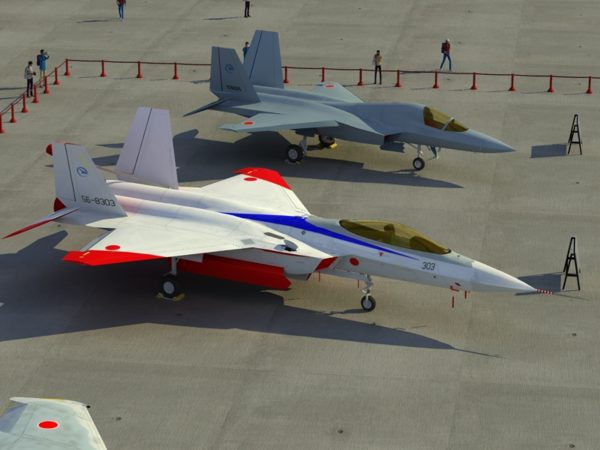
This is the prototype engine for the F-3.
SlowManI have a feeling they paid something for the design and altered it from there. It had too much in common to be indigenous.
Japan would redesign something for the sole purpose of putting its engineers through an exercise. The F-2 was a similarly an “indigenous” project. It looks like an F-16, but it is dimensionally different from an F-16 and the Japanese engineers had to go through the engineering process from scratch, complete with a Japanese FBW system.
With two indigenous fighter jet program completions under the belt, Mitsubishi is confident it can do the F-3, which isn’t much different from the F-22 in terms of aerodynamic and stealth performance, but is a generation ahead in terms of sensors and avionics, hence the “6th gen” designation.


 Sign In







