 aditya
You forgot popeyes and Nukes! 😀
With 4 main weapon hard points with 6 ton capacity each imagine a triple ejector rack for BrahMos… 12 missiles on 4 pylons with a flight radius of 2,000km or so… that is one impressive ship killer. Of course twin BrahMos would probably be simpler and easier, but still 8 BrahMos per aircraft would leave warload capacity for the bomb bay to carry some ordinance too.
Mines, or depth charges, or perhaps extra fuel…
adityaWell its just not another upgrade of Su-27 with the new engines and all….


6th December 2005, 18:11
Austin Austin is offline
Rank 5 Registered UserJoin Date: Oct 2003
Location: India
Posts: 1,531
Su-35 ( T-10BM ) The Definitive Flanker
Su-35 Big Modernisation Project
Janes IDR
March 2005
Piotr Butowskihttp://i25.photobucket.com/albums/c5…ak/Su-35BM.jpg
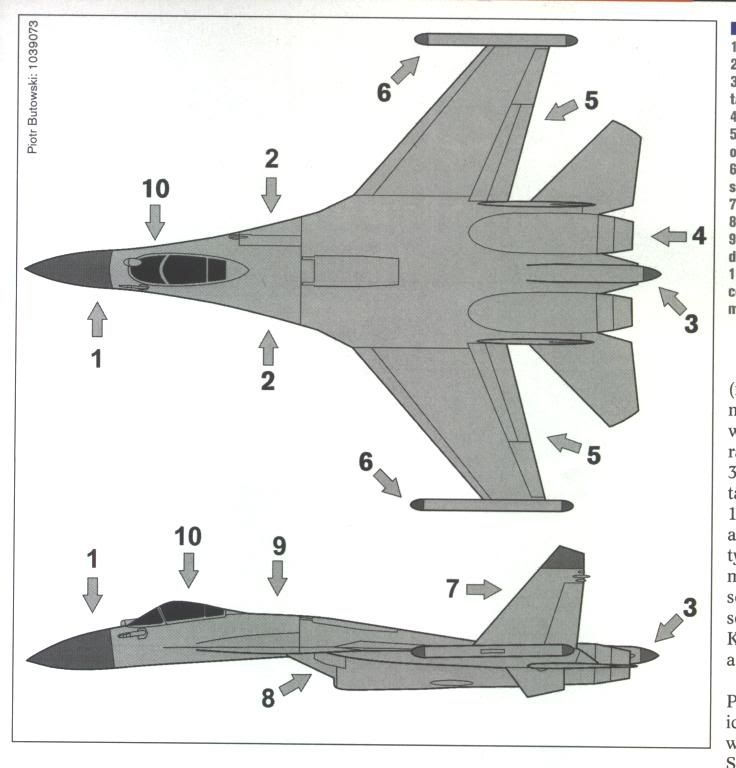
Photo Credit JanesNew Features Of the Su-35 ( T-10BM Big Modernisation )
1 – N035 Irbis Radar
2 – No canards
3 – Rear-looking self-defence radar in shorter tail sting
4 – AL-41F1A turbofan engines rated at 147kN
5 – Extended high-lift devices with large flaperon occuping the full trailing edge
6 – L175M Khibiny-M electronic-warfare self-defence system
7 – Reduced-area empennage
8 – Larger Air Intakes
9 – New and lighter systems, including quadruple digital fly-by-wire flight-control system.
10- New man-machine interface with fully-glass cockpit with two large LCD screens and helmet mounted display.
The OKB Sukhoi design bureau and the KnAAPO factory are now focusing their attention on a project with the internal designation T-10BM ( Big Modernisation ) and the official designation Su-35 , The one and the only presentation so far of this new edition of the Su-35 was a model that was put on display in December 2003 in Dubai.
The Designation Su-35 has a long history , In 1992 , Sukhoi assigned the designation Su-35 to the export version of the Su-27M ( T-10M) fighter fitted with canards and the N011 radar. Series production of the Su-27M started in Komsomolsk during the last days of the Soviet Union. Five of the 15 manufactured fighters ( including the prototypes ) are presently in service with the 237th Regiment at Kubinka Air Base near Moscow ; several others are used as experimental aircraft. The Su-35 was offered without sucess to several countries including South Korea,UAE and Malaysia and is presently taking part in competition in Brazil. It should be noted that this Su-35 is a new project and not a Su-27M.
The demand for Su-27/Su-30 fighters as they are manufactured currently bu KnAAPO has been nearly fulfilled and it is still a long way to Russias new-generation fighter the PAK-FA. On 26 April 2002 , a government committe chose Sukhoi’s T-50 offer in the contest for the 5th gen fighter PAK-FA fighter , On 10 December 2004 Sukhoi submitted the T-50 pilot project for approval by the airforce.
Statements made then say that the prototype T-50 will fly near the end of 2007 and its series production will commence in Komsomolsk around 2012-15.
The Su-35 ( T-10BM) should fill the interim period. Therefore 2007 has been declared by the Sukhoi design bureau as the year when the work on the Su-35 is to be completed , Another objective of the Su-35 programme is to gradually test and implement solutions under development for the T-50. The “transitional” fighter Su-35 is being realised by the same co-operating parties that take part in the T-50 programme. The absence of subsystems and components imported from beyond Russia in the Su-35 project is regarded as being a great advantage for the Russian Air Force as well as for some foreign customers , such as China.
The Russian aerospace community takes delight in subdividing fighter aircraft aircraft into generations . According to their Classification , the Su-27 is a fourth-generation fighter , the Su-30 MKI/MKK belong to the 4+ (four plus ) generation , The new Su-35 (T-10BM) will belong to generation 4++ and the future PAK FA (T-50) will be a fifth generation fighter. There is also a 5- ( five minus ) generation which includes the early series of the PAK-FA ( T-50 airframe with temporary equipment from the Su-35 )
http://i25.photobucket.com/albums/c5…BMArmament.jpg
Photo Credit JanesThe external appearence of the new Su-35 ( T-10BM) is more similar to the Su-27 than to the former Su-35 ( T-10M):
1 ) It has no canards
2 ) The fins are smaller than before and the sting protruding rearwards between the engines is shorter.
3 ) The high-lift devices have been changed and are similar to those applied to the Su-33 shipborne fighter with big flaperons occupying the whole trailing edge of the wing.
4 ) The Su-35 will be powered by two of the new AL-41 F1A turbofans , providing 142 to 147 kN of thrust each.The AL-41F1A engine is as “transitional” as the whole Su-35 aircraft. The final production engine for the PAK-FA (T-50 ) will be the AL-41 F1 fitted – when compared with the present A version – with a new core.
In July 2003, all the leading Russian air engine manufacturers signed an aggrement to work together on this.
The Tikhomirov NIIP institute in Zhukovsky is now designing for the Su-35 the new N035 Irbis radar with passive electronic scanning . When compared to BARS the Irbis radars antenna is suspended on a quick-fastened console rotating in azimuth by 50 to 60*(degree) to each side ( therefore securing a field of regard of more than 200* ) ; the console is additionally rotated in roll.
The Su-35 has also a small radar installed inside the sting between the engines and looking aft. Such an idea has been developing in Russia since mid-1980: rear-looking radars were installed on several prototypes of the ‘old’ Su-27M/Su-35 ( N012 radar designed by NIIR Rassvet) , to the Mig-1.42 ( Rassvet N015) and to the Su-27IB ( V005 radar by Leninets ) . At the same time , tests were made of the air to air missiles launched rearwards. The interest in this concept declined and only came back in early 2000s. The Tikhomirov NIIP institute suggests for this purpose its passive phased array radar Osa and is expected to announce a new active phased-array radar of this class within the next few months.
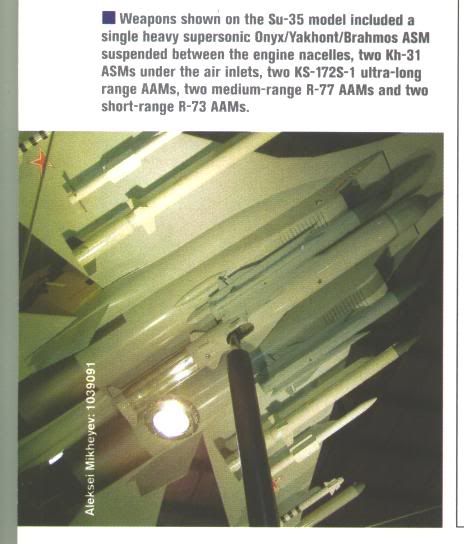
The model of the Su-35 (BM) shown in Dubai in December 2003 carried an interesting armament . A large supersonic anti-ship missile of the Onyx/Yakhont/Brahmos family ( depending on the customers requirement , each of the missiles variants may be used ) was carried between the engines.
Under the wings were two ultra-long range KS-172S-1 air to air missiles developed by the Novator Company of Yekaterinburg. This was the first presentation of this missile after 10 years of silence ( in August 1993 , in Zhukovsky a full-size mockup of the KS-172 missile was shown with the Su-30 fighter ).
The maximum range of the KS-172, stated by Novator is 300 km. The missile is to be used against targets flying at any altitude betwenn 10 – 100000 ft with speeds of up to 4000 km/h and with g-loads up to 12 , including all types of aircraft , as well as long and medium range anti-aircraft missile ( in self defense ). The remaining weapons seen on the Su-35 model were standard Kh-31 air to surface missiles and R-77 and R-73 air to air missiles.
An announcement by the Ramenskoye PKB Company, the manufacturer of avionics for both PAK-FA and Su-35 , said there will not be any analogue instruments in the Su-35 cockpit. In front of the pilot there will be only two liquid crystal displays ; additionally the essential information will be repeted on the pilots helmet screen
adityaTitbit on engines from Su-35BM article:
Maxim Pyadushkin
Russia’s Sukhoi Design Bureau has made the final choice of engines for its new Su-35 fighter. This so-called transitional combat aircraft is expected to meet operational requirements of the Russian Air Force in 2009-2015 before the Russian version of a fifth-generation combat aircraft – the PAC FA, also being developed by Sukhoi – enters service.
In its selection, Sukhoi opted for 117C engines to power Su-35, joining the engine’s development made by a team of Rybinsk-based NPO Saturn and UMPO from Ufa. In June, the Sukhoi Design Bureau and two engine manufacturers signed an agreement to share the costs needed to complete the 117C engine’s development. Under the agreement, Sukhoi will bear 40% of the expenses while the NPO Saturn and UMPO shares will be 30% each. The participants plan to spend about $110 million to finish the engine’s design and put it into series production.
117C engine is considered to be a first step to creation of new powerplant for Russia’s next-generation fighterThe 117C turbojet is a further modernization of the Al-31F engine being installed on various versions of the Sukhoi Su-27 and Su-30 aircraft. The new turbojet combines Al-31F experience with new technologies gained from the development of Al-41F engine during the last two decades. While Al-41F was being developed for a fifth-generation Soviet fighter, the 117C is considered to be as a first step to creation of the engine that will power Russian PAC FA fighter.
Compared to the Al-31F, the 117C has its thrust increased by 2 tons to 14.5 tons, and incorporated a larger inlet diameter, a vectoring nozzle and digital flight control system. At the Moscow MAKS air show in August 2005, NPO Saturn unveiled the engine’s prototype – called the 117A. To date, the manufacturers have produced five prototypes, which have been successfully tested on Su-27LL and Su-30 fighters. Based on the test results, the designers have improved the engine’s fan and flight control system.
Until now, NPO Saturn and UMPO had no government subsidies for this engine’s development. As NPO Saturn’s 117C program chief Evgeny Marchukov explained to the Russia & CIS Observer, both companies so far have spent almost $40 million for design and testing of the 117C.
According to NPO Saturn representatives, the agreement with Sukhoi covers the additional development needed to increase the engine’s service life up to 4,000 hours and the time between overhauls as high as 1,000 hours. Development work on 117C version should be completed in 2008-2009.
The Russian media quoted Vassily Danilov, NPO Saturn’s commercial director, as saying that Sukhoi’s participation in the program “put an end in the choice of powerplant for a new family of Sukhoi combat aircraft, defining the success of both the aircraft and the engine.”In an informal competition to power the Su-35, the 117C beat another contender – the Al-31FM-1 engine, which was promoted by NPO Saturn’s rival, the Moscow-based Salyut. Salyut’s version also has a digital control and an option to install all-directional vectoring nozzle, but has a lower thrust – 13.3 tons. Nevertheless Salyut’s Al-31FM-1 has been chosen by the Russian Air Force to power another Sukhoi product – the Su-34 bomber that enters series production at the NAPO plant in Novosibirsk this year.
Sukhoi plans to start the sale of Su-35 fighters in 2009. In addition to its improved engines, the aircraft (which is based on Su-27 airframe) is expected to feature an Irbis radar with passive-phased array antenna and new avionics. The fighter’s manufacturer hopes that with Su-35, it will be able to give a boost to its export business. Sales of Sukhoi’s former best-sellers – the Su-27 and Su-30MK fighters – experienced as significant drop in the past two years as its major customer, China, suspended further aircraft purchases from Russia.
At the moment, Sukhoi has no orders for Su-35s from foreign clients. The company’s representative explained to the Russia & CIS Observer that the first customer could be Venezuela, which recently started large arms purchases from Russia. But the negotiations with this Latin American country are still at very early stages. The Russian Air Force, considered to be a major domestic customer, has shown no interest in the aircraft to date.
adityaGentlemen,
Sorry I havent read the complete thread – but has the Su-35BM flown? Any pictures – esp of the sting?
adityaThe news of India’s interest in Tu-22M appeared a few years and has died down completely since then. There is a MPA competition on right now, and Tu-22 or likes of it havent been remotely mentioned – yes these are different from MPAs but nevertheless.
IMHO, India would do good by going in for Su-34 Fullbacks and more IFR aircraft. Fully capable of launching Brahmos, they are sufficient for any threat in the Indian ocean. A couple of squadrons for IAF also will be nice too.
adityaNo evidence of vectored thrust nozzles from photos. I suppose equipping Fullback with TVC will require new development due to higher thrust.
The chief designer says the scope of upgrades that can be done in the field includes even the installation of innovative thrust-vectoring engines.
aditya… Anyone know what those white balloon shaped object is in the background (First Pic) ?
Go here: http://www.capcomespace.net/dossiers/espace_sovietique/bourane_energia/transport.htm
adityaThe anti-tank mission became defacto invalid when the missiles expired (they have not been replaced).
Sengupta fabricates stuff but he could also have cut and paste it from somewhere else.
Does any one know if the “Tankbusters” are still Tank-busting, with the AS-11 retired? Can’t imagine them still being at Jodhpur for anything else?
adityaAnyone have better pictures of Tu-22M, Tu-160 from this angle?
Just realised how similar Tu-22 is to MiG-25/31 except size ofcourse
adityaHow can all of you ignore the mighty Blackjack? 😡
adityaA couple of my fav pictures
adityaCan anyone draw up a scenario where a carrier brone MiG-29 would meet PLAN Su-30s?
adityaWhen and where was this picture taken? The direction of the nozzles indicate that it is indeed AL-31FP
What is it for? if they wanted a 2 seater Su-33 why not just do what they did with the Su-27 (put the second pilot behind the first). It seems to lack the dedicated strike equipment carried by the Su-34 (ie radar), making the idea of it being a dedicated striker seem unlikely.
The side-by-side arrangement allows for better/easier instruction for carrier landings and take-off. Unlike Su-32FN/Su-34 this aircraft was concieved as a trainer aircraft with all Su-27K armament retained.
And what about the AL-31FP engines-if they were needed to aid carrier take-off why not install the AL-31FM1 which has more thrust, and besides these appear to be laid out in the same way as on the MKI suggesting they are to improve agility.
TVC on a carrier borne aircraft is a major development IMHO. AFAIK only V/STOL aircraft have had this capability till now….. I assume in Su-33 the TVC will help towards superagility, and not necessarily for V/STOL (unlike SHAR)
At the moment AL-31FP is the most ‘tried and tested’ TVC engine available, which explains the choice. The choice of a two-seater for implementing is obvious, instead of single seat Su-27K.
adityathe beer tent
😀 😀 😀
adityacockpit photo gallery;
http://vayu-sena-aux.tripod.com/gallery-cockpits.html


 Sign In








