 Griffiths911
(Ken, you’ll have to help me with some of the abbreviations: OOW – Officer of the Watch, RPs – Radar Plotters?, TI – Target Indicate?)
Spot on!
Griffiths911I think it’s possible, as a Boeing 707 did. Also is possible that both missiles were fired against the same target.
The Boeing 707 was visual with us, turning and diving steeply when we fired our salvo at a range of 30nm plus. Bear in mind the 707 had been given freedom to fly around the formation of British ships on their first approach and therefore knew exactly where we were at all times when they decided to turn back in for a second look. It was only a stupid ‘Weapons Tight’ weapons restriction order issued by HMS Bristol that saved the ‘Burglar’ from being shot down on their first approach.
The Exeter Learjet was totally different. At high altitude, they had no idea that they were heading straight towards a British Type 42 – it was a classic down the throat shot…perfect for Seadart.
Griffiths911The Canberra pilots said they avoided Sea Darts fired during the night missions on June 1st, 4th, 5th, 10th and 12th.
I think this is another case of aircrew exaggerating their post combat reports, let me explain. With reference to the night Canberra missions my ship HMS Cardiff constituted 50% of the Type 42 contingent on the dates quoted. HMS Bristol had Seadart but was not tasked with inshore night missions throughout her time down south and only one of the Type 42s were detached from picket duty at any one time.
4 June: Cardiff on NGS gunline Bluff Cove – no Seadarts fired.
12 June: Cardiff in San Carlos – no Seadarts fired.
Without looking to see where Exeter was on the other nights in question , how do you explain the airborne Seadarts on the 4th and 12th June?
Griffiths911I think we deployed late December 1982. I really could not tell you what a Canberra undercarriage looks like therefore I didn’t know what I was looking at back then.
Don’t get too drawn in by the Lively Island thing. I have asked Falkland Islanders via the SAMA82 site if they knew anyone still alive who lived on Lively Island in 1982 (Falkland Islanders move around a bit) and if any are found could they ask them about a possible Canberra crash. I got nothing back that indicated anyone had any information about a Canberra crash on Lively Island, also, one would expect to have seen a picture of the wreckage on the internet by now.
nazca-steve, don’t take this the wrong way but I get the feeling that no matter what evidence is produced about various disputed engagements there will be no way of persuading the Argentinean military, past and present, that the official post combat reports by the pilots of the day were, in some cases fundamentally flawed. Even today twenty-seven years on Argentina cannot accept that an Exocet did not damage HMS Invincible.
That aside, I am more than happy to discuss what I remember about my time back then.
Call me Ken or Griffiths911…Griffiths is my surname and you are giving me flashbacks to my very junior navy service. :D:D
Griffiths911Do you know where B-108 came down and also the location where the partial remains of Captain Casado were found?
On my second deployment to the Falklands in 1982 I went ashore on Lively Island and was shown part of an undercarriage that the locals said was from a downed Argentine Canberra. They told us the Canberra crashed with such force the earth shook noticeably. Can they be right about it being a Canberra? Did any other Argentine aircraft crash on Lively Island?
Did you know that Cardiff’s pennant number was D108?
Griffiths911Fascinating information from all involved and has cleared up a lot of my questions about this incident, even if the jury is still, and potentially always will be, out on what exactly was fired at who.
I had no idea that B-108 was potentially severed in two by the Sea Dart, in fact I’m curious to know where that info came from. My guess is that it might have broken up after Pastran ejected, or broke up on impact. I wonder then, did the Royal Navy find some wreckage from it? Is it also possible (bear with me here, total civvie question) that radio transmissions could have been interecepted? I ask this because Pastran was captured shortly afterwards, and I wonder if the RN knew he had ejected? Sharkey Ward talks about the ‘muerta negra’ transmissions in his book, so perhaps RN personnel heard that Pastran was ejecting…
To be quite frank there is no speculation on the Royal Navy side about who shot at who that night. There is some mystery as to why HMS Penelope’s crew perceived that an air to surface missile had attacked them but that apart the rest is very simple. One Seadart missile was fired by the only Seadart fitted ship within range of the attacking bomber formation and escorts (let us not loose sight of their mission that night) and that ship was HMS Cardiff. Some of my memories that relate to that night/morning are bound to be flawed but not the fact that Cardiff shot down B-108 with a single Seadart at a range of 32nm. I so am confident of this I could bet my life on it.
I cannot recall where I got the information about our Seadart breaking B-108 in two but the impact speed combined with the expanding rods mentioned by Creaking Door would have caused a fair bit of damage. I would be interested to hear, in his own words what Captain Pastran experienced when his aircraft was struck.
I have no idea if our Comms Tech boys were listening to the Arg pilots, sorry.
Interesting questions.
Griffiths911#454
What´s about Tinkler´s book claim of an Exocet falling 400 yards from them in this raid? Do you think he is wrong? Or perhaps he mixed the date of the failed MM-38 Exocet attacked from shore on 1st june?
I did not know that the late Lt. Tinkler had written anything about this incident, it is the first time I have heard about this. Avenger claims she shot down the Exocet with her 4.5″ gun. I doubt that happened and think the missile was seduced by chaff, ran out of fuel and ditched into the sea, but nowhere near Glamorgan.
According to FAA pilots, the visual range was about 8-9 miles that day. But although low, they had a better point of view flying over 30-45 feet higher.
I recall it was a bright, clear and brisk day with good visibility…good flying weather.
I suspect you were NE from Exeter. This would let you to see the raid from left to right. Also let to see the Sea Darts following a NW to SE course. But
15 miles doesn´t match. If then, you should have shot at them. It would be in the range of you Sea Dart. Except for a failure in the system (not rare at all). A kind of triangle: Avenger south. 12,5 miles NW from her Exeter and in an unknown distance but just north from Avenger and NE from Exeter, Cardiff.
The distance to detect a low level raid must be around 25 miles at most (the horizon radar is around that distance for very low level target as this was). You place the target at 15miles. So your relative position from Avenger could be in the range of 15-25 miles. What do you think? Is it reasonable?
You could well be right. Again, I was not officially on duty in the radar room and witnessed the attack standing behind a seated radar operator. I was not orientated properly and got a series of strange ‘snapshots’ of the event. If you asked me tomorrow what I witnessed I would say that we detected the raid at around 20nm they were very intermittent contacts with Exeter’s link 10 data ‘dancing’ around them. We did not achieve a lock up with our 909s. They passed us to Starboard around 15nm. I’m sorry, I know I must be wrong but that is how I remember it.
I tell you my particular point of view. Mirages were some miles behind Canberras. Only one of them turned on his radar in order to follow “Bacos”. So we have two separated pairs of planes. The leader of second pair emiting a Cirano IIB radar signal with his wingmen following him in visual contact.
The ingress route was from Lively island to Mt Longdon. When Canberras dropped their bombs from high altitude (40000 feet) probably made it from a medium way betwen Fitzroy and Longdon. Then, turned 180º to come back for the same way. This means that Mirages, which were separated from them some miles, probably never overflew farer than Fitzroy.
By the other hand Canberra fell to sea south Fitzroy so probably impacted just north from it while heading south. Cardiff detected Cirano IIB emisions.
Is there a possibility that Cardiff engaged the southern pair (Mirages)?
I remember (don´t ask me where) discussions on the net (I know not the best source) about this that placed Exeter on scene. Exactly north, north-east of Stanley. Do you have a way to contact your friend on her to confirm they weren´t close to shore that night?
I have been in touch with my friend who served in Exeter 1982 for many years. There is no question (100%) that Exeter was not inshore that night/morning. However, this could be important – I recall an email sent to me by Rear Admiral Harris (Commanding Officer HMS Cardiff 1982) in 2007 in reply to my query about this incident. He thanked me for the letter that had been printed in the aviation magazine ‘FlyPast’ where I attempted to put the record straight about the Exeter/Cardiff error. He also said that our Seadart flew over the island to reach Canberra B-108 and I’m quite sure he said that we were positioned North of Port Stanley. This would make total sense with regard to the overland flight of the Seadart.
Sadly, I did not save that email, however, I am sure I sent a copy to Creaking Door who was pivotal in getting my letter printed in FlyPast, he may recall reading it or indeed still have a copy?
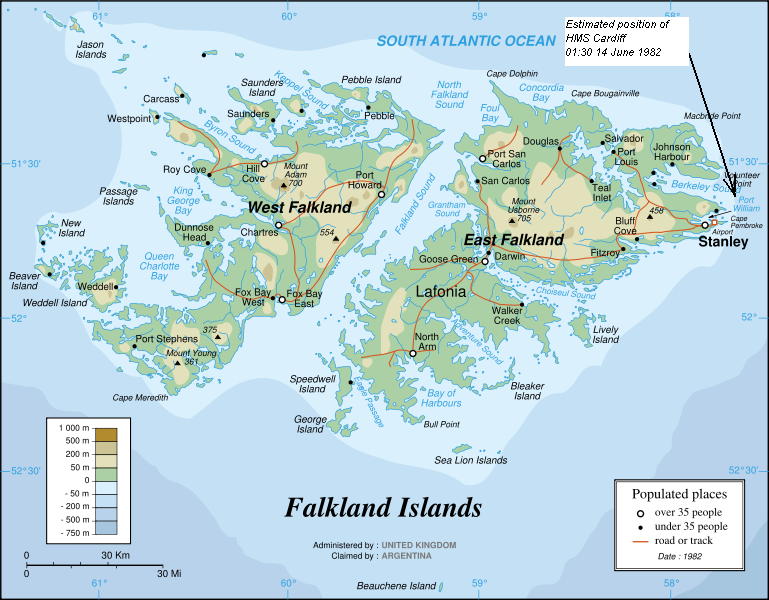
I have updated my map accordingly.
Penelope launched Sea Cats or chaff rockets against the suposed hostile missile they saw. Could it be your Sea Dart flying from east to west heading for the target (according to your map)?
Were short range Sea Cats the missiles seen by Mirage pilots?
Yes Yes! I have argued this view with a radio operator who served in Penelope 1982. He was very annoyed with me. He is convinced that an Israeli Gabriel? (unsure) missile that was purchased by FAA was fired at them, how bizarre is that? I am convinced they saw our dart and thought a missile had been fired at them and the missile they saw at close range was a rouge close range weapon.
I forgot to mention that HMS Yarmouth was inshore conducting NGS that night also.
Aaargh!…The fog of war :rolleyes:
Griffiths911Very interesting, esp. the range of 32nm when the Canberra was hit. That is a lot further than I thought. Griffiths, from what I have read, the Argentine radar control at Stanley also thought a Mirage had been downed, it was not until a bit later that repeated attempts to contact ‘BACO 2’ failed and they realised B-108 was down.
What is also interesting is this talk of the Mirage escort having to avoid these multiple SAMS. I’d be curious to know whether this was inbound to the target or outbound. From what I read, the Cans were lit up after the bombed and turned for home, and then hit very shortly after this turn. Not being a Sea Dart expert and knowing the speed of travel for 32nm, one would think this implied they had been lit up prior to this turn and fired on before. Maybe Griffiths can confirm his thoughts on this. Also the sad irony that the very escorts sent to protect them were responsible in way for the detection of the whole flight.
Either way, it just shows what a tough old girl the Canberra was to take that Sea Dart hit right near the No.1 fuel tank and not just outrightly explode. Very brave of Captain Pastran to buy as much time as possible for Capt. Casado to eject, which sadly was not to be.
B-109, the other Canberra in ‘BACO flight’ claims it had a hell of ride home and had to avoid AAA and more SAMs, using their countermeasures. This certainly doesn’t tally with the single Sea Dart launch that night, but then who’s to say what one might mistake in such circumstances.
Jualbo, thanks for the info as well. I heard that the 2 Para man had damaged ear drums, or possibly that was from an earlier raid in May. Graham Colbeck in ‘3 Para to the Falklands’ remembers the sound and concussion from one of the night bombing raids prior to Mt. Longdon. I wonder if this Eagle Base attack is the same incident? My records also show a telephone exchange was damaged in one raid – need to check the date on that.
We detected this raid way out on our aged 965-surveillance radar. They appeared on that radar as one ‘long’ contact and were locked up by both our 909’s for what appeared to be a long time. If my memory is right they were flying at 26,000ft…the aircraft we were locked onto that is. They just kept coming and coming and I remember that before we fired one or two aircraft (it’s hard to tell with 965 – wavelength 1.2metres) turned away which left one contact (again hard to tell) that continued towards our Intercept Point (IP). We launched as they approached, however, B-108 may well have been turning at the time the missile impacted. After releasing a solid rocket fuel booster which is around 8nm Seadart flies at mach 2.5. It is not possible that Seadart engaged B-109 on their return leg but if the pilot looking over his shoulder at the war fighting on the ground…who knows what he thought he saw.
This is where I estimate Cardiff’s position was at 01:30 (GMT) 14 June 1982:
Shortly after the conflict I was informed that our Seadart severed B-108 into two pieces but Captain Pastran stayed with his aircraft by now spinning madly out of control and he ejected at around 14,000ft. Is this likely? If any of you have read the books written by Rear Admiral Woodward and Commander ‘Sharkey’ Ward you will read that HMS Cardiff and a single Seadart destroyed B-108 that morning (GMT).
Griffiths911Hi Griffiths. A very interesting post. This attack is like a puzzle in which we try to match all pieces. And sometimes they doesn´t so we have to imagine the most logical explanation to facts that as you well say happened 27 years ago.
Do you remember if the incoming planes seen on the radar screen wer coming from left to right or just the opposite? That would place Cardiff on the east or west of the raid ingress trajectory.
I didn´t know about Sea Darts fly profile after being launched. VLS missiles go up and the turn into the way of the incoming target while go down. In a directional launcher, missiles use to be launched almost horizontal. But I told you dídn´t know Sea Dart particular case. I see you have a great security about what gun crews fired at. Totally discarded that targets gunned were a possible chaff rocket fired by other ships in the zone? Some time, argentinean pilots missidentified them as SAMs.
By the other hand your account on 13th june raid is also polemic. Brown says in his book that Penelope and Norland were in the zone and were fired a missile that fell to sea close to them. Argentineans didn´t so it´s suposed an erratic SAM froma ship. The incoming raid came from Lively island towards Two Sisters and then turned 180º to come back home. As you say, Mirage pilots reported many missiles fired at them while flying 30000 feet, so Rapier and Sea Wolf or Sea Cat must be discarded as a possibility. Some authors mention Exeter in the zone, but you place her in the ring around Task Force. Interesting your account. One of Mirage pilots (Sánchez) mentions an erratic missile.
About Canberra ops, I would mention that in the last raid a british soldier (Para 2) was hurt. It was the unique mission flown with an escort. They were also the planes that in 8th june attacked VLCC Hércules, hitting her with at least one bomb. Some argentineans sources talk about another succesful mission of this planes over San Carlos area on 26th may in which one tent was destroyed and some material damaged close to a helicopter base called “Eagle Base”. It would be interesting to be confirmed or not by our british friends. Canberras flew with two fly profiles (High or low) and from 1st may they only flew over the island at night. Used to be armed with 5 to 8 Mk-17 bombs except for the last mission in which soviet made bombs supplied by Perú or Lybia, were used.
Always nice to read you.
(I) Do you remember if the incoming planes….
My memory may be wrong here because I remember the raid being 20 or so degrees on our starboard bow tracking left to right passing 15nm to starboard. This does not fit with what I have read recently but that is what I remember.
(II) I didn´t know about Sea Darts fly profile….
My use of mortar bombs to explain Seadart’s flight profile when fired at a low flying target was exaggerating a bit. What I should have said is Seadart arcs skywards significantly when launched against surface targets and low flying aircraft before impacting in diving trajectory. This is not the case for high-level engagements.
Our gun crews opened fire to Starboard at flashes on the horizon. There were only three ships in that vicinity, Cardiff, Exeter and Avenger (transiting towards the inshore gunline) and none were in visual range of Cardiff. It is not possible to see a ship launch chaff beyond the visual horizon.
(III) By the other hand your account on 13th june raid is also polemic….
Cardiff was not in company with the frigates inshore that night which included
Penelope, Avenger, Ambuscade and Active. These little warriors were conducting Naval Gunfire Support (NGS) or on escort duty. Is it possible the pilots were seeing muzzle fire and fall of shot from 4.5″ shells, not to mention all the ships launching chaff including HMS Fearless? Some distance offshore away from all this commotion Cardiff, the only vessel that could have caused any damage to the enemy formation launched a single missile, it was a very calm and simple engagement. I was reporting the raid to all ships on HF radio and one of the carriers launched a single Harrier that eventually turned back as it had no chance of catching up with the outbound raid. It has always been a mystery to me why the Arg pilots reported what they say they saw and I suspect they did not see the single Seadart that impacted with B-108.
Griffiths911In the last night of the conflict a bomber mission integrated by two Canberra and two Mirage IIIEA as air cover was lunch on the 13th night.
They could drop theirs bombs but one of the Canberra was shot down by a Sea Dart lunched by the HMS Exceter.
The Camberra commander could bail out, Capt Pastran, but the bombardier/Navigator could not so he perished after the crash.
Pastran could rich the shore and he was took a war prisoner after the end of the war.
Thanks for the information cosmiccomet.
B-108 was shot down at 01:30 (GMT) 14 June 1982 by a single Seadart fired by my ship HMS Cardiff. The missile impacted the Canberra at a range of 32nm from Cardiff.
Argentine accounts of this event include multiple Seadart launches with dramatic evasive manoeuvres by the fighter escorts. I was on watch that night and witnessed the whole thing from beginning to conclusion. We were not in Choiseul sound as was the perception of the Arg pilots but offshore south of Port Stanley on radar ambush for C130 inbound flights. Incidentally we thought we had hit a Mirage as it was their radar that our UAA1 (ESM) equipment detected and thus alerting us to the approach of this formation.
HMS Exeter was on picket duty with the Task Force, Cardiff was the only Seadart fitted ship in the area that night.
Well, there it is, another controversial account for you to ponder over.
Thanks again.
Ken.
Griffiths911Thanks a lot for your answer Griffiths911. I thought your mention to “gun crew” was refered to the vickers 4,5″ one. My english must improve 😉
the Sea Dart range I was talking about effective range against low level targets. More or less the horizon radar. If I would be the Task Force commander I wouldn´t place two type 42 less distance than the double of such a effective range at low level. In that way both ships would cover totally his horizon with no gaps betwen them. That´s why I think les than 50 miles betwen 2 Type 42 appears to be not logical except for a transit. In a more or less static defensive position in the outer ring, they had to be further than a visual range such a one that let Cardiff gunners observe and even fire against Exeter´s Sea Darts. And even more, if you watched it means you were more or less closeAbout to the trajectory the missiles followed from NW to SE.
Thanks again.
Regards
Thanks for the reply jualbo. Let me explain a few things that need to be aired to get a balanced perspective of my input to this forum.
I was a 19-year-old inexperienced Able Seaman (Radar) back in 1982. I had no tactical/warfare qualifications or training. As I participate in this interesting thread I am recalling experiences that happened almost 27 years ago, some of the details from back then are vague and some as clear as if they happened yesterday.
Now, I do know that the picket 42s were not stationed 50-60nm apart. I do know that on the 30 May 1982 our gun crews fired at FLASHES on the HORIZON and those flashes were Seadart launches from Exeter. Don’t forget, when Seadart is launched against low level targets it takes a flight profile that resembles a mortar bomb…straight up and comes down on the victim from above, it does not fly straight towards the target. Were you aware of that? Also, the effective range for Seadart against an aircraft flying at more or less sea level in open sea would be around 15-20nm, we didn’t detect them till about 20nm.
On that day I was not on watch when the ship went to full action stations but did go to the radar room and watched the attack, standing behind the Target Indicator Operator. I had no time to familiarise myself with the fleet disposition or other tactical information. I saw the attackers fleetingly and everything looked very confusing as I tried to make sense of what was going on…I had been sound asleep only fifteen minutes previously. My point there is, I may have some of the ranges wrong but I can only tell you what my memory tells me and I have been fairly accurate with my recollections in the past.
I repeat to you that our gun crews fired at ‘flashes’ on the horizon and those flashes were Exeter’s Seadarts arcing skyward toward the incoming raid.
Please do not think I am upset or annoyed by your questions or observations…I welcome them as I learn a lot from you all.
Regards.
Ken.
Griffiths911Good Morning Ken , How are you ?
Have you heard anything regarding F 4 Phnatoms deployed in Chile during the Confict ? Or it may still be in a close Folder ?
Thank You regards Enrique
Hi Enrique,
I’m well, thank you for asking. Thunderbird167 has posted much more on the subject than I ever could.
Changing the subject, could anyone tell me what kind of aircraft this is and where were they deployed on the Islands?
Regards.
Ken.
Griffiths911Hello everybody.
I´ve been a long time without reading the forum. Last days I made it. You´ve talked about many interesting things.In the 30th may attack, Griffiths911 talked about Cardiff firing 4,5″ shells against Sea Darts launched by Exeter.
But these ships are both Type 42, so they are believed to be separated around 50-60 miles in order to aproach all Sea Dart performances (suposed to be around 25-30 miles effective range in the 1982 version) and act as a real antiair warfare vessel. Didnd´t happen in this way that day?In that case where Cadiff was respect Exeter to be able to fire 4,5″ gun against Sea Darts? The raid came from SE towards NW. Sea Darts are believed to be fired from almost the opposite direction (W-NW to SE). Argentineans planes turned to SW after passing the target abd didn´t report to watch any other ship in that way. By the other hand, Cardiff had to be placed close enough from the trajectory of Sea Darts. Anyway she hadn´t fired against them with a relative short effective range weapon in the antiair role as Vickers 4,5″ is. And is also suposed to have any collapsion with her own Sea Darts, the primary AA weapon. What do you think?
Another question. In David Tinkler letters book, he, a later killed crewmember from Glamorgan, says that the AM-39 fell to sea just 400 meters from them.
Where were them? It´s puzzling.Regards and happy New Year (a few late)
I did not say that Cardiff fired 4.5″ shells at Exeter’s Seadarts. I can’t find the post you are referring to but if I could I’m sure I would have said that in Cardiff we were “firing” at the Seadarts launched by Exeter.
Our gun crews on the upper deck, 20mm Orlikon and up to 15 crewmen armed with SLR’s converted to fire fully automatic nervously opened fire on flashes they saw on the horizon (Exeter’s Seadarts). We were clearly not 50-60NM away from Exeter and the range of Seadart in 1982 was not 25-30NM (Cardiff shot down a Canberra at 32NM and just missed a 707 at 35NM +). I can still hear the frantic shouting of the young officer on the intercom as he saw the flashes on the horizon but did not know their true range or what they actually were. He screamed “Alarm missile……” and obviously thought it was an Exocet. The upper deck gunners, by now confused and very twitchy opened fire.
It happened my friend. It happened.
Please excuse my editing but here is what I originally posted on a previous thread about that incident titled
Falklands Aircraft Kills.
No mention about 4.5″ shells:
I remember this day well. I was off-watch when we went to action stations and went to my off-watch station (spare hand, Junior rates dinning hall). I stayed there but ended up being the only one left………I got scared so went to the Ops Room and stood behind George Foster (TI Operator) and watched the attack on radar. We saw the exocet on radar (19nm…I think) and all hell broke loose. Exeter was firing Darts which became visible to our gun crews………a young Sub Lieutenant screamed on the intercom “Alarm Missile……..” so all the gunners started to fire at the Darts (miles away and well out of range). After a few moments of bedlam……Ops Room trying to get a ‘lock’ on the radar targets and the gunners firing at friendly missiles the Captain asked the young officer for a visual update and got the reply……..”Sir, I don’t know what the effing hell is going on!”. The Captain was very calm and his eyes were ‘smiling’. It was all over in a flash……….and I wish I had stayed in the bloody dinning hall.
Griffiths911Slightly off thread but for those interested in Falkland/Malvinas related stuff:
Griffiths911Think Sea Eagle became operational in 1985 (ish).


 Sign In







