 Griffiths911
Ref#258
Enrique,
That sounds great. For me participating in this forum is a daunting experience. The people who are posting her are very clever and knowledgeable on a variety of subjects and I sometimes feel out of my depth. I have not researched the Falkland/Malvinas war to any great degree and am mostly limited to knowledge I have from my ship’s actions and those of my friends on the Discussion Board of the South Atlantic Medal Association 82 web site. There are lots of information posted there by men who were in the army, navy, marines and the RAF down south and I will be more than happy to share this information here.
Regards.
Ken.
Griffiths911I’d be interested to know more about your nightly replenishment flights to Port Stanley, I believe F-28s were used as well as C-130s.
That would be interesting. We (HMS Cardiff) spent quite a few nights waiting in ambush for the C130 off Port Stanley. Each time we would close after dark…just sit and watch:
30 May Nothing.
31 May Nothing.
02 June Fired 2 Sea Darts C130 inbound – missed. Fired 1 Sea Dart at C130 outbound – missed.
07 June Nothing.
These guys were flying very low and using the land to hide their approach. By the time the lads saw them and we got a missile away it was too late, must have scared them a fair bit though, assuming our missiles got any where near them!
Griffiths911#246
What an interesting and detailed article. It took me back to my ASW days with 814 Squadron, just before I left the navy in 1995. I ended my service as a Fleet Air Arm Aircraft Controller…I provided tactical and safety radar control for embarked Seaking and Lynx helicopters, mostly from HMS Invincible.
I am amazed that this contact was only classified as Possub low 2/Possub high 3. They have a radar contact with what they think is a periscope (riser) and then a visual with said riser. They have contact on active and passive independent sonar plus mechanical noise (clanking) from LOFAR sonobouys. Having already dropped one torpedo, they continue to prosecute this contact for a while, even managing to get nine MAD (Magnetic Anomaly Detection) runs in to further classify this contact before dropping another weapon. And after all that it is still classified low 2/ high 3.
You sound as if you have more than book knowledge on the subject of ASW. Does something not seem right with you about the classification?
On the other hand I have been out of it for years and was only becoming barely competent on the subject of ASW when I left the service in 1995 :rolleyes:
Regards.
Ken.
Griffiths911You may think that a 20′ container full of electronic inside plus a 25 foot tall antena on top turning at 6 rpm would give your spoter the clue that it was a radar – No , not al all it was de smell of coffee that betaryed my position –
Regards Enrique
You had time to drink coffee! We were too easy with you guys :D:D
Regards.
Ken
Griffiths911Enrique…11 June
The Captain of HMS Yarmouth wrote in his diary:
Friday June 11th INVASION DAY + 21
It’s now 3 weeks since we re-invaded. Reasonably quiet day today. We did a RAS (A) with Fort Grange to top up with 4.5 ammunition. Then we headed once again to the gun line. ARROW and GLAMORGAN were in company, ARROW was going to the Northern gun line and ourselves and GLAMORGAN were heading for the Southern gun line where we were to meet up with AVENGER. We did the trip at 28 knots all the way so as to get there as soon as possible to give the guys ashore the best opportunities to get as far as possible. Each ship is programmed to fire approximately 300 rounds each. We have been informed that there are 6 of our batteries of 5 150mm set up ashore and they will fire about 1000 – 2000 rounds per battery, consequently I would not like to be an Argentinean tonight. If everything goes well Port Stanley should be ours in a few days.
Griffiths911REYDELCASTILLO
Cardiff had not reached the Falklands by 1 May, however here is a paragraph and a link that may help you:
The other three ships, the destroyer HMS Glamorgan in company with the frigates HMS Alacrity and Arrow, approached the coast of East Falkland just to the east and south of Stanley. Using their main gun armament they began a bombardment of the airfield and its surrounding area. All three ships hit the aircraft parking area first, before switching to engage individual targets. These included the road from the town of Stanley to the airfield as well as suspected radar and gun positions north and south of the town.
These three ‘Musketeers’ were attacked earlier in the day and returned to the gun line after dark to show that they were not deterred.
Griffiths911The Falklands and a lucky escape for a nuclear sub
Commander T M le Marchand, captain of nuclear submarine HMS Valiant, remembers the conflict:
Valiant was on a deep and fast passage across the Atlantic when Argentina invaded the Falklands. News does not travel easily to submarines when deep, and it was by means of the BBC World Service that we discovered the reasons for the Prepare for War signals that had emanated from the Flag Officer Submarines.
Perhaps we could go straight down there . No, after two months at sea there was not enough food – as ever the human machine is the limiting factor in a nuclear submarine. So the plan evolved: get home fast, top up with stores and torpedoes, and deploy for a long trip, which in the end was to last exactly 98 days under water.
Earnest preparations at base ensued. Our weapon system was upgraded to the most recent Tigerfish development, stores and provisions for 95 days were stuck down below, and one member of the ship’s company married his fiancee. From the outset, we were utterly convinced that this was going to be a shooting war, and that our task was going to be to take the Argentinian navy out of the equation.
The submarine entered the war zone on May 1 after a high speed transit south. Drills every watch on attacking and torpedo evasion had made us confident that we could do our part; recognition was honed – strangely difficult when our enemy had until recently been friends: it has always seemed `not cricket’ to gather intelligence on those whom one expects to be on one’s own side.
More importantly we practised and became very skilled at operating the Tigerfish Mod 1 weapon system – in effect an underwater guided missile – which was to be our prime weapon against all targets, surface or submarine. Not for us the World War II Mark 8 – which was in fact the weapon which Conqueror employed with such devastating effect against the Belgrano.
On one occasion, whilst at periscope depth, we suffered a near miss from a stick of six bombs, the fourth one of which was close enough to spill cups of tea. Having to assume we may have been detected, though there was no other indication that we had, it was prudent to get some distance between us and where it happened. We later assessed that it was returning aircraft jettisoning their unused bombs before landing back at base that had so nearly scored a fluke hit. The moral was to get off track from their return route. We were lucky, but a few feet closer and it might have been something of a bad luck story.
A word about the ship’s company. We numbered 105, and kept to a six hours on, six off watchbill for the whole deployment. Keeping the highly sophisticated but 21-year-old nuclear submarine at peak performance for night after day was a fantastic achievement. Heroes daily dealt with steam leaks, hydraulic bursts and even the odd fire; one person, the smallest man on board, had to slide 12ft down between the pressure hull and the port main condenser (a space of nine by 18 inches cross-section) to replace a flange from which steam was leaking. Unrepaired we would not have been able to use full power – a crucial get-away requirement.
Discipline and morale were outstanding – the more so because no one was conscious that such characteristics were under trial. Throughout the deployment all were acutely interested in how the `real battle’ was going and determined to do all possible to contribute. There were no defaulters; no one was even ill.
Valiant returned to base in Scotland in early August. There was one single frozen chicken in the ship’s fridges.
Griffiths911Going back to picture # 1
HMS Cardiffs after a night of Naval Bombardment – Picture taken on June the 7 th , bombardment must have been night of June the 6 th –
Question : Where at the bombardment , remember which targets ?
Regards Enrique
We closed the gun line around midnight near Bluff Cove. We fired 277 rounds of HE. A SAS spotter ashore was reporting our fall of shot but I do not know what where the locations were. However I do know the targets included gun emplacements and troops dug in.
Regards.
Ken.
Griffiths911Enrique,
7th June 1982.
0810 hours.
Two reconnaissance Argentine Learjets of FAA Photo Reconnaissance Grupo 1 are engaged at 40,000ft by Sea Dart from HMS Exeter over Pebble Island. One of the Learjets, 35A is destroyed and Wg Cdr de la Colina and his crew are killed.
This link may help you with dating issues and there is some interesting information here: Britain’s small wars
Please note that there are some time/date differences e.g. Canberra bomber was shot down at 01:30 14 June (GMT), 21:30 13 June (Buenos Aries time). The British were operating in GMT.
Regards.
Ken.
Griffiths911We had just shot down one of our own helicopters killing four British army guys…very sad indeed. The Ministry Of Defence have released the official Board Of Inquiry document, previously SECRET but now made public under the twenty-five year rule. You can also read the BOI about the sinking of HMS Antelope, HMS Coventry and Atlantic Conveyor. I hope these documents will be of interest to you and your colleagues:
Griffiths911Its me
It is nice to see your face 🙂
Griffiths911Enrique,
I know that you and your countrymen find it difficult to believe that bombs from those two A4’s did not hit Invincible but your pilots were wrong, very wrong. Even though I witnessed that attack on radar I cannot remember the positions of the ships…we were looking at an air picture not a surface picture and I was off watch but went to the operations room when action stations sounded. I stood behind the Target Indicator operator (the guy who tracks targets allocated to Sea dart). We, the British have no need to theorise the attack; the only mystery is whether Avenger took out the exocet with her gun or did it get distracted by chaff and run out fuel. Avenger’s crew say they hit it with a 4.5″ shell…I doubt that claim.
The attack was a complete failure; the exocet was fired and missed. Two out of the four A4’s were shot down and the pilots killed. The remaining two A4’s bravely attacked a ship they thought was Invincible and dropped bombs. That ship was HMS Avenger…why they mistook it for an aircraft carrier is amazing, truly amazing. It was, however, a very brave attempt and could have succeeded if the SuE’s had continued for another 20nm before making their left turn on the final leg of the attack…that would place them behind the pickets? Now, that would have been an entirely different story.
I might add that I am more than happy to discuss any of these issues with you my friend. If you have any questions, even if you think they may annoy or upset us, please, please get them off your chest and ask.
Regards.
Ken.
Griffiths911Nice photographs…..as always! 🙂
HMS Hermes looks in quite good condition here (as opposed to the way she looked when she returned to the UK) was this taken on the same day as the one of HMS Invincible?
This was not taken by me and is Hermes leaving Ascension on her way south. I’m pleased that you enjoy my pics.
Griffiths911Enrique,
Are you Arg intelligence services?:confused:
Griffiths911Enrique,
I see your logic but I think you may want to consider this:
(i) During the conflict the Royal Navy operated a ‘layered’ defence posture around the High Value Units (HVU), now known as Mission Essential Units (MEU’s). It starts with the Missile Engagement Zone (MEZ) 40nm around the HVU, however, because one of the HVU’s (Invincible) had medium range SAM’s (Sea Dart) and was in company with Bristol, also fitted with Sea Dart, the MEZ could be extended. The ‘picket’ ships (Cardiff & Exeter) could be stationed further down threat at around 20nm from the formation centre, effectively increasing the range of the MEZ. There is also a Fighter Engagement Zone (FEZ), Cross Over Zone (COZ), transit corridors etc. etc.
(ii) Why would a commander station his ‘pickets’ 10nm away from other medium range SAM’s in his force (Bristol & Invincible), effectively reducing his reach to shoot down an attacker?
(iii) Originally, Avenger may have had the station you mentioned but it would have been very close to the formation centre and as I have stated she was in no sector when the attack commenced but had left her station and was in transit towards her night time position (gun-line) to shell Argentine targets. I do not recall exactly the range Avenger was from Cardiff during the attack but I think she was within 10nm from Exeter.
You are more than welcome to post any pictures you see here. I will post some tomorrow. Tonight I am going to a party and will be dancing and drinking lots of beer…I will have one for you Enrique;)
Regards.
Ken.
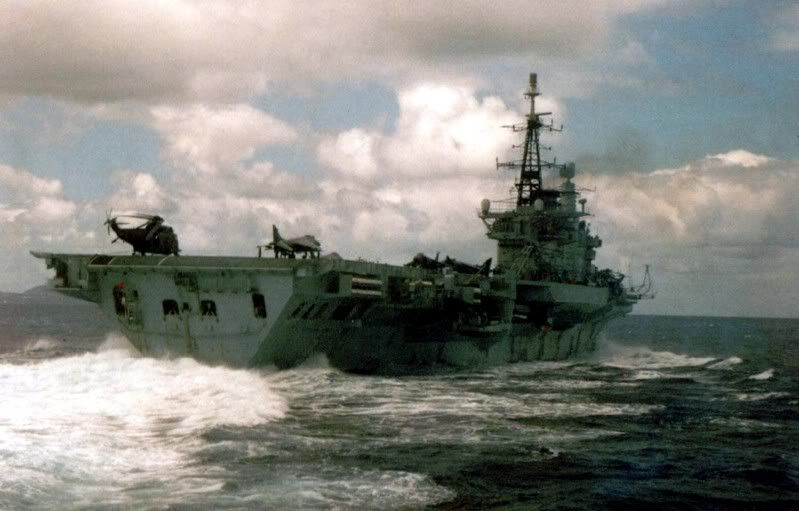
Don’t forget HMS Hermes:


 Sign In







