 Griffiths911
Perhaps one RAF aircraft that should have ‘pride of place’ in any flypast is Chinook HC1 ZA718 ‘Bravo November’.
This was the only Chinook to survive the destruction of Atlantic Conveyor by Exocet and was the only Chinook available to the British forces until after the end of the war.
Last sighting I had ZA718 was still earning her keep (23 years later) out in Iraq!
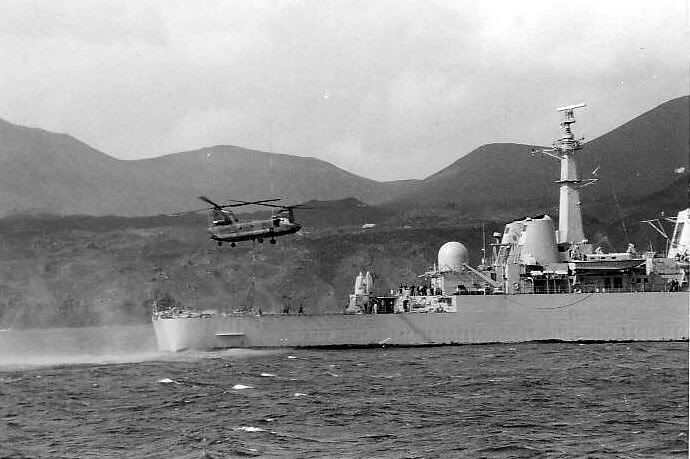
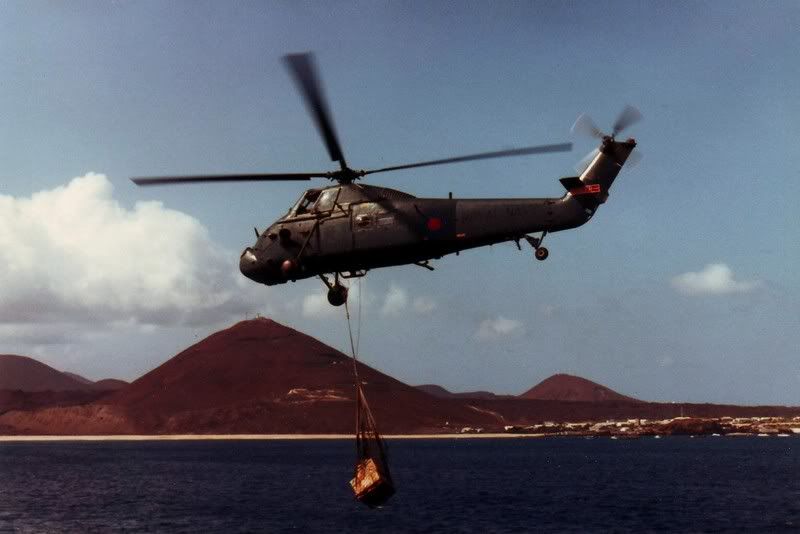
Yes, would be nice to see her or any veteran rotary wing in June. Here is Bravo Hotel 1982 on the apron at Ascension and at work supplying the Bristol Group on the way south. Also a ‘Wezzy’ (my favourite) with an underslung load for HMS Cardiff. Is Bravo Hotel still operational?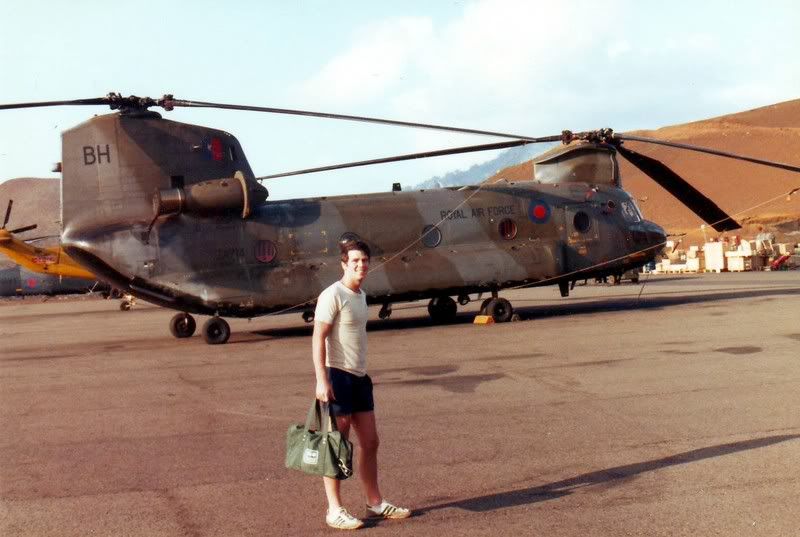
Griffiths911Many thanks Bex.
Griffiths911Taken by me at Ascension Islands on the way South: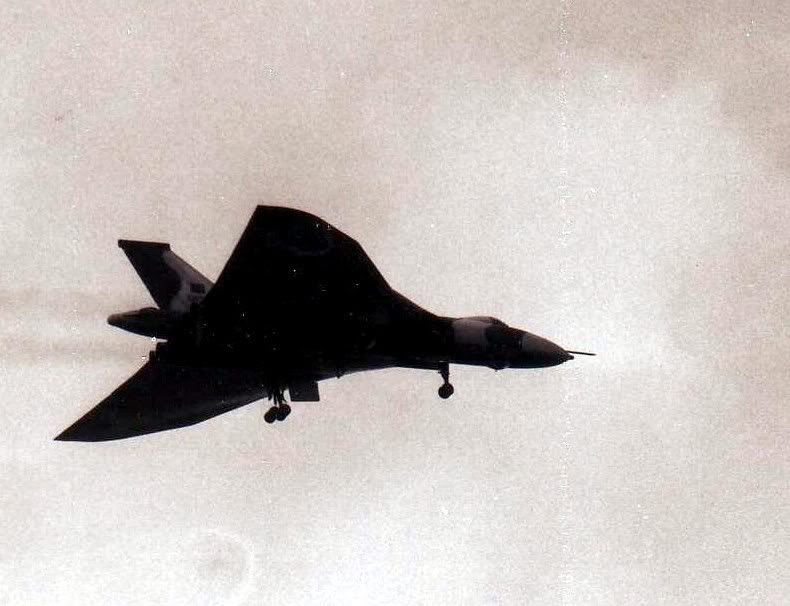
Griffiths911Now what was the thread here……………..oh yes, will the Sea Harrier be flying June 17th?
Well I hope so!
I’m going to be proudly marching that day, hopefully with a couple of thousand of other blokes who took part in liberating the Falkland Islands from the Argentine invader. I say ‘proudly’ because I am bloody proud of the fact that we did our duty and did it well.
I will not react adversely to some of the ‘bizarre’ comments I have read here.
Regards.
A proud sailor of the South Atlantic Task Force 1982.
p.s. I took this picture at the Ascension Islands on the way South.
Griffiths911I thought it was excellent, a real insight into the thought process of the Task Force commander.
It was particularly good on the war from the viewpoint of the frontline ‘picket’ Type 42 destroyers (Woodward had once been captain of Sheffield) and also particularly good on the reasons and practicalities behind the sinking of Belgrano (Woodward was a submariner by trade).
Thanks, my Captain was a submariner also; I think they make excellent tacticians.
Griffiths911I’m going to buy it tomorrow……………….watch this space.
Griffiths911Ok, I’ll trust the Admiral….we did back then. Is it a good read?
Griffiths911Sheffield’s Air Team would have had two operators watching 965 (on range 256nm) and two watching 992 (on range 64nm). Two of these four guys would be switching down range as contacts appear and close. So when you are looking at 965 set on range 256nm and even assuming one may have been looking at 128nm range it is unlikely they would spot the SuEs ‘pop-up’ at 40nm. The two operators on 992 at 64nm (one may have been looking at range 32nm) are more likely to have spotted these targets.
Now, Glasgow is a different matter. What range from Sheffield was she at the time of the attack? I would suggest she would have been spaced at least 60nm away on the ‘outer-screen’ and down threat (SW & NW of the Main Body) with Sheffield…………she may have spotted the SuEs on 965?.
Griffiths911That sounds familiar to me. One thing though, are you sure it was the 965 radar that did the detecting and not the echo foxtrot band 992?
Delta band 965 is a long range air surveillance radar, range out to 256nm, slow rotation speed (eleven per minute – I think) and because the wave length is 1.2 metres the contacts appear on radar ‘long’. The data update is poor therefore not accurate for Target Indication (TI) for weapon systems.
992 is the medium range 10cm wave length TI radar. Good out to 64nm, fast aerial rotation giving good data update.
The radar operators might have seen the contacts on 965 (the SuEs and maybe!) but I suggest the reporting, both voice and data link 10 (code name ‘Expert’) was conducted on 992.
I have seen exocet on 992 only.
Griffiths911HMS Sheffield
In the case of Sheffield it was widely suggested at the time and subsquently that power diverted to sat-comms caused her radars to perform ineffectively… Though maybe this is just ill-informed speculation.
Transmitting on Scott (sat-comms) ‘deafened’ the Electronic Support Measures (ESM) equipment called UAA1 on Sheffield. This equipment will identify what radars are out there and give us a bearing they are transmitting from.
So, SuE pilot ‘pops-up’ at forty miles and turns his radar on to look for us……….UAA1, programmed by then to identify SuE radar as hostile, would have alerted the Electronic Warfare team and all radar operators get a digital bearing line displayed on their screens (the bad guy is looking for you on that bearing). So even if us radar guys miss this ‘pop-up’ by the SuE we know he’s looking for a target and we know what bearing to look down. You then start launching Chaff for distraction and Chaff for confusion (rockets & shells) as required. By the time the SuE launches the Exocet you have got false radar echoes (Chaff) deployed and all eyes are looking down a particular bearing……………….you’ve got a chance!
Sheffield’s radars (her eyes) were not affected by Scott one bit. Sheffield’s ESM (her ears) were made useless at a very critical moment.
I’ve experienced an Exocet attack with ESM support, you get to see very little on radar…..without it you’ve no chance.
That gentlemen, is why Sheffield did not react in time to this attack.
Griffiths911Captain to Captain
A bit more about the ‘Weapons Tight’ call from HMS Bristol:
Bristol was the leader of that group heading south. Her Commanding Officer was Captain Alan Grose R.N. (now Vice Admiral) and our Commanding Officer Captain Mike Harris R.N. (now Rear Admiral) was junior………….but not by much.
When we ‘locked-up’ the 707 on the first approach with our 909 radar we reported to the Anti Air Warfare Co-ordination (AAWC) ship (Bristol) “Birds Affirm Hostile ****” thus telling the AAWC we are ready to engage with a surface to air missile……………there was a short delay and over the radio came “Weapons Tight Hostile ****”. We and presumably all the other ships were aware that there was an airway almost directly above us and Captain Grose became immediately concerned that we could be engaging a civilian airliner. He failed to take into account the electronic signature emitting from the 707 that the groups’ Electronic Warfare operators had identified as Argentine and were reporting. More amazingly he ignored the strange side stepping manoeuvre this aircraft was making around his group.
Let me tell you, a blind man on a galloping horse could have made a better assessment of our situation!
In warfare situations time either stands still or whooshes by in a flash………there appears to be no middle ground and that day things seemed to go very very quickly. Before we knew it we had fired (no request to Bristol this time) and had a salvo miss situation. Mike Harris got on the encrypted radio circuit and spoke to Alan Grose……….it was an extremely heated conversation and Mike kept saying “I had him in my bloody sights……….” and told him in so many words that his command decision making skills were severely lacking. This candid talk between two senior officers surprised us all………….it just isn’t done.
That incident affected us and I couldn’t wait to get into theatre and detach from that Captain.
I served under Captain Grose in HMS Illustrious in 1985 and it was the worst time I had in the Royal Navy.
Oh! and by the way……today I’m bloody glad we didn’t kill those airmen.
HMS Bristol storing on her way South: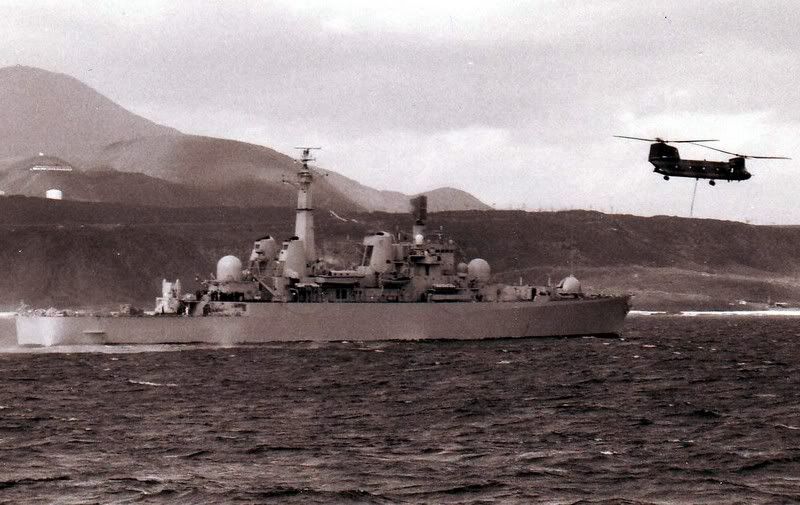
Griffiths911Still with you.
Still visiting regularly chaps and will add if I have anything useful to say…………still enjoying your observations and comments.
Griffiths911I’ve checked which Type 42 the various books credit with this Canberra:
Air War South Atlantic (Ethell/Price) – HMS Exeter (Sea Dart)
Falklands the Air War (Burden et al) – HMS Exeter (Sea Dart salvo plus HMS Cardiff missed with Sea Dart salvo)
The Royal Navy and the Falklands War (Brown) – HMS Cardiff (single Sea Dart)
One Hundred Days (Admiral ‘Sandy’ Woodward) – HMS Cardiff (single Sea Dart)
Sea Harrier Over the Falklands (Commander ‘Sharkey’ Ward) – HMS Cardiff (Sea Dart)
Interestingly the ‘Navy’ men all credit HMS Cardiff with this Canberra.
Mmmmn……..I wonder who’s right?
Joking aside, thanks to Creaking Door for spending the time to looking into this.
For a minute, just assume that my memory is accurate and Cardiff did fire the single shot that downed the Canberra.
Question: Why did the Mirage pilots report that they saw all those incomming SAMs? What did they see that made them think that two type 42’s had unleashed a relentless stream of Sea Dart missiles at them?
Griffiths911Does he provide any details? Were they lost in accidents? I am not aware of any record of an impressed Argentine civilian aircraft being lost during the conflict, and these did not venture into the combat zone – I don’t know what that HS.125 did but imagine it was the same communications & mainland/inshore patrolling for which the other impessed planes were employed.
As for the Canberra, B-108 and B110 were downed (by Sea Dart and AIM-9L respectively) but my “bible” FTAW by Burden et al says of B-109, “Not confirmed as deployed to Trelew but noted in post-war use at Parana in 11.82.”
Re your Gazelle pic separately, this is a new picture for me. FTAW reports that XX377, downed by Cardiff’s Sea Dart, was the only 656 Sq Gazelle lacking that temporary SNEB rocket pack – and the machine in your pic clearly sports a SNEB pack. In any case I’d have thought a Dart-struck Gazelle would be pretty well demolished. When XX411 was downed by smallarms fire on 21.5.82 it is reported as having crashed into Port San Carlos, and the crewmen swam ashore – though the pilot died subsequently. So it’s got to be XX402, brought down shortly afterwards: “..(it) crashed into a hillside near Clam Creek [UC 640922]..” FTAW/Burden et al p357.
Your seagoing pics too are great, useful and interesting, thanks.
hps
No, he didn’t but TEEJ has covered it brilliantly.
The Gazelle:
Yes, 3 Commando Brigade Air Squadron Royal Marines. Ken Francis and Brett Giffin being the two fatalities (both were killed by very accurate machine gunfire)…..very sad.
Griffiths911Canberra, B-109, is in the museum at Moron.
Images on this webpage:
http://aeroweb.brooklyn.cuny.edu/specs/englelec/canberra.htm
‘I flew Argentina´s Air Force Canberras between 1992 and 1998 as a pilot, until the Squadron was deactivated. I won´t add anything new about their operational qualities or performances, but a tale about the “lucky aircraft”, instead. Canberra B-Mk-62 Registration Number B-109 (original british number WJ-109), which is in fact displayed at our Aeronautics Museum since 2000, had a colourful career in the Air Force. These are its main highlights:
1-By unanimous opinions from most pilots I flew with and including myself, B-109 was by far the nicest aircraft to fly: well balanced, vicious free, nice response through all the flight envelope.
2-It flew several bombing missions during the South Atlantic Conflict in 1982, always coming back home.
3-Although it went through several in-flight emergencies during its career, all the crews returned safely (the last one happened to me in 1994, when the starboard engine suffered a massive collapse and literally “swallowed” the first stages of the compressor).
4-In 1997, during a TV documentary footage at its operational Air Force Base, B-109 was unofficially named “Karina”, after one of the TV programme members – a nice looking girl – flew formation and low level tactics in a rear ejection seat.
5-It was the last Canberra to fly in Argentina.
08/21/2006 @ 15:20 [ref: 13946]’HS-125,LV-ALW,was destroyed in 1985
http://aviation-safety.net/database/record.php?id=19850411-0&lang=en
Very informative TEEJ. I think Jorge thought that it was B-108 in the picture.
This is B-109 on a display stand…..clearly not in 1982.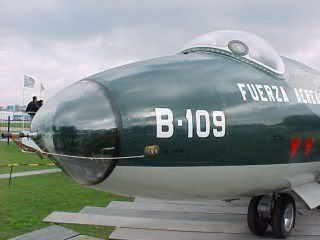


 Sign In







