 Griffiths911
These are great – pity Cardiff doesn’t have a web site of her own to show them off to a wider audience like many of the other ships involved in the war.
Yes, a damn pity……….I wouldn’t know where to start.
Griffiths911Argentine casualties.
Another Argie Jorge picture………….he tells me both these aircraft were destroyed in 1982.
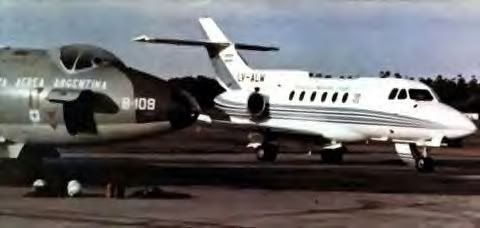
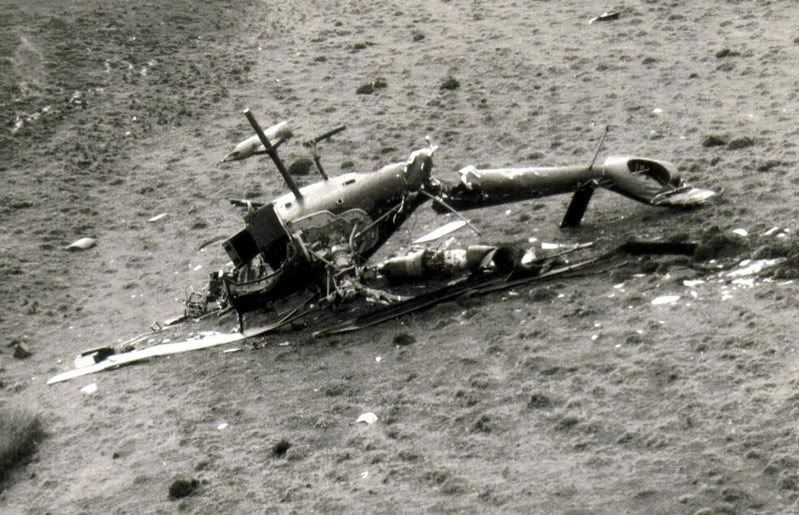
Griffiths911Casualty – Falklands 1982
This is one of three Gazelles downed in 82. Two by Argentine small arms fire on the 21st May 1982 and one by Sea Dart fired by HMS Cardiff 6th June 1982. I have no idea which of the three this one is……………..any takers?
The damage to the tail section is ‘strange’.
Griffiths911Fascinating… You were there and I have to defer to your personal experience. I simply passed on information derived from what I believe to be the best reference sources – though an admission first, I mistakenly wrote “19th June” when I should have written “13th June” – the date recorded in both Salvador Mafe Huertas’ book “Mirage III/V”, and the magisterial “Falklands – The Air War” by Burden et al. Huertas is a highly respected aviation author, who based the considerable Falklands coverage in his Mirage book on personal interviews with pilots in Argentina. OTOH I am aware that some Argentine accounts were highly coloured from the start, right from the first air-air kills when a Mirage pilot seemed to suggest that he had collided with a SHAR rather than being hit by an AIM-9L… Of course, air combat has always produced some accounts that proved subsequently to be wildly mistaken, understandable given the speed with which events occur, and the pressure upon pilots’ senses.
In FTAW, Burden et al write: “Several SAMs were launched at the Canberras..the Mirages (also came under attack) and one missile locked-on to Sanchez’ aircraft…he spiralled down towards it in an attempt to break the lock but the missile suddenly exploded below him at the end of its run..A second missile passed by him at 15k feet…without detonating. The missiles launched at the Mirages had been Sea Darts from Cardiff and those that had brought down the Canberra were from Exeter, both warships having been in the Choiseul Sound area of E.Falkland.” I’m curious: why would Cardiff have launched only one missile? In similar circumstances, even with only a single target acquired, Sea Dart ships made multiple launches. Was there an awareness that, as Creaking Door (?) suggests, multiple launches could lead to guidance confusion?
hps
Yes, I understand where you are coming from. The reason why there is some confusion regarding the date 13th & 14th is because the incident occured around midnight on the 13th.
I remember HMS Yarmouth was conducting NGS, possibly with HMS Avenger on the Northern Gunline (can’t remember where exactly that is) and we were to the East of Port Stanley (ish, clear of land…….maybe 10-15nm). HMS Cardiff was not in the Choiseul Sound area and I would hazard a guess that HMS Exeter (being the only other 42 left – HMS Bristol had Sea Dart also) was back on her station in the MEZ (Missile Engagement Zone) out with the carriers.
Another thing I remember clearly: I was reporting that raid on the AAWC (Anti Air Warfare Coordination) frequency HF, a clear memory because Joe Frazer (AAWO’s Assistant) told me off for shouting (I got a bit excited) and that was the only frequency we were reporting the raid on and I was the only voice on that frequency.
My point being that ships within range of each other report the air picture on the LAAWC (Local Anti Air Warfare Coordination) frequency UHF. I know the carriers were receiving my reports because one of them launched a single Sea Harrier but it turned back as after we engaged the raid they opened to the west rapidly.
I can’t remember HMS Exeter being inshore much conducting NGS or radar ambush in June. She had the only 1022 radar in the Task Force (far superior to 965) so maybe as the Type 42 numbers started to dwindle the Admiral kept her on station in the MEZ…….only a theory.
Questions:
Why was I the only operator on the HF frequency broadcasting the raid?
Why did Exeter not report “Birds-Away” on HF (a requirement and indeed an automatic trained response from a ship firing a missile thus informing other units and the AAWC ship who’s engaging who)?
Why did we not broadcast on LAAWC?
Why was Cardiff the only unit broadcasting the raid on Data Link 10 (Radar to Radar link……..missile launch is broadcasted also)?
Griffiths911You mean a warning issued in June 1982 by Admiral ‘Sandy’ Woodward the task force commander about the number of Sea Dart missiles being fired?
Yes, that’s right. I apologise about the amount of updating I am doing….this subject about Exeter etc. has upset me somewhat and I’m desperately trying to keep my writing subjective.
Griffiths911[QUOTE=hpsauce;1084640][QUOTE=Griffiths911;1084578]No, that’s not what happend. I’m assuming you meant the 14th June 1982.
HMS Cardiff was the only Type 42 involved in this engagement. People think HMS Exeter might have been involved (she has been credited with the kill in some books) ……. The Mirages turned away (we had not fired yet) but the Canberras (or at least one of them) continued to close. We then fired Sea Dart………..I honestly only remember us launching one, the missile went straight to the target (which was tracking straight on our radar). Guys, I am quite sure we fired one missile…….but definitely no more than a single salvo. As for the Mirages evading our Sea Darts, they had turned away before we fired. Now how about this……….could the Mirage pilots have been reacting to what they could see on the ground……lots of flashes, ground engagements?
I’m curious: why would Cardiff have launched only one missile? In similar circumstances, even with only a single target acquired, Sea Dart ships made multiple launches. Was there an awareness that, as Creaking Door (?) suggests, multiple launches could lead to guidance confusion?
hps
No guidance confusion. As I stated, I can only remember one Sea Dart being fired but it may have been a salvo. Before I joined this forum if anyone had asked me about that night I would have said we fired one Sea Dart at the Mirage formation…….but you have made me doubt my memory. I do recall there was a weapon expenditure (Sea Dart) ‘bollocking’ issued by the Admiral some time in June.
When It comes to how many Type 42’s that were involved in that engagement I can easily put my hand on the Bible etc.etc. Get a sense of how certain I am about that? I know you are only stating what has been written but they are wrong – it did not happen like they state. I may get some detail wrong but what they are saying is borderline farcical. Why would honourable, proffesional pilots say these things? Also, unlike other engagements I have mentioned, this one was a relatively calm affair.
Now I’m curious: How do the Mirage pilots know that Cardiff & Exeter were firing at them that night?
A good friend of mine (ex Leading Seaman Radar Mac McColl) was serving in HMS Exeter at the time.
Griffiths911Well, that’s some history that needs to be re-written then!
When I originally asked about HMS Exeter and the Canberra claim you sounded very sure that it was actually HMS Cardiff that got it but I had no idea that HMS Exeter didn’t fire any Sea Dart and wasn’t even ‘inshore’ that night.
I had no idea that you, or anyone else thought there was a pair of 42’s involved that night.
I was a Radar Operator. I watched these things happen…..I listened on the radio frequencies to other units. Because I remember how some events went, it doesn’t mean that’s how they really happened outside of HMS Cardiff.
Me at work in the Operations Room HMS Cardiff February 1982.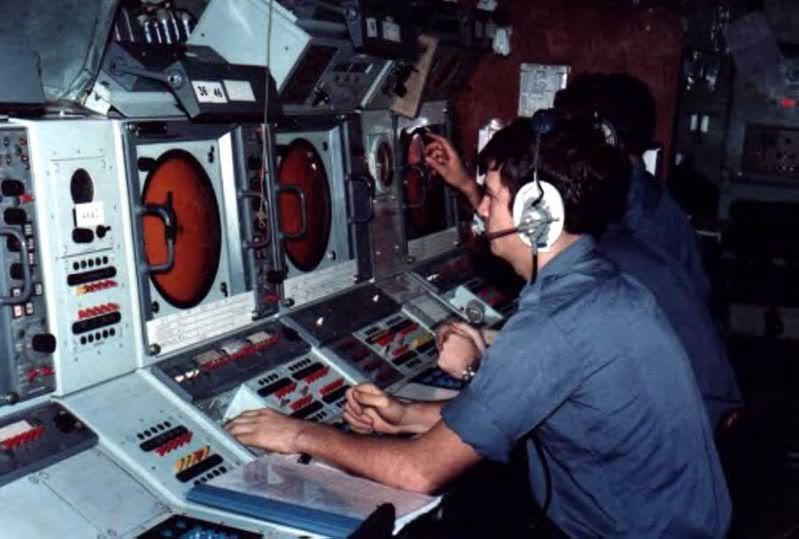
Griffiths911Sea Dart had curiously mixed fortunes, bringing down an Argentine Puma early on, and that high-altitude Learjet on June 7th (as well as our own Gazelle…), so it’s clearly a versatile missile. OTOH there were disappointing failures such as 19th June, when two “Baco” flight Canberras and two “Pluton” flight Mirages were fired on after dark over E.Falkland, as described by Huertas in his valuable “Mirage III/V” book (Osprey 1990):
“(Sanchez, Mirage pilot) noted a missile being launched, which was probably defective because it started gyrating wildly…(he) suddenly realised the danger as four or five more SAMs started climbing almost vertically towards them…the missiles seemed to be locked onto the Canberra section – probably Baco 2. (the pilot)… launched several flares and chaff bundles while initiating a series of evasive high G turns. The missiles eventually passed behind him……(Sanchez) almost missed a new volley of missiles. He saw them first with his peripheral vision, much lower, but climbing very fast in his 12 o’clock position. He could distinguish the cluster of bright red exhaust trails perfectly, as the weapons scorched up towards the formation. One of them in particular grew much bigger, seemingly locked onto his Mirage. At that time he was at 30k feet in a wide turn at Mach 0.92. The missile was inside his turn, but somewhat lower. Reducing his engine power, he tightened the turn and began a steep, spiral descent…Then the missile exploded in a brilliant flash and fireball…(he) realised the Mirage had not been hit….but then (another Sea Dart) could be seen climbing rapidly towards him…the missile..passed by on the starboard side.”
This was the mission mentioned earlier, when B-108 was taken out – but two Mirages and the other Canberra escaped what seems to have been a considerable volley of Sea Darts, while certainly well within range.
hps
No, that’s not what happend. I’m assuming you meant the 14th June 1982.
HMS Cardiff was the only Type 42 involved in this engagement.
People think HMS Exeter might have been involved (she has been credited with the kill in some books) but Exeter was not inshore that night. There were other naval assets in the area but only one 42.
When we ‘locked-up’ the Mirages we had no idea there were a pair of Canberras in the formation. The Mirages turned away (we had not fired yet) but the Canberras (or at least one of them) continued to close. We then fired Sea Dart………..I honestly only remember us launching one, the missile went straight to the target (which was tracking straight on our radar). Guys, I am quite sure we fired one missile…….but definitely no more than a single salvo. As for the Mirages evading our Sea Darts, they had turned away before we fired.
Now how about this……….could the Mirage pilots have been reacting to what they could see on the ground……lots of flashes, ground engagements?
On the other hand, I could be totally wrong…………..but I don’t think I am.
Griffiths911On the subject of Seadart launches, this has recently been loaded onto YouTube. 😉
The first minute and a half is not very interesting and the misfire itself occurs 2 and a half minutes in.
Never seen anything like it. Looks like the booster detaches(this normally happens after 8nm!)on launch and disintegrates. What really amazes me is the lack of response from the Officer Of The Watch on the bridge………….no sounding the ship’s General Alarm system and a “Fire Fire Fire……………” call bellowed down the ship’s tanoy. There is a ‘what do we do now’? feel about the whole thing. That incident could have been very serious……..I’m ‘gobsmacked’.
Griffiths911Also sent to me yesterday. The two aircraft on the bottom right are SuE’s and it was their last exocet attack.
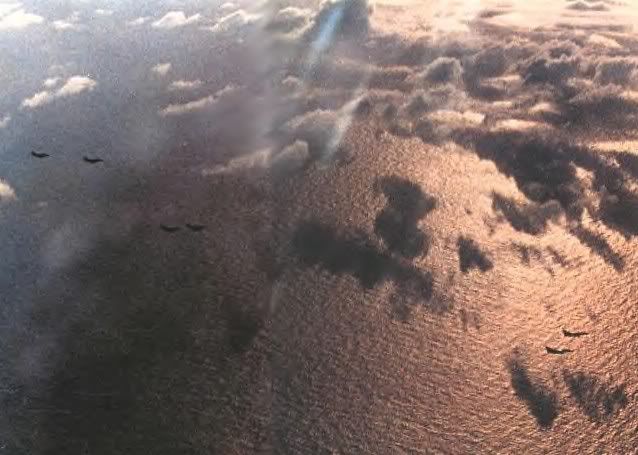
Griffiths911Nope, not seen that one before.
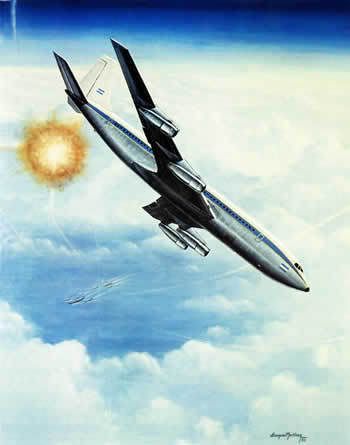
Incidentally back on the 707 – on this site there is an account from the crew of the aircraft which states that one of the crew spotted the first incoming missile, and took control of the aircraft. The first missile exploded nearby, the second one sailed past close to the nose without detonating. On landing they found the fuselage and tail streaked with brown from the near miss.
Excellent Damien.
There’s a few problems with what they say happend…..anyone spot them? Here’s a clue…………Sea Dart has a proximity detonation device and built into the missile are expanding rods (a lot of them) that are designed to ‘whizz’ in all directions after detonation (originally designed to cause maximum damage to Soviet bomber formations).
Use this to translate from Spanish to English, not a perfect translation but good enough to follow what they are saying: http://babelfish.altavista.com/
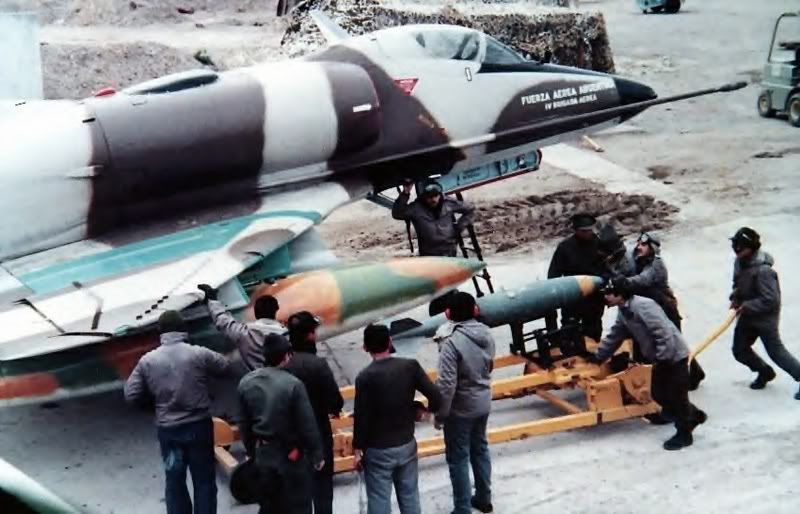
Griffiths911I haven’t. Was this photo taken during the war?
Is the blue area sprayed on the wing upper surface an identification feature?
I know some Argentine aircraft had yellow identification ‘stripes’ added after some of their blue-on-blue losses but I’ve never seen blue before.
Yes, that’s what I’m being told by Jorge. I get the feeling that it is from 1982.
If you look closely you will find bits of blue on the starboard wing drop tank pylon………I think it is part of the colour scheme.
Griffiths911A4 Skyhawk
This picture was sent to me today by my Argentine contact……..has anyone seen this before?
Griffiths911I’ve always understood that the 707 radar was capable of picking-up ships but not aircraft or missiles. Maybe somebody on this forum has first-hand experience of the 707 radar?
I’ve had a look on the Fuerza Aerea Argentina site and on there they state they were operating the B-707(387B)since 1975. It is basically a transporter but undertook fifty “Recognition and air reconnaissance” missions in support the “Batalla para los malvinas”. They also proudly state that they take their president anywhere in the wolrd! In essence, the aircraft we nearly shot down on the 22nd May 1982 in position 31 45S 30 43W was a basic transport/passenger aircraft with no significant radar capability or military modifications.
Argentine Boeing 707.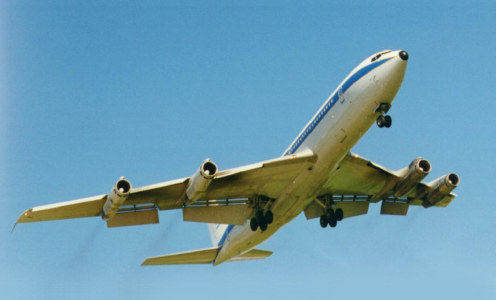
Griffiths911Yes, the Argentine technician. They believe Exeter fired the Sea Dart and Avenger the Mk8 4.5″ gun but I believe Exeter got both Skyhawks.
As far as the capability of the 4.5″ gun as an AA weapon…….I can’t remember us having much confidence in it in that role. It was a bit of kit at the ‘pointed-end’ that went BANG! when we were conducting NGS, however, the Type 21 Frigate only had the Mk8 and Sea Cat so maybe their gunners are likely to disagree with me.


 Sign In







