 Griffiths911
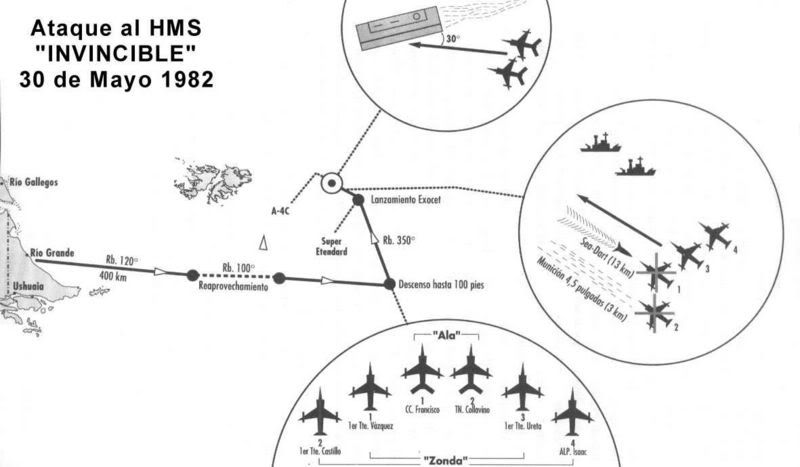
As I see it HMS Exeter fired three Sea Dart missiles during this engagement. The first was at the last Argentine Exocet fired during the war but this (not surprisingly) missed. The second brought down Lt Vasquez and the third Lt Castillo.
HMS Avenger was firing her 4.5 inch gun but this is not a good weapon against fast, low-level aircraft. If HMS Exeter hit the first A4 with Sea Dart she should have hit the second, closer, A4 with more ease.
Nope, never have but I think I came to about the same number when I tried to total them.
I remember this day well. I was off-watch when we went to action stations and went to my off-watch station (spare hand, Junior rates dinning hall). I stayed there but ended up being the only one left………I got scared so went to the Ops Room and stood behind George Foster (TI Operator) and watched the attack on radar. We saw the exocet on radar (19nm…I think) and all hell broke loose. Exeter was firing Darts which became visible to our gun crews………a young Sub Lieutenant screamed on the intercom “Alarm Missile……..” so all the gunners started to fire at the Darts (miles away and well out of range). After a few moments of bedlam……Ops Room trying to get a ‘lock’ on the radar targets and the gunners firing at friendly missiles the Captain asked the young officer for a visual update and got the reply……..”Sir, I don’t know what the effing hell is going on!”. The Captain was very calm and his eyes were ‘smiling’. It was all over in a flash……….and I wish I had stayed in the bloody dinning hall.
Argentine view of how it went.
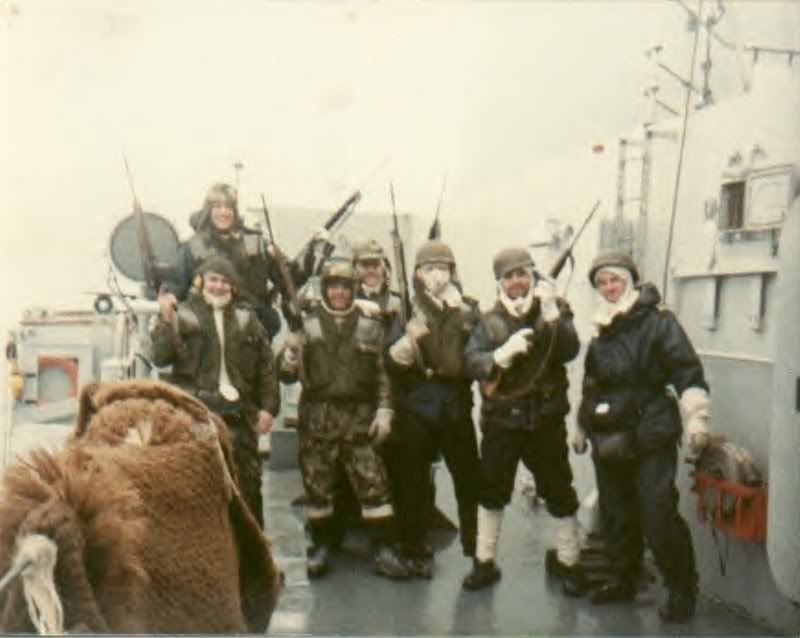
Cardiff gunners, Sub Lt. on the right. The SLR rifles were ‘doctored’ to fire fully automatic with 30 round Bren Gun magazines.
Griffiths911As I understand it the radar on the 707 was the same as that fitted to the commercial airliner/cargo 707 which, after all, is what the Argentines acquired them for. I don’t think the Sea Dart could have been seen on radar.
Not sure about an ESM fit, I would guess not. Anyway that wouldn’t help them detect a launch. Even assuming they could detect the 909 from Cardiff that wouldn’t change when the Sea Dart was launched.
We were informed that this aircraft was an Argentine reconnaissance asset and I assumed, wrongly it seems (I was a 19 year old Able Seaman), that it had the capability to ‘surface-search’ with radar and be alerted when they have been ‘locked-up’ by a Fire Control Radar with Electronic Surveillance Measures (ESM). To think they were using their ‘MarkI Eyeball’ seems absolutely unbelievable to me. Of course ESM kit would not have alerted them to our missile launch but would have given them an indication of our intent when they detected our fire control radar.
Is it the case, as far as you know, that they only had some kind of weather radar onboard?
Yes, the Youtube footage is very good. Incidently Sea Dart is now a very old and outdated weapon………. but I agree with you. It is impressive.
Griffiths911Hi,
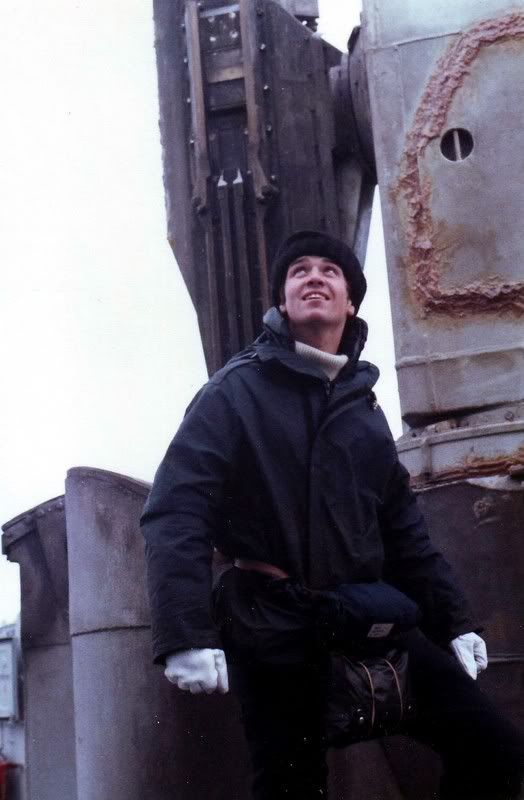
Yes, the heavy duty grease was to keep the launcher’s ‘technical bits’ waterproof as at times the weather down there could be atrociuous.
It’s weird, I assumed everyone would know what time of day the 707 engagement took place and all the ‘gumpf’ that goes with it. I have read very little on the Falklands War so am unaware of what has not been written…….does that make sense? I have done some internet searching and have a good contact in the Argentine Air Force who sends me pictures etc. but he is forever asking me why nobody has pics of the damage to Invincible…….ermm now let me think about that one Jorge!
Ok, back to the questions. The engagement took place in the afternoon on a bright crisp South Atlantic day. As the 707 approached our upper deck gun crews called “AIRCRAFT VISUAL GREEN………”, meaning they had sighted the 707 on the GDP through this bit of kit (photo taken at a later date).
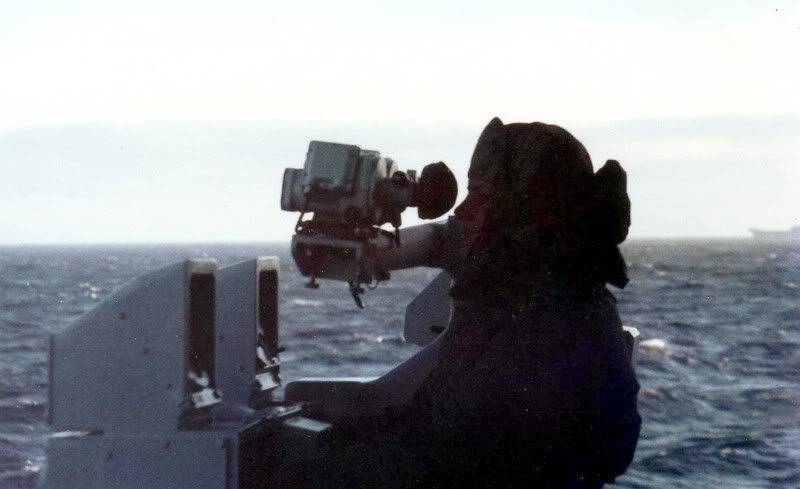
Ok, we can see them, albeit through a special bit of kit, so maybe we could be seen by them when a Sea Dart is launched. We have to assume the crew were well motivated to keep a good look out for a missile launch.
This is Invincible ‘letting one go’ in 1982 (lucky amateur shot) never seen before.
The other thing that has to be considered is what was the radar capabilities of the 707? Did it have a good ESM package? Did they see our launch or detect it on radar? Could they see us at that range? I just don’t know. What I do know is that they reacted very, very quickly once we launched.
With regards to the spacing of the missile launches I can only remember that the missiles had around 8nm spacing between them in flight….I’m not 100% sure there. What did surprise us is the fact the first detonated short (out of fuel so they ‘destruct’) and the second, which has further to go to the target seemed to merge.
Here’s the ship in question……..HMS Cardiff, Port Howard, June 16 1982.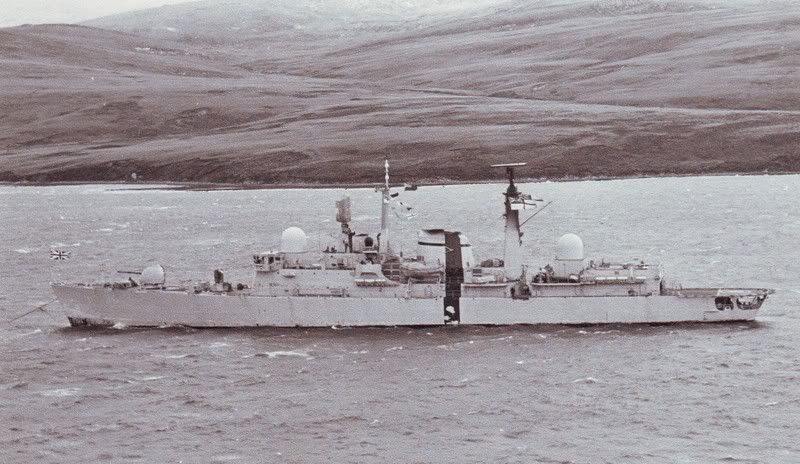
Hope this helps.
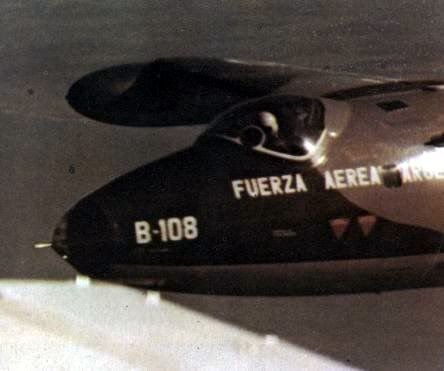
Griffiths911The Canberra in question June 1982
Griffiths911Me and a ‘tired’ looking launcher June 1982
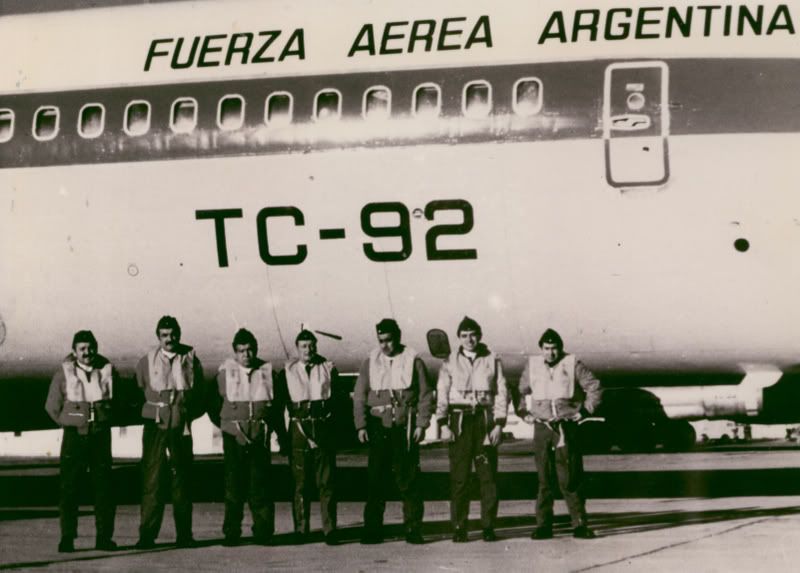
Griffiths911The Aircraft in question & crew
Griffiths911Hello again,
I haven’t a clue why some authors credit Exeter with the Canberra kill that night.
Cardiff had been detached with orders to close the islands and ambush an Argentine C130 aircraft that had been flying in supplies nightly. We were inshore almost every other night either on radar ambush or conducting NGS on the gunline…even after Coventry sank. I was on watch and can remember the engagement quite clearly. We thought we had engaged a Mirage formation as we were only alerted to Mirage radar on our UAA1. The formation turned out to be two Mirages: callsign Pluton section, Pilot:1 Major Jose Sanches, Pilot:2 Capt Ricardo Gonzales and two Canberra Bombers: callsign Baco section, crew:1(B-108)Pilot Capt Roberto Pastran & Navigator Capt Fernando Casado. crew:2(B-109)Pilot 1st LT Roberto Rivoller & Navigator 1st LT Jorge Annino.
With regards to the Boeing 707 incident on the 22nd May, we had been closing the TEZ with the Bristol Group and had been alerted to the fact that an Argentine 707 was airborne (I think Coventry had tried to engage it earlier that day, but had a problem with her launcher). We picked up the 707 radar and eventually the aircraft on radar……I couldn’t believe it, they were flying right towards us at 20,000ft plus, it was a ‘down the throat’ shot. We asked Bristol if we could engage and got a ‘Hold Fire’ response, for some reason her Captain was not happy about the ID. Our Captain was absolutely ‘gobsmacked’. The 707 closed to inside thirty miles, had a bloody good look at us then skirted around the group keeping around thirty miles plus distance. Our captain had seen enough and turned Cardiff ninety degrees to starboard and stopped. The 707 was now opening on a reciprocal heading to the group. The group sailed on and when they were about 10nm away and the 707 was now about 40nm, it turned back in and closed. At 35nm it appeared to turn slightly to starboard…….that was enough for the Captain he ordered two darts away. As soon as we launched the first dart they turned away sharply and the 909’s recorded a rapid decrease in height, we watched the missiles on our radar open towards the target at amazing velocity. The first one exploded (you can see this on radar) about three to four miles astern of the target. The second, by now being very verbally urged on by the lads seemed to merge and explode.
It is very likely the crew saw the first missile launch and the pilot initiated an almost suicidal dive for the sea. This manoeuvre and the fact we fired at extreme range saved the aircraft and her crew. They would not have survived if Captain Grose had not been so cautious. By the way whilst all this was going on HMS Bristol fired two Sea Darts at two closing contacts, this turned our to be interference from other 992 radars in the group and was a problem at that time……….was Invincible reacting the same?
Nine Sea Darts fired: I say nine because that is my recollection. I cannot validate this or tell what all the targets were. It is simply my recollection.
Griffiths911HMS Cardiff 1982
HMS Cardiff shot down one Canberra Bomber B108 on the 14th June 1982 and one friendly Gazelle XX377 in the early hours of 6th June 1982. She did fire a salvo at a Boeing 707, one fell short and the second ‘merged’ but we now know both missed. I recall we fired nine darts in total throughout the conflict. Feel free to ask me any specific questions you may have and I’ll try my best to recall details from my time back in 1982.
Regards.
Ken Griffiths.
ex Radar Operator, HMS Cardiff. 1982.


 Sign In







