Sign
SignThe Viggen didn’t have all moving canards, the Cheetah has a greater wing sweep and smaller aspect ratio, and non-moving canards. Can’t really comment on the J-9, but the Lavi was a multirole fighter.
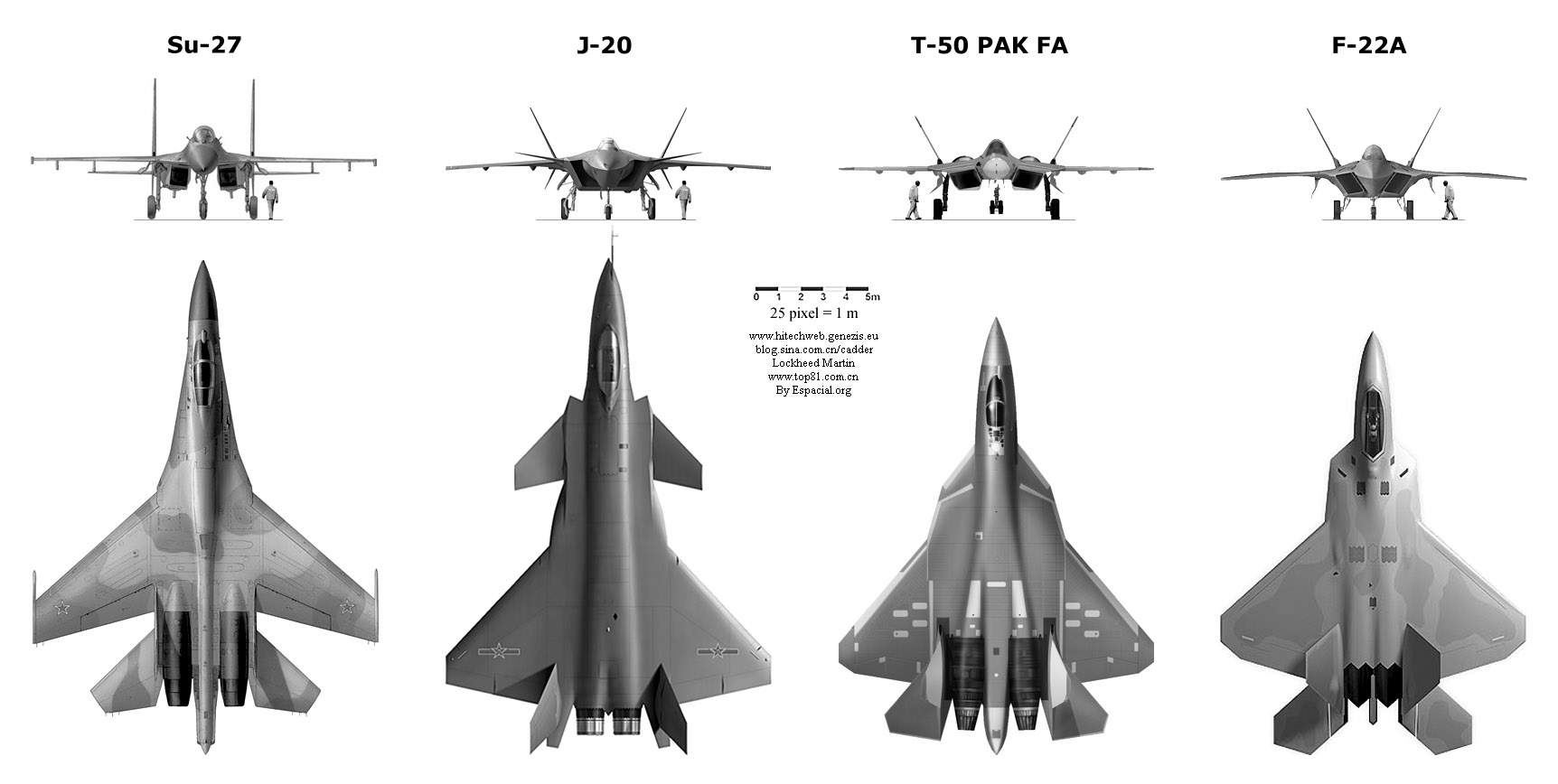
I gave some thought about the Su-34 after I made my comment, but designs optimized for the strike role need to have high payloads, and it would seem strange to me that you would create a stealthy airframe that needed to carry payload externally for a strike role if that’s what the airframe was optimized for. The J-20’s weapons bays aren’t that much bigger than the F-22’s after all. For them to be significantly bigger, the J-20 would have had to be the 23 meter long giant that it is clearly not.
Furthermore, if you look at the wings of the J-20, they don’t seem to be designed for large payloads. The wings are thin, which would indicate optimization for supersonic regimes of flight, but if it was purely an interceptor, again why go with all moving canards with such high degree of motion? I just don’t see the J-20 fitting the role of a bombtruck or being limited to the role of an interceptor. Payload would be too small for a bomb truck, and every interceptor you’ve mentioned with canards don’t have all moving canards or other optimizations for greater maneuverability (all moving stabs, lerxes, chines).
I’m sure that the J-20 could probably perform either role, but I’m not convinced that it is specialized for either of them.
modern 4 gen interceptor(optimized for that role) like Eurofighter and gripen do have thin delta with canard, gripen even got close-coupled ones.
Also a delta wing as on the Gripen/Eurofighter/j-20 offers a light but strong and stiff structure in conjunction with the use of CFC on the outside skins and main spars, even when the relative thickness of the wing is small.
Earlier generation this was not the case for Viggen
The question of stiffness is vital, as the single-spar aluminium winged Viggen had shown years before. Not initially meeting the severe requirements on roll rate at high dynamic pressures, more hydraulic cylinders for the moving of the inner trailing edge elevons had been added. And the wings broke.
SignI thought this was an F-5 thread, that is a MiG-28 🙂
dooh! dont mention this to the others 😉
Signguess the operator 😉
SignMaybe but I have seen the same on an Hornet once under high G
maybe youre right, but its no good for radar diffuse returns..
Signfor the sukhoi, the jump is done with a few A2A missiles and a light fuel load. To operate with the Marines, the aircraft will have to be able to carry lots of ground ordnance with good persistency over the battlefield -> fly very heavy. there’s no way that a single engine fighter takes off with today’s technology in a couple of hundreds of meters without external help (catapult)…
and if it´s to fly with a bomb or two over a couple of hundreds of km, they can keep the harriers 😉
yes, its all about requirement and cost. STOBAR lighter load or Catobar full load. Both is possible with the “sea-Gripen” according to the feasibility study.
The thing with Stobar gripen is that its probably very good at it, due to its original design requirements.
Signwhat is the stealth advantage?
i mean, these components can be built entirely of composites, so aren’t/don’t need to be radar reflecting anyways.
two surfaces in an angle to each other is good reflector for geting the signal back the same way it came from, instead of sending it in another direction. the best for stealth is to get rid of the rudder once and for all, and all depend on TVC 😀
Signlol computer games not real
no **** sherlock, a simulation isnt better than the parameters put into it. Is a better way to put it.
Signlook at those lerx, the surface seems like a wave. the same goes with parts of the wings. bad build quality?
Signin any case, even considering that your ship is used one aircraft at the time, the marines use their aircraft mostly for ground support, meaning heavy loaded… so, you design a ship with the runway on which your gripen will take off and land using the whole length of the deck, which, with minimum safety margins, good headwind and ship advancing would mean a ship that is good 400m long.. which is still 30% bigger than todays biggest carriers USA have…
methinks that if they canned the F-35B (would spare a lot of money to many, USA included) the best thing for the USMC (which they should have decided from the beginning btw), would be to take the CATOBAR version and forget about vertical stuff
why not use arrested landings and STOBAR launch and you got a very short deck?
no 400m are needed…
Just look at the standard requirement for SU-35 for 450m runway, and it can still jump of a ship.
Signthing is, any fighter can come close to any SAM as long as it stays below radar horizon. Flying @ 100ft at high subsonic speed brings you way within the range of the AASM enabling you to hit the SAM battery by a pop-up maneuver… before ducking back to ground level to try to get out of radar coverage again. the major problem (besides the SAM you’re after and which will be after you quite rapidly once you pop-up, requiring a very rapid retreat back to deck level) on such a sortie would be the manpads which, unless you fly over a completely flat country will have limited range anyway.
Another thing is that no fighter would operate alone, except something like a Rafale on a nuclear strike mission, which is still quite unlikely to happen (and won’t be a SEAD mission anyway 😉 )
J24, why do you think you can see french videos from Tchad where they fly really very very low? Do you think the french defense ministry sends fighters to Africa just to give their pilots some fun?
Yes! allways for fun (and breathtaking videos)
SignTakeoff in 400m, while loaded with stores?
Gripen A/B/C/D runway requirements are in all possible circumstances to be able to use a 600mx9m runway. In reality this means that it could land and takeoff from 350m to 500m depending on conditions and load.
The forward motion of a carrier, against the wind direction is very beneficial as well for these numbers, due to gripens low approach speed of about 120 kts.
Due to the better charactaristics of the F414 in low speed and low altitude, as well as the new landning gears, this STOL ability will improve on E version.
This doesnt mean a “sea-gripen” wouldn´t need any mods for being operated at sea, just that its a good starting point for such a mod. (cheaper to take it to carrier than most A/C) And in an emergency it could be possible (theoretically) to use a carrier deck.
SignDutch? The Dutch don’t stick dragons on their fighters, do they? Looks more like a Swedish F-35 to me!
maybe its the swedish griffon everybody is talking about!!?
SignLower angle of attack and sustained turn possible because the intake is blocked from the air stream.
Highly maneuverable aircraft must still have its intakes at the bottom or by the side.
couldnt this drawbacks be compensated extra doors (with flat surface) underbody mounted al a MIG 29 style?
SignMSPhere I have a few issues with your assumptions. Lets look at them for a second.
1. Can a Non thrust vectoring 4.5 gen class fighter beat a thrust-vectoring class fighter in WVR consistently? The answer from the evidence we have is yes.
F-16 Versus Su30MKI
http://vayu-sena.indianmilitaryhistory.org/exercise-red-flag-su-30mki-comparison-fornof.shtml
Typhoon versus SU-30MKI
http://www.defence.pk/forums/indian-defence/121746-british-typhoons-beat-india-s-sukhois-joint-exercises.html2. Is the WVR game basically a mutual kill for all parties involved if they all have HOBS? YES
3. Is the F-35 in the 4.5 generation + maneuverability class? The answer is yes
The U.S. Marine Corps’ short-takeoff/vertical-landing (STOVL) F-35B Joint Strike Fighter (JSF) has completed all of the vertical landings and about 80 percent of the short takeoffs required to begin testing aboard an amphibious assault ship later this year, according to a test pilot at Naval Air Station Patuxent River, Md.The tests are filling in details about the plane’s flight characteristics, which are turning out to be quite similar to the F/A-18 Hornet.
The STOVL variant, which was placed on a two-year “probation” late last year by Defense Secretary Robert Gates, has been plagued by teething problems with various inlet doors and other ancillary hardware associated with vertical landings.“The testing has been going very well over the last couple of months,” said Marine Lt. Col. Matthew Kelly, an F-35 test pilot with an F/A-18 Hornet background. “We have performed all the vertical landings necessary to go out to the boat and do testing.
F-35 High AOA testing http://www.youtube.com/watch?v=mfWHHuLILs0
Its obvious that LM could have made the F-35 faster more maneuverable, and on the A model at least they could have added TV for less weight than the stovl version. Why didn’t they? Why didn’t they load the plane up with mach 1.8 SC and TV? The answer is simple. [COLOR=”Red”]The customer did not require those things in the contract.[/COLOR]. What the customer did require was a lower price for not having those capabilities. YES in this regard, it remains to be seen if the F-35 will reach its goal. That doesn’t make Lockheed morons for giving the customer what they asked for.
I Would also like to point out that the J-20 is no by any means a medium or light weight fighter.
We are talking about a 60-80K LB class fighter with a subpar WS-10 class engine that MIGHT put out 30kLbs of thrust in full AB on a good day.
Wiki is suspicious claiming 40KLbs each in AB, But I don’t see the Chinese leap frogging both the Russians and Americans in engine tech and reliability, and Ill leave it at that. What you have is a near F-111 class-fighter that you are imagining will turn in burn in a vertical rolling scissors with a F-18 class fighter, ignoring the facts that even the mighty Chinese have not achieved God like status, and will also be subject to the laws of physics.To make matters worse for the Chinese and Russians, VLO is all about shape, shape, shape, and materials. If we all know this is the case then why have the Chinese and Russians made the choice of only signals managing 1/2 of their aircraft? Do they expect to NOT egress from the target? Do they NOT realize that the Americans have a lead in LO tech? These questions are not things easily over looked.
The crossection of the pak-fa is really inkredible for a fighter with internal bays!
it could really turn out to be a really fast jet in this bunch. How is the intakes optimized?
SignVarious leakers in Brazil have a difference of opinion
http://www.france24.com/en/20090906-…silva-brasilia
vs
no one dare to mention gripen in this case 😀 not the french or the US


 Sign In