Sign
SignAgainst fighter size aircraft, I think source was one of the janes publishing bud I dont remember exactly. But 360 degree scan mode range is quite modest its about 400km.
“fightersized” is often refered as 1m2, but the size of a real one is going down every year, and 4+ gen is 0,5-0.0001m2. As you all probably already know..
often youre AEW is just intressed in what´s going on one 140-100 deg side. And use as much of you´re energi there. The energi produced onboard should be 360kilowatts but that does not say as much of the output energy…(http://www.northropgrumman.com/review/rev_mag/review_issue_two_2006.pdf)…
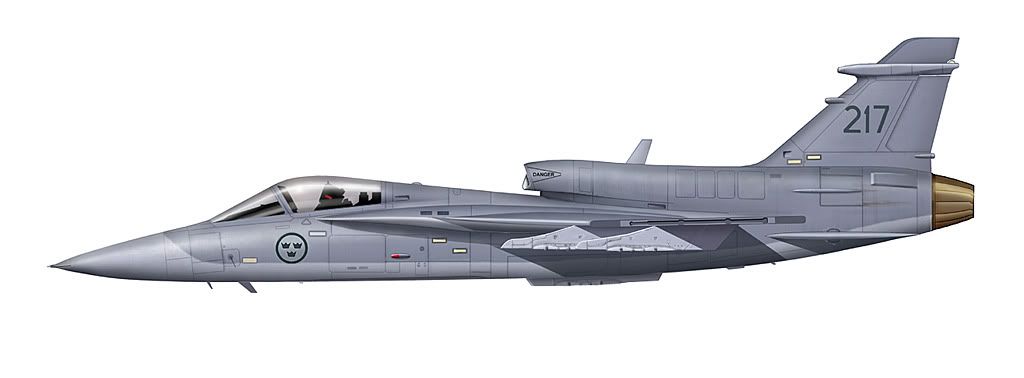
SignI sent my drawing to a friend of mine, and he did a quick colour job on it.
Looks nice.:)
Looks like a hi-wing CAS, aka Su-25 frogfoot variant of gripen to me! Nice
Wonder wat the weight of the supercompact 2100 model would be.. maybe it fits my UL-B certification 🙂
SignWhatever the price you consider (recurring flyaway, flyaway,weapon system cost, lifetime cost) the F 35 will still be less expansive than any eurocanards.
😀 Gripen NG is aimed to cost less than Gripen C/D in lifecycle terms…which is in SWAF today lower than 2500 USD for an hour flight..
Beat that and your on….
SignIn 60 degree sector scan it has range about 700km.
that seems very long range… is it 1m2 or what? any source?
SignListen Scooter you are arguing over nothing here. The real knock is not in size. It is the fact that the US is now on it’s second generation fighter based AESA. They have a 15 year head start and billions of development dollars advantage on the competition. Plus its not just the hardware, its the thousands of lines of code that have been written that allow you fully realize AESAs advantages. None of which the Euros or Russians currently have and by the time they actually field a combat worthy AESA the US will have moved the goal posts yet again because rest assured they will not stop their ongoing development. That is what matters. Not who is making it and the number of modules. That is when everything is equal. Clearly that is not the case here.
Nokia, Motorola, Nokia has done mobiles for at least 20 gen. And still Apple beats them all in its fist gen. 🙂
Many of the euro companies have fielded the latest of AESA:s in other systems that are sea- land- based, and also airbased(Erieye, gradualy uppgraded for 4-5 gen).
In the fighter area, there have been demonstrator programs for many generations..the only problem is that no goverment wanted the Aesa’s fielded until now, because of the newer PESA radars of euroland..
SignThe combination of a high performance platform with a modular AWACS.
http://en.wikipedia.org/wiki/Gulfstream_G550
The G550 is famous for its high altitude performance and flight behavior (50.000 feet) and did not suffer much in the Israeli AWACS configuration.
Any thoughts on G550:s radar performance?
SignBTW Can you provide a source???
Standard question when it not turns the JSF way, scooter :rolleyes:
A hint:
Newspapers used to be in paper…
SignThe ATF designs rejected canards most likely due supercruiser/drag issues
Close coupled canards is suppose to reduce drag….
i think is more likely to be a proven design for the americans, and also elevators of F-22 and f-35 seems to be a good cover for IR signatures from the engines..
SignThat makes 31 confirmed kills against zero loss. Impressive!
🙂
SignAfter watching the clip, Gripen’s small size and single-engine doesn’t leave much for further upgrades or adding additional stuff for the airframe. Nice clip, though, and somehow I could only picture F-20 Tigershark instead of the Gripen whenever they show the jet from the clip.
Todays upgrades, is more like relacing hardware(read no increase in weight or volume) and adding software, not adding hardware. The weight and volume of gripen A to Gripen NG is not a big deal..still so much much more capable. Most of the weight increase is to make room for extra fuel.
Same goes with all “digital” fighters…
F-20 is a hole other story, a bad managed project which was terminated in prototype stage because of big techincal issues, and budget overruns. Nothing to do with capability.
This is hardly the case for gripen.
Sign[QUOTE=Scooter;1418373]
That maybe true……….Yet, the F-35 was envisioned to operate under the “very same conditions” from the beginning of the JSF Program. Operating from such countries like the US (i.e. Alaska), Canada, and Norway. As a matter of fact. Many area’s in the Northern US even experience Arctic like condition is the deep winter months. (i.e. North Dakota, Minnesota, etc.)
Its also worth noting that the F-35’s cousin the F-22 Raptor. (both made by Lookheed Martin) Has Squadrons Permanently based in Alaska. (under Arctic Conditions)
So, for the Gripen Supporters to in any way suggest that the F-35 is handicapped in that area. Without any fact to support such a statement. Is disingenuous at best………:rolleyes:
Y take one out of several arguments, make credible for f-35 and than F-35 is on top? ;),
Still lots of hangars, equipment, service men, service hours, big airfields(exept one version) etc..
SignI can’t see that being right. Doesn anyone have a reliable source on this? To put it in perspective i’d heard the Rafale is 2m^2 and Typhoon is 1m^2.
http://forum.keypublishing.co.uk/showpost.php?p=1321013&postcount=1
Thats FOI papers, science institution for warfare, thats reliable
Sign[QUOTE=Scooter;1418293]
I am saying many American Aircraft have been adopted to operate in extreme cold. Which, have done so with no major problems and served well for decades………..
BTW Do you have a source that states the Gripen NG would be better than a F-35 is harsh climates……………..If, so I would love to see it. Especially, considering the Gripen operate with many Western Components. Including US equipment like Engines…………;)
That was one of the biggest requirement for gripen A/B for SwAF. Harsh meaning small/bad airstrips, artic conditons, small number service constripts, no hangars, small emount of equipment ans so on…
Sign4. Ground static thrust, AB thrust and Maximal military thrust:
* EF-2000: 18,370 kg / 12,240 kg
* Rafale: 15,300 kg / 10,200 kg
* Gripen NG: 9,979 kg / 6,360 kg
* MIG-35: 18,000 kg / 10,795 kg
* F-16E: 14,515 kg / 8,618 kg
* F/A-18E: 19,958 kg / 12,720 kg5. Ground static T/W ratio:
* EF-2000: 1.08 / 0.72
* Rafale: 0.98~1.03 / 0.65 ~ 0.69
* Gripen NG: 0.87 ~ 0.88 / 0.55 ~ 0.56
* MIG-35: 1.01 / 0.61
* F-16E:1.04 / 0.61
* F/A-18E: 0.91~0.93 / 0.58 ~ 0.59Except EF-2000, I can’t see the evidence that Rafale with M88-2 has the under-power inferiority comparing with any other candidate in MMRCA competition. And it seems that Eurofighter is not the top one candidate in the MMRCA…..
Those buying Gripen NG will get the >22000lb thust version, it´s even cheaper than RM12 !?! so your RM12 figures is out.. at least for new customers..
It could even be a case to buy it with 26000lb thust. who knows? the only thing stated from saab are >22000lb F414.
SignWrong. (or rather, misleading…)
RCS for international variant to partners will not be different from the US version…
However for non-partners, the RCS may or may not be the same… that’s depends on the US authorities and what they clear for export to that country.
So Norway’s F-35s will get the same RCS as the US ones. But if, say, Brazil or India buys F-35 they may or may not get the same RCS…
L
Thats kind of bull**** to me, full ToT need to be in agreement if thats the case, and thats not the case…to date.
the steath is something you maintain not buy…
At delivery they are the same, not after half a year of service..


 Sign In