toan
toanWill the AESA RBE-2 have a NCTR capability?
The NCTR capability has been introduced to the French fighter’s radars since the RDI radar for Mirage 2000 in 1990s. I see no reason why the PESA RBE-2 can’t have it today, not to mention AESA RBE-2 after 2012.
toanIt often take several years for a new radar system to be fully mature, debugged and merged with all the other systems after it has entered service.
The RBE-2AA will enter service next year, so it shall have around three years to solve any operating problem that is found during the real service operation of French AF and Navy before it is handed over to IAF.
CAPTOR-E, on the other hand, won’t be able to enter service until 2015 at least. There is simply no time for CAPTOR-E to accumulate real service operational experience and to solve the operating problems before it is handed over to the IAF.
toan>> IAF must frankly tell MoD that national security demands scrapping the overpriced MMRCA procurement and buying F-35 through a single-vendor contract…….
A:
It is IAF itself, not anyone else, that chose Rafale and Eurofighter as the final competitors for the MMRCA, and rejected American offer of F-35 during this summer. Now you want IAF to tell Indian government “Let’s forget MMRCA and buy American” ?? What a crazy suggestion:eek:
toanThe final winner of MMRCA shall be decided in this or next month, and the AESA radar that IAF wants you to offer is just near the first stage of development, while your opponent’s AESA radar will enter service next year ?? ~ It really sounds not like a good news for Eurofighter to me……..
http://www.lep.co.uk/news/minister_reveals_6m_bae_boost_1_3922551
Ben Wallace, MP for Preston North and Wyre, said he had met with directors of Italian firm Finmeccanica which is looking to develop the radar with BAE last week to discuss the plans.
He said: “The Government has agreed to put forward this £6m towards the first stage of development of this radar which could be vital for exports.
Ken Nicholls
Monday, October 31, 2011 at 07:27 PM
“As an ex-employee of BAE I can see this 6 million being spent on meetings and teacoffee breaks in the first 12 months, lol”
toanMeteor BVRAAM shall be much more expensive than MICA EM/IR ~ It may be even difficult for IAF to buy enough numbers of Meteor BVRAAM for 126 to 189 MMRCAs to use, not to mentioned other fighters.
toanThe real RCS pictures for the conventional fighters and the stealth fighters are something like below:
http://www.radartutorial.eu/18.explanations/ex09.en.html
http://album.udn.com/community/img/PSN_PHOTO/YST2000/f_6346312_1.JPG

The RCS of a fighter changes greatly from different angle and aspect. Therefore, although the minimal frontal RCS for F-22 and F-35 may be reach -30 to -40 dB class, their RCS from the worst angles/aspects may be many hundreds, or even several thousands of times bigger than this…..I think ALEXANDER DAVIDENKO takes the 0.1 m2 as the “averavge RCS” that he believes for the stealthy fighters like F-22A and F-35.
toanToan’s numbers are by no means the ultimate truth, but they are useful extrapolations based on some comments made by industry people. Given the lack of firm RCS/radar data, that’s all we can really toy around with.
That’s right, my personal estimation is for “the EADS expert’s calculation”, which is not necessarily the ultimate truth for the real war scenario like what Mr. Sens described in his previous post.
I don’t think the EADS expert did a very complex calculation and considering many factors (EWs, large external weapon loads, change of RCS from different angle and aspect, multiple v.s multiple A2A…..) that needs supercomputer to solve the problem. Otherwise, he (or she) won’t offer such a confirmative answer like “The CAPTOR-E shall be able to recognize F-35 at the distance of 59 km away”.
I think the EADS expert used the most simplified 1 vs 1 + head to head A2A scenario with the fixed RCS for both F-35 and EF-2000 to do his (or her) calculation, and the result shall mean the detecting range performance of CAPTOR-E under the most ideal condition ~ and that is what I would like to predict.
toanThe minimal frontal RCS is -40 dB class (or marble size) for F-22, -30 dB class (or golf ball size) for F-35, and -10 dB class (or 0.1~0.5 m2) for the western and Russian semi-stealth fighters such as F/A-18E, Rafale, Gripen, I.42/44, S-37/Su-47 etc. ~ These declarations were originally declared by the fighters’ manufacturers or their owned airforces, not by the fanboys.
http://www.strategypage.com/htmw/htairfo/articles/20051125.aspx
November 25, 2005: The U.S. Air Force, in it’s effort to get money to build more F-22s, has revealed just how “stealthy” the F-22 is. It’s RCS (Radar Cross Section) is the equivalent, for a radar, to a metal marble. The less stealthy (and much cheaper) F-35, is equal to a metal golf ball. The F-35 stealthiness is a bit better than the B-2 bomber, which, in turn, was twice as good as that on the even older F-117. Much older aircraft, like the B-52, have a huge RCS, which makes them very easy to spot on radar. But with a smaller RCS, it’s more likely that the aircraft won’t be detected at all.
You can chose to believe what ALEXANDER DAVIDENKO told you, but I don’t think the manufacturers and the users of F-22A, F-35, F/A-18E, Eurofighter, Rafale, Gripen etc. will agree what he said for their owned fighters, and it is also highly impossible that the EADS expert used RCS = 10m2 or so for EF-2000 and 0.1 m2 or so for F-35 as the basis to do his (or her) calculation, otherwise, the dectecting range performance of CAPTOR-E will be only 1/3 ~ 1/4 of the dectecting range performance of Irbis-E declared by Russian (Detecting RCS = 3m2 target at the range of 350 to 400 km away, or detecting RCS = 0.01 m2 target at the range of 90 km away), which is not even better than the detecting performance of Gripen’s PS-05/A radar today:D
toanThree kinds of my personal estimation for the EADs expert’s conclusion:
1. Typhoon RCS = 0.5 m2, F-35 RCS = 0.03 m2 or less, the recognize range of CAPTOR-E:
* RCS =10.0 m2 target: 254 km
* RCS = 5.0 m2 target: 214 km
* RCS = 3.0 m2 target: 188 km
* RCS = 1.0 m2 target: 143 km
* RCS = 0.5 m2 target: 120 km
* RCS = 0.03 m2 target: 59 km
* RCS = 0.01 m2 target: 45 km
* RCS = 0.001 m2 target: 25 km
(In this estimation, the detecting range performance of CAPTOR-E is around 50% of Irbis-E)
2. Typhoon RCS = 0.1 m2, F-35 RCS = 0.006 m2 or less, the recognize range of CAPTOR-E:
* RCS =10.0 m2 target: 379 km
* RCS = 5.0 m2 target: 318 km
* RCS = 3.0 m2 target: 280 km
* RCS = 1.0 m2 target: 213 km
* RCS = 0.1 m2 target: 120 km
* RCS = 0.01 m2 target: 67 km
* RCS = 0.006 m2 target: 59 km
* RCS = 0.001 m2 target: 38 km
(In this estimation, the detecting range performance of CAPTOR-E is around 75% of Irbis-E)
3. Typhoon RCS = 0.02 m2, F-35 RCS = 0.00125 m2 or less, the recognize range of CAPTOR-E:
* RCS =10.0 m2 target: 567 km
* RCS = 5.0 m2 target: 477 km
* RCS = 3.0 m2 target: 420 km
* RCS = 1.0 m2 target: 319 km
* RCS = 0.02 m2 target: 120 km
* RCS = 0.01 m2 target: 101 km
* RCS = 0.00125 m2 target: 59 km
* RCS = 0.001 m2 target: 56 km
(In this estimation, the detecting range performance of CAPTOR-E is around 112% of Irbis-E)
According to my personal belief, the possibility of the three estimations should be 2 > 1 > 3:D
toanHis calculation shows that the F-35’s APG-81, which allegedly has 1,400 T/R modules, will be able to recognize the Eurofighter or semi-stealth fighter at 120 kilometers or farther based on the assumption both radars have the same capability.
Hmm, interesting. Irbis-E manufacturers claim 90km detection of a .01m2 target, obviously a much lower RCS target than the Typhoon.
1. According to the article mentioned above (A radar with CAPTOR-E capability shall be able to recognize F-35 at the range of around 59 km, and Typhoon or other semi-stealth fighter at the range of 120 km or more), it seems that the EADS expert believed the RCS of F-35 is around 1/17 or less of the Typhoon or other semi-stealth fighter.
2. I think the conclusion of EADS expert means that the CAPTOR-E radar shall be able to recognize RCS = 0.1 m2 class target at the range of 120 km away. According to the formula, it shall be able to recognize RCS = 0.01 m2 class target at the range of around 67 km away, and the RCS for F-35 that the EADS expert used shall be 0.006 m2 or less.
toanhttp://www.koreatimes.co.kr/www/news/nation/2011/10/205_97236.html
F-35: a game changer in modern warfare
By Lee Tae-hoon
==============================================================================================
Officials of Lockheed Martin say that the F-35 Lightning II is a game changer in 21st century warfare where most nations are trying to reduce their defense budgets amid a volatile economic climate.
They claim that the F-35 is the only fighter jet available on the market with all-aspect stealth, first-look, first-shot, first-kill capabilities at an affordable price to purchase and sustain over the next few decades.
“The F-35’s very low observable (VLO) stealth feature revolutionizes the way pilots engage or fight adversaries,” said David Scott, director of the company’s F-35 international customer engagement office.
He made the remarks against claims from its rivals, EADS and Boeing, that the F-35’s stealth capability may become obsolete as the latter’s Active Electronically Scanned Array (AESA) radars or other advanced radars can detect the stealth aircraft upon the opening of its internal weapons bay to fire a missile.
“They are saying that it is not valuable to detect somebody at a long range, but it is,” Scott argued.
“It allows you to have a better situation awareness of the battle, allowing you to determine whether you close in and fight, disengage, swing around and come in from the side or from the back where the enemy cannot see you.”
==============================================================================================
According to a calculation by a senior EADS radar expert, the Captor-E, which will use 1,426 T/R modules and is scheduled to be integrated onto the Eurofighter Typhoon in 2015, is capable of recognizing the F-35 at around 59 kilometers away.
He acknowledged that the chance is high for the F-35 to detect and fire missiles first against fourth-generation jets, such as the Eurofighter or Boeing’s F-15, but claimed that the latter are capable of dodging missiles and successfully counterattacking at such a long range.
His calculation shows that the F-35’s APG-81, which allegedly has 1,400 T/R modules, will be able to recognize the Eurofighter or semi-stealth fighter at 120 kilometers or farther based on the assumption both radars have the same capability.
In this regard, Scott said that an advanced fighter might be able to lock on to the F-35 momentarily upon its launching of a missile, but will not be able to keep track of it due to the latter’s inherent low observable stealth design and as it would be busy dodging the missile for survival.
“Once the F-35 opens its weapons bay and fires a weapon, the enemy may be able to see something for a moment, but it disappears again,” Scott said.
“Being detected doesn’t mean that you are being tracked and targeted with weapons. Now they know you are out there. They don’t know where you are and will be busy avoiding the missile you just launched.”
Stephen O’Bryan, Lockheed’s vice president for F-35 business development, claims that it is unrivaled in air-to-surface capability, and is second only to the F-22 in air-to-air capability.
“Using U.S. Government analysis tools and highly accurate and classified data, the F-35 has been shown to be six times more capable in air-to-air engagements than any fourth Generation aircraft,” he said.
==============================================================================================
O’Bryan stressed that the average unit recurring flyaway cost of the F-35 will be approximately $65 million when measured in 2010 economics.
O’Bryan noted that though it does not account for annual inflation projections, the $65M price tag includes much more than some media often speculate.
“It includes the engine and all mission systems such as the APG-81 AESA radar, internally mounted targeting system, electronic attack and warfare systems, self-protection systems, infra-red missile warning system, communication and navigation equipment, and the helmet mounted display that is also used as a night vision system.”
He said that many of the mentioned systems are added on to the price of fourth-generation aircraft.
==============================================================================================
Randy Howard, Lockheed Martin’s director of the Korea F-35 Campaign, said that the F-35 was designed from the very beginning to be VLO and its stealth coating is resilient enough that the aircraft’s radar cross section will not suffer after numerous day-to-day operations.
“You can even take a knife and hardly scratch the finish of the F-35,” he said.
“Given what we know, it comes with a guarantee of the radar cross section at the end of 8,000 flight hours. It’s essentially guaranteed to be a VLO for the life of the aircraft.”
Howard said even if there is a scratch, there is a tool that allows mechanics to quickly find the impact of the scratch and whether it needs to be fixed.
“It is twice as cheap in maintaining the aircraft to remain as a VLO compared to the F-22. It is significantly supportable, cheaper and better than the F-22,” he said.
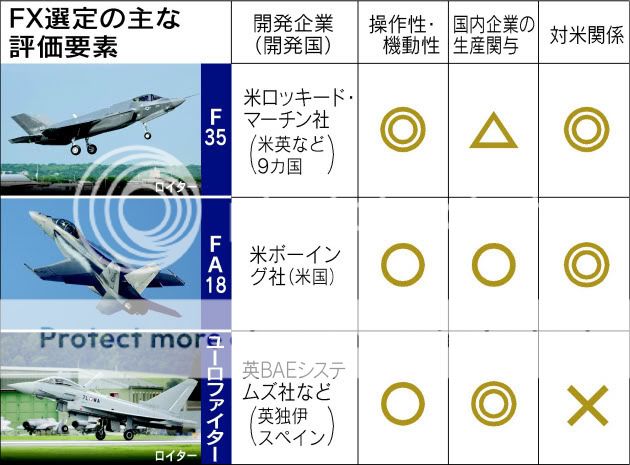
toanBiggest surprise for F-35 haters is that it placed the F-35 above the F-18 and Typhoon in “Operability/Maneuverability”
1. Not so surprising if the graphic includes the “Stealthy capability” in the definition of operability.
2. As for maneuverability, you can also easily make F-35A as the No.1 under the certain definition:
* F-35A can fly to Mach 1.6 with two 2,000 pounds bombs and two AIM-120, while both EF-2000 and F/A-18E can only fly at subsonic speed with the same payload.
* F-35A can reach the AoA of up to 50 degrees even with the payload mentioned above, while F/A-18E can do the same thing only under the clean configuration, and the productional EF-2000’s maximal AoA limited by the FCS is no more than 30 degrees in any kind of configuration.
toanIt would be a nice black humor if Moammar Gadhafi was really killed by the attack from a Rafale……..
The newest propaganda for exporting Rafale:
“Keep your promise and buy me, or I will bomb you to the hell:dev2:”
toanThe greatest A2A threat for France at the time of Mirage 2000’s R&D was MIG-25: a threat that can come from the altitude of 25,000 to 30,000 m with the speed of 3 Mach class.
And the pure delta design is the best choice for the class of climbing performance and acceleration that are needed for intercepting MIG-25, especially when your fighter’s engine is not powerful enough, and your fighter has no super anti-MIG-25 weapon system like AWG-9 + AIM-54…..
toanhttp://www.vectorsite.net/avmirf1.html
The Mirage F1 could literally fly rings around the Mirage III, with better maneuverability, 30% shorter takeoff run, and 25% slower approach speed. The F1 had 43% more internal fuel capacity and 2.5 tonnes (5,510 pounds) greater maximum takeoff weight.


 Sign In