 toan
toanAnd i wonder why he doesnt think the Apg-77(V)1 is a worthy competitor .
According to the USA policy right now, F-22A and APG-77 series won’t be sold to any foreign customer, right??
I think it should be the main reason why he doesn’t think the Apg-77(V)1 is a worthy competitor……
toanSorry buddy this just wont work :). We dont know as others have said if these are even close to max turn rates. Or what speeds they are conducted at – altitudes etc etc; with so many other factors to take into consideration too. And neither of these videos are the best representations for their particular aircraft that I have seen. Over at F-16.net there are some videos with much better turn rates for the F-22 and the same holds true for the tiffy.
As for the problem of altitude….I think if the fighters want to show their skill to the viewer on the ground, their flight altitude should be at the similar low-level……
As for probability that F-22A and/or EF-2000 doesn’t/don’t do their best in the video I’ve gotten……well, may someone here provide the better video(s) to me?? Thank you very much.
According to AIR International 2008 July, “Raptor swoops into Britain”:
Major Paul D “Max” Moga, the pilot for Raptor’s airshow in UK:
1. The skills that Raptor will show in UK: tail-slide, extreme turning, back-flip, Helicopter J-turn, and Power loop.
2. The range of Raptor’s G-load during the airshow: -3/-2G ~ +9.5/+10.5G.
3. The maximal instaneous turn rate during the airshow: more than 40 to 50 degrees per second ~Personally, I don’t believe this kind of turn rate can be achieved in traditional turning, which will cause the G-load which is so high that it’s impossible for human’s body to endure it. I think it can only be achieved during the skills of superagility, such as Helicopter J-turn or back-flip.
toanEuropean…. 🙂
An interesting declaration from an Italian pilot about the radar detection capability of CAPTOR radar:
http://www.airpower.at/news07/0512_4stormo/index.html
Dazu zhlt auch eine Sensorperformance welche die italienischen Piloten offensichtlich beraus positiv beurteilen. Und Nuzzo – Gunnery Instructor auf dem Tornado ADV – vergleicht: “Alleine die Radarreichweite habe sich im Vergleich zum Tornado ADV mehr als verdoppelt”.
Translating from German to English (http://babelfish.altavista.com/tr):
“The radar (detective) range (of Eurofighter) is more than two times of the radar (detective) range of Tornado F3 ADV.”
–> CAPTOR radar’s (detective) range is more than two times of the radar (detective) range of AI.24 Foxhunter.
As for the detective range of AI.24 Foxhunter:
http://www.secretprojects.co.uk/ebooks/Foxhunter.pdf
Original AI.24:
185km vs a bomber target, head on engagement.
130-140km vs a bomber target, tailchase engagement.
120-130km vs a fighter target, head on engagement.
75-90km vs a fighter target, tailchase engagement.
Upgrading AI.24 “Z standard” after 1988 (10~15%+ increase in detective range):
204~213km+ vs a bomber target, head on engagement.
143~161km+ vs a bomber target, tailchase engagement.
132~150km vs a fighter target, head on engagement.
83~104km vs a fighter target, tailchase engagement.
According to the data mentioned above, theoretically, the detective/tracking range of CAPTOR today should be:
408~426km+ vs a bomber target, head on engagement –> 245~300km+ in tracking range.
286~322km+ vs a bomber target, tailchase engagement –> 172~256km+ in tracking range.
264~300km+ vs a fighter target, head on engagement –> 158~210km+ in tracking range.
166~208km+ vs a fighter target, tailchase engagement –> 100~146km+ in tracking range.
DATE:29/05/08
SOURCE:Flight Daily News
ILA 2008: AESA radar solution now for Typhoons
Although some customers specify an Active Electronically Scanned Array (AESA) radar in their next generation fighters, Eurofighter says it has so far found that the performance of the Typhoon’s mechanically scanned Captor (Captor-M) exceeds that of first generation AESA radars, and this has convinced the doubters.
“The only AESA radar that will come anywhere close to holding its own against Captor is the APG-63(V)3 being developed for USAF F-15s” according to one Selex source.
Though electronically scanned radars offer faster scan rates, with search and track times up to one third quicker than those of mechanically scanned radars, the Captor-M enjoys significant advantages in range and azimuth coverage, and especially in range at the edges of the scan, where energy losses inherent in phase shifting can dramatically reduce the range performance of an AESA radar.
toanSo what exactly is the obsession on this forum with frontal or minimal RCS? I definitely missed it, so can I please see the new aerial combat rulebook that says fighters are going to line up perfectly (or near it) head on and engage each other in only this manner.
I think it just give you a hint that the possible minimal range that the two fighters should be able to find each other.
Simple speaking, according to my personal opinion, the “See first, lock first, and shot first” capability of Su-35BM in BVR engagement is significantly bigger than Rafale, roughly equal to Typhoon, and inferior than Raptor. The detective / tracking capability of IRBIS-E should be good enough to use R-77M or R-37/KS-172 to engage EF-2000 or Rafale today at the range of 100~150 km+ away at least. Therefore, beside integrating Meteor BVRAAM and AESA radar (especiaaly for Rafale), I think both the manufacturers of EF-2000 and Rafale should accelerate their pace of integrating more advanced LO techonology to their fighters in order to face the threat like Su-35BM in the near future (post-2012).
toanAlso Toan, where the heck are you getting those RCS values?
Declaration of airforce officer or Manufacturer, for example:
http://www.strategypage.com/htmw/htairfo/articles/20051125.aspx
November 25, 2005: The U.S. Air Force, in it’s effort to get money to build more F-22s, has revealed just how“stealthy”the F-22 is. It’s (F-22) RCS (Radar Cross Section) is the equivalent, for a radar, to a metal marble. The less stealthy (and much cheaper) F-35, is equal to a metal golf ball. The F-35 stealthiness is a bit better than the B-2 bomber, which, in turn, was twice as good as that on the even older F-117.
According to Google:
The area of cross section of a marble: 0.00015 (standard marble) ~ 0.0006 m2 (very big one).
The area of cross section of a golf ball: 0.0012 ~ 0.0015 m2.
toanComparison among F-22A, Su-35, EF-2000, and RAFALE C
Comparison among F-22A, Su-35, EF-2000, and RAFALE C (2008 Revised)
1. Normal take-off:
* F-22A: 29,250 kg
* Su-35: 25,300 kg
* EF-2K: 17,350 kg
* Rafale: 15,100 kg
2. MTOW:
* F-22A: 37,876 kg
* Su-35: 34,500 kg
* EF-2K: 23,000 kg
* Rafale: 24,500 kg
3. Internal Fuel:
* F-22A: 8,165 kg
* Su-35: 11,500 kg
* EF-2K: 5,000 kg
* Rafale: 4,750 kg
4. Maximal Payload:
* F-22A: 10,000 kg
* Su-35: 8,000 kg
* EF-2K: 6,500 ~ 7,500 kg
* Rafale: 9,500 kg
5. Maximal Speed, 11,000 m:
* F-22A: 2.00 Mach+ (2.25 ~ 2.42 Mach)
* Su-35: 2.25 Mach
* EF-2K: 2.00 Mach+ (2.25 Mach)
* Rafale: 1.80 Mach+ (2.00 Mach)
6. Maximal speed, 200 m:
* F-22A: 800 kts
* Su-35: 1,400 km/hr
* EF-2K: 1.14 Mach
* Rafale: 750 kts
7. Climb rate:
* F-22A: 350 m/sec, sea-level
* Su-35: 280 m/sec+, 1,000 m
* EF-2K: 315 m/sec+, sea-level
* Rafale: 305 m/sec+, sea-level
8. Operational Altitude:
* F-22A: 60,000 to 70,000 fts
* Su-35: 59,000 fts
* EF-2K: 55,000 to 65,000 fts
* Rafale: 55,000 fts
9. Ferry range:
* F-22A: More than 1,850 miles ferry range with 2 external wing fuel tanks.
* Su-35: 4,500 km (Internal Fuel + 2000 L tanks*2)
* EF-2K: 2,600 km (Internal Fuel)
* Rafale: > 2,100 km (Internal Fuel)
10. Acceleration:
* F-22A: unknown.
* Su-35: 13.8 secs from 600 km/hr to 1,100 km/hr, and 8 secs from 1,100 km/hr to 1,300 km/hr(with 50% internal fuel, standard A-A configuration, and height of 1,000 m).
* EF-2K: less than 20 seconds from 200 kts to Mach 0.9 (Twin-seaters with one 1,000 L tank and two ASRAAM, altitude unknown).
* Rafale: around 20 seconds from 300 km/hr to 1,000 km/hr at low altitude.
11. Normal upper G-limit:
* F-22A: +9.5~+10.5G
* Su-35: +9.0G
* EF-2K: +9.0G
* Rafale: +9.0G
12. T/W ratio of normal take-off(AB / Max. Mil.):
* F-22A: 1.09 ~ 1.21 / 0.79 ~ 0.81
* Su-35: 1.10 ~ 1.15 / 0.69 ~ 0.70
* EF-2K: 1.06 ~ 1.12 / 0.71 ~ 0.81
* Rafale: 1.01 ~ 1.02 / 0.67 ~ 0.68
13. Take-off with standard A-A configuration:
* F-22A: 244 m
* Su-35: 400 to 450 m
* EF-2K: 228 ~ 275 m(Emergency take-off)to 457 m(Normal take-off).
* Rafale: 400 m
14. Landing:
* F-22A: unknown.
* Su-35: 650 m(with the help of braking and parachute)
* EF-2K: 500 to 700 m
* Rafale: 400 m(with the help of braking only)
15. Radar’s range:
* F-22A: Tracking target of RCS = 1 m2 at the range of 200 km away –> Detecting target of RCS = 3m2 at the range of 375 to 440 km away theoretically –> 329 ~ 386.
* Su-35: Detecting target of RCS = 3m2 at the range of 350 to 400 km away –> 307 ~ 351.
* EF-2K: Tracking target of RCS = 5 m2 at the range of 160 ~ 185 km away –> Detecting target of RCS = 3m2 at the range of 200 to 272 km away theoretically –> 175 ~ 239.
* Rafale: Detecting target of RCS = 5 m2 at the range of 130 ~ 148 km away –> Detecting target of RCS = 3m2 at the range of 114 to 130 km away theoretically –> 100 ~ 114.
16. Maximal horizontal scanning angle of Radar:
* F-22A: +/- 60 degrees
* Su-35: +/-120 degrees
* EF-2K: +/- 70 degrees
* Rafale: +/- 60 degrees
17. Capability of multiple target engagement:
* F-22A: Tracking 100 and engaging 6+.
* Su-35: Tracking 30 and engaging 8.
* EF-2K: Tracking 20+ and engagine 6 to 8.
* Rafale: Tracking 40 and engaging 4 to 6.
18. Frontal minimal RCS / Ratio of RCS / Ratio of range being detected:
* F-22A: 0.00015 ~ 0.0006 m2 –> 1 ~ 4 –> 1.00 ~ 1.41
* Su-35: 1.0 ~ 3.0 m2 –> 6666 ~ 20000 –> 9.03 ~ 11.89
* EF-2K: 0.1 ~ 0.5 m2 –> 666 ~ 3333 –> 5.08 ~ 7.60
* Rafale: 0.1 ~ 0.2 m2 –> 666 ~ 1332 –> 5.08 ~ 6.04
19. Su-35 v.s other western fighters:
* Theoretically, F-22A shall be able to detect / track Su-35 at the range of 285 to 440 km / 200 to 308 km away in head to head engagement.
* Theoretically, Su-35 shall be able to detect / track F-22A at the range of 29 to 48 km / 17 to 34 km away in head to head engagement.
* Theoretically, EF-2K shall be able to detect / track Su-35 at the range of 153 to 272 km / 107 to 163 km away in head to head engagement.
* Theoretically, Su-35 shall be able to detect / track EF-2K at the range of 150 to 256 km / 90 to 180 km away in head to head engagement.
* Theoretically, Rafale shall be able to detect / track Su-35 at the range of 87 to 130 km / 52 to 91 km away in head to head engagement.
* Theoretically, Su-35 shall be able to detect / track Rafale at the range of 150 to 203 km / 90 to 142 km away in head to head engagement.
toanPersonal Opinion for this topic
F-22A
1. APG-77 Radar:
It has been declared to be able “track” the target of RCS = 1m2 at the range of 200 km+.
2. Minimal frontal RCS: Marble size, or around 0.0002 ~ 0.0005 m2.
3. Effective range of its BVRAAMs in supersonic head-to-head engagement at medial to high altitude:
*AIM-120C6 (now): 81 ~ 92.5 km (maximal range), 55 ~ 75 km (maximal effective range), 35 ~ 50 km (NEZ range).
*AIM-120D (2013): 111 km (maximal range), 75 ~ 90 km (maximal effective range), 45 ~ 60 km (NEZ range).
F-35
1. APG-81 Radar:
It has been declared to be able “track” the target of RCS = 1m2 at the range of 160 km+.
2. Minimal frontal RCS: Golf ball size, or around 0.0012 ~ 0.0015 m2.
3. Effective range of its BVRAAMs in supersonic head-to-head engagement at medial to high altitude:
*AIM-120D (2013): 111 km (maximal range), 75 ~ 90 km (maximal effective range), 45 ~ 60 km (NEZ range).
EF-2000
1. Captor-M Radar:
It has been declared to be able “track” the target of standard fighter (RCS = 5m2) at the range of 161 ~ 185 km+. With the help of AESA upgrading, the manufacturer has hinted that the effective detecting / tracking range of CAPTOR-E may increase 50% at least.
2. Minimal frontal RCS:
0.1 ~ 0.5 m2 should be the most reasonable range of estimation according to the military information that I’ve collected.
3. Effective range of its BVRAAMs in supersonic head-to-head engagement at medial to high altitude:
*AIM-120B (now): 74 km (maximal range), 50 ~ 60 km (maximal effective range), 30 ~ 40 km (NEZ range).
*AIM-120C5 (2008): 81 ~ 92.5 km (maximal range), 55 ~ 75 km (maximal effective range), 35 ~ 50 km (NEZ range).
*Meteor (post-2012): 200 km+ (maximal range), 150 km+ (maximal effective range), 100 km+ (NEZ range).
MIG-31M
1. Zaslon-M Radar:
It has been declared to be able “detect” the target of F-15 / Su-27 classs (RCS = 10 ~ 25 m2) at the range of 400 km+.
2. Minimal frontal RCS:
Unknown, but I see no reason that it can be smaller than F-15 / Su-27.
3. Effective range of its BVRAAMs in supersonic head-to-head engagement at medial to high altitude:
*R-77: 50 ~ 80 km (maximal effective range).
*R-77M: 80 ~ 120 km (maximal effective range).
*R-33: 160 km (maximal effective range)
*R-37: 300 km+ (maximal effective range)
Su-35BM, post-2012 ~ 2015
1. IRBIS-E Radar:
It has been declared to be able “detect” the target of RCS = 3 m2 at the range of 350 ~ 400 km+, or the target of RCS = 0.01 m2 at the range of 90 km+.
2. Minimal frontal RCS: may be reduced to 1 ~ 3 m2 with the help of RAM.
3. Effective range of its BVRAAMs in supersonic head-to-head engagement at medial to high altitude:
*R-77: 50 ~ 80 km (maximal effective range).
*R-77M: 80 ~ 120 km (maximal effective range).
*R-77 Ramjet-powered: 160 km+ (maximal effective range)
*R-37: 300 km+ (maximal effective range for anti-AWACS mission)
*KS-172: 400 km+ (maximal effective range for anti-AWACS mission)
According to the data and estimation mentioned above and the basic formula for RCS:
1. F-22A with APG-77 shall be able to track MIG-31M at the range of 350 ~ 450 km+, and Su-35BM at the range of 200 ~ 265 km+.
2. F-35A with APG-81 shall be able to track MIG-31M at the range of 280 ~ 360 km+, and Su-35BM at the range of 160 ~ 210 km+.
3. EF-2000 with CAPTOR-M shall be able to track MIG-31M at the range of more than 190 ~ 275 km, and Su-35BM at the range of more than 108 ~ 163 km.
4. EF-2000 with CAPTOR-E shall be able to track MIG-31M at the range of more than 285 ~ 410 km, and Su-35BM at the range of more than 162 ~ 285 km.
5. MIG-31M with Zaslon-M shall be able to detect / track F-22A at the range of around 21 ~ 35 km / 13 ~ 25 km; and F-35A at the range of around 33 ~ 45 km / 20 ~ 32 km; and EF-2000 at the range of around 100 ~ 190 km / 60 ~ 130 km.
6. Su-35BM with IRBIS-E shall be able to detect / track F-22A at the range of around 34 ~ 42 km / 20 ~ 30 km; and F-35A at the range of around 53 ~ 56 km / 32 ~ 40 km; and EF-2000 at the range of around 160 ~ 240 km / 95 ~ 170 km.
toanThey are of course classified but Toan posted a few speed vs height comparisons of the tiffy, F-22, F-15 and an Su-xx. The F-22 came out on top in every circumstance and they were from published sources I assume. The tiffy came 2nd.
http://www.airpower.at/flugzeuge/eurofighter/flightenvelope.gif
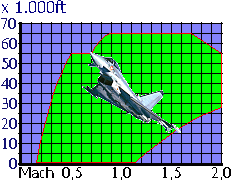
http://vayu-sena-aux.tripod.com/images/al-31fp.gif
Comparison of flight-envelope between EF-2000 and Su-30MKI
Sea-Level
EF-2000: 0.15 to 1.15 Mach
Su-30MKI: 0.20 to 1.10 Mach(Without TVC)
Su-30MKI: -0.25 to 0.45 Mach(With TVC)
2,000 meters:
EF-2000: 0.18 to 1.28 Mach
Su-30MKI: 0.22 to 1.30 Mach(Without TVC)
Su-30MKI: -0.28 to 0.50 Mach(With TVC)
4,000 meters:
EF-2000: 0.20 to 1.46 Mach
Su-30MKI: 0.23 to 1.45 Mach(Without TVC)
Su-30MKI: -0.30 to 0.55 Mach(With TVC)
6,000 meters:
EF-2000: 0.22 to 1.65 Mach
Su-30MKI: 0.26 to 1.60 Mach(Without TVC)
Su-30MKI: -0.32 to 0.60 Mach(With TVC)
8,000 meters:
EF-2000: 0.29 to 1.90 Mach
Su-30MKI: 0.30 to 1.80 Mach(Without TVC)
Su-30MKI: -0.38 to 0.70 Mach(With TVC)
10,000 meters:
EF-2000: 0.30 to 2.00 Mach+
Su-30MKI: 0.35 to 2.00 Mach(Without TVC)
Su-30MKI: -0.44 to 0.80 Mach(With TVC)
11,000 meters:
EF-2000: 0.32 to 2.00 Mach+
Su-30MKI: 0.38 to 2.15 Mach(Without TVC)
Su-30MKI: 0.38 to 0.80 Mach(With TVC)
12,000 meters:
EF-2000: 0.35 to 2.00 Mach+
Su-30MKI: 0.40 to 2.15 Mach(Without TVC)
Su-30MKI: 0.40 to 0.80 Mach(With TVC)
13,000 meters:
EF-2000: 0.38 to 2.00 Mach+
Su-30MKI: 0.43 to 2.15 Mach
14,000 meters:
EF-2000: 0.41 to 2.00 Mach+
Su-30MKI: 0.65 to 2.10 Mach
15,000 meters:
EF-2000: 0.44 to 2.00 Mach+
Su-30MKI: 0.80 to 2.00 Mach
16,000 meters:
EF-2000: 0.47 to 2.00 Mach+
Su-30MKI: 1.00 to 1.90 Mach
17,000 meters:
EF-2000: 0.50 to 2.00 Mach
Su-30MKI: 1.10 to 1.80 Mach
18,000 meters:
EF-2000: 0.75 to 1.85 Mach
Su-30MKI: 1.40 to 1.60 Mach
19,000 meters:
EF-2000: 0.85 to 1.75 Mach
19,500 meters:
EF-2000: 0.88 to 1.70 Mach
PS1:
The EF-2K with standard air-combat configuration (BVRAAM*4 & WVRAAM*2) could reach the speed of Mach 2.0 or above between the heights of 28,000 fts and 55,000 fts (8,500 ~ 16,750 meters).
PS2:
The Su-30MKI with unknown configuration could reach the speed of Mach 2.0 or above between the heights of 10,000 meters and 15,000 meters.
It seems that EF-2000 is better in the flight-envelope of high altitude, while Su-30MKI is obviously superior in the area of low-speed superagility at low altitude.
toanAs for the turn rate of Raptor and Typhoon
F-22A flight show in UK, 2008:
http://tw.youtube.com/watch?v=mMeNz7J0zzo
EF-2000 flight show with one 1000 liter external fuel tank:
http://tw.youtube.com/watch?v=nypwKZT6MZw
Both fighters had performed traditional horizontal 360-degree turn with afterburners during their flight shows. I think we can calculate the time they need to make a traditional 360-degree turn in these video and make a little comparision…….
According to my personal view and calculation:
1. In the video, it takes Eurofighter (with one 1000 liter external fuel tank) around 18 to 22 seconds to achieve a 360-degree turn, horizontally or vertically.
2. It seems that the time the Raptor needs to achieve a 360 degrees traditional turn is not less than the time the Eurofighter needs to do the same thing. Although Raptor has the much better performance in the skills of high AoA and superagility.


 Sign In







