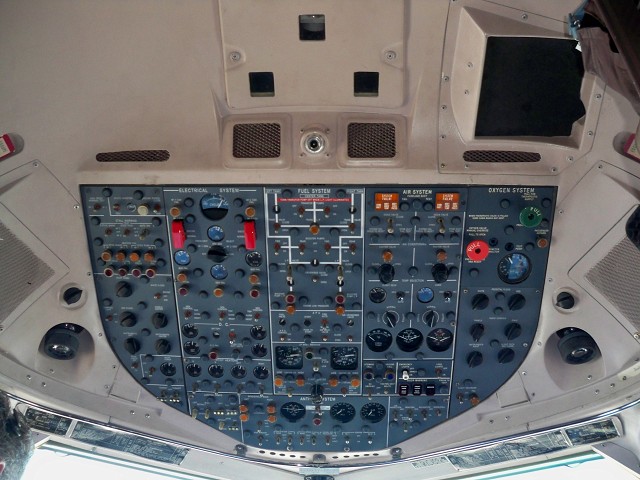
That looks to be a BAC 1-11 overhead panel probably a 400 series at a guess, it’s not the same as the 510ED version I’ve got. http://www.classicjettours.com/pictures/100_2711.JPG
There are always other avenues with this. I have a pretty random collection of aviation items covering the whole gambit from high tech military to civvy promotional items, some of the things I acquire at the point where I’m their last chance before getting skipped. Generally they are cleaned and conserved and restored if they are beyond the point their patina can be saved. A couple of times a year I’ll see a project which needs something I have but don’t need so I donate. Newark Air Museum provides a great platform for us private collectors to bring our kit and get it displayed for the public to see and I always try and bring something each time that hasn’t seen the light of day for a long while. The last couple of years I have taken panels from XW666 which ditched in the Moray Firth, the panels as you can imagine are totally wrecked but they are exactly as they were removed from the aircraft. They had been skipped and the chap I got them from rescued them, I bought them because although they are essentially scrap they have one hell of a story to tell and are more talked about than the tidy panels I show. Then again I have given a home to a British Airways enamel potty!
My thoughts were in the Swift, Attacker, Sea Hawk realm but I can’t find any pics showing one that sits on the ground. Javelin is interesting, I haven’t found a pic of a rear cockpit ladder yet the front one is pretty elaborate to get over the intakes.
The Sea King behind the Rangey was one the moments on the Sunday that made me chuckle I should imagine there was quite a few odd looks on the road when folks saw that.
There is also a dataplate on the forward end of the rudder but I don’t think you can track that back to the main dataplate???
[ATTACH=CONFIG]253870[/ATTACH]
So the trick will be to look for where the fleet finished up
SX-OAC, SX-OAE with Olympic still had the SIA panels when they went to the scrap man:
http://www.airliners.net/photo/Olympic/Boeing-747-212B/232258/L
SX-OAD is still at Bruntingthorpe, no idea if the upper deck cabin is intact. A call to GJD at Brunty may answer that for you.
Airfleets lists the onward operators as pax or freighter birds so running the reg’s may yield something.
I was going to say Dunlop Denovo but I think they are riveted and not bolted it’s also similar to an Isetta wheel. The only other thought is trailer or sidecar.
Keep up the sterling effort and the updates I always look forward to reading them. Every restoration has to start somewhere, when I’ve done cars in the past the first thing I start with is figuring out what’s good and what’s not. Doing so enables me to save the time spent cosmetically restoring parts only to find they either don’t work or are not reliable. Also this often means when I get to the shiny paint stage everything is good to go which means less scope for damaging the fresh paint debugging a thorny issue. Looking at the electric trickery means you will have been pretty much all over the jet so will have a good idea what’s lurking and needs sorting out on the metalwork side. The flip side of it is we all need a pick me up at points during a resto and there’s nothing quite like breathing life back into long dormant machines to perk up your day.
That’s XP831 “landing” at Le Bourget on 16/06/1963 I have a close up Keystone Press photo with the caption in French. I don’t own the copyright so can’t post it sadly.
Hi
Mrs E uses Towergate insurance for her living history group and they are pretty reasonable.
Cheers,
Mike
I seem to remember the issue also being linked to the physical method of riveting used during construction. Rather than pre-drill the rivet holes and then following up with riveting the factory apparently used punch riveting to speed up production. There has been suggestion that the punch riveting process may have caused initial fractures or created imperfections in the rivet holes which subsequently propagated.
The text I was referring to is:
“In February 2015 the ejection seat manufacturer ceased to provide technical support
or replacement parts for ejection seats fitted to aircraft which no longer operate in their
original military role. Ejection seats installed in civil-operated ex-military aircraft fall into
this category and replacement cartridges manufactured by the original manufacturer are no
longer available. As a result, the ejection seat manufacturer considers that such ejection
seats should be deactivated to prevent the risk of inadvertent operation. This is contrary to
the current CAP 632 requirement for ejection seats in swept-wing aircraft to be operated in
a fully operational and armed condition.”
The AAIB will report once they’ve got as much of a picture as they can about what happened.
For me the seat question is an interesting one, if I understand it correctly the CAA require the seats to be live however the OEM/design authority has withdrawn support for the seats and no longer supplies cartridges. So technically either the CAA certifies the fitted cartridges longer or every aircraft using that type of seat is grounded by virtue of being unable to operate a live seat with fully compliant servicing.
In trying to think of other jets of this sort of size and vintage only the Canberra springs to mind which I’m guessing the sole flightworthy PR9 having a later out of service date uses a different seat type which is still supported?

Blimey time is marching on isn’t it!
Hopefully I’ll be bringing:
Nimrod XW666 – Pilot, Co-Pilot and Centre engine panels
HS Trident 3B G-AWZN – Flight engineers station
Boeing 707-430 D-ABOF – Co-Pilots panel
Lockheed L1011 G-BEAL – Pilots panel
HP Victor B1a – Co-pilots panel
Vickers Viscount XT661 – Co-Pilots Panel
HP Hastings – Co-pilots Panel and Engineers panel
Whatever else I spot as I load up 😉
Cheers,
Mike
I can’t find any pictures but any possibility it’s from a Riley Turbo exec or Carstadt Jetliner conversion? Might explain the differences.