 galdri
No problem with questions like this. Everyone has to learn from somewhere;)
Reverse is mostly found on turboprop and jet aircraft. On jets there is a “reverese lever” mounted at the front of the throttles. In flight, this lever is inhibited. It only works after WOW (weight on wheels), after the aircraft senses it has landed by proximity switches on the landing gears. Once the aircraft has landed, it is a simple matter of sliding your hand forward and pulling upwards on the reverse levers which in turn will activate the reverser shells on the engines.
On turbo props, the basic princeple is the same, but in stead of reverser levers you would have to lift the throttles upwards and then move them backwards to achive reverse on the props.
galdriGuess you have seen this webpage from the TAM museum.
http://www.museutam.com.br/smt/jsp/default.jhtml?adPagina=445&adArtigo=4070
Looks like the restoration is finished to a good standard. Unfourtunately the page looks spanish only.
http://upload2.postimage.org/334767/photo_hosting.html
http://www.jetsite.com.br/2006/mostra_nostalgia.asp?codi=106
galdriAlso keep in mind the fact that at the time of building of the VC10, jetstar etc, the certification requirements for isolation of engines in case of fire and disintergration were a lot less limiting than today.
The VC10 did have armour plating between the engines to help stop an errant fan blade or turbine blade and to delay the onset of fire to the other engine. This would cost a lot of armour plating today with today´s big fanengines, and would probably never achive certification by the authorities.
galdriCould well be the machine Counsul has offered. The history of the aircraft is:
NT449 NF30 (units)125/609/29 To 6934M 26.11.51
Taken from this site: http://www.dehavilland.ukf.net/_DH98%20prodn%20list.txt
galdriJust thinking about re-engineering, how do J3s flying with an O-200? Too nose heavy?
Both of these are J3´s with O-200s. (copyright Baldur Sveinsson)
http://www.verslo.is/baldur/1024/TF-CUP-KAS_2401g_1024.jpg
The yellow one is built as a J3, with O-200 and rearseat solo. It flys like a dream, I´ve got a few hours on it already;) No hint of noseheavy-ness.
The Blue and Yellow one was built to PA-11 standard (cowlings, wingtanks etc.) and is flown solo from the front seat. It is noseheavy when flown solo, but nothing that is not managable.
Fournier Boy, I would imagine the tab for A65 engines has all but dried up. Spares are getting very hard to find, expessially the crank shaft, though I seem to remember an STC for an O-200 crank to be installed (do not hold me responsible if it is a fabrication of my mind!). I do know about a spare A65 in condition unknown, but looks good on the outside, and whether there are any logs I´ve got no idea. I´ve no idea if it is for sale however. Drop me a PM if interested and I can give you contact details. It does not hurt to ask if it is for sale, NO would be the worst possible answer.
Continental A65 Please, complete with logbooks. Hours left SMOH not essential, its going to get rebuilt anyway!
This comment leaves me wondering. Why do you need the log books if it is going to be rebuilt anyway? All maintainance organizations can, and will, make a new log book for an engine after overhaul if no logbook exists. All they need is the dataplate from the engine to be able to do it. If you are not sending it to a maintainance organization, but intend to rebuild it yourself as a homebuilt (the aircraft on the PFA), you can, at least according to Icelandic rules, rebuild the engine yourself and make a new logbook for it. The only case I can see for you to need logbooks with an engine, is if you intend to install it un-rebuilt in a CofA aircraft. But what do I know, I´m only icelandic;) 😀 😀
galdriAll I can say is Congratulations on the Stearman. It must be wonderful. I only wish I could be doing your job:o Being a grease monkey on P-51´s and flying a Stearman during the spare time is heaven come true.
galdriI think you should all start looking in the Syrian desert. I have it on good authority that a whole squadron on Spitfires is hidden there. That was the secret reason for the Israeli airstrike there this year. They wanted to keep up the prices of Spitfires as they are intending to sell their black one:diablo: I have it on good authority that they missed the location altogether, and the Spits are still there in very good condition.
galdrino interest in taking it much further than the Stearman I currently fly
You must surely be eyeing up the possibility of gratuating to the Mustang, as soon there will be two of them on your little airfield;) 😀 😀
Anyways, congratulations on the Stearman, I didn´t know you were flying the beast already.
galdriBeen discussed here already:
http://forum.keypublishing.co.uk/showthread.php?t=76863
Nice to see the whole clip though.
galdriWere there any early aircraft that went against the convention by having nose gear?
I have some ideas and would be particularly interested to know the first nose gear fitted aeroplane.
Well, the first nosegear fitted aeroplane to fly, would have to have been the Curtiss (or Aerial Experimental Association) June Bug that first flew in June 1908.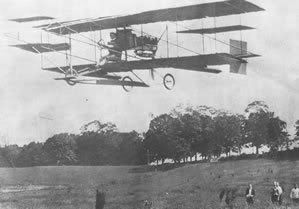
The Curtiss design continued to be utilized for a long time in the form of the Beachy “Little Looper”. I think that one was built in some quantity up to around 1914, If anyone knows how many, and how long it was produced, I would be happy to know. Here is a picture of a reproduction flying in the late 60´s early 70´s.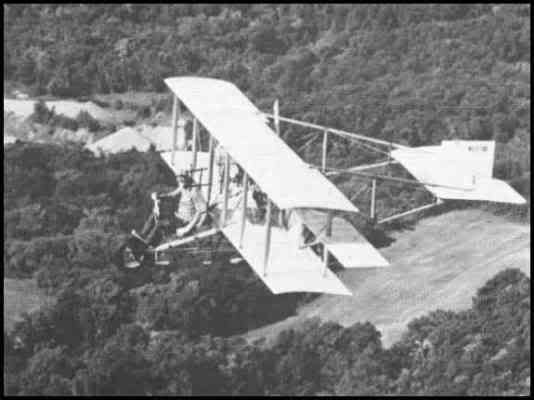
In Europe, the Voisin family of aircraft had nosegears from the earliest aircraft. The exact date of first flight of Voisin is something I do not know of the top of my head and am too lazy to check. I would guess it was around 1909. Here is a Voisin 3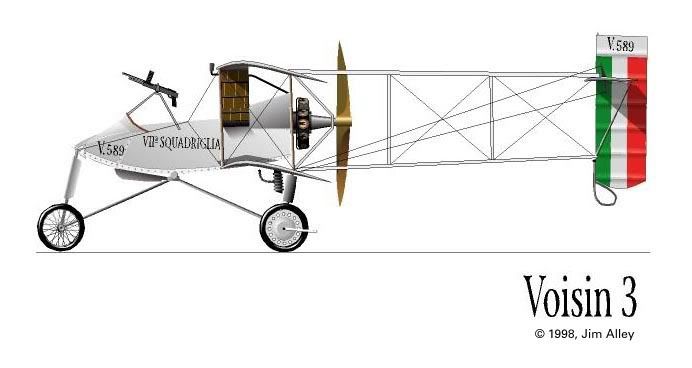
These photos have been “stolen” by me over the years and live on my computer. I have long since forgotten where I got them from, so if the copyright holder has objections I will pull them right away!
As can be seen, all the first nosegear aircraft were pushers. I guess when people started the convention of putting the engine at the front, they really didn´t have much choise but to put the wheel at the back since the slow reving engines of the first aircraft needed a big propeller to create enough thrust. To build a nosegear aircraft would have resaulted in a very long leg at the front, and that would have been very difficult to build strong enough with the materials at hand.
galdriGenerally you are better off buying a flying aircraft than to build/restore if you can find what you are looking for in restored condition. Buying a flying wreck is not a good idea, then it is better to start the restoration your self and do it right. A good restored aircraft is usually cheaper than doing the restoration yourself.
galdriOne thing that has always intrigued me, is the yellow band on the leading edges of the wing outboard of the cannon. Every other Spit seems to have them. Sticking in my memory is something I think I read a long time ago, about these yellow bands being used only by the Fighter Leader School and they were used to identify instructors. Is that incorrect, or are they just painted on machines today because they look good?
galdriMEP rating holder and staying well clear of the technicals! :p
I need to stay well clear of the technicals as well. I´m only instructing in twins, and am a certified examiner on them. I´ve never flown a four engined machine. All my time I´ve believed that the blade position in the prop arch does not matter, only the specific RPM of the respective engines. That is why I can not see why a light shining from the cockpit will assist in syncing the engines. But what do I know, never having flown a four engined machine?
I´ve clearly lost the plot somewhere.
galdriThis is old ground being treaded once more. On one of these threads (do not remember where), I quoted John Searby DSO, DFC from his book The Bomber Battle for Berlin, as saying that the deletion of just the mid -upper turret would have resaulted in signficantly lower casaulties due to the higher speed of the aircraft and the inability of the german night figher force to cope with the higher speed of the pray.
That sentiment is born out in an article I read in one of the monthlies, where a german night fighter pilot is telling of his difficulties of catching a Halifax going flat out for England after a sortie close to the shores of Holland. He was flying an Me 110, and had great difficulties indeed closing on his pray that was going flat out at a steady altitude.
galdriSo it was pilot error? :confused:
I´m playing the devil´s advocate here, but I would like to point you to one of the best books ever written. The book is Fate is the Hunter, by Earnst K. Gann. In it, he makes the very relevant point, that there is no such thing as “Pilot error”.
An accident, very rarely, just happens. Usually there is a chain of events leading to an accident. The chain of events can be totally outside the pilot´s control, and he will just be along for the ride. In a typical accident (if there is such a thing!), the chain is usually 5 to 8 factors (sometimes more), and if the chain goes unbroken, an accident will happen. All of us who fly, start a chain of events, on every flight, that might end in an accident. Thing is, in 99,99% of instances the chain gets broken before something happens.
I´ve not read the accident report for this accident, and I can´t be bothered to read the journo version. If what you say about the flaps not being correctly set for take off is correctly quoted from the accident report, it is only one of the factors in the accident. What was the aircraft doing so far off the side of the runway, and why did it end up there, instead of going off the end? Why, why why, I can go on for ever with whys. Do not forget that the accident might have started the day before, or the week before, when a chain was set in motion with something that was outside the pilot´s control. Indeed the whole chain might have been outside the pilot´s control right up to the point of not setting take off flaps. Even an accident report sometimes does not cover the whole history of something that happened the week before the accident.
My bottom line is, NEVER use the word pilot error unless having considered very hard ALL the evidence.


 Sign In







