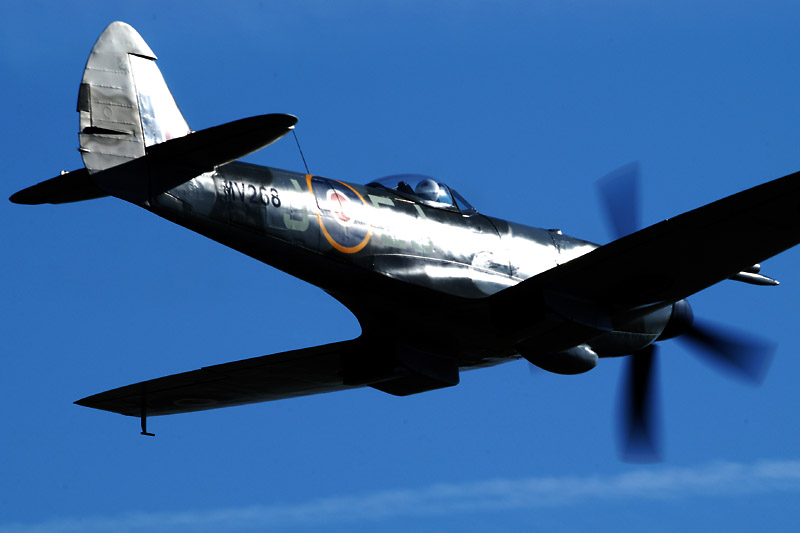
Ideally any long lens should be properly supported with a decent tripod, but at an airshow? No I never use one, I donโt find it practical, and Iโd miss far too much. I do use a monopod in some situations, especially with the sigma 50-500 lens which helps at the long end of the zoom for taxiing/takeoff shots, but for displays in the air I always handhold.
If you are getting unsharp images try upping the ISO, donโt be afraid to use 400, 640 or 800 ISO, its much better to have a sharp, well exposed photograph with a bit of grain/noise (film/digital) than an image ruined by camera shake. There are some very effective noise reduction programmes (Neat Image etc) that can help if the noise becomes too objectionable.
A 60-300 lens is likely to have a maximum aperture of F5.6, add a 2x converter and your maximum aperture will be F11, very difficult to use effectively. Iโd try loosing the converter and using the lens on its own. A 300mm should be enough to get some decent results if you think carefully about your position at a show, look to see which end they come over the threshold or start their takeoff run and position yourself there, rather than at the centre of the display line.
All the stuff I posted yesterday at Elvington Photos were taken with a 70-200mm lens+1.4x converter (effectively 280mm) so it is possible to get reasonable images with this focal length so long as you think about your location.
Gareth

thanks, the AT-6 was from Anthony Hodgson’s stable according to the programme, kept at a private strip in North Wales. Was supposed to be accompanied by a Beech 18, but that did not turn up unfortunately.
Think the pole simply separated rather than broke, they are in sections, rather like a long fishing pole I believe. Mind you its certainly bending a bit in this previous frame!
Not many of the flight line I’m afraid, they had all got their covers on when I arrived, and by the time they were removed I didn’t want to loose my place on the display line.
Here’s the few I did get…


Did the Victor and Bucc both taxi ?
yep…


first time I found the ‘curves’ function in photoshop…
guess I overdid it a bit!! ๐
Pity someone cannot arrange for a 617 sqn Gr4 to show her what a real high speed, low level pass sounds like. That would put PA 474โs flypast into perspective.
This drivel in the Torygraph as well? thought she was more of a Guardian type…
Snapper โ you have a fantastic way with words!! ๐
True, Iโd love to have the opportunity to try though, now that would be fun ๐ ๐
Originally posted by Ashley
…Does anyone have any more pics of the lovely Lizzie?Ashley
Couple of my attempts, black finish and bright blue sky, not the easiest to expose for, tend to loose all detail if not careful…


http://www.warehouseexpress.co.uk/ list the sigma 80-400 OS as ‘arriving July’ and give a price of ยฃ899.99
hth
Gareth
thats the only problems with D-SLRs, the cost of buying the camera is only the start of it!!:D
(microdrives, photoshop, faster PC, extra lenses….. never ends!)
Been using the 50-500 with my D100 for about 6 months now Septic, done four shows (Coventry, Kemble, Waddington and Legends) with it and am very pleased with it.
Being able to pull back to 50mm (75mm equivalent on the D100) to get a tristar in one minute, then zoom in to 500mm (750mm equivalent) on the next fighter makes it invaluable when it gets busy. For what it does (10x zoom range) it has no competition (for Nikon owners at least), and the price is unbeatable. Nikon does produce a 100-400VR zoom but since it has no AF-S it is slow to focus, not good for aircraft.
The 50-500 does need careful handling however, I generally handhold it but have used a monopod at arrivals days, that improves my success rate at the 500mm end, and relieves the strain on the back, neck and shoulder, it IS a Heavy beast! I prefer to keep it stopped down a couple of stops whenever possible, even if this means pushing the ISO to 400, 500, it certainly improves its sharpness. The 80-400 sounds interesting especially with its optical stabilisation, but Iโve yet to see an independent review of it published so far.
Couple of examples taken with my 50-500


Basically you take a reference shot of a white surface (well stopped down and out of focus) with your camera, the programme identifies any dust spots on the sensor and from this makes a reference file for your sensor.
You then open your photograph in Spotkiller and it then uses this information to attempt to remove the marks from your images. It does batch processing so you simply load all the photos in a folder and leave it to run.
Saves an age with the clone tool in PhotoShop!
Wonderful photographs Steveb, wish I could have managed to get to RIAT this year now…
For anyone having trouble with dust on the sensor of a D-SLR then SpotKiller is worth checking out, its a freeware utility discussed at DPreview which can save an age with the clone tool, and, once set up can batch process a whole folder of images automatically.
Yeovilton circa 1976, aged all of 8 and armed with my dads old rolicord. (wonderful camera for aircraft that, twin lens reflex, 12 shots on a roll, 75mm uncoated lens but hey it had a ‘sports finder’ which consisted of a wire type frame and a little mirror in the middle!!)
PA474 was there with no mid upper turret, and the Sally B was resplendent in polished aluminium finish. Seem to recall a German starfighter crashed on approach whilst we were looking around a radio communication tent, as they tended to do quite regularly then.
Couple of photos from the archive (I’ve a sneaking suspicion my Dad ‘helped’ me with these:) )