 21Ankush
Begging your pardon, I dont know how the author compiled the story (IANS was the original source not TOI) and whether he/she did any research on MKI or not. But for some reason he/she did manage to mention many of the good points in this very article that you have mentioned in your above post, i.e. In a blot on its otherwise unblemished record and that The Su-30 has won universal acclaim and that it had more than held their own against the US’ F/A-18 and F-16 combat jets.. Nevertheless I do know what you mean by ‘moron journos’ in that region, but only because of the mention of one negative line, i.e. In the case of the Su-30, however, there have been “recurring complaints” by pilots about problems with the jet, it becomes DDM. Why?
On another note, we know that SU-30 has had an accident-free record for the last 12 years. Although the news story mentions 55 fighters in the fleet, the most recent estimate is close to 80 or so (based on the number of squadrons already in place). Now accidents (even with twin engined fighters) happen all over the world, so the question is why did IAF decide to ground the entire fleet and that too for almost a month (if we are to believe this news story) in spite of an unblemished record for the past so many years? Some might say that I might be reading too much into, and by all accounts I might be doing so. But plese feel free to correct me where Im wrong.
the reason they grounded the fleet was because there was no plausible explanation as to what caused the accident. luckily one of the pilots survived, so the IAF will know his account of what went wrong. what we do know is that it was not pilot error, rather some system malfunction which couldn’t be pin-pointed and hence, no corrective/preventive measure could be taken on the rest of the fleet. so, while the 12 Russian specialists try to find the fault, the fleet had been grounded, rather than risk another such catastrophic failure.
to suddenly say that “pilots have complained about issues with the MKI” as said by the journo, suggests that the IAF knows what the issue might be and if so, they wouldn’t take so long to de-bug it and resolve it for the rest of the fleet.
21AnkushLooks like Peru will need to respond with more than just a handful of MiG-29SMPs. Su-30MKP, perhaps? 😉 Or used Mirage-2000-5s from Qatar?
only if Qatar has a reasonable expectation of how much those Mirage-2000-5s are worth..asking for $650 million for 12 Mirages with weapons is a lot, even if they have more service life left in them, when Chile is getting 18 second hand MLU’ed F-16s for just about $145 million or thereabouts..
21AnkushScooter, you say that the LCA will be obsolete by the time it enters service..obsolete against what ? the F-7PGs and 6th generation JF-17s of the PAF ? :diablo: or the 7th generation J-10s ?
you have been reminded time and again that the avionics of the LCA are/will be as good and better than that of the equivalent avionics on the Su-30MKI (which itself uses avionics that originally were developed for the LCA program) when it reaches FOC..its internal EW (Mayawi), its indigenous RWR, its radar, its weapons, et. al.
then again, India could easily source any equipment it wanted from Israel, France, or even indigenously, to equip the LCA. there is an indigenous AESA program going on as well, apart from the one that is producing the indigenous AEWACS on the EMB-145 platform. the fighter AESA should hopefully have results by the time the LCA Mk.2 is ready. till then, the Elta 2032 (which is believed to be better than the APG-68(V)9 of the Block 50 F-16s) should be more than adequate for the kinds of threats the IAF has to tackle. and if the indigenous AESA is not good enough, then a foreign source would always be open. anyhow, the IAF will ensure that the LCA will remain current under any circumstance.
and even then, the LCA Mk.1 need not be the cutting edge of the IAF. that role can be taken by the Su-30MKI and by 2014, the IAF should have 229 of these in service (subtracting one lost and if no more are lost), alongwith all its 66 upgraded multi-role MiG-29UPGs and (if they ever get upgraded) 51Mirage-2000-5s.
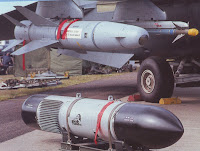
21AnkushIAF Mirage-2000s can also carry the Israeli Griffin LGB kit on a standard British Mk.21 bomb as seen below on an IAF Jaguar

21AnkushIAF Mirage-2000s carry the Israeli Crystal Maze long range standoff weapon. unfortunately, I have no pictures to show for this. 🙁
India all set to acquire Crystal Maze missiles from IsraelSHISHIR GUPTA
JERUSALEM, DECEMBER 12India is on the verge of acquiring a long-range weapon with Israel scheduled to deliver the 100-km range air to surface stand-off Crystal Maze missile next month. Manufactured by Rafael, the Crystal Maze is similar to the Popeye all-weather bunker busting missile that is launched from an aircraft to destroy command and control centers, enemy bunkers and even militant training camps from a distance of 80-100 kilometres.
The TV-guided missile, which has a 80 kg warhead, is highly accurate with an error range within three metres. Other than some US allies in Asia and Pacific, this missile is not in the armoury of either China or Pakistan.
The acquisition of Crystal Maze missile is extremely significant for Indian offensive capabilities. For the first time, the IAF will have an air-to-surface launched cruise missile that can be fired from an aircraft. The present Indo-Russian venture Brahmos is essentially an anti-ship cruise missile and it is very difficult for the bulky missile to be mounted on an aircraft.
Apart from the Crystal Maze missile, New Delhi is also looking to acquire Delilah II anti-radiation drone with missile firing capability and Penetration-500 bombs that have the capability to take out runways, radars and concrete bunkers.
The long-range Delilah II drone, akin to US’ Predator used in Afghanistan, has the capability of hanging around (called loiter capability) the target and then hone in at an appropriate time to destroy it.
New Delhi signed the Crystal Maze contract with Tel Aviv two years ago, but the IAF this month gave its green signal after successfully testing the precision weapon at the Mahajan Ranges in Pokhran last month. The IAF first test-fired the missile from a Mirage aircraft in December 2004 at Pokhran but the weapon failed to explode after penetrating the concrete bunker. The second test was performed in April 2005 and this time the missile exploded 200 metres short of the target.
But last month, the missile fulfilled all its test parameters and destroyed the target. Essentially, the missile is launched from a multi-role aircraft like the Mirage that climbs up to height of over 40,000 feet and uses litening pods (Israeli made binocular devices for all-weather targeting) to fix the target from a distance of over 80 km. The missile is launched after target identification.
21Ankush
India’s new government to speed fighter jet deal
Fri May 22, 2009 6:39am EDTNEW DELHI, May 22 (Reuters) – India will soon hold field trials for the purchase of 126 fighter planes in a $10.4 billion contract that is one of the world’s biggest current arms deals.
Boeing’s (BA.N) F/A-18 Super Hornet, Lockheed Martin Corp’s (LMT.N) F-16, Russia’s MiG-35, Sweden’s Saab (SAABb.ST) KAS-39 Gripen and the Eurofighter Typhoon, a consortium of British, German, Italian and Spanish companies, are in the race for the lucrative contract.
France’s Dassault Aviation was knocked out last month on technical grounds, but could be back after answering queries related to its aircraft, a defence official said.
“All the paperwork is over and a technical evaluation report on the fighters has been placed with the ministry,” defence ministry spokesman Sitanshu Kar said.
“Security concerns are a top priority of the government and things should start rolling once the new defence minister takes charge,” he added.
STRONGER MANDATE
Prime Minister Manmohan Singh was due to be sworn in for a second term on Friday and name the new defence minister in his cabinet.
With a stronger mandate, Singh is expected to push through key decisions including greater military cooperation with the United States which had been stymied because of opposition from his former communist allies.
“Much of the Congress-led government’s last term was spent on the civilian nuclear deal with the U.S. while its communist allies objected to strategic defence ties,” said Uday Bhaskar, a New Delhi-based strategic analyst.
India increased its defence spending by nearly a quarter in 2009/10 to $28.9 billion as the government was keen to focus on security following last November’s Mumbai attacks.
It is looking to spend more than $30 billion over the next five years to modernise its largely Soviet-era weapons systems.
With elections over, the defence ministry will push for clearing pending projects, including the induction of the Phalcon Airborne Warning and Control Systems (AWACS) aircraft from Israel to track incoming missiles or enemy aircraft.
A defence team from India will visit Russia next month to speed up delivery of the aircraft carrier Gorshkov for induction into the Indian Navy by 2012. (Editing by Sanjeev Miglani)
21AnkushAnd how much would a structural upgrade cost? You also fail to take into account the likelihood that I mentioned, that the prematurely retired USAF aircraft will not be those available for sale, but even older, lower-spec ANG airframes.
even if the only F-16s available for sale are the older F-16 A/Bs of the earlier blocks, they could be upgraded.
PAF F-16 A/Bs of early 1980s vintage are being upgraded to nearly Block 50 standards through MLU avionics upgrade kits and the structural life is being enhanced as per the Falcon STAR program whereby the service life is brought up to 8000 hours by replacing some key structural components.
and if you look at the scope of the upgrade that PAF F-16A/Bs are going through, its quite comprehensive. The MLU upgrade kits will include the following avionics- source
APG-68(V)9 radar; Embedded GPS/INS (EGI); Link-16 data link; APX-113 Advanced Identify Friend or Foe (AIFF); Color Cockpit with Color Moving Map; ALQ- 211(V)9 Advanced Integrated Defensive Electronic Warfare Suite (AIDEWS) Pod; Night Vision Imaging System (NVIS) Cockpit and External Lighting; Sniper Advanced Targeting Pod; Joint Helmet Mounted Cueing System (JHMCS); Reconnaissance Pod capability; improved avionics systems; JDAM capability; EGBU capability; AIM-120 AMRAAM capability; and AGM-84
Harpoon capability.While many of the avionics systems and capabilities are common with the new Block 52s and the MLU, some significant differences
remain between the MLU F-16 Block 15s and the new PAF Block 52s: there
are no improvements to the Block 15s mission range and loiter time; there are
no engine improvements; and, there are no improvements to payload capacity.Overall, the MLU program will extend the service life of Pakistan’s original F-
16 aircraft and very significantly increase the capability of the Pakistan Air
Force to conduct Close Air Support and night precision attack missions.
the cost for the 60 F-16A/B MLU and Falcon Star Upgrades is $1.3 billion.source that works out to $21.6 million per upgraded fighter that is nearly as good as a Block 50 F-16, but at about 50-60% less than the price of a brand new F-16 Block 50/52. to reduce the price, they could ask for fewer upgraded avionics or a less comprehensive upgrade. Chile’s 18 MLU’ed F-16s from the Netherlands cost them only $150 million.
now tell me that its not worthwhile for a country like Thailand, which already is a F-16 operator, and can’t raise the 300-350 million it needs to pay for an additional 6 Gripens, to pay half that amount to get a squadron of these used but upgraded F-16s to use them for another decade. if they can’t afford that either, then they really cannot afford a decent sized Air Force at all.
If you want some aircraft for air policing, & intend to operate them at a low tempo & in an undemanding way (Mexico & Tunisia spring to mind – F-5E users), they could be worthwhile.
look at Austria. they use Tranche 1 Typhoons for air-policing ! they don’t even have BVR weapons with the Austrian Air Force. I doubt those Typhoons would ever be stretched to their limits, so its all for show. if the only purpose of their fighters was to chase light planes, then those Typhoons are a total overkill. its like campus police driving around in Lamborghinis.
but any air force that needs a good fighter at half-prices that’ll last a decade and a half or more, till they can decide on their next fighter, could go in for these F-16s.
But for a real front-line fleet, as a type not previously operated, I suspect the start-up & upgrade costs would not be worth it.
as a type previously not operated, it could still be worthwhile, if the buy is mixed with brand new F-16s. that means that you’ve already committed to operating F-16s for 25-30 years, so you could definitely do with purchasing cheap second hand F-16s till you can afford to buy brand new ones in large enough numbers as you originally wanted, but lacked funds for. Chile is an example. I’m pretty sure that they’ll go in for a repeat order for 15-20 F-16s when the MLU’ed F-16s they purchased are approaching the end of their service life.
21AnkushNot a huge pool. The total number is 250 fighters to be retired early of all types – only 134 F-16s. It’s safe to assume that those to be retired will be those with least useful life remaining, perhaps ANG aircraft, with newer front-line aircraft cascading to ANG units. Any country buying the retired F-16s would therefore get aircraft with a limited life, & not the latest spec. Upgrades would be possible, of course, but would add to the price.
134 F-16s is a huge pool by any stretch of the imagination. and many of these will still have a few hundred to thousands of hours on their airframe, because these are being prematurely retired, to make room for newer fighters for the USAF..a structural upgrade could easily add a couple of thousand hours to their life, meaning another decade and half of service.
basically, looking at Chile’s purchase of second hand Belgian F-16s to augment brand new Block 52s, and the number of countries like Thailand, which need fighters but don’t have the money to buy even 6 more brand new Gripens, second hand refurbished F-16s would be a blessing. many of these could also be bought for cheap as spares supplies, but the not-so-rich countries that operate F-16s and need to defer a decision on a new fighter for another 5-6 years would be tempted to look at this option. IMO this will likely give the Saab a little bit of a headache, because they’re the most likely to fill the F-16 niche and the Swedes have a large number of Gripens that they want to get rid of as well to settle on a final figure of 100 Gripen C/Ds.
21AnkushIsraeli connection for arms deal scam. the shady world of arms deals in India.
Ex-DG of ordnance board held in arms deal scam
Josy JosephWednesday, May 20, 2009 3:46 IST EmailNew Delhi: The Central Bureau of Investigation (CBI) has arrested the just-retired director-general of the Ordnance Factory Board (OFB) and three of his associates for allegedly fixing several defence deals in favour of foreign suppliers, especially Israel Military Industries.
The Kolkata-based OFB is the corporate headquarters of the Indian Ordnance Factories Organisation, which has 40 ammo manufacturing units under it.
The CBI has found cash, jewellery, and bank accounts worth more than Rs6 crore in the name of Sudipta Ghosh, who retired as director-general of the OFB on April 30.
Among those arrested is Pradeep Rana, a close associate of Sudhir Choudhrie, the arms dealer whose role in the Rs10,000 crore medium-range surface-to-air missile (MRSAM) deal was exposed by DNA.
The deal was signed with Israel Aerospace Industries (IAI) on the eve of the general election despite unfavourable legal opinion and without competitive bidding, accepting an unusual 6%, or Rs600 crore, as business charges.
Today’s arrests corroborate DNA’s probe showing the grip Choudhrie, an NRI from London, has over defence procurement in India. Choudhrie is the agent for most Israeli and Russian arms firms operating in India.
While the CBI arrested Ghosh and his associate Kanai Lal Dass from Kolkata, Rana and Aashish Bose were picked up in Delhi. Rana is the adviser to IMI in India. Bose’s exact role in the scam is, as yet, unclear.
The agency is raiding several premises in both cities as the lid comes off the dirty world of arms dealers and their links at the highest echelons of India’s defence establishment.
During his tenure, Ghosh had aggressively pushed for several joint ventures with Israeli firms. The last big deal was for IMI to set up a massive ordnance factory complex in Nalanda, Bihar, at Rs1,200 crore for making Bofors ammunition.During his tenure as OFB director-general from May 2007 to April 2009, the CBI said Ghosh had entered “into a criminal conspiracy” with a “private person and other accused” to demand and obtain “huge illegal gratification” for supply orders placed by the board to “private manufactures/suppliers, including a foreign supplier” and for transfers and postings.
The CBI has recovered details of a bank account in Singapore in the name of Ghosh containing $999,997 or Rs4.76 crore. The details of the account, with RBS Coutts Bank, were recovered from the residence of Ramesh Nambiar, an additional general manager of Air India, who has close ties with several foreign military equipment suppliers. The CBI also recovered Rs22.92 lakh from Nambiar’s residence.
Besides the Singapore bank account, the CBI has found evidence of massive amounts of money and properties in the name of Ghosh and his family.
From Ghosh’s house in Kolkata, the CBI recovered Rs87 lakh in cash, $10,000, National Savings Certificates worth Rs13.85 lakh, details of monthly income schemes worth Rs22.78 lakh, and jewellery worth Rs23.74 lakh. The CBI also recovered British pounds, euro, and other foreign currencies from his home.
From the premises of Kanai Lal Dass, the agency recovered details of bank accounts containing around Rs80 lakh.
In New Delhi, the agency recovered Rs47.70 lakh from Aashish Bose and Rs45 lakh and $5,000, or Rs2.4 lakh, from Pradeep Rana.
21AnkushAir Force proposal aims to eliminate 250 fighter jets
Spangdahlem Air Base in Germany would lose 18 F-16s — and possibly one of its three fighter squadrons — in a plan the Air Force announced Tuesday to eliminate about 250 fighter jets from its inventory.
The move, tied to the service’s desire to free up more money for next-generation aircraft and unmanned aerial vehicle operations, would save $355 million in fiscal 2010 and $3.5 billion over the next five years, according to an Air Force news release.
“We have a strategic window of opportunity to do some important things with fighter aircraft restructuring,” Secretary of the Air Force Michael B. Donley was quoted as stating in the release. “By accepting some short-term risk, we can convert our inventory of legacy fighters and F-22s into a smaller, more flexible and lethal bridge to fifth-generation fighters like the F-35.”
The service would retire 112 F-15s, 134 F-16s and three A-10s under the Combat Air Forces proposal. Five additional fighter aircraft already had been designated to go out of service in the next fiscal year, which begins in October.
The Air Force has three bases with fighter squadrons in Europe: Spangdahlem, Aviano in Italy and RAF Lakenheath in England. Aviano was not listed among bases that would lose aircraft under the proposal, but Lakenheath would have six fewer F-15s.
The 52nd Fighter Wing at Spangdahlem currently has about 42 F-16CJs, according to information provided in the release. The 81st Fighter Squadron flies A-10 Thunderbolt IIs. The F-16s are flown by the 22nd Fighter Squadron and 23rd Fighter Squadron. A loss of 43 percent of the jets might indicate the loss of one of the squadrons. But 2nd Lt. Kathleen Polesnak, chief of public affairs for the wing, said that’s speculation.
“At this point, we really don’t know [what the picture] will be like,” she said, noting that there are a number of variables that could come into play if the proposal becomes reality.
Lakenheath has three fighter squadrons: the 492nd, 493rd and 494th. The 493rd flies F-15Cs and the other two F-15Es. The 493rd would lose six of its F-15Cs under the proposal, and retain 18 jets. The other two squadrons would not be affected.
“We would not lose a squadron,” said Capt. Alysia Harvey, a 48th Fighter Wing spokeswoman.
Spangdahlem wouldn’t be taking the biggest hit around the globe under the proposal. Tyndall Air Force Base in Florida would lose 48 F-15s — about two-thirds of its force. Hill Air Force Base in Utah and Elmendorf Air Force Base in Alaska would lose two dozen aircraft as well. Elmendorf is in line to receive 36 F-22s, though, and Hill is seen as a candidate for the other next-generation fighter, the F-35.
In total, the moves could free up 4,000 personnel slots that the service could shift to operations such as unmanned aerial vehicles and nuclear deterrence, according to the release. The Air Force would also establish a fourth active-duty B-52 squadron and invest in upgraded systems and munitions for its remaining fleets.
http://www.stripes.com/article.asp?section=104&article=62793
goodness gracious ! that’ll create a huge pool of second-hand F-16s that could be refurbished and then sold on the second-hand market..some of the poorer nations that were looking to get some new fighters could be then tempted to go with a brand new + second hand upgrade F-16 deal..countries like Romania that are struggling to raise the money to fund a purchase of nearly 48 brand-new fighters could possibly be interested in such a deal.
21AnkushFirst F-15C with APG-63(v)2 was delivered to the USAF in 1999. Last one was delivered in 2000.
First APG-80 was delivered to Lockheed Martin for installation in an F-16 in 2003. The first delivery of an APG-equipped F-16 to the UAE was in 2005.
The USAF had F-22s with APG-77 before the UAE had any F-16s with APG-80. First production F-22 was in the hands of the USAF in January 2003, i.e. before the first APG-80 left the factory. F-22 operational test & evaluation began in October 2003.
Given this timescale, it does not seem likely that the APG-63(v)2 was put into service solely to permit the sale of the APG-80. Note that the UAE selected the F-16E in May 1998.
The USA knew that Japan was already building AESA radars for the F-2.
Thanks Swerve.
21AnkushThe USAF has over 100 fighters with AESA why would the -80 not be allowed on the basis of non avaialbility of AESA in the USAF? The USAF has itself delayed plans to retrofit the Vipers with AESA , Choosing instead to add tot he F-15 and keep on developing the AESA tech and lower cost so that it could be implemented fleet wide at a later date when financial backing can be made available .
Had the -80 had similar restrictions LMA would have not offered it , and even if they still did it would have created a mini-storm of sorts within the reporting community !! I doubt that the -80 will be much of an issue !! But that is assuming the Viper is being considered or ends up winning. I think it would be wiser for the IAF to go witht he SH Block 2 or 3 (whichever is lates – i loose count :)) as the navy has a smoother program of upgradation , value there SH very dearly , and have quite an eff. and financially stable spiral development going not to mention there strong commitment to Key A2A enablers such as JHMCS , 9X and Aim-120D and its further development (Navy insisted on a Anti-cruise missle capability for the D Varient , and also LOAL for the 9x at its spiral) .
Bring_it_on, whom are you replying to ? I wasn’t the one who stated that the APG-80 was only offered for export after F-15Cs with APG-63(V)2s were retrofitted. Ante_climax said that there were US govt. laws that precluded any sale to export nations, without USAF fighters having AESA radars.
I was simply posting an article that showed that the APG-80 was delivered in 2003, and if Ante_Climax had to be right, the 18 F-15Cs at Elmendorf should’ve been retrofitted with AESAs before the APG-80 was fitted to the UAE’s F-16 Block 60s.
21AnkushI am not sure if it was developed first but the congress required the U.S to have fighters with AESA operational before it could export it to a foriegn customer. So they retrofited some F 15s with an AESA ie before the APG 80 vipers were made/delivered.
the Northrop Grumman APG-80 was first delivered in 2003. the APG-63(V)2 is a Raytheon product installed on the F-15Cs in Elmendorf, but I don’t know in exactly which year this was done.
do you have a source to prove your claim that the US govt. laws stated that the APG-80 AESA could not be exported (even though UAE money funded its development) before a US AESA radar was operational in the USAF or USN ?
it sounds exactly like the issue South Korea is facing now, where as per a LM/KAI contract, F-50s cannot be more capable than KF-16s, so KF-16s are also not getting AESAs like the RACR or SABR.
August 27, 2003 (by Stefaan Vanhastel) – Northrop Grumman Corporation’s Electronic Systems sector has delivered the first AN/APG-80 advanced agile beam fire control radar to Lockheed Martin Corporation for the new F-16 Block 60. The first batch of Block 60 aircraft is being produced for the United Arab Emirates.
APG-80 radar deliveries are scheduled through late 2005 for the fleet of 80 F-16 Block 60 aircraft destined for the UAE.
As Northrop Grumman commences delivery of production APG-80 radars for the F-16 Block 60 program, testing of additional software modes will continue into next year using test radars on board the company’s BAC 1-11 test bed aircraft in Baltimore. Following formal radar acceptance tests in mid-July, the radar was delivered to Lockheed Martin’s Aeronautics Company facility in Fort Worth, Texas.
The radar will be installed in the first F-16 Block 60 airframe by the end of September. First flight of this aircraft is scheduled for late november.
21AnkushWhat kind of radar do those Mig-29Ks have at the moment?
One can’t help thinking that the Russian have an fully functional Zhuk AESA radar by now..
And that the IAF have/will test it on those Mig-29K or the Mig-35 demonstrator.Thanks
mechanically scanned array Zhuk-ME.
Phazatron does have a functional Zhuk-AE. its been demonstrated at AI-07, but in a scaled down fashion, with fewer T/R modules because the radar processors and back end was too big. they do want to make these smaller so that more T/R modules (around 1000) can be fit in and better utilisation of the space in the radome is done. as of now, you can see that the MiG-35’s radome is smaller than that of the MiG-29 or MiG-29K, because the array itself is placed a little forward due to space constraints.
21AnkushWith the first 4 points you named I don’t agree. The price tag is not an F-18 advantage. Available weapons aren’t either. Maintainability you question yourself. And the MMRCA isn’t asking for Growlers.
feel free to believe whatever you want. The prices that I’ve seen quoted for SH for the USN ($54 million per unit) seemed quite good. Even considering any export levy and profit margin, the price is far below what the Typhoon or hte Rafale will be at..the Gripen NG package to Netherlands gave us some idea of what price to expect from them. its around $70 million per Gripen NG, including support, but no weapons. Weapons are SERIOUS advantage for the SH. nothing new has to be integrated for the SH and it carries state of the art weapons for BVR, WVR, PGMs, HARMS, et. all. all of these are already operational as well, so its a distinct advantage for the SH and the F-16IN. the Rafale and the Gripen NG lack a SEAD weapon and the MICA for BVR and WVR is damn expensive. Typhoon’s A2G weaponry is woefully inadequate as of now, and Austere A2G capabilities will not impress the IAF enough.
and the MMRCA isn’t asking for Growlers specifically doesn’t mean that there is no possibility of converting some options to Growlers IF the SH is chosen. the RAAF has just done that, with 12 of its 24 SH Block II’s capable of being converted to Growler config whenever required- the change being made on the SH assembly line itself.


 Sign In








