 21Ankush
HAL’s Dhruv has secured 2 international orders this week ..:)
HAL secures copter order from Peru
Praveen Bose & Ravi Menon / Bangalore June 24, 2008, 0:49 IST
After several false starts, aircraft maker Hindustan Aeronautics (HAL) has finally hit pay dirt for its much-publicised defence project. The Bangalore-based PSU has bagged two orders for its Advanced Light Helicopter (ALH) from Peru, sources said.
The orders for the 5.5-tonne class (dry weight 3.3 tonne) ALH, christened Dhruv, are for two heli-ambulances to be used by the country’s health services.
This is the first international civilian contract bagged by the PSU.
According to sources, the craft has been priced around Rs 40 crore apiece, 10-15 per cent lower than similar machines in its class.
The interiors of the ALH ambulances to be delivered to Peru will be done up in Europe. HAL is in talks with a few firms specialising in interiors and other accessories typically required by heli-ambulances.
“The reason for interiors being done in Europe is that there are no firms in India specialising in heli-ambulance interiors,” an HAL source added.
Earlier, supply and service contracts with the Myanmarese and Chilean governments fell through either because of political pressure or competitor’s lobbying.
The contract with the Nepal Air Force is said to have run into rough weather when “technical problems” were detected in one of the two ALHs sold to the country in 2004.
HAL sources said that ALH had impressed the Chileans with its manoeuvering ability and user-friendly avionics.
“HAL even flew down four aircraft to Chile and put them through paces. The successful trials prompted the Chilean government to consider the possibility of buying a few choppers. Pressure from government quarters in the US , however, forced Chile to cancel the order and root for Canadian Bell Helicopter’s Bell 412, despite the price advantage offered by HAL,” the source added.
An undeterred HAL targeted other countries in South America buoyed by its clear price edge over Bell and Eurocopter. HAL displayed the chopper at international aero shows in Singapore, Paris, Dubai, and Farnborough (UK).
The effort is now translating into customer enquiries. HAL has over the past year received enquiries from the national air forces of 35 different countries for the ALH, coupled with requests for demonstrations, according to industry sources. More contracts are clearly within reach for a chopper which made a lacklustre debut in the autumn of 1992, and later, laid low by US sanctions in 1998.
ALH comes in different configurations “but the copter can be adapted to any role and hence should have a good market,” according to Ratan Shrivastava, director of Frost & Sullivan’s Aerospace & Defence practice (South Asia and West Asia).
Many of the prospective customers who evinced interest in the indigenously developed all-terrain chopper are air forces from Latin America, Africa, West Asia, South East Asia and a few Pacific Rim nations.
While HAL has gone about developing the chopper with customary self-effacement, ALH has not been short of publicity after series production started in 2002. The first lot of variants of the chopper were delivered to the three Indian defence services and the Coast Guard in March that year.
By December, the Army is set to take delivery of the weapon-fitted version of ALH. Over 75 helicopters were delivered to the Army by end-2007, while 10 more operate in the civilian space. HAL plans to produce a maximum of 23 units annually.
Heli-ambulances have attracted interest in the domestic market too, according to Wing Commander C D Upadhyaya, chief test pilot with HAL’s rotary wing. Though, the cost of operating the chopper has been a deterrent to purchase plans taking off. “Every time, we are stuck with the same question – who will pay for it? But, now there appears to be some discussions on the issue with a few insurance firms.”
Industry experts note that overall the helicopter is still priced a few crores at the higher side. Besides, ALH critics feel that the machine is yet to create a turbulence in the global markets by way of high conversion rate (customer enquiries translating into actual sales).
second one is from Ecuador
link
New Delhi, June 25 (PTI) India today made aviation history by concluding a USD 51 million deal with the South American Republic of Ecuador for the sale of seven ‘Dhruv’ Advanced Light Helicopters (ALH).
The deal signed between Ecuador Aviation Authority and bluechip state-owned Hindustan Aeronautics Limited (HAL) envisages the supply of seven helicopters in semi knock-down conditions to the Republic in a time-frame of 15 months to two years, defence ministry officials said.With this, India has joined a select group of nations with a capability to bid for international contracts for choppers. So far, the helicopter market has been dominated by US, European companies and Russia.
The ALH ‘Dhruv’ has been making waves in international air shows worldover from the past two years but international sales of the helicopter have eluded HAL.
HAL came very near bagging its first international order when it bid for the Chilean armed forces contract two years ago, but was beaten to the closing line by the US competitors.
21AnkushBad strategy, since the MKI would have to be limited in range and speed for the MiG-21s to keep up.
Bad strategy, since the MKI would have to be limited in range and speed for the MiG-21s to keep up.
Crobato, that depends on the mission profile..MKIs are based much farther inland, but during wartime, they’re deputed to FABs. so, they will have composite air packages, like during Kargil, when Mirages were accompanied by MiG-29s for air defence missions. so, if the MKI is doing CAP over one region and is supplemented by Bisons, its not being handicapped due to the Bison’s shorter range. however, if the MKIs are ingressing deep into enemy territory, one could hardly expect Bisons to accompany them.
during Ex Cope India, Bisons were “embedded” among the strikers and were nose cold, with targeting data and information being passed via datalink from Su-30Ks. they just acted as Adder platforms and took down F-15s that were ignoring the strikers since they did’nt expect anyone among them to be carrying BVR missiles.
so, within the IAF, tactics are evolved that exploit the capabilities of one fighter, to help another one which may not possess those capabilities. in this case, the Su-30K’s N001 cassegrain radar was doing the radar illumination, while Bisons launched the weapons. now, with MKIs with Bars the range at which a J-7 size target would be detected would be even better.
and with the Phalcons coming in, fully expect the target data to be passed from the AWACS to the Bison, so its capabilities are much greater..IFF won’t be a big issue considering that all IAF fighters are IFF equipped and would be detected as friendly by a Phalcon with greater confidence.
21AnkushI see little or no relation to the Sepecat Jaguar with the FC-1. It was inspired by the Super-7 project with America and can trace its routes to the Mig-21.
Fedaykin, he’s not referring to the FC-1, but the Mitsubishi F-1.
21AnkushWell you are the only person who thinks that. Go ask that to anyone in the industry in any country and you would get the same answer – no way.
Planes, and especially fighters, might have thousands of hours of flight time on their airframes, but that does not mean they are designed to fly all that time pulling max G. That is why you hear stories of planes being ‘overstressed’ or ‘overused’ and degrade the airframe. Because thats what years of flying does – it degrades the materials the plane is built from because of all the stress and strain. Its basic physics and chemistry.
A refurbished planes is the same as a refurbished car in most ways. It might have the same specs as a new built model, but the older the refurbished car, the less likely it is to reach those specs and the greater the chances of break downs.
Besides, G-limit is only on factor, the more important indicator of flight charaterisics of turn and roll rates favour the J7 overwhelmingly.
who said that a fighter had to be maneuvering at its limits at all times??..however, just because a fighter is refurbished does’nt mean that its not capable of pulling its max Gs during combat..and yes, as the fighter ages, its maintenance becomes a hassle, but nevertheless, none of that matters when it comes down to combat, except to reduce the turnaround time/sortie generation rate.
If you have been paying attention, you would realised that the latest J7s also have HMS and HOBS missiles in the form of PL8s and PL9s. When both have HMS and HOBS missiles, that pretty much cancels each other out.
And just a point to all those ‘HMS is pure win’ folks out there, HMS gives you a bigger cone of engagement, but that does not mean the flight charateristics of your ride is totally irrelevent. a 180 degree engagement zone is still no use if the hostile is behind you and popping AAMs up your tail pipe.
the scenario you’re describing assumes that the Bison pilot ALLOWED the J-7 to enter into WVR and then the Bison pilot got into a turning fight..considering the loadout of the Bison with 1 centerline fuel tank (which allows for adequate range anyway for a point defence fighter), 4X R-77s or 1 centerline fuel tank and 2 X R-77s and 2 X R-73Es, the fight would most likely be over before the J-7 would even know what happened..the detection range of the Kopyo M for a J-7 sized target would be anywhere around 50-60 kms out, and tracking would be a shade lesser, but more than enough for the Bison to be able to engage the J-7 with its Adders.
do J-7s carry any EW equipment ? the Bison does, the Elta 8222 SPJ, none on the J-7 that we’ve heard of.
going by your arguments, its absolutely useless to have BVR weapons at all..just get fighters with fancy maneuvering and you have it all..:D
The only one who is blinded by nationalism here is you buddy. Not only do you dispute universally accepted facts such as brand new build airframes are better then refurbished, but you also ommit facts that are inconvenient to your POV, such as the fact that the lastest J7s have the option of HMS and HOBS missiles etc. Your nationalistic pride kicks in the second someone dares to utter that something might be better then your precious Bison in any field and precieves that as a slight against India itself. :rolleyes:
of course brand new builds are better than refurbished airframes when it comes down to heavy usage and reduced maintenance..but this is not a big factor when it comes down to combat..the Bisons are NOT curtailed in combat just because they’re older airframes.. as to the personal stuff, the mods can deal with that.
The only thing I have done is stressed throughout that the J7 is superior in WVR combat and so far, not one of those who seem to have problems with my posts have disputed that with much conviction. Its mostly, ‘well Bison have HMS so it has to be a draw, Now can we stop talking about WVR and spend all our time marvelling at the wonder of BVR please?’
Besides, the Mig21 is short legged enough as it is. If you are arming it with 2 R77s, then you would need to ditch the two underwing drop tanks to give it any WVR missiles. That is going to majorily limit the range of the Bisons.
so what if the J-7 turns faster or has slightly better performance in WVR? it would be a lucky J-7 pilot who’d even get into a WVR combat scenario with a Bison..and even if he does, the Sura HMS + R-73E combo would be hard to defeat. that is a universally accepted fact.
a Bison with a centerline fuel tank and 4 R-77s or 2 R-77s and 2 R-73s has more than adequate range to deal with equally short ranged J-7s. its not like the J-7s range is double the original MiG-21s. anyway, BVR is not hinged upon range. if anything, it is WVR which requires fuel reserves to allow for a few minutes of hard turning combat. so, Chinese buddy, it is the J-7 which should be worried about being short legged. 😎
Well that is an amusing spin you try to put on things. By the same virtue, you can just as easily argue that BVR is the Bison’s only hope.
The Bison is nowhere near the level of capability needed to be able to ‘choose’ whether to engage or not at will. With a search range of 80km is only against 5m^2 targets (http://www.rusarm.ru/cataloque/airf0rces_cataloque.html), the detection range for J7 sized targets is going to be a lot less, the track range even more so.
What is the track range for the kopyo-m btw? Because that is the true range at which a BVR shot can be made. The fact that it is not listed is telling in itself.
BVR is any day far better than WVR..the IAF learnt it the hard way when the French AF Mirages spanked IAF Mirages during exercises, ending most engagements before they ever got into WVR range. for the few of the fights that were conducted at WVR, IAF pilots stood out over Adl’A pilots, but the point was learnt by the IAF- BVR is the way to go.
the track range for a J-7 size fighter (even if its as low as 50 km) would be more than adequate for the Bison to deal with the deaf and blind Chinese fighter. that poor sod would’nt know what hit him..:cool: since you’re not the one doing any flying, its obviously easier for you to sit on your rear and spout how the J-7 would rip apart a Bison in WVR..if you were to be the one flying, you’d be darn scared and praying hard that you could slip in close to the Bison. :dev2:
the fact is that, if WVR was all that was required, all Chinese fighters would be TVC equipped and there’d be no need for SD-10s..why bother developing those missiles with “the wonder of BVR” ?:rolleyes: hypocrisy on your part, Chinese buddy..
The fact of the matter is that the Bison’s BVR capability, especially against the small J7s, is highly questionable. Even more so in real world conditions where both sides are likely to be guided by GCI and/or AWACS and the pure carry capability limitations of the mig21 airframe means that the Bison is going to have to choose between range/endurance or weapons.
oh so you question the BVR capability of the Bison despite praises from the USAF in official documents, and who is more credible ? you ?! 😀 thats right, Chinese buddy, close those eyes of yours and just keep repeating that the Bison fires duds at BVR range and the J-7 rapes Bisons at WVR for fun and it’ll all come true. 😀
The typical BVR load of a Bison is just two R77s plus tanks. If its BVR shot misses or if it doesn’t get to take the shot, then it will get raped by the J7 at WVR on account of better airframe performance and HMS+HOBS missile combo. If it takes R77s plus R73s, then its going to be low on fuel and can’t afford to use the AB as much or stay in a fight as long as the J7, if it could get to the fight at all, that is.
its not like the Bison is dealing with a Su-30MKI..the moment the R-77s are fired, the J-7 is on the defensive. if its not already toast, its using up its precious fuel reserves to try to outmaneuver the Adders (which could mean dropping precious fuel tanks to allow it to pull more Gs). in the meantime, the Bison can, whenever it wants to, simply turn back and there’s NOTHING that the J-7 can do because it does’nt have fuel reserves that will allow it to chase it down and no weapon that can go long range in a tail chase mode.
As I have said from the start, both planes have their own strengths and weaknesses in different areas, which could be used to beat each other depending on the scenario and mission. The difference is not that great, and anyone who thinks otherwise either, a) knows something nobody else here does, b) have not studied both planes enough, or c) is blinded by other factors.
the only strength the J-7PG has is better maneuverability, other than that, it lags behind the Bison in all spheres. no BVR, no SPJ, no EW equipment, no real PGM capability. the J-7 is good for nations that are either too poor to afford anything better or are just looking for a token air force.
So pointing out the nationalistic bias in others is bringing nationalism into the equation now is it?
Its also funny you should meantion neutral observers, since they have pretty much all concluded that they would prefer the J7, while it is only the Indian supports who seem to think the Bison wins hands down in every department.
look who’s talking..nationalistic bias indeed ! the only reason you’re even engaging in this discussion is because the J-7 is Chinese and it hurts your pride that its being considered second to an IAF MiG-21 variant..so obviously, if its incapable of BVR combat, BVR suddenly becomes not so important. :rolleyes: and no, neutral observers (like Flex and Hyperwarp) have clearly stated which fighter they believe is better. you’re the one twisting the truth.
its only Chinese supporters and those whose nations operate J-7 (except Hyperwarp, he’s Sri Lankan) who claim that the J-7 variants are the best MiG-21 of all.
21Ankushsome newly released pictures of Tejas LSP-2
http://bp3.blogger.com/_o_no4M2xEPY/SF_usPJKqDI/AAAAAAAAC-M/DiBLRU0MdRI/s1600-h/LSP2-776458.jpg
http://bp2.blogger.com/_o_no4M2xEPY/SF_usZVk0kI/AAAAAAAAC-U/nMjOMso8y0Y/s1600-h/LSP22-777164.jpg
Nose seems to have gone bigger ?
just the perspective of the image..the dia of the LCA nose is 730 mm, and increase in that will require some extensive redesign and model revalidation work.
21AnkushLet’s not forget that as excellently equipped as they are, the Bisons are still 25-year old airframes. Refurbished they may be, they’ll suffer much more from everyday wear and tear than your brand new Chinese toy.
By definition, the MiG-21 is a point defence fighter anyway. To be used in QRA against intruding aircraft, and at least be able to get them to jettison their offensive payload. Considering the likely speed of intruding aircraft, you’d need very early Early Warning to launch your Bisons, position them and get a BVR missile off. The defended envelope is far bigger, but you really need AEW/AWACS support. The MiG-21 just hasn’t got the legs for loitering in CAP. The J-7G does the job the airframe was designed for best IMHO. Short (and I mean short) range air defense.
Bisons in India are based at Forward ABs with 2-3 at least on QRA. the moment there is an intrusion detected by radars on the border, these Bisons will be up in the air and at least for the initial part, be directed by ground intercept. once their Kopyo’s detect the fighters, it’ll still give them adequate time to fire off the R-77s..even 15-20 kms is adequate for the Bison to have the edge there. now, with Phalcon AWACS and Aerostats being inducted, the time first detection and QRA launch will be even shorter.
and even if the MiG-21 does’nt have the range to loiter, neither does the J-7 and the point of the discussion is the best MiG-21 variant out there. with the range of equipment the Bison can carry and its radar and avionics, it wins hands down, followed by the multirole Romanian MiG-21 Lancer with its Elta 2032 and R-73E and PGMs. what is disappointing about the Lancer is the lack of a true BVR weapon..the Derby would’ve suited it just fine.
21AnkushI find it amusing that some people would find the obvious so difficult to swollow, a touch of national pride at play maybe?
All I have said is that the latest J7s are superior to the Bilson in WVR, and not a comment on which is better overall, so some people need to read more carefully and take a chill pill.
The latest J7s have HOTAS and HMS+HOB missile options plus RWR and countermeasures since the start. With its far superior handling, better cockpit visibility and brand new airframe, only someone blinded by nationalistic fever would choose a Bilson over it in WVR combat.
The Bilson might have BVR, but thats all it has. If you already have the airframes, then the upgrade thats a nice boost to your overall capabilities at a reasonable cost, but it will only ever do a moderate job of any task you set it. That is the cost of having BVR. The latest J7s otoh are uncompramising dogfighters. Get them into WVR combat and they will give even the latest fighters a good run for their money. On their own, that might be a big ask, but if used as part of a well balanced fighter force, then they can allow you to win battles with much smaller losses to your best fighters.
first of all its the Bison, not Bilson. next, even if the airframes are old, they’re refurbished and have adequate hours on them, so there is no difference whether these are old or new in combat- they can both pull the same Gs anyway
also, the cockpit visibility on them is as good if not better than the J-7PG..they now have a bubble canopy with no frame to block front view. MiG-21 Lancers on the OTOH still retain the older style canopy which restricts forward view.
Bisons are also multirole, although A2G is not their main role..it can carry PGMs like the KAB series bombs, and in their main role of point defence fighters, 4X R-77s or 4 X R-73Es + centerline fuel tank. add the Sura HMS to the R-73E and there is no real WVR superiority left to even talk of for the J-7.:rolleyes:
the fact that someone actually talks of dogfighters like the J-7 with mostly day capability as being superior to fighters with BVR and WVR capability like the Bison’s, just because they’re new build, shows that they’re blinded by nationalistic fervour..
the fact is that the Bison pilot can CHOOSE not to enter WVR combat, whereas the J-7 pilots ONLY HOPE is to enter WVR combat..if you’re not blinded by national pride, you’d choose to be the pilot who can finish combat in BVR and go back home safely.
as to advice on taking chill pills, keep it to yourself. you’re the one bringing nationalism into the equation when technical arguments alone would be enough to convince a neutral observer about what the better solution is.
21AnkushYou are claiming this based upon pride and not upon aerodynamics, the reason why the J-10 has to be as good as the JAS-39 is simply based upon aerodynamics and statements made by the US navy.
The MiG-29 and Su-27`s configuration assures good AoA and turn ratios, the Eurofighter configuration too, any analysis made in the West considers its aerodynamics and the AL-31 to calculate its weight and performance and just by the Al-31 they consider its weight and its planform easily gives some performance data wayYou dream the LCA will be a super fighter with a tailess configuration, just why? well simply by national pride, however if you are cold you know the LCA has real aerodynamics and real limits, if you know the real limits of the tailess configuration you understand that the tailess configuration is used to keep weight down but it has some aerodynamic drawbacks and the reports go well along it, the AoA is limited simply by the use of flaps, no other aerodynamic pitch control devices can be applied unlike the tailed and canard configurations.
The LCA has to be kept light enough because the Kaveri has an specific thrust yield and to achieve a performance, it is needed to keep an specific weight, thrust and lift /drag relationIf you want a simple striaght answer the Su-35BM, F-16MATV and MiG-29OVT are the most agile fighters ever designed since the TVN technology has a 3D capability unlike the 2D of the Su-30MKI, the Su-35BM deleted the canards because the TVN technology makes it not necesary to have canards, canards became superflous in the Su-35BM, thrust vectoring means you can vector the thrust and the 117s can vector the thrust in pitch and yaw, unlike the AL-31F version used on the Su-30MKI which only vector it at pitch, then canards are needed in the Su-30MKI because canards also can be used for roll, pitch and yaw .
The J-10 is indeed one of the most agile fighters now and you like it or not the J-10 is in the class of the Gripen, while the LCA is in the class of the Mirage 2000, simply by aerodynamics and you know perfectly the Rafale surpasses the Mirage 2000 by a great margin
ADA explored the canard delta configuration on the N-LCA and did’nt find it improving performance, so decided that could be done without.
Extremely sharp viewers may note something that isn’t immediately apparent – the nose canards or ‘moustache’ as seen on previous Naval LCA models, are missing. The canards were indeed deleted from the design after extensive wind tunnel testing showed that they provided no significant performance, lift increase or improved handling at higher AoA. The LEVCONs will however, be retained and along with a higher thrust to weight ratio, will help the naval variant exceed the conventional LCA’s AoA and turn performance. Both the trainer and naval version have an additional intake at the tail-base for cooling the tailpipe.
also, the TVC option is being studied for the Tejas’ future batches. anyway, if the Tejas meets or exceeds the Mirage-2000’s performance, its already done well enough. with the avionics that it’ll have on board, it’ll be on par with the Mirage-2000-5 and that’s one good fighter.
feel free to believe whatever it is you want to believe. I’m not going to post more on this, because neither of us will change our arguments.
21AnkushThe Bilson has the better radar and longer reach, but the latest J7s will rape it at wvr.
on the contrary, Bisons with off-boresight R-73Es and Sura-K HMS and a bundle of chaff/flares, would be the ones raping F-7s.
21AnkushBasically, if I was in the market for a small single engined fighter on a limited budget I’d go for the FC-1. If I couldn’t afford that I’d take an F-7G over a tired old MiG-21Bis upgraded to MiG-21-93 standard in a heartbeat and I don’t think I’d care that the F-7 can’t carry BVR missiles since they are of limited use on an aircraft with such short legs.
are you joking ? the Bison was giving F-15Cs headaches and had taken a few down during exercises between the IAF and USAF, with simulated R-77 shots..a F-7P/PG would’nt even get into firing range before a F-15 would take it out.
fact is that in a head to head faceoff, a Kopyo + R-77 equipped Bison would take the F-7 out from BVR range while the F-7 pilot would not even be aware of the Bison’s presence without AWACS. the cockpit of the Bison is much more uncluttered, and with HOTAS controls reduces the pilot’s workload.
The Indians flew a number of different fighters, including the French-made Mirage 2000 and the Russian-made MIG-27 and MIG-29, but the two most formidable IAF aircraft proved to be the MIG-21 Bison, an upgraded version of the Russian-made baseline MIG-21, and the SU-30K Flanker, also made in Russia, Neubeck said.
this was against F-15s that look to finish most combat in BVR itself, against pilots who are very experienced at BVR. against pilots who mostly look to fight WVR fights, the Bison could choose not to ever enter the WVR arena and if it missed at BVR, simply disengage and egress. nothing the F-7P/PG could do about that..
how on earth does short legs have anything to do with BVR combat is beyond me..its WVR that requires substantial reserves of fuel for maneuvering when the merge happens. with BVR, you can shoot well before the merge and scoot. in fact, the capability to conduct BVR shoots offsets any manuvering gains the F-7 may have over the MiG-21Bis.
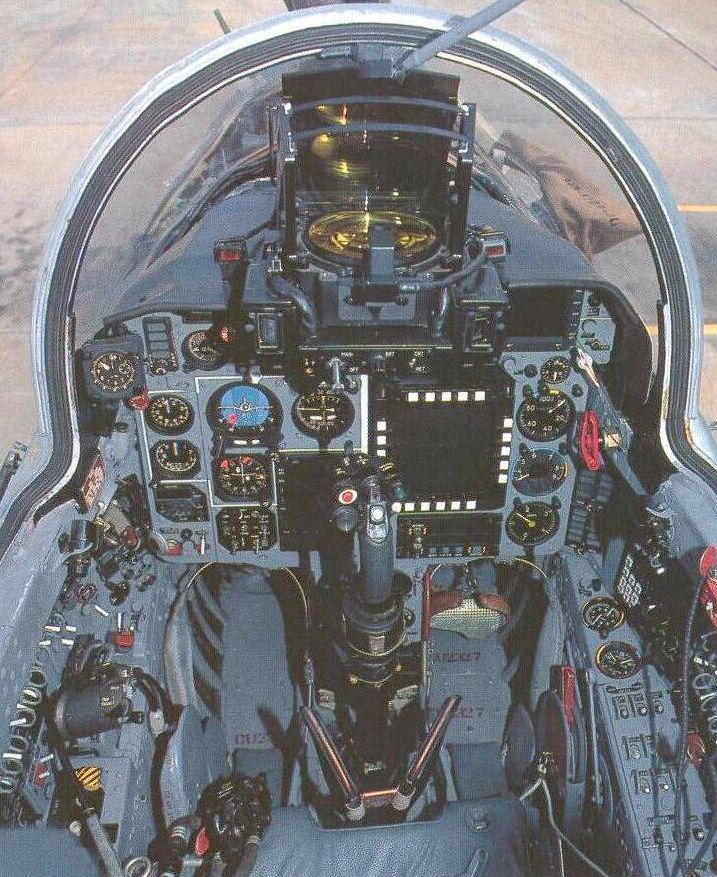
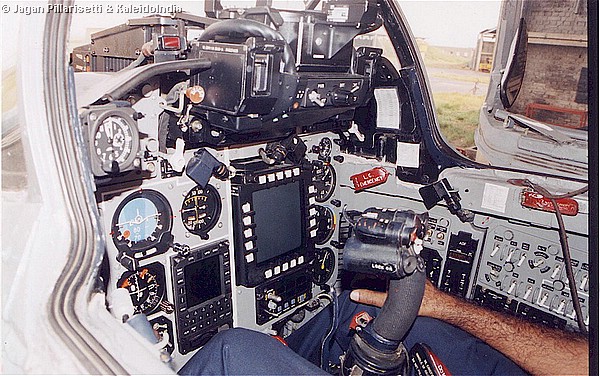
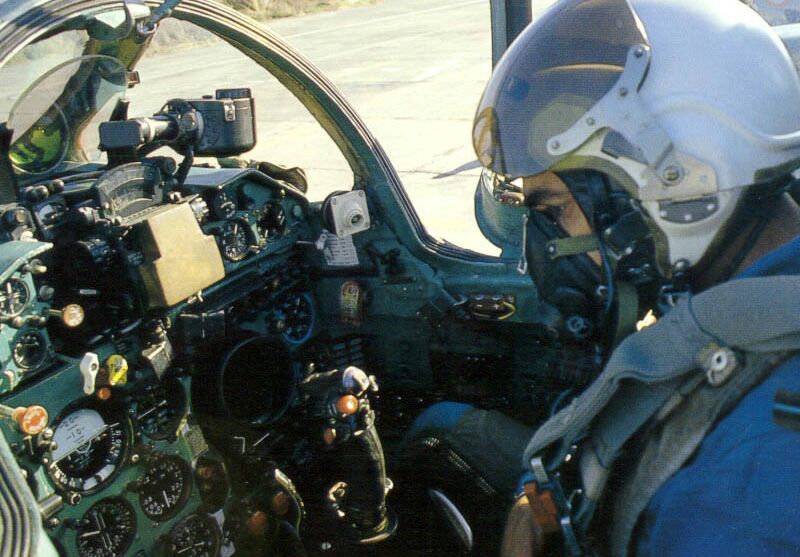
Bison cockpit compared to original MiG-21Bis cockpit
the Bison incorporates Elta ELM 2022 SPJ, twin conformal Vympel chaff and flare dispensers (26mm, 120 rounds), DRDO’s Tarang RWR (used on the Su-30MKI and Tejas as well) in addition to Sextant’s TOTEM RLG-INS with NSS-100P GPS embedded GPS receivers, El-Op HUD, Sextant MFD-55 LCD display, autopilot, digital flight data recorder, new liquid air cooling system, HOTAS controls, a SURA helmet mounted sight (HMS which can be slaved to R-73Es for high offbore sight shots), stores management system, digital air data computer system, short range radio navigation system, new HF/VHF/UHF radios and a new electric power supply system.
also, the Bisons were structurally upgraded, so they’re not “tired” Bis anymore..in fact, IAF MiG-21 accident rates have reduced significantly after the induction of the Bison.
21Ankush.
The Rafale has more than 30 deg of AoA limits and the J-10 very likely is in that area.
very likely..:rolleyes: its talk like this that has built up the J-10s reputation..where are the OFFICIAL figures ? you just look at canards on the J-10 and that automatically means the aircraft has performance that matches latest Euro canards?
had the LCA not been so much in the news through official and media reports, any Indian could have claimed that it had a “likely” max AoA of 30 degs and it would have become “one of the best fighters in the world”.
21Ankushman i am not saying that India did wrong but the reality is China has been more practical and they have a fighter that in reality is one of the best in the world, how they did get it well it is another matter.
India was in many ways less practical and its engine less ambitious, the WS-10 is a more powerful engine and the J-10 a heavier fighter, the kaveri is not as powerful and this has doomed the LCA in some ways
best in the world !? based on what official figures ?! everything on the J-10 is based on fanboy reports, with nothing officially published. how can that be compared to established European or American fighters whose performance figures are not based on guesswork and blogs..
you’ve been giving explanations of how canards are the be-all of maneuverability, but have’nt explained why the Russians deleted the canards on the Su-35BM..I’m still waiting, and this time don’t just wish it away saying that its different in the case of the Su-35BM..
also, how was India’s engine less ambitious? it did’nt reverse engineer ANYTHING, unlike China. there was a post on this forum about a CFM core that China reverse engineered and used for the WS-10. just because the WS-10 produces more thrust does’nt make it more “ambitious”..that way, the Snecma M-88 is a rather “un-ambitious” engine, since its thrust is even lower than Kaveri’s. The Kaveri’s issues are mostly believed to be related to metallurgy, not the thrust it generates. it was meant from the beginning to generate a given thrust and once its issues are sorted out, it will generate that.
21AnkushHowever the Indians wanted a small aircraft since their engine capabilities were still modest and building an AL-31 or WS-10 type of engine was out of their reach, so they opted for the delta wing with a notch at the root of its wing leading edge like the one seen in the Viggen.
The LCA is simply the lightest airframe with the a relatively big wing and powered by a modest engine to be designed in India.
you’re totally twisting the truth !
the requirement from the IAF was for a light fighter to replace the MiG-21..they laid down the ASRs, and were not the least bit concerned about what technology existed in India, that was to be the headache of those who were to build the LCA.
Indian designers knew what thrust specifications the Kaveri had to meet..if it did’nt have to power a medium weight fighter like the J-10, why the hell would its thrust have to be higher than the F-404? its only now, after extensive flight testing that the IAF feels that the F-404 does’nt meet its thrust needs and that there is a requirement for a higher thrust engine. besides, GTRE could’ve easily taken Russian help to develop a RD-33 or AL-31 derivative if it wanted to and used the RD-33 for the Tejas prototypes. instead they chose the to develop a more western like engine and for the prototypes, chose the F-404, which is extremely reliable and closely matched the specs they’d set for the Kaveri.
also, there has been extensive requirement creep in the program due to the fact that the Tejas is now meant to be a lot more than a simple MiG-21 replacement. its avionics are top notch and in many instances better than any current IAF fighter, including the Su-30MKI.
if the Chinese are so whizbang at the cutting edge of technology, why’re they still buying AL-31s and not developing a Al-41 type WS whatever?? fact is that they’ve learnt a lot from the Russians and their own engine building capabilities were very modest till now.
21AnkushMiG-23MLD, stuff that you’re talking about are very commonly known among aircraft designers..what makes you think that all of this was not taken into account during the initial design phase before the configuration was frozen? there was extensive wind tunnel work done before that and a lot of consultancy from Dassault as well..I’d imagine that the stuff you’re pointing out was more than well known to the people who designed the LCA..actually, the low wing loading will make the LCA a very nimble fighter, with high instantaneous rates, but lower sustained rates.
as I’ve pointed out, using the analogies you’re using in your arguments, kindly show how the new Su-35BM is more maneuverable than the Su-30MKI..with its TVC control and canards it can turn on a dime, which the Su-35BM cannot, so that makes the Su-35BM inferior to the MKI as far as aerodynamics goes. I’m sure you agree, since I’m using your own argument to prove this.
by the way, ADA has plans on introducing TVC on the later batches of the Tejas LCA.
21Ankushthanks Kakarat. nice images of the LSP-2..I somehow find aircraft in primer very nice looking..:D


 Sign In







