 Logan Hartke
Yeah, I was aware of that. An F-104A also made a record setting flight topping out at over 100,000+ feet. I was referring to the posted figures, however. Service ceilings and such.
Logan Hartke
Logan HartkePerhaps the F/A-18 or MiG-29 would be preferred, or even the F-5E.
Problem with that, though, is that there few low hour F-5Es and F/A-18C/Ds out there. The MiG-29 has the same issues that the Su-27 would have, namely ticking your neighbor off. I think that F-5EM/FMs would be perfect, but they’re unavailable, really.
They need something with low hours because they’re going to be around a while.
The only twin possibility that wouldn’t carry a Super Hornet or Rafale pricetag and wouldn’t cause relational issues might be an attempt to get low-hour legacy Hornets from the US. I’d think those might end up being a maintenance headache for Mexico, though, as they’re almost sure to be well-used (like the Hueys). I just don’t see that option as being terribly practical.
Although this is yet another Russian option, I think that one of the neatest possibilities would be a semi-navalized Frogfoot (to protect against salt-water corrosion). Get some upgraded versions of those. They’re rugged, twin-engined (if that’s important to you), fly well, aren’t intimidating like the Flanker, and have the multi-role capability that Mexico needs. They can hunt down a cigarette boat, catch a bizjet, and carry enough different types of weapons to suit any need. Load the pylons down with tanks and it can fly wherever you need it to.
Got heavily-armed drug runners? Go after them with the Frogfoot. It can take hits that Cessnas (or F-16s, for that matter) can’t. Clean, it can break Mach 1, enough to catch a bizjet.
That’ll never happen, though.
Logan Hartke
Logan Hartke…and that conversion has been carried out on some A/B models, both developmental and I think some of Hungary’s were originally A/Bs with C/D wings and air-to-air refueling.
Logan Hartke
Logan HartkeOne of the best options I think the Armada could go for is a combination of S-3Bs and ex-Swedish Gripens. They don’t need any brand-spanking-new Gripens, and the Swedish Air Force is still trying to get rid of its excess, non-upgraded models. The S-3B can perform tanking to compensate for the Gripen’s lack of range.
Basically, you operate S-3Bs in the maritime patrol mission 95% of the time, possibly armed with a Maverick and a targeting pod for anti-smuggler patrol work. If one of the E-2s that Mexico has picks up an aerial threat, you send out the Gripens, meeting the threat out as far away as possible. You scramble an extra S-3B with a buddy tank when the Gripens tank off. The Gripens need only carry a tank or three and a couple of Sidewinders for 90% of its missions. If the Gripens are running low on the way back, you tank from an S-3B on the way home.
The Gripens won’t get the US all hot under the collar, like Flankers or a J-10. They can probe and drogue refuel, unlike F-16s. The S-3Bs are perfect for the mission and will be good for the Mexicans because it’ll help relations with the US, they’re just right across the border in mothballs right now, and the Mexicans can outsource a lot of the maintenance and training to the US, making it simpler and cheaper for them.
Second-hand Gripens and Vikings be cheaper to buy than new Su-27s or Rafales or something, would be a lot cheaper to operate, and would allow the option of the Mexican Air Force replacing its F-5Es with Gripens as well, increasing commonality. The Gripen’s going to be current for some time yet, and it can always be upgraded at a later date or replaced with new Gripen E/Fs for fairly low cost and little risk.
Mexico keeps current, doesn’t break the bank, keeps it neighbors happy, keeps its options open, and does the job it sorely needs to.
Logan Hartke
Logan HartkeThe F-4 was a generation after the F-104. It was able to build off of the lessons learned from the F-104. Compared at least to the early F-104s… It had range, the F-104 didn’t. It could carry a significant payload, the F-104 couldn’t. It had a good radar, the F-104 didn’t. The F-4 also had better performance, being faster and possessing a higher ceiling.
Basically, the F-4 was a true multi-role platform, one of the first in the way that we think of it today.
The F-4 was far more forgiving, as well. It could take more of a beating, serve more roles, and do nearly any job better.
In its defense, the F-104 was designed for an entirely different role. It was a single-pilot aircraft, requiring half the number of skilled aircrew, and it was significantly cheaper to build and operate (not counting losses). It was great in point defense, especially, having a higher rate of climb than the F-4 (one of the few areas of performance where it was better than an F-4).
The F-104 had very temperamental performance characteristics. In the right hands, it could outfly most anything in the sky, using its power to control an engagement and its internal 20mm Vulcan cannon (another area it was better than the F-4) to slice and dice. Read some of the manuals on tactics devised for the aircraft in the Vietnam War. They just never got to prove themselves in that conflict in the air-to-air role. Unfortunately, most pilots never achieved the skill level required to take advantage of the aircraft. It just was never suited for it. It was such an export success because it was so cheap yet offered amazing performance. These same factors combined to produce an aircraft that has probably earned the nickname “widowmaker” and “flying coffin” in more languages than any fighter in history. Novice pilots kept getting plopped in this high-performance, challenging aircraft and graduating from F-104 flight school as craters in the ground.
Really, the F-4 was just better in so many ways. It could fulfill almost any mission asked of it. From carrier aircraft to ground pounder to MiG dogfighter to interceptor to reconnaissance to Wild Weasel, the F-4 could do it. Due to its pathetic range and radar, the F-104 could hardly be a good interceptor or strike aircraft, let alone anything else.
Logan Hartke
Logan HartkeCheck out his albums, too. Those Hind, and Halo shots are especially awesome.
Logan Hartke
Logan HartkeIt depends on the load. The C-27J can carry the US Army’s vehicles. The C-295 can’t.
Logan Hartke
Logan HartkeIt looks interesting, but don’t discount the pusher for STOL operations, completely. Right now the main problem with your aircraft’s basic layout STOL-wise is its complete inability to rotate very much on takeoff. It needs longer gear, even from a rough concept appearance.
Although there are plenty of disadvantages with any layout, you always need to find a compromise. On a CAS aircraft, gun accuracy is of utmost importance, so I’d agree with your intentions of keeping the nose clear. I’ve always thought the Pucará was one of the best pure CAS aircraft and layouts from a design perspective.
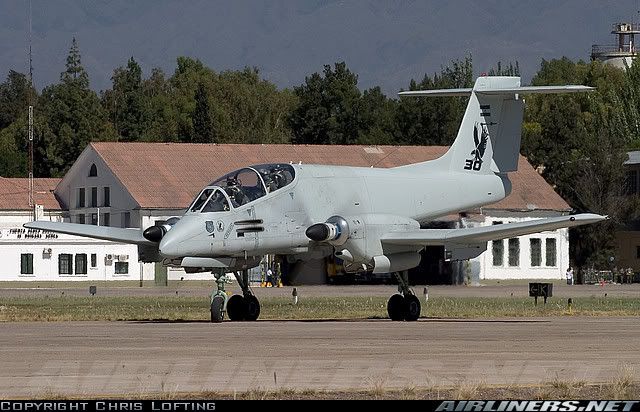
You have that twin-engine reliability, respectable payload, two-man crew (four eyes are better than two), GREAT visibility, and it’s still relatively rugged and reliable. It also wisely adopts the conventional fuselage, since two tails is more vulnerable to ground fire than one. For durability, go with a single tail when possible. The actual aircraft could be improved in a number or details, but as far as pure design goes, it’s great.
Logan Hartke
Logan HartkeInterestingly enough, it used to be exactly the opposite.
High-wing aircraft were preferred for passenger aircraft, and low-wing aircraft were preferred for use in cargo aircraft. There was a story, I can’t remember what it was from (I’m thinking the Chaco War), but it was commenting on the use of Junkers Ju 52s compared to the high-wing trimotors of the time. A piece of heavy equipment-an artillery piece, if I recall correctly-was loaded into a Ju 52 and flown somewhere. The same load was attempted with a high-wing trimotor (possible a Ford Trimotor, but I’m not certain), and it fell through the floor of the aircraft and was deposited on the ground beneath it.
In earlier aircraft, when the structure was lighter and planes were smaller, the low-wing configuration was preferred in cargo aircraft since the wing box was an area of great strength, on which particularly heavy cargo could be placed. This allowed a low-wing aircraft to safely carry much heavier loads. Often, cargo was loaded directly from trucks, whose beds were conveniently at that height.
High-wing aircraft, however, were still preferred for passenger aircraft since they placed the fuselage closer to the ground, therefore making ingress and egress of passengers far easier and not requiring airfields to have stairs on site. They also afforded the passengers better, unobstructed views.
After World War Two, aircraft got larger and ramps became all the rage on cargo aircraft. Soon, it became more sensible to lower their overall height. Their cargo quickly became whole vehicles, which obviously needed to load at ground level, not four and five feet off the ground.
Conversely, the choice of a low-wing configuration for such modern airliners as the DC-4, Connie, and all of the follow-on jets soon made stairs impractical due to the height they would have to be, and passenger loading bridges became the preferred method for handling passenger traffic at modern airports. Since there was no longer a need for passengers to load and unload near the ground, the obvious aerodynamic advantages of a low-wing configuration made it the preferred configuration for passenger aircraft, and that is the main way it’s done to this day.
Interestingly enough, for modern passenger aircraft designed to primarily fly into smaller airports not equipped with passenger loading bridges, the high-wing configuration is still popular, partially for the advantages of being closer to the ground. Examples of this are the BAe 146, the Dornier 328, the Dash 8, the ATR 42, and the An-148.
Logan Hartke
Logan HartkeI’m not sure you want the Dornier Do 335 Pfeil as an example as it had a prop on the nose, too, not just in the tail.
I was well aware of that when I typed it. I’ve seen the Do 335 in person so am quite familiar with it. I included it since it is a prime example of an aircraft with the tail-mounted propeller and tricycle undercarriage.
Logan Hartke
Logan HartkePushers are used to get “clean” air over the wings and in turn get higher fuel efficiency during the cruise phase.
That’s also the reason that the B-36 opted to use that configuration. It was one of the few aircraft big enough at the time to putt that off without disrupting the airfoil or putting the aircraft in the fuselage and coupling them to a complicated shaft arrangement. That’s the main reason why pushers aren’t used more often in multi-engine aircraft. Some newer business aircraft have adopted the fuselage-mounted podded pusher prop configuration. Although this necessitates some serious structural engineering, it does offer one of the few non-pod & boom multi-engine propeller configurations that keep the engines off of the wings, keeping the wings free of engines and allowing the design to benefit from all that is entailed with clean wings.
There are a number of very good reasons why you don’t see it that often. if you look at the rear view of you average aircraft and take away everything that you see with a control surface, there aren’t many spots left for you to put an engine. One of the few is the very rear of the fuselage. That didn’t use to be an option since most aircraft were tail-draggers at one point in aviation history. Even with tricycle gear, it isn’t easy to rotate with the prop mounted at the rearmost portion of the airframe.
Interestingly, enough, for the brief period in time when propellers were still king and tricycle gear became more commonplace, pusher aircraft suddenly became far more popular. Even discounting the more traditional pod & boom pusher aircraft (such as the Saab J 21 and Vultee XP-54 Swoose Goose), there were a number of advanced pusher designs, such as the Curtiss XP-55 Ascender, Northrop XP-56 Black Bullet, Dornier Do 335 Pfeil, Kyūshū J7W1 Shinden, and Douglas XB-42 Mixmaster. In the case of those fighters, the pusher configuration allows all of the guns to be placed up front, right in front of the pilot, the most natural and accurate location for a gun to be on a fighter. It is interesting to note that the top-scoring aces for the US, Germany, and the USSR in WWII all flew aircraft whose armaments were primarily in the nose. If you read what those pilots like Bong and Hartmann thought of the configuration, it’s clear that they attributed part of their success, and much of their accuracy to that layout.
As a final chapter in the late-WWII pusher craze, it is interesting to note that this configuration also allows an aircraft to be relatively easily converted from propeller to jet configuration, such as the Saab J 21, XB-42/43 Mixmaster/Jetmaster, and Northrop YB-35/49. We’ve seen this happen again in a few UAV designs that have gotten larger and decided to switch from propeller to jet propulsion.
Logan Hartke
Logan HartkeOne 1T12 is assigned to the regimental 83M6 command post to find the site locations for the batteries. Anything else should be covered in the entry on my blog I think.
Ah, there we go. The right designation helps in finding out more info about it.
Logan Hartke
Logan HartkeAnyway I have no idea how the site surveying goes or what it entails, but the 1T22 is the vehicle used.
Do you have any more information on this vehicle or pictures of it? Is it issued at a one per battery level or one per regiment? Are there any other miscellaneous vehicles that are standard with the regiment?
Logan Hartke
Logan HartkeI’m well aware of the differences in deployment based on the service/country using it. I never specified that I was interested in Russian use of the S-300/400. In fact, I am more interested in the export users.
As far as the Tor-M1s go, I was just thinking that in war, it would be prudent for a battery to change locations to somewhere maybe 5-10km different. While that’s not too far, in rough terrain, that might be a move lasting up to an hour or more, with take-down and setup. In a case like that, the S-300/400 battery is an asset worth a little more expenditure to protect when it’s at its most vulnerable. Still, however, I think it’s main role is intercepting incoming munitions, like a glide bomb.
Logan Hartke
Logan HartkeThanks very much for all of your responses. The only one that I still have a question about is in regards to the Tor-M1.
Those would be managed separately. The command system of the S-300PM-2, for example, is only capable of integrating long-range SAMs like the S-200. Also, the Tor-M1 is an Army asset, not PVO, so they’d be part of a whole different command structure as well. With the S-300PM-2 and S-400, shorter range intercepts can be prosecuted using the 9M96 missiles anyway.
I was under the impression that some Tor-M1s were procured to operate with the S-300 batteries in the Hellenic Air Force, with what appears to be two Tor-M1 per S-300 battery. I was also under the impression that China may operate them similarly. Can your Google Earth analysis confirm this, at least in Greece’s case?
Their role, from what I understand, was to protect the battery from missiles, bombs, and attack helicopters-threats which the S-300/400 is not set up well to defend against. It would also be wise to have them around to protect an S-300/400 battery when it’s on the move.
Thanks again,
Logan Hartke


 Sign In







