Logan Hartke
I totally understand why our European friends aren’t going to believe this, but this really isn’t a case of dishonesty to insure the US candidate wins. What follows makes no judgment on the relative merit of the two aircraft.
…
This is my understanding of what went on exactly. Good summary, ST-21.
Cheers,
Logan
Logan HartkeUnfortunately, when judging the evolution of how these systems came to be and how the party lines got divided, you have to. The USAF made absolutely the right decision in going to boom when it did. It simplified things in a lot of ways. It’s easier to design aircraft with boom receptacles than probes in the nose. You don’t need to cram it somewhere in the nose. It can go anywhere that’s convenenient. You don’t need fuel lines running through the nose or retractable hinged assemblies.
Sure, I’m not saying “all boom, all the way”. Never did. Neither did the USAF. I do think that the boom has been superior for the USAF since it’s inception, especially for large aircraft. I think that with 20/20 hindsight the KC-135 should have had hose & drogue pods since the 60s. The F-111 was good for boom, as were all the bombers. Heck, even the F-15 seems fine with the boom, but I agree that P&D improves as you go lower down the size scale. F-16s could just as easily have had probes and by the 1980s at the latest KC-135s should have had wing pods for hose & drogue.
That having been said, if you were going to pick wrong, F-16s with boom is a far better option than C-130s with probe, to say nothing of bombers. The USAF decided that boom was the way to go which required them to develop a proper tanker, the KC-135. That is–to this day–the standard by which all others are measured.
I think that just about everyone here can agree that a modern tanker needs to have 1 boom and 2 hose & drogue pods. Given the fact that the USAF has greater experience with both systems than any other service in history, and the results of those experiences show that the boom has fewer disadvantages than advantages for the missions being performed, I think that the USAF is absolutely the authority on the matter.
The USAF operated what, around 400 hose & drogue-equipped tankers (not counting the “Iron Maiden”) in the past 60+ years? Anyone else come close to that?
It’s not because the USAF has the “cult of boom” as Arthur alluded to in post #35 and swerve joked about in post #37. It’s because they’ve tried both…a lot and found that the boom is superior to probe and drogue for their needs.
Cheers,
Logan
Logan Hartke…
I think you may be missing one point which has been made earlier.In being currently limited to roughly half that of the boom, any large A/C, such as another tanker in this case, will need to spend more time hooked up to take on the required fuel for eventual offload to the final vector; in this case the Vulcan.
At the fuel burn of a VC10 or Victor, even if each wave needs 10 to 15 min extra to offload the fuel needed to top up the next wave, I think that this will naturally increase the number of tankers, whichever way you look at it.
Exactly.
Cheers,
Logan
Logan HartkeWhen I read this and remember the Black Buck missions I realise that the US-centric view is blinding many; a strategic bomber refuelled by P+D carrying out the longest ever bombing mission (at the time) …and to state ‘Probe and drogue simply won’t do’ is incorrect and undermines everything the writer says. Clearly ‘probe and drogue does do’….as it does for refueling fast jets or is the USN in some way unqualified in this department (setting aside any US versus other debates)….
No it doesn’t. I said this earlier in my post if you’d cared to read it.
Now I know that the RAF proved that P&D refueling is perfectly feasible for large jet aircraft, but the USAF still foolishly believes that a boom tanker may be the better way.
That’s sarcasm in the above quote, obviously. This:

Is the military equivalent of “There, I Fixed It”. It’s like saying, “there’s nothing wrong with my refueling method, see?” When, in fact, it’s pointing out the exact opposite. If your refueling method transfers so little gas that you need that many tankers to support one bomber–even at that range–then you clearly have a problem and could only send a couple planes on such a bombing mission. It was a bottleneck at the tankers that the RAF gave itself by staying wed to P&D.
Ten years earlier, the US put up 78 bombers IN A SINGLE RAID from Guam to Vietnam–not an inconsiderable distance–and it didn’t require 585 tankers to get the job done. Why? Boom refueling.
Cheers,
Logan
Logan HartkeActually, the decision was made by & for SAC, not the USAF as a whole. The switch to booms was made by SAC for refuelling bombers, for which the advantages of booms are obvious. I’m not aware of any USAF analyses that showed that booms were better for fighters. Receptacles were fitted to tactical air because the tankers had booms.
Not entirely. TAC had it’s share of problems with probe and drogue. Some F-84s and F-105s had both systems set up. The probe and drogue required greater effort on the pilot’s part and ran into the same issues that I mentioned above…and then some. All one has to do is read about the F-100’s nasty probe issues and the boom that brought back the wounded F-105 back from Vietnam and it’s no wonder TAC decided that the probe and drogue was just not worth it for them anymore. While Vietnam experience later led to the F-16 LWF, the era that TAC went to booms was the era of the F-4 and F-111, with the F-15 on the horizon. Even little old TAC was fielding aircraft with takeoff weights that fit nicely between a B-17 and B-29. Fuel transfer could absolutely be an issue with the size aircraft TAC was getting.
Quite frankly, for TAC booms had more advantages than disadvantages.
Cheers,
Logan
Logan HartkeUnknown. All sources, I’d imagine. The “F/A-18 Convertible” was from a KC-10. The B-66 was a neat plane. Very good-looking.
Cheers,
Logan
Logan HartkeI don’t think I stated the frequency of the occurrence short of its relation to boom refueling. My own knowledge comes from first-hand tales of the McDD legacy Horney line at St Louis. Hornets with damage to either the probe or the airframe from refueling incidents were a fairly common sight coming back to the factory. We’ve all read the stories of “Flying an F/A-18 Hornet Convertible”. F-15 damage due to boom refueling was practically non-existent.
I’m not saying it’s a daily occurrence by any means, but if we’re going to talk about boom failures, I think that P&D incidents are going to be a far greater concern for the user.
Cheers,
Logan
Logan HartkePost #40:
Rather sweeping by implication…;)
Ah, I just saw that as a response to 35-37 where the USAF was being mocked for not going P&D and J Boyle just pointing out the one very important factor that made P&D impractical for the USAF. I didn’t see that as an attack on P&D as much as a counter to the argument being made that the boom was a poor choice between the two.
In the end, it comes down to “different strokes for different folks”. A C-5 or a B-2 is a much different aircraft than a Tornado or MiG-29, so I don’t expect many non-USAF types to understand the needs of the USAF in refueling aircraft that need to fly an 8,000 mile non-stop mission with a heavily loaded 4-8 engined aircraft. Probe & drogue simply won’t do. On the other hand, boom does well refueling fast jets. If the USAF’s focus is on large aircraft and fast jets, then boom is the answer.
Of course, as you correctly state, the boom is better suited to the USAF, but of course the USAF’s KC-X (and Y and Z ad infinitum) will have to cater for the needs of “prodders” such as the USN, USMC, RAF, FAF etc…:) – and have “WARPS” properly integrated from the start.
100% agree. The USAF has more than just itself to consider, which is why their future tankers will all have 3 refueling points.
Logan, I was probably a bit harsh saying that. Sorry.:)
Not a problem, we understand each other.
Cheers,
Logan
Logan HartkeHaving experience of one and knowledge of the other’s capabilities I was only offering comment on a rather sweeping statement that one was better than the other.
I didn’t see that statement you’re referencing. I saw somebody ask about fuel transfer rates (a very valid question) and then you ran to the defense of P&D refueling. P&D isn’t perfect, sorry.
And yes, P&D has it’s issues – no system’s perfect – but they are not as widespread as you’d like them to appear.
“As I’d like them to appear” ? I’d prefer we just have one system for everything. Standardize it. The two systems is annoying. As it is P&D is the only one that could take over for both.
The fact of the matter is, however, that P&D has enough deficiencies that when it came to refueling a fleet of thousands of thirsty jet aircraft, the USAF correctly decided that the boom method was right for them. The P&D method is good for the USN and many of the world’s smaller air forces. That doesn’t mean it’s best for the USAF. It’s not.
Now I know that the RAF proved that P&D refueling is perfectly feasible for large jet aircraft, but the USAF still foolishly believes that a boom tanker may be the better way.
You were trying to state that a boom going out would leave you up a creek without a paddle. That’s correct, but it’s also rare enough that it’s a non-issue. Far more common, however, is a hose not unreeling, damage to either the hose/basket or the receiver due to a collision (P&D refueling requires far more proficiency on the pilot’s part than boom), or a probe getting bent, broken, or just deciding not to work that day.
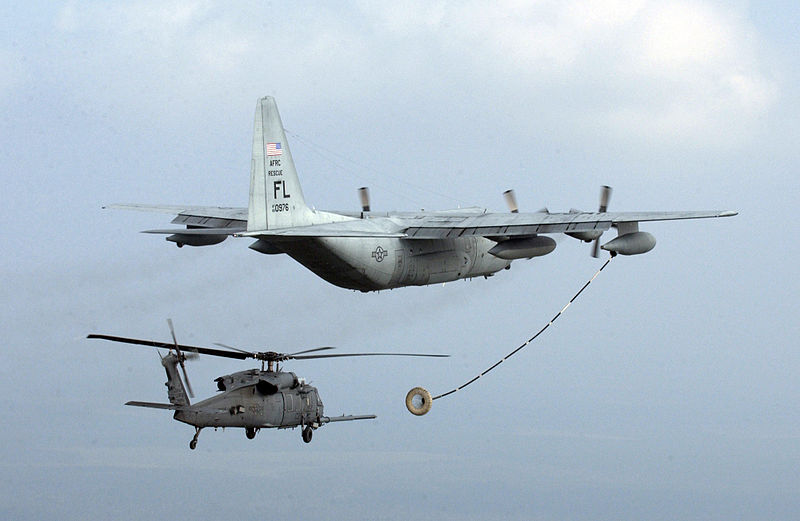
There are things P&D can do that boom cannot. Helicopter refueling, buddy tanking, refueling multiple aircraft simultaneously, etc. The USAF understands that and is going to get aircraft capable of doing 1 boom or 2 P&D.
Boom refueling still does the job of refueling large aircraft better than P&D, so the USAF rightly keeps it for that purpose. The USAF has well over 1000 large aircraft (not counting the tankers themselves) that would more than max out the fuel transfer rate of P&D and take a massively long time to refuel. Furthermore, when a C-17 or even C-130 is refueling, you can’t refuel anything else anyway, P&D or not. I’ve never seen a picture of a probe-equipped C-130 and a probe-equipped fighter refueling from the same drogue-equipped tanker. Since refueling large aircraft is a big part of what USAF tankers do, P&D is rightly seen as more of a liability than an advantage. Practically, you cannot refuel airlifter- or bomber-size large aircraft with probe and drogue.
Ironically, boom refueling is actually winning over more services through the continued export of the F-15, F-16, and F-35. Twenty years ago you could count the number of air forces with boom-equipped tankers on one hand (USAF, Israel, Iran, France, and am I missing anyone else?). Within the next couple of years there will be over a dozen operators (USAF, Israel, Iran, France, Netherlands, Turkey, Omega Air, Japan, Australia, Chile, Italy, UAE, and Saudi Arabia). We may even see more join that crowd within the next ten years as the US retires its KC-135s and other operators opt for an A330 MRTT with ARBS or IAI/Bedek 767 conversions with boom.
Cheers,
Logan
Logan HartkeP&D, unless on a single hose equipped KC10 or a BDA equipped 135 will also offer more redundancy, as invariably the tanker will have more than one available, so there’s less chance of having to refrag the plot should one hose go u/s. If the boom doesn’t play, it’s a very expensive “game over” for that sortie, and then you’re looking for the boys and girls with spare gas!
Yes, but you see far more mishaps with aircraft attempting to perform P&D refueling than boom. Furthermore, I almost never hear about KC-135 boom issues forcing them to stop refueling and abort the mission. I’ve seen many a picture of a fast jet with a windscreen broken, a dented radome, or–most commonly–a probe that’s been broken off. I know many an F/A-18 used to come back to McDD sans probe after a refueling accident. The F-15 never had any such issue. That’s to say nothing of broken baskets, hoses that won’t let out or retract (I’m familiar with many of those issues), or damaged hoses/baskets after collision with the aircraft that’s refueling.
The USAF is one of the few services IN THE WORLD that has had thousands of hours refueling fast jets using both probe and drogue. It’s not a service-wide mandate. Some USAF use probe and drogue, but most of their aircraft use boom. It’s not a religion or cult that drives boom use, it’s experience.
I don’t see how you can have one guy that owns and drives a Toyota and has only driven Toyotas and so prefers Toyotas can be the better expert on Hondas than the guy who has owned both and prefers the Honda.
Cheers,
Logan
Logan HartkeLADIES AND GENTLEMEN (AT LAST) SYRIAN MIG-23ML (¿IN UZBEKISTAN?):dev2:
http://forums.airforce.ru/attachment.php?attachmentid=23041&d=1267296772
Regards from Spain.:)
Ah, just got its first kill.
Cheers,
Logan
Logan HartkeBoth are recent. The UH-60Ms are brand spanking new, but the Apaches are the original AH-64A airframes with very recent Longbow upgrades.
UAE’s 30-Helicopter Apache Upgrade Program Underway
Cheers,
Logan
Logan HartkeSaudi Arabia needs 10 C-17’s like Hungary would need a Carrier Battle Group.
They have been needing an update for sometime. The SMS Szent István was never suitably replaced.
Agree fully. This has I feel always been the the unwritten rule between the White House and the House of Saud.
America will support you as long as you funnel a huge percentage of your oil windfalls back into American defense manufacturers.
I can fully see this being the biggest reason behind this purchase. Saudi Arabia has lots of petro-dollars and US defense aid money to blow and the US has some top-of-the-line prestige equipment to sell. This weekend I had a $20 gift certificate for a local candy shop that expired that same weekend. Did I need $20 worth of candy? No. Did I find $20 worth of candy to buy? Yes. Did I find ways to use up the candy? Yes.
It’s similar to Saudi Arabia. Do they need it? No. But they have the money to spend, things to spend it on, and they are better off then not having it at all. Is it the best use of a few billion dollars? No. Is it a total waste? No.
Saudi Arabia needs 10 C-17’s like Hungary would need a Carrier Battle Group.
Well, if Saudi Arabia wanted to continue operating as they have for decades, this would be true. The planes would sit on the ramp and eventually die away. To be honest, the same thing was said when the RSAF decided it wanted E-3As in 1981, when you could basically count the number of AWACS users on one hand (US, UK, USSR, NATO, & Israel…IIRC). That was a decision that proved to be both wise and timely.
In many ways, the large military airlifter market is doing the same thing the AWACS market did 20 years ago. They went from being something that only the largest air forces had to something that every air force needed if it wanted to stand a chance in its region. Now, everyone has to have airlifters and the C-17 is the only thing left in the market. No longer are wars on your doorstep, they’re thousands of miles away. No longer is your country only expected to take part in humanitarian efforts in your region. Now they’re expected to help no matter where the aid crisis is. If you want to be seen on the world stage, you have to have airlifters.
That’s why countries that used to be fine with C-160s are buying A400Ms. Countries that used to be fine with C-47s are buying C-130s. Countries that used to be fine with C-130s are getting C-17s. It’s a shift across the board.
C-17s are as much about getting you noticed as anything else anymore. That’s why Qatar painted their C-17 the way they did. To get noticed. It worked. They didn’t buy them to drop paratroopers over Iran, they bought them to get air time on the BBC and CNN. Saudi Arabia wants a piece of that, especially since the Saudi image is a little tarnished in some places.

Also–from a purely military perspective–it has a great deal of deterrent value. With no real amphibious capability and Iraq not wanting to get involved in another shooting war, Iran can threaten, intimidate, and just plain frighten its Gulf neighbors with little threat of retribution beyond an air strike. An air strike is unlikely to be enough to prompt a regime change, so Ahmadinejad et al. have little to fear. With the UAE’s growing amphibious and littoral capabilities and what may soon be over a dozen C-17s in addition to many C-130s, Qatar, UAE, and Saudi Arabia are going to quickly have enough capability to at least give Iran pause.
I’m not saying that the Gulf states are buying C-17s with a plan to invade Iran, neither do I believe Iran plans to nuke Dubai, but this is just another escalation in the arm wrestling match going on. On top of that, if anything does start between the Iran and the other Gulf states, the C-17s are just one way of getting more people behind the Gulf states. Turkey may not opt to stay neutral if Qatar, Saudi Arabia, and the UAE all send C-17s to bring aid during their next earthquake. You can bet there will be plenty of those in Turkey in the next 30 years.
Like I said, the motives right now might be primarily to make the US happy and gain some headlines, but I think 20 years from now they’ll probably have a lot of flight hours on them, will have delivered a lot of aid to a lot of people, and Saudi Arabia will be glad they bought them.
Cheers,
Logan
Logan HartkeI don’t think that’s what he was saying. I think those are just his pictures from the Gulf War when he was stationed in Saudi Arabia with the 3rd Herd of the USAF.
http://www.flickr.com/photos/markfaloon/sets/72157604902377092/
If you look at the rest of his album, you see that there’s no way he’s asserting the MH-53 is RSAF any more than the F-117. That having been said, there’s some lovely photographs in there of derelict RSAF C-47s, F-86s, and T-33s. Also, there are some nice shots of the Hawks and Tornados.
Cheers,
Logan
Logan Hartkethe problem is that, if you followed what happened, boeing won the contract initially (before there even was a competition), than, senator McCain un veiled a bribery offence from boeing and the competition was organized.
Well aware of that.
then, the USAF (the guys who are supposed to use the thing) preferred the NG/EADS proposal, yet, boeing contested the decision and won on the argument that the proposed aircraft was bigger than his own and that it wasn’t fair to take it in consideration since it had bigger payload, etc… the fact that those who are supposed to use it have chosen it visibly had no importance, and another “competition” was to take place… except that the terms are clearly favoring boeing.
This is where your history gets off. Your understanding of what happened with the competition is poor. The USAF preferred the KC-30, I’ll agree to that; I won’t speculate to why, however, because 2 out of 3 times the “users” (USAF) have preferred the 767. Politics is as much a factor with the USAF as anything else.
Boeing wasn’t ticked the USAF wanted a bigger plane, it was ticked because the USAF hadn’t stated that preference in the competition, or else they might have offered the KC-777. If size had been a major positive factor in the competition, the USAF would have stood a far better chance at getting away with it.
The terms of the first competition favored Boeing, too. The fact that the KC-30 won it wasn’t a result of the KC-30 being so much better. Better or not, the RFP favored the KC-767. The KC-30 won it because the USAF didn’t follow the scoring process it established. The only way to win a game that’s rigged against you is to cheat. That’s what happened, but in a game this closely monitored, the USAF was caught. A game it wrote the rules for…
In no uncertain terms, the USAF screwed itself.
In the end, it’s not about “USA vs the rest of the world” or “which aircraft is the best” or “fits the best service’s needs”, but which lobby will be able to win… and for now, boeing lobbyists seem to have the upper hand.
Welcome to politics. That’s why I liked the Canadian C-130J selection process so much.
“The C-130J procurement sparked political controversy, with accusations the process used avoided a competition. Canada began by issuing a solicitation of interest and qualification requiring any potential bidders to demonstrate their ability to meet mandatory high-level performance criteria. including delivery schedules.”
Canada practically said, “I want an airlifter that exists today, can be delivered in 3 years, begins with an ‘L’ and ends in ‘ockheed’.” People screamed that the process favored the C-130J and didn’t allow the A-400M a chance. The response was basically a shrug. At least they were honest about it. No attempt to do a fair competition or any sort of sham. They wanted the C-130J, they’re getting the C-130J. Simple, easy.
Cheers,
Logan


 Sign In