kiwinopal
The graph doens’t tell the whole story/truth. Just like the tailerons on an unstable conventional configuration, the elevons helps control the pitch moment. As the canard is a moving surface it works in conjunction with the elevons to control pitch. The advantage for the delta/canard is that positive lift is avaliable all the time, even when initiating a pitch moment. The control surface inputs to achieve a similar pitch rate is considerably smaller for a delta/canard. More lift, less drag. It’s a lift/lift situation. The canard works as a moveable LEX. It is adjusted automatically to give optimum lift/drag at all speeds and AoA, contrary to the considerably less flexible and draggy LEX on the F-16, MiG-29 etc.
The graph you posted is made by Dwight Looi of the WAFF forums. I’d be careful to build a case on it.
Robban
I disagree with you, i think the main advantage of the unstable canard configuration is it will have a very strong pitch up force at turns so it will enhance its ITR greatly, but here we have to see a new element, while making unstable a tailed aircraft you are making it a better supercruiser, since a tailheavy aircraft needs kill lift on a canard wing configuration by reducing canard lift; in the other hand the aircraft with tailplanes can use its lift to reduce its tendency to pitch down its tail.
The T-50 uses thrust vectoring to reduce its vertical tail size and supersonic trim leaving the tailplanes for roll increasing supersonic agility.
The T-50 also uses LERXes to reduce supersonic trim.
The F-22 does the same but probably its thrust vectoring is not as good since it has been proven tail size reduction can be achieved by use of thrust vectoring or the americans saw an all moving tail might create roll unstabilities on the F-22.
The T-50 has an all moving vertical tail reflecting the reduced size done by use of thrust vectoring.
kiwinopal1st, the more lift offered by delta wing which area is larger than conventional design would totally offset the downforce generated by canard and gravity even much more.
2nd, the graph were showing a subsonic situation, those green arrow would moving rearward leading downforce canard produced trend to zero even to be a positive lift.
I would not say that i think the advantage of the canard is that pitching up will be easier since it has a high pitch up force so it would not need to trim just let it go, the tailplane in a turn will kill lift in order to allow the pitch up force act on the aircraft, but when the pitch up speed increases really rapidly the canard then needs to kill lift to avoid over pitching, the tailplane will do the opposite to avoid over pitching it simply needs to add lift at the back to avoid over pitching.
This will make for a very good ITR in the aircraft with canards, however in the case of the unstable aircraft with tailplanes crusing will be easier since in order to keep the tail heavy aircraft trimmed, the tailplane will use its lift.
the aircraft with canard will be near neutral stability while the tailed will have higher levels of unstability to achieve the same results..
kiwinopalinteresting drawing
http://img245.imageshack.us/f/canardvstailhc5.jpg/
In a conventional configuration the tailplane needs a down force to stabilize the nose down force but in a unstable it needs an up force to balance the tail heavy aircraft it is exactly the opposite in the canard wing aircraft
at the begining of the pitch up force an unstable canard delta wing configuration will allow its lift to generate a pitch up force but as it nears its max pitch up speed it will generate a nose down force, exactly the opposite is with an unstable tailplane wing configuration.
kiwinopalTNCA Serie A
kiwinopalIs the Series H shown in colour a restored aircraft or a recently-built reproduction?
The military parade showing several towed series H machines – do the wings fold??
Re the close-up of the Aztatl engine I’m assuming it is a radial engine?. I can see the exhaust pipes coming off each cylinder head.
Any idea if the cylinders had inlet and exhaust valves as I can see no external push rods common on radials.
In your specifications list are the length and span dimensions the wrong way round??
Roger Smith.
Roger
I would like to answer all your question but saddly i can not do it at least right away, but i can answer a few, yes you are right the specifications are wrong, i mistook the span and length and these are all the way around.
Up to what i have read the Aztatl was a radial engine, this engine was flown for the first time on 16 May 1917 on a TNCA Series A piloted by Horacio Ruiz, this was the third aircraft to be built of the series A.
Like this one


The engine design was lead by the Italian born mexican engineer Francisco Santarini who also lead the design team of the Trebol and SS mexico engines.
Francisco Santarini died in Veracruz, Mexico in 1954, but his first engines were made in Europe.
The Trebol engine was also fitted to several aircraft. the Series H was one but here we see a Morane-Moisant that was also engined with a Mexican engine Trebol
The Aztatl was also fitted to Bleriot XI aircraft built in Mexico
kiwinopalAlthough there was some data showing that ITR of Raptor could be over 40°/s, but according to demonstration, F-22’s ITR was never better than Rafale, meanwhile, we are not absolutely sure that ITR done by Raptor did not using TVC.
On the other hands, Kfir’s canard is fixed surface and Viggen’s is with elevator, ergo there is no comparable thing between F-15 and Kfir, MiG-29 and Viggen.
Canard aircraft have some advantage in ITR due to delay of the download force on the Tailplane caused by AoA deflection, however ITR is the result of the max lift coeficcient at the max overload thus saying the F-15 surpases both the Viggen and Kfir is okay and the same is the Harrier versus Viggen or Kfir since the max ITR is a result of max lift coefficient.
To put an example the MiG-29A has a STR of 23.5 deg/s and the Rafale of 22 deg/s but the ITR of the MiG-29 is 28 deg/s and the Rafale of 30 deg/s, however here we can not make a clear analogy since both aircraft have different empty weight and wing area however we can see here we have a canard aircraft with better turn performance than an aircraft with tailplanes.
However in the same way we can applied the MiG-29 versus Gripen or Viggen where the MiG-29 best both canard aircraft in STR and the Viggen in ITR
The IAI lavi and F-16 make more sense in terms of a comparasion since both aircraft have almost the same fuselage and similar TWR.
Now we do not know the ITR of the F-22 but it will be more than 30 deg/s very likely since already 28 deg/s STR is only 2 deg/s from 30 deg/s.
The F-22 as you can see uses TVC to reduce supersonic trim and the tailplane for roll.
This shows that basicly there are many technologies to fix undesired characteristics of some configurations.
Now Rafale never achieve a single kill even having a ITR of 30 deg/s this means it never was faster pointing the nose than the F-22.
Now the study i am telling you is a general mathematic model to explain the TVC gains on turn rate based upon experimental data of the F-18 HARV on any aircraft, it basicly says TVC will increase in the range of 5% the turn rate on any aircraft.
Therefore it is logic to say the F-22 achieves its STR mostly on aerodynamics, why because this study says in order to increase turn rate even with TVC you will need to increase TWR.
kiwinopalmore TNCA Series H, one close up shows the Aztatl engine designed and built in Mexico
kiwinopalHere we can see the 5E-132 Parasol, another beauty of TNCA, this aircraft was built by TNCA and was designed by Angel Lascurain.
This aircraft was closely related to the Tolocho and Quetzatcoatl, the Toloche was the 3-E-130 and the Quetzatcoatl the 4-E-131
wing span…………..47′
length………………22’4″
Wing Area……………………279 3/4 sq.ft.
Empty weight……………1,276 lb
Max weight…………1,760 lb
Top speed……………74 mph
Ceiling…………………..16,400 ft
Endurance…………………2 hrs.
It was powered by Le Rhône 80 h.p
kiwinopalLong time ago in a Typhoon thread i read of engine maker making a case for
TVC on Typhoon, saving 5% or so fuel during flight.
That must be true because Paul Metz claims thrust vectoring greatest gains are at supersonic maneouvring see.
Kopp:
There is some debate in the fighter community about the relevance of thrust-vectoring in this day and age of Helmet Mounted Displays and 4th Generation heaters. What advantages do you see in having thrust vectoring, and how does it influence both instantaneous and sustained turning performance in the F-22A?
Metz:
Thrust-vectoring is often thought of in terms of the classic ‘dogfight’ where one aircraft is trying to out-turn his opponent at ever decreasing airspeeds. Whether a pilot should ever engage in these slow speed fights is a matter that is hotly debated within the fighter pilot community. Certainly, there is general agreement that it is best to not get slow – ever. With the advent of the helmet mounted sight, 4th generation heat seeking, off-boresight missiles the slow dogfight becomes even more dangerous. ‘To slow or not to slow’ are questions of tactics and best left to the expert fighter pilots of the future. The F-22’s thrust-vectoring can provide remarkable nose pointing agility should the fighter pilot choose to use it.What is not widely known is that thrust-vectoring plays a big role in high speed, supersonic maneuvering. All aircraft experience a loss of control effectiveness at supersonic speeds. To generate the same maneuver supersonically as subsonically, the controls must be deflected further. This, in turn, results in a big increase in supersonic trim drag and a subsequent loss in acceleration and turn performance. The F-22 offsets this trim drag, not with the horizontal tails, which is the classic approach, but with the thrust vectoring. With a negligible change in forward thrust, the F-22 continues to have relatively low drag at supersonic maneuvering speed. . But drag is only part of the advantage gained from thrust vectoring. By using the thrust vector for pitch control during maneuvers the horizontal tails are free to be used to roll the airplane during the slow speed fight. This significantly increases roll performance and, in turn, point-and-shoot capability. This is one of the areas that really jumps out to us when we fly with the F-16 and F-15. The turn capability of the F-22 at high altitudes and high speeds is markedly superior to these older generation aircraft. I would hate to face a Raptor in a dogfight under these conditions.
Kopp:
kiwinopalWell hard to argueing with that.
Increase in TWR is allways a winner:)
The problem is allways the weight gain on block/version upgrades.
I assume TWR is Thrust to weight ratio?Thanks
Yes Haarvarla, TWR means thrust to weight ratio.
read this article at pages 3 and 17 http://www.aero.iitb.ac.in/~akn/kunal-aug.pdf
probably that is one of the reason Rafale and Eurofighter have not implemented TVC since the gains are not as great in a turn and you can get them with higher TWR.
TVC is mostly useful at post stall maneouvring
kiwinopal5%:confused:
In which setting kiwin?Thanks
The article says a general increase of 5% at all speeds, they say in order to increase STR even with TVC you need to increase TWR but again the gains are modest, by modest is not like people usualy imaging, but you can reduce turn radius 15% even with this modest gains which is a lot at any setting
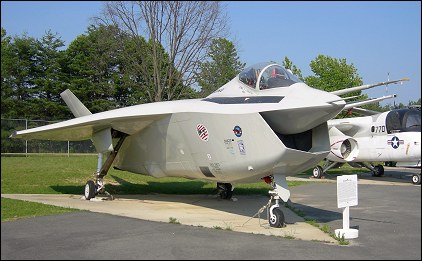
kiwinopalwhat’s the matter? you don’t like airplanes that smile at you? 🙁
in many ways its like a stealthy F-16
besides, the X-32 wouldve been cheaper to maintain because of its skin, longer ranged.. its only weakness being in the X-32B which was underpowered, but as far as conventional models go.. -32A is it!
it is a good one i like aircraft smiling at me
kiwinopalwell how about the production mock up, it’d change the smile to a gaper
haha good one:D i like the gaper
kiwinopalas I said in my previous post, the TVC allows the F-22 to use its tail planes for additional lift, as they don’t have to do pitch control which is done by the TVC. from there on, you increase overall lift and, thus, allow for higher G for a given speed.
without TVC, you loose that lifting surface (since you have to control pitch with these, basically generating “down” force to keep turning) which means you loose lift and so, you loose some of that turning ability.
I said it in my previous post already. Now, how much of it? I can’t give an accurate number (nobody here can), but saying “STR will be improved little, in the range of 5%” is just as plain BS as saying ‘it will kill 80% of it.
Here is where you are plain wrong, you are claiming something without basis and afirming it as true, 5% has been stablished by studies based upon experimental data, the reason you do that is because you think that but you have no proof to quantify it, then you make a myth a fact without any real evidence to support you.
You think it is more but you have no evidence supporting you. Why you say that because you have seen kulbits and you equate them to turns.
Real facts TVC only will increase turn rate no more than 5%
If you do not believe me read this
http://www.aero.iitb.ac.in/~akn/kunal-aug.pdf
Which is a study based upon F-18 HARV flights using TVC.read page 3 and 17
If you think the Indians are right when they say the Su-30MKI has a higher STR than 23 deg/s even when the regular Su-27 has one of 21 deg/s probably you have not read it, the article says in order to increase the STR with even TVC you need increase TWR, that is the reason the Su-35BM increased TWR and deleted the canards.
The Indians were using propaganda when the americans affirmed the Su-30MKI can only get 23 deg/s but they say more than 23 deg/s, i believe this study and American pilot but i do not beleive the Indians
kiwinopalwhat are you talking about man?
if you have any idea about the subject, I invite you to go here:
http://www.csgnetwork.com/aircraftturninfocalc.html
just put in the values and then, please, tell us where my “mathematics” are wrong. (speed and STR)
Simply i was talking about a simple fact how much TVC will improve STR? i asked you that and now you are dodging me the answer.
TVC is not magic it does improve turn performance but even improving only the turn radius by reducing it 15% it is a great improvement.
But the STR only will be improved a little in the range of 5%.
Most of the F-22 STR is result of aerodynamics, the Su-35BM, MiG-29OBT, S-30MKI and F-22 will have gains in STR and ITR but these are not like some we believe in the order of 100% or 10 deg/s, these are modest but with an important reduction of turn radius.
TVC is most effective as post stall device where you need to turn the aircraft at low speeds where it becomes a more important factor as a vertical vector but in reality to improve turn rates you still need lift and thrust


 Sign In