 kiwinopal
It is naive of you to think they will copy the old radar of Su-33. Definitely a up to date and much powerful radar is put in with more modern features..
Man in my country we are building and designing aircraft, we are building from the newest Learjet 85 whole fuselage to the all series of MD helicopters fuselages, we are designing low presure turbines in partnershipt with ITP and Rolls-Royce that will be used on even the Boeing 787 and most of Airbus aircraft besides we build lots of aircraft parts for Honeywell, Hawker Beechcraft but you know what does the mexican government have as a state policy?
Well it is the protection of intelectual property of any aircraft maker in Mexico, what China did with the Su-27 is a thing to be ashame, Mexico alone in 2009 recieved more investement in its aerospace sector than China or Russia, the reason is simply we are not going to break agreements like China did.
Now we have even Chinese companies doing business in Mexico but we are going to respect their rights.
It is shameful and foolish what china does, economically for us was good what China did because we have won Bombardier`s Learjet 85 plant thanks to the fact Bombardier trust us and this is even in spite China has cheaper labour, however China can not guarantee the respect of the intelectual property as Mexico is doing.
China took a Su-27 and Su-33 illegally from Russia and has paid by Russian unwilliness to trust China.
In fact Embraer is mulling to stop operations in China
see
Brazil’s Embraer admits possibility of abandoning operations in China [ 2010-05-06 ]
Sao Paulo, Brazil, 6 May – The Brazilian aeronautics company Embraer will decide by August whether to maintain its factory in China or leave the country, the company’s investor relations director, Luiz Carlos Aguiar, has stated in Sao Paulo.
“We are waiting to see what happens next regarding the licences. We very much want to stay in China, but this way it’s impossible to honour contracts,” he said, adding that the company has signed contracts but cannot move forward with them without the licences.
With the import licence, the company has seven Embraer 145 models guaranteed, along with 20 Embraer 190 models.
kiwinopalThat is unaccurate, a canard on and off configuration can explain why you are wrong.
both a canard off and on have no significant difference in total lift at level flight, it is only at high AoA when it will be a difference in favor of the canard on configuration.
Due to downwash the canard on has no significant difference with a canard off configuration on total lift at level flight.
With this i am saying the downwash is all the time and downwash does happen when the canard is above wing level.
why? because despite even having two lifting surface on the canard on configuration, the wing has less lift because of the canard downwash.
This equalizes the total lift generated by the canard on and canard off configurations at level flight.
As the AoA increses is when the canard on configuration starts to have a higher total lift than the canard off configuration.
Basicly the canard and LERX have the same behavior at high AoA
kiwinopalMan is not i am against canards as you might think in fact i like a lot the Su-34 and Su-33KUB and the Rafale is one of my favorite aircrafts, what happens i am balanced, i can remind you these factors you want to avoid
LERXes Aerodynamic Advantages
Better maneuverability, especially during turns in aerial combat
Smaller wing for same lift
YF-17 showed 50% increase in max lift for just 10% more wing area
F-16 was able to reduce wing size and save about 500 lbs in weight
Reduced transonic lift center shift, giving lower supersonic trim drag at high g
Huenecke, Modern Combat Aircraft Design
http://webcache.googleusercontent.com/search?q=cache:YXZ4UumDlEAJ:www.aoe.vt.edu/~mason/Mason_f/LEXS04.ppt+f-18+leading+edge+extensions+wing+aerodynamics&cd=3&hl=en&ct=clnk
this is for proving a tailed design like the F-16 and T-50 can reduce their Supersonic Aerodynamic center of shift
and this
The horizontal and vertical tail surfaces are generally highly swept in order to make their effective moment arms as long as possible, while also helping to maintain their critical Mach numbers higher than that of the wing
http://webcache.googleusercontent.com/search?q=cache:ca2BbzK1zMYJ:www.mae.ufl.edu/~sforza/EAS4700/Wing%2520and%2520Tailplane%2520Design%252008-05.doc+tailplane+mach+number&cd=3&hl=en&ct=clnk
Now you completly forgot that the downwash on the tail can be used a trimming device to give a nosedown force to the airplane.
This downwash strikes the top of the stabilizer and produces a downward pressure, which at a certain speed will be just enough to balance the “lever
http://www.americanflyers.net/aviationlibrary/pilots_handbook/chapter_3.htm
The main point is you have to see that the canard delta configuration has trade offs and there are technical ways of improving a tail aft configuration to make it good for supersonic cruise, the F-22 and T-50 are good examples.
can you use canards yes you can but there is no advantage as you claim
The main advantage of the canard delta configuration is you can make small aircraft it is common in Europe to make compact aircraft the Tornado and Rafale are small, same the Gripen, in this situation yes canards offer and advantage and can yield good results but they are not perfect niether the only way to make agile aircraft
kiwinopalKiwi, high aspect aeroprofile (canard, wing, whatever), with other parameters being equal, produces LARGER wave drag than low aspect one.
It’s only under alpha increase, that the higher AR profile, produces less drag, than the lower AR, because it’s physically smaller.
This is why F16 got high aspect wings, as opposed to, let’s say, Mirage III.
Momentum arm is important here, because the larger it is (canards as far fwd, as possible), the less trim a low AR wing requires during turning, something a high AR wing is inherently better for.
Even in straight flight, longer momentum arm controls require less trimming input, making plane less draggy in almost all flight profiles.Yes, low AR wing has larger area for the same span than high AR one. So?
Look, you’re mixing things again.
Eurocanards have control canards, not lifting ones and so the requirement for the lifting properties are different.
You can’t just throw all of them together, because they’re all “canards”.
And yes, canards are generally smaller (in area sense) than elevators, due previously stated reasons.True, but I used a difference between tab and slab canard, to illustrate the difference in requirements.
Apparently Viggen’s small tab was enough for what SAAB had in mind for it, plus it makes canard’s stalling alpha fixed, which immediately simplifies controls, etc, etc…
No i am not mixing things you are just avoiding a fact, any canard generates lift that is the whole point of having a canard ahead of the center of gravity, they can be used as control devices too, this in many ways outstrips the advantages of a LEVCON and LERXes, but you are just trying to dodge a fact, the Eurocanards are designed with low drag as a must, why? because in general terms a canard makes more drag and kills more lift.
The ideal canard for lift is big, but as a compromise the best canard will be high aspect and small near the wing as the ones in Rafale in fact Rafale is the best of the Eurocanards due to that very practical canard arrangement.
see the Eurofighter even needs strakes to reinforce the vortex shed by the canards which are farther ahead of the wing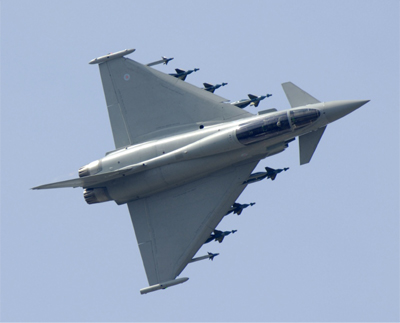
So a high aspect ratio canard coupled with a low aspect wing is the best compromise in a fighter giving the least drag and excellent lift.
see this is why the Eurofighter uses the canard near its nose
The wing behind a lifting canard would suffer some performance penalty due to its presence in the canard’s downwash field. This penalty would be proportional to the canard’s lift and span, and inversely proportional to the square of the distance between the canard and the wing panels
Since the effects of the wing lift,the nacelle volume, and interference-lift were dominant factors in generating the nose shock strength, the lifting canard did not significantly alleviate the sonic boom of this configuration.To be of significant value as a low-boom feature, the canard would have to be moved forward closer to the nose. In this more forward location, it’s downwash effects would be some what reduced, though not eliminated. Moreover, it’s lift would be a little more effective as a rotation-inducing force during takeoff and low-speed flight. As a result, it might be possible to reduce the configuration’s size and weight
however, that a canard generating lift during cruise did cause a drag increment and acorresponding liftldrag ratio decrement due to the wing’s location in the canard’s downwash field.If the wing and canard can be positioned so that this drag penalty can be aerodynamically minimized, then there might be sonic-boom benefits to be realized.
http://webcache.googleusercontent.com/search?q=cache:fq3bZSG0jN8J:ntrs.nasa.gov/archive/nasa/casi.ntrs.nasa.gov/20060005154_2006004319.pdf+canard+wing+distance&cd=5&hl=en&ct=clnkhttp://ntrs.nasa.gov/archive/nasa/casi.ntrs.nasa.gov/20060005154_2006004319.pdf
kiwinopalActually i think the same thickness was calculated for both configurations in order to get any meaningful results, while in fact the delta wing is structurally stronger and made thinner. In addition, i suspect the models was calculated in subsonic not to add additional variables.
There are some positive side effects
I agree with your points, of course when i design bureaux takes the decision of making a canard delta configuration that is the best way of making a competitve design.
kiwinopalI’d like to congratulate Deino & the PRC on their latest counterfeit.
With T-50s and new MiG-35 russia will remain ahead, so congratulations to Sukhoi, the Su-33 is old and the J-15 a mere copy based upon technology transfered from Ukraine
kiwinopalHere, I mean it’s no big secret…
Viggen’s canard is a compromise between lift and wing energizing requirements.
EF’s isn’t and it’s main purpose it to keep trimming forces at the minimum, but not by using a highly cambered profile, like Viggen’s is, but far forward position and long momentum arm.Finally. 😀
Yes well, either way Gripen beats F16’s turn, as a result of advanced aerodynamic solutions, which is particularly impressive since F16 has explicitly configured for sustained turning.
The Viggen uses a low aspect canard and the Eurofighter one of high aspect, that is all, in the Eurofighter they know the canard is killing wing lift the best canard shape then will be high aspect, if it is fully moveable of has a different cambered profile or moment arm has nothing to do with the fact it is high aspect to reduce drag.
By trigonometry you should know that if the wing leading edge is the hypotenuse, and the trailing edge the opposite side then there is a physical limit size on the opposite side size at a given angle, this limits a low aspect canard to be small, so in order to make an effective low aspect canard it has to be big because as the opposite size grows the angle increases and then the adjacent side diminishes, so the only way to make the opposite side bigger is upscaling the canard or changing to a larger angle.
You statement was a canard is smaller than a tailplane but you have forgotten that the ideal canard for lift is big, making a high aspect limits many aspects of the canard among them the supersonic number and the vortices generated.
The Viggen has canard ideal for lift because of its shape not because it has a tab or not, even it is possible they just made it a tab because being fully moveable the drag would had increased and become a real hindrance to the aircraft`s lift it self
kiwinopalWhere it has demostrated the STR on videos posted here? that is not true the Gripen has a lower STR it has been writen in books and webpages, by the way the Viggen canard has the perfect shape for lift; the eurofighter`s for least drag, the eurofighter high aspect canards reduced wing tip formation and downwash therefore has less drag.
The Viggen low aspect canard needs a long leading edge to generate powerful vortices meaning a big area or a big delta canard.
An by the way the TWR of the F-16 is not as high as you suppose barely it is 1.1:1 nothing extraordinary or very high compared to the Gripen which is close to 1.
kiwinopalPossibly, but you generally don’t need as large canards as you’d need the elevators, to be, due better position and consequential effectiveness.
Besides, when ditching the elevator, you get to fulfill a wing/elevator gap with more lifting surface. 😉
Delta wing moves 1g Cp further rearward, making canard (like EF’s extreme forward position), the least trim demanding, increasing sustained performance.LOL yes, but the thing you’re missing here, is that canard doesn’t need as much cambering nor as high thickness/chord ratio to produce required trim force due generally larger momentum against average Cp position and cleaner boundary flow in front of the wing, so it can get away with lesser Cl, meaning higher critical Mach number and less wave drag.
Frankly, by looking at T50 (and to a lesser degree F22) layout, I can’t help but wonder why not make it delta, when the elevator is already inset into the wing…
Finally. 😀
Gripen with 20% or so less thrust, can match/surpass F16’s STR and that’s quite an achievement.
Now, imagine Gripen running around with F110 in it’s a$$.Kiwi, LEVCON is essentially a slat.
How would it have downwash, when it doesn’t have trailing edge??
Read the whole article to have a better understanding see this
These are, conveniently, the same designs with lowest drag. The situation is less favorable for canard designs. Although small canards of high aspect ratio produce least drag, large canards of small aspect ratio achieve the highest CLmax. Moreover, the sensitivity of CLmax and drag to canard aspect ratio leads to greater compromises in each of these areas than would be required for an aft-tail design.
http://aero.stanford.edu/Reports/MultOp/multop.html
If you read this you will see the Viggen has a canard ideal for lift, while the Eurofighter for drag
Conclusion you get a smaller canard with less powerful vortices, in the Rafale the solution was make this canards as close as possible to the wing.
Large canards give you the best lift since they are low aspect or delta wings with powerful vortices, if they make the canard small is just to reduce drag but they also will reduce lift at the same time
By the way early F-16s have a STR of 21.5 deg/s higher than the Gripen and the MiG-29 is even higher 23.5 deg/s
kiwinopalOk now i know it is the downforce you are worried about, but as was explained, this is where canards truly shine.
In short, no worries 🙂
I do understand what are you saying, however then most designs would go for Canards and no tailplanes, but disreagarding other aspects as total lift generated, constraigns in position, vertical separation, leading edge sweep angles and the use of LERX and strakes.
see the conclusions of this paper
Wing/aft-tail combinations achieve generally lower drag than wing/canard systems of equal weight and area. If the section CLmax is constant over all sections, aft-tail configurations exhibit greater maximum lift capability than canards of moderate aspect ratio. Relaxing static stability results in canard and aft-tail designs with very similar performance.
http://aero.stanford.edu/Reports/MultOp/multop.html
What i am saying is by sweeping more the tailplane, using LERXes or LEVCONs, wing fusulage blending, most tailplanes design won`t suffer as people say besides canards have constraigns in position, aspect ratio and lever arm.
To me the fact the F-22 and T-50 have tailplanes is the product of good yield results in performance and agility.
If in Europe they have taken the Canard is mostly as a result of size constraign and the lack of real powerful engines.
Russia has now show a new control device the LEVCON which as i said to you has no downwash, this shows there is still new technics to improve agility and keep stealth.
kiwinopalAdd LERX will be the same?
no:
The LERX already is reducing the shift, same as a canard, and the tailplane is more swept than the canard reducing its drag and increasing its moment arm.
This comparation you make takes canards and tailplanes of the same size and forms and further more similar moment arms to be valid but you forget the tailplane will be more swept and its position will be farther from the wing since in this way increases its moment arm; the canard is constraigned to be less swept than its wing or at least with the same angle of swept.
The tailed aircraft with LERXes will have the amount of shift further reduced so will need less deflection
There is no reason why a tailplane will be at the same distance of the wing as a canard because the canard needs to be close to the wing and reduce its size to reduce downwash drag on the wing
Additionally the canard has to be high aspect making less drag due to downwash but reducing its effectivity as a vortex generator and lowering its critical Mach number making it more draggy as speeds increases.
Besides the degree of unstability will be different see a neutral stability is the best for Canards and a 10% to 20% is recomended for tailplanes in order to get same results see:
The differences between aft-tail and canard configurations’ maximum lift capability is again related to the trim constraint. There exists one position of the center of gravity for which each surface carries maximum lift. This optimal static margin is shown in figure 11. Nearly neutral stability is required for canard designs while static instabilities from 0 to 20% are necessary for aft-tail designs
http://aero.stanford.edu/Reports/MultOp/multop.html
here is a graph that shows the real lift obtained and you can see tails alwasy get the most lift
Put the canard farther from the wing its vortex system becomes less effective then you need strakes adding more drag.
In few words saying the F-16 or MiG-29 will have more drag is just a cliche if you not consider the constraigns the canard has.
kiwinopalI had posted principle of this but you have no memory, for your remember, here is a form to help you keeping it easily….
You analysis is simplistic
see this
Leading Edge Extensions
David Gallagher
Adam Entsminger
Will Graf
AOE 4124
3/26/2004
2
Outline
Physical Description
How does it work?
Aerodynamic Advantages
Aerodynamic Disadvantages
Implementation on Aircraft
Conclusions
References
http://www.eng.vt.edu/fluids/msc/gallery/vortex/mil02b.htm
3/26/2004
3
Physical Description
Combination of less sweptback wing (better low-speed properties, greater flap effectiveness) and delta wing (better stall characteristics)
Leading edge can be straight or curved
Must always have a sharp leading edge
Small aspect ratio
High sweep angle
http://www.globalsecurity.org/military/systems/aircraft/f-16-pics.htm
3/26/2004
4
How does it work?
At low angles of attack, the LEX has little effect
At higher angles of attack a vortex, formed from the leading edge of the LEX, flows over the wing.
The vortex helps to energize the upper surface boundary layer, delaying separation.
LEX vortex stabilizes wing leading edge vortex and prevents it from separating
LEX vortex and wing leading edge vortex exist side by side and support each other
Huenecke, Modern Combat Aircraft Design,1987
3/26/2004
5
Aerodynamic Advantages
Higher
Higher
Better maneuverability, especially during turns in aerial combat
Smaller wing for same lift
YF-17 showed 50% increase in max lift for just 10% more wing area
F-16 was able to reduce wing size and save about 500 lbs in weight
Reduced transonic lift center shift, giving lower supersonic trim drag at high g
Huenecke, Modern Combat Aircraft Design,1987
You are comparing a Mirage F1 versus a AJ-37 and unstable tailed aircraft without LERXes add LERXEs and unstability and you get the same results
kiwinopalHere is few quatations so you can see what really happens
Most airplanes are designed so that the wing’s center of lift (CL) is to the rear of the center of gravity. This makes the airplane “nose heavy” and requires that there be a slight downward force on the horizontal stabilizer in order to balance the airplane and keep the nose from continually pitching downward. Compensation for this nose heaviness is provided by setting the horizontal stabilizer at a slight negative angle of attack. The downward force thus produced, holds the tail down, counterbalancing the “heavy” nose. It is as if the line CG-CL-T was a lever with an upward force at CL and two down-ward forces balancing each other, one a strong force at the CG point and the other, a much lesser force, at point T (downward air pressure on the stabilizer). Applying simple physics principles, it can be seen that if an iron bar were suspended at point CL with a heavy weight hanging on it at the CG, it would take some downward pressure at point T to keep the “lever” in balance.Even though the horizontal stabilizer may be level when the airplane is in level flight, there is a downwash of air from the wings. This downwash strikes the top of the stabilizer and produces a downward pressure, which at a certain speed will be just enough to balance the “lever.” The faster the airplane is flying, the greater this downwash and the greater the downward force on the horizontal stabilizer (except “T” tails). [Figure 3-13] In air-planes with fixed position horizontal stabilizers, the airplane manufacturer sets the stabilizer at an angle that will provide the best stability (or balance) during flight at the design cruising speed and power setting. [Figure 3-14]
If the airplane’s speed decreases, the speed of the air-flow over the wing is decreased. As a result of this decreased flow of air over the wing, the downwash is reduced, causing a lesser downward force on the horizontal stabilizer. In turn, the characteristic nose heaviness is accentuated, causing the airplane’s nose to pitch down more. This places the airplane in a nose-low attitude, lessening the wing’s angle of attack and drag and allowing the airspeed to increase. As the airplane continues in the nose-low attitude and its speed increases, the downward force on the horizontal stabilizer is once again increased.
source
http://www.americanflyers.net/aviationlibrary/pilots_handbook/chapter_3.htm
this what is downwash
There are many factors which influence the amount of aerodynamic lift which a body generates. Lift depends on the shape, size, inclination, and flow conditions of the air passing the object. For a three dimensional wing, there is an additional effect on lift, called downwash, which will be discussed on this page.
For a lifting wing, the air pressure on the top of the wing is lower than the pressure below the wing. Near the tips of the wing, the air is free to move from the region of high pressure into the region of low pressure. The resulting flow is shown on the figure at the left by the two circular blue lines with the arrowheads showing the flow direction. As the aircraft moves to the lower left, a pair of counter-rotating vortices are formed at the wing tips. The lines marking the center of the vortices are shown as blue vortex lines leading from the wing tips. If the atmosphere has very high humidity, you can sometimes see the vortex lines on an airliner during landing as long thin “clouds” leaving the wing tips. The wing tip vortices produce a downwash of air behind the wing which is very strong near the wing tips and decreases toward the wing root. The local angle of attack of the wing is increased by the flow induced by the downwash, giving an additional, downstream-facing, component to the aerodynamic force acting over the entire wing. The downstream component of the force is called induced drag because it faces downstream and has been “induced” by the action of the tip vortices. The lift near the wing tips is defined to be perpendicular to the local flow. The local flow is at a greater angle of attack than the free stream flow because of the induced flow. Resolving the tip lift back to the free stream reference produces a reduction in the lift coefficient of the entire wing.
The analysis for the reduction in the lift coefficient is fairly tedious and relies on some theoretical ideas which are beyond the scope of the Beginner’s Guide. The result of the analysis is an equation for the reduction of the lift coefficient. The final wing lift coefficient Cl is equal to the basic free stream lift coefficient Clo divided by the quantity: 1.0 plus the basic lift coefficient divided by pi (3.14159) times the aspect ratio AR.
Cl = Clo / (1 + Clo /[pi * AR])
The aspect ratio is the square of the span s divided by the wing area A. For a rectangular wing this reduces to the ratio of the span to the chord. Long, slender, high aspect ratio wings have less lift reduction than short, thick, low aspect ratio wings as shown in the graph on the right of the figure. Reduced lift coefficient is a three dimensional effect related to the wing tips. The longer the wing, the farther the tips are from the main portion of the wing, and the smaller the lift reduction.
sourcehttp://www.grc.nasa.gov/WWW/K-12/airplane/downwash.html
using this you can see with Rafale has delta wings (low aspect) and high aspect canards
kiwinopalI still don’t understand the terminology “downwash”
what’s negative about it ?
As the wing`s high pressure from its bottom and tip goes up suddenly will go back in a down direction for filling the low pressure of the upper wing wake trail, this has a download component that is felt specially on the tailplane as a down force, this down force kills lift on the tailplane, by doing this it is said decreases its AoA and helps trimming but also adds drag in the form of turbulent wake reducing wing lift
kiwinopalFirst condition, more lift given by LERX along with the speed increasing. This is true.
Second condition, for unstable configuration, tail elevator is upwards so that cause a trim drag, the more angle deflected, the more trim drag being there.
Now let’s see you conclusion how funny it is.
Because the speed of supersonic is higher than transonic or subsonic, therefore, LERX contributes more lift, but for unstable a/s, during supersonic, its CoL will be moving rearwards so that reducing its angle of up deflected tail elevator which also decreasing its trim drag was caused by this deflected angle.
However, the LERX you emphasized contributes an additional lift at this wrong time when be in supersonic and wrong place where be ahead of wing, which delay the lift moving rearwards, in other words delay the trim drag decreasing.
This is the key point why we say trim drag of normal layout is higher than canards.Before thus, there is some one post a video in which showing Gripen can do STR more than 20°/s, meanwhile, we have to point out that TWR of Gripen is lower than both of MiG-29 and F-16.
The images does you no good if your reasoning are going wrong direction.:D:diablo:
If you have no idea about why should the tail be put far from CoG, certainly you will have no knowledge of what advantage long-coupled canards has.
Relatively, “the tail should stay at base”:cool:All Eurocanards announced they can do supercruise.
F-22 got something special like CERET inlet and diamond shape wing.
And we have to say, you made a double standard again.
Thousands mistakes will never be right.
That is not accurate.
A canard adds lift ahead of the center of gravity by doing this at supersonic speeds the supersonic center of lift shift is reduced then you have less drag.
A convention tailed aircraft like the Mirage F1 wont have lift ahead of the center of gravity, so on this condition it will need more tail deflection during trimming adding more drag at supersonic speeds.
However the F-16 and MiG-29 have extensive fuselage-wing blending and fuselage lift specially on the LERX section which is ahead of the main wing and between the engine nacelles in the case of the MiG-29.
The F-16 and MiG-29 have as in the case of the aircraft with canards extensive forebody lift mostly generated at the LERXes, so this will mitigate supersonic center of lift shift in the same way a canard does .
Now when flying at supersonic speeds both the Rafale and MiG-29 need to trim one uses canards the other taiplanes however any deflection will add drag the main diffence is while the Rafale kills wing lift, the MiG-29 does not kill wing lift just adds drags due to tailplane deflection at trimming
The T-50 uses the same concept of the MiG-29 and Su-30MKI, but unlike the Su-30MKI which has a canard adds a LEVCON that follows planforming and has no downwash drag.
Canarded aircraft only are more efficient when are compared with aircraft without extensive fuselage forebody lift in example F-4, Su-15, J-8II, MiG-21


 Sign In







