 kiwinopal
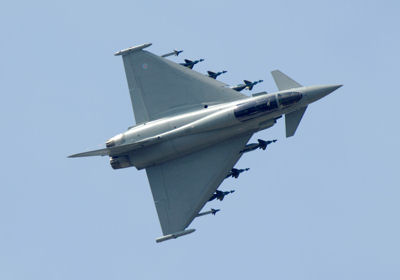

But their size is huge and they are far from the engine nozzles and main body of the F-22, Rafale has its canard above the inlet, the Eurofighter below the cockpit.
Ah and a detail farther the canard is from the wing lesser the canard vortex can re energize the wing and more its vortex breakdown will affect the wing then you add strakes as in the Eurofighter and you make bigger canards, but Rafale then is a more practical aircraft with small canards near the wing.
A canard also is deflected increasing drag on the wing killing lift.
The F-22 has a better moment arm simply because the nozzles and main fuselage weight is farther ahead.
In fact the Eurofighter`s canard is not at the tip of the fuselage niether the farthest thing from its center of gravity, but in the F-22 the tailplane is the farthest thing from the center of gravity.
kiwinopalas long as it is straight line, it would probably manage to do fine, with, eventually, a few “reinforcements” around the leading edges etc, to withstand heat.
however, if it tried to manouver at supersonic speeds, that’s another story.. but I guess it would depend on aircrft’s history. some F-15s started to break in recent years, obviously, the structure grew old at some point… the efforts it would have to stand while being hot may be difficult to manage, indeed
The F-22 frontal cross section is a diamond with fuselage-wing blending, the F-15 is a box with wings, with conformal fuel tanks is the same, the F-22 has a wing good for supercruise with RAM covering, the F-15 is not an aircraft designed to supercruise but to dogfight at Mach 0.8.
You also disregard the F-22 airframe, it was designed to give the least drag at Mach 1.7, the F-15 only achieves Mach 2.5 clean, and basicly achieves that speed thanks to raw power and variable geometry inlets add weapons and it will fly at Mach 2 and very few times in many years.
See it in the Su-35BM it has supercruise capable engines but it won`t supercruise as the PAK FA even having the same engines, will it supercruise yes, but the efficiency is lower than the aircraft specifically designed to do that
kiwinopalHaving downwash aeroprofile (wing) in line and in front of another (elevator), actually reduces elevator effectiveness, until elevator’s upper surface gets into the wing’s downwash stream.
And no, again.
Canards and wing by virtue of their Cp and AC positions, usually have larger momentum arm. This is one of the reasons, why canards are generally smaller, since required trim forces are smaller.
An aircraft has its fulcrum on its center of gravity, the moment arm is the relation between the control surface aerodynamic center and the center of gravity.
By definition tailplanes are farther way from the wings, now canards need to be near the wing so their distace with respect the center of gravity is close.
Rafale has a good pitch up motion because the aircraft has a huge wing with relaxed stability, so it is tail heavy and with canards it is amplified.
You can give relaxed stability to an aircraft with tails and LERXed and you get an aircraft with in pitch up as good o better than Rafale in example T-50 and F-22 .
kiwinopalThe F-15 won`t do like the F-22, it has smaller wings and more clutter in the airframe even the F-15SE won`t be comparable, no stealth and no wing designed specifically to supercruise.
the F-22 diamond cross section also has fuselage-wing blending, the F-15 is more in the line of the MiG-25 a box with wings
kiwinopal@ obligatory:
when you read:
“Wind tunnel testing and project work on alternative aft tailed configurations had pointed out many advantages for that particular layout, where perhaps range and sustained turn rate were the most noticeable, granted the technological level of that time. “
you underlined “range” and “sustained turn rate”, while there was another interesting part which is “given the technological level of that time”.
what it does say is that for the knowledge of that time it was that way, but isn’t necessarily that way anymore. It’s just like saiying that it was proven in the 1960’s that “engine in front” was proven to be the most efficient way to build a formula 1 given the technological level of that time, and you undeline just the “engine in front” and ” most efficient”, forgetting that technology has advanced since then – which is hinted by the last part (how many F1 racing cars with front engine do you see these days? 😉 )
the F-22 still has tailplanes and has 28 deg/s STR with modern technology
kiwinopalsorry, but comparing fixed canards with movable ones is apples and oranges comparison: useless
That is a poor excuse, then you admit a tailess delta is in disadvantage and canards are useless in the kfir to increase STR and ITR to beat a regular interceptor like the MiG-23
kiwinopalWhat you said is fitable to subsonic not higher speed. In supersonic, canards will be less trim drag than tailed a/c.
Nothing you explained, propeller a/c has 400 kph approximately between top speed and lost speed, but now a/c with TVC has 1400 kph between them at least. 😎
The reason the americans still use tailplanes is simply what they want to achieve.
Only the F-35 and F-22 can say are supersonic, most fighters fight at Mach 0.7 pretty much turning at those speeds is what is needed. Rafale and even the Eurofighter will dogfight at Mach 0.9, the Su-35BM and Eurofighter might be able to dogfight at Mach 1.3 but at those speeds turn rates diminish that basicly is only to give better kinematics to a BVR AAM.
kiwinopalYou wasted your time very much again, the Kfir according to my investigation was a fix-surface canards a/c. If your MIG-23 is fixed tail, that will be fair.
Especially, in modern air combat directing nose to foes a/s in a very moment for launching missile is much common than run circles like a mill donkey.
Otherwise, this data showing quite clear the disadvantage of low swept wing: faster speed, worse maneuver.
That is just an excuse, is like people say this aircraft is better even having not stealth and supercruise who needs supercruise? my aircraft does not have it and its alright
STRs are needed because any other aircraft will turn to avoid being shot, and it is not like you are saying the Mirage 2000 is pointing the nose like a Su-27 in the bell, it is simply banking, it means the aircraft rolls fast but can not turn as fast.
Once it starts turning it loses the initial advantage, by the way the F-16 has other speeds where it will beat the Mirage 2000, however that graph is selective even does not meantion STR simply because it will show the Mirage has a lower STR than the F-16 at any altitude.
Also you have vertical agility or Loops the F-16 must be a better aircraft too in that due to higher TWR.
By the way the MiG-23 was not a dogfighter if you get a F-5 versus Kfir you will see canards are not of much help for the Kfir.
kiwinopalTurn rate is not made for avoiding missile whereas is for pointing foes a/s.
turn rate is used to avoid persuers and get good kinematics to the air to air missiles.
kiwinopalYou’ve wasted your time, we are talking about canard and tail:cool:
No i did not, any aerodynamic configuration has pros and cons, canards also induce flutter. reduce lift, increase drag etc etc.
No aircraft can be good in everything even the F-22 has problems with rain and maintainance, it degrades its stealth
See it in this way, the Mirage 2000 and Gripen have excellent ITR but bleed energy so fast that they have a difference of ITR and STR of 10 deg/s, they can bank fast but not turn well.
Usually the LERXed aircraft have only a difference of 5 deg/s between their ITR and STR due to wing specifically design for speeds of Mach 0.7.
The reason the americans still use tailplanes is simply what they want to achieve.
The Russians were very smart by making the T-50 with tailplanes and LEVCONs since it uses the best qualities of LERXes and Canards without the drag a canard involves, the same was done in the Su-35BM deleting the canards
In general aircraft design will be a balance, why canards are not commonly seen in stealth aircraft is simple, they have more compromises.
Even the stealthy Gripen had its canards above the wing affecting in general its LO, tailplanes always are benefited by the downwash of the main wing and can always have a better moment arm.
So it is not they are better or worse they simply are used depending in what type of wing they want to use.
The general performance will be a balance of drag, lift, thrust, weight etc etc.
kiwinopalhere we see some of the almost four dozen Series A built in Mexico by TNCA.
kiwinopalA Toloche another aircraft by TNCA designed by Angel Lascurain in 1923.
kiwinopalHere is the Lascurain`s Sport twin engine aircraft.
This aircraft was the first twin engine aircraft built in Mexico, this was the product of Angel Lascurain and Gustavo Salinas, it was financed by Roberto Fierro and first flew in 1939.
It was sold later to a private company.
Only one aircraft was ever built.
kiwinopal“Russia is trying to stabilize its population at 145 million.”
“But officials say that the population could decline to 125 million by 2025 unless a host of measures,..”Both options are still possible.
well let us hope Russia`s population grows, they need it and they have the land
kiwinopalTaiwan Sends Mixed Message on Fighters
Comments made by Taiwan’s Air Force chief of staff have confused the issue over whether Taiwan actually wants F-16s.
On May 13, Air Chief Ger Hsi-hsiung told members of the legislature that F-16s would meet Taiwan’s immediate requirements, but the F-16 lacks the stealth and short-takeoff and vertical-landing (STOVL) capabilities that will be needed in the future.
When asked by the legislature to identify the fighter better suited to meet Taiwan’s long-term needs, Ger identified the F-35B Lightening II.
Taiwan first requested 66 new F-16C/D Block 50/52 fighters from the United States in 2006, but Washington has been hesitant to release the aircraft due to pressure from China.
Ger’s response sends the wrong signal to Washington at a time when the government is pushing hard for the release of F-16s, said a Taiwan defense official.
Full Story
F-35 interesting


 Sign In







