kiwinopal
Alright, my bad ..little bit of googling showed Russia’s population increased in 2009 (first time since 1995).
Population grew 25.000 in 2009
Reuters:Russia says population up for first year since 1995
Straitstimes:Russian population increases
that is good for russia
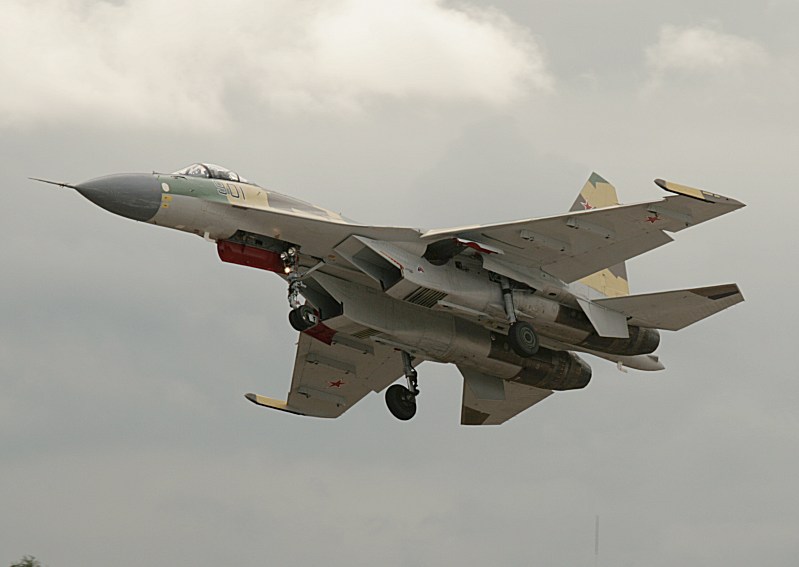
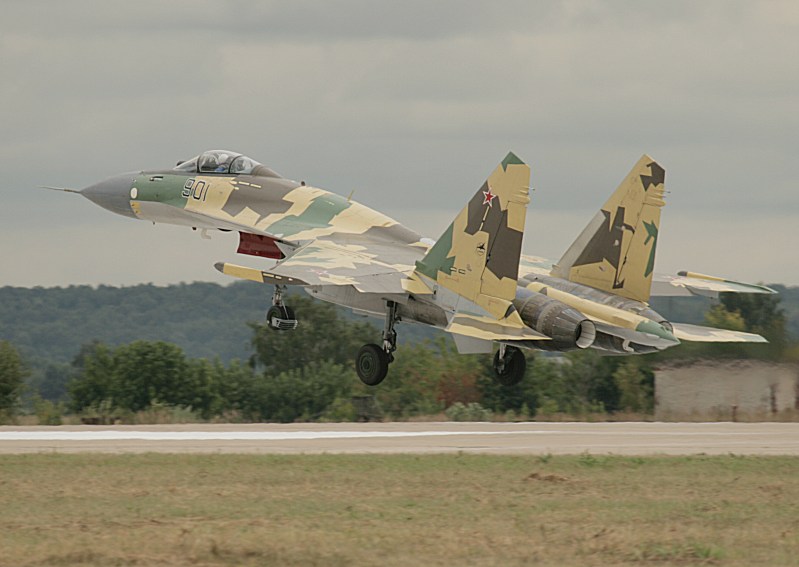
kiwinopalIt’s the same pilot that’s flying the prototype T-50 – Sukhoi Test Pilot Segei Bogdan.
At the MAKS 09 airshow, he made a few landings in the Su-35 from a short curved approach, only straightening out at the last moment…..
The photo you are quoting was taken on the day I wasn’t there – and he obviously didn’t kick it straight before touching down 😮
No big issue with a Flanker though – it’s built like a tank.
Ken
nice pictures
kiwinopali also think its the difference in the avionics and systems they operate in, as 4.5 platforms are similar enough to be worked in the chosen system effectively with the appropriate avionics etc
one point, the sh lerx had the benefit of decent computer modeling available for its design of vortex management and i would argue that if not the best is as good as the best, i havent seen sources or claims of better than it for 4.5 gen
we seem to be happy about the 24 sh we ordered, 12 being wired as growlers
Perhaps they have cured the wing drop properly, and the F-18E is a fine aircraft, but most US critics point the fact still it is a basic F-18 with higher payload and reduced RCS, in my opinion it is a cool design, better than the F-14 and competitive with the Rafale, Su-27BM and Eurofighter, but if i was going to elect a fighter i would take the Su-27BM on terms of agility but true with HMS and AIM-9Xs i would not fear the Rafale or J-10 niether a Su-27BM.
but in the context of stealth and canards i guess the F-22 with tailplanes is the best and from my point of view canards are not superior to taiplanes and a well designed aircraft
see it
early concept of the F-22
real aircraft
No canards and yes stealth most of its detractors say canards are better than tailplanes and TVC is to explain its excelent agility
kiwinopalMost light weight modern delta aircraft have ITRs of around 30 deg/s and a STRs of around 20deg/s
The LERXed aircraft will be in the region of 28 deg/s ITR and 22 deg/s STR
The Gripen has a ITR of 30 deg/s and 20 deg/s, the Mirage 2000 of 19 deg/s STR and 29deg/s ITR
Now a F-16 with a 27-25 deg/s ITR and 21.5-20 deg/s STR will be even with any of these two delta aircratt.
Now compare the F-22 with the Rafale and Eurofighter or even the MiG-29 and you find the Eurofighter has lower STR than even the MiG-29.
Pointing the nose but not being able to sustain it means you bank very quickly but you turn slow, the Gripen and Mirage 2000 will bank quickly but will turn slow, as a result you will need to try to avoid sustained maneovring and turning.
It is not like the Mirage 2000 or Gripen will point their noses like Su-27 with the Bell or hook using the cobra, no it is not the case they are simply banking quickly but not turning fast, this is good for changing direction but not aiming
kiwinopalI do not agree with you for the following reasons:
A-The Rafale and Eurofighter have high TWR
This contradicts your claim of these aircraft not needing high thrust.
B-STR are not needed
This is even more illogic, if you point you nose a second is not worthed because the other aircraft is already avoiding you limiting the chances of getting it on your crosshairs sight.
the best aircraft is the one with a high ITR and little difference between its ITR and STR so it points its nose quickly and keeps its nose at the same angular speed or in few words close to its ITR, example MiG-29 it will point its nose at 28deg/s and will sustain it at 23.5 deg/s, same is the F-22
The only reason the Mirage 2000 and Gripen are competitive with the F-16 is because their STR are not so different to the F-16`s STR so they are more or less even with a higher ITR than the F-16`s ITR and a lower STR than the F-16`s STR
Now a swing wing aircraft sweeps its wing according to the speed, basicly it means each wing is optimized for a flight envelope.
The U-2 has a wing for high altitude and high lift at low speed
The XB-70 has a wing for high speed.
The F-18 has a wing for near transonic speeds
Same in an F-14, it sweeps its wing low at landing like a U-2, it uses a medium sweep at Mach 0.8 like a F-18 and sweeps back its wing at Mach 1 and Beyond like a delta of a XB-70.
At Mach 0.8 where most aircraft fight happens, the best lift you will get is with a wing like the F-18 and MiG-29.
The Rafale and Mirage 2000`s delta wings at Mach 0.8 therefore won`t have good STR due to drag that is the reason they use Canards and relaxed stability. Here drag is not a result of AoA but because of wintip vortex formation and downwash.
however with the advent of the F-22, supercruise speed. forces the use of wings optimised for higher speeds and you can see it in the F-22 rhomboid-type of wing
If you have read the report i gave you about the MiG-23, it says the MiG-23 at high speeds it has better turning ability than the F-16 this is because at high speed its wing at 72 deg of sweep gets less drag than the F-16`s wing.
why then a Delta wing? deltas allows you for good acceleration and low drag in level flight, so yo add a canard and relaxed stability and you get mitigated most of the cons this type of wing has at low speeds.
kiwinopalHow many degrees per second can the pilot of an F-15/16 turn their head w/ JHMCS and AIM-9X? You can’t compare 2 aircraft solely on STR/ITR, if there are other mitigating factors(weapons systems, pilot skill, etc..).
I agree but my commentary was just aimed at the aerodynamics and performance of each design, definitively the Rafale is aerodynamically speaking quit agile and on a gun battle will beat always the F-15 and F-14 and will leave the MiG-23, MiG-21, Kfir, Viggen and most earlier jets as lumbering beasts.
However agility is always an advantage in terms of dodging missiles and getting the first look first kill
kiwinopalIn turn performance both aircraft are similar, the higher ITR of the Mirage 2000 will mean a first chance to attack and disengage, but once the furball starts the Mirage 2000 has to avoid getting in a dogfight, however the F-16 won`t have the advantage the MiG-29 will have, a well flown Mirage 2000 has good odds of beating the F-16C but has to avoid a bit the long combat maneouvres.
Same will be a Gripen versus F-16 or Gripen versus MiG-29.
If it is true the F-16A has a 21.5 deg/s STR then it can force the Mirage 2000 into a turn fight and the Mirage 2000 will be in disadvantage.
Rafale is different if it has at least 23 deg/s STR then it will beat the F-16 easily and the F-15, F-14 will be too easy.
kiwinopalIt was the HMS that was the decisive factor, and the response LUFTWAFFE came up with was: Typhoon.
F-16 is still a amongst the most cost effective bomb trucks around.
see this Combat Manoeuvrability
Instantaneous turn rate @ 15,000 ft. (4,572m) – Two IR Missiles – 50% Int. Fuel
Mach 0.7
Mach 0.9
Mach 1.2
Mach 1.5
°/sec
°/sec
°/sec
°/sec
Mirage 2000
22
17,5
13
10.5
F16 C
18
17.5
13
10.5
F18 C
18.5
14.5
11
8.5
source see how they do not mention the STR
http://www.mirage-jet.com/COMPAR_1/compar_1.htm
kiwinopalThat is not true, the F-16 is one of the best fighters ever built, from 1976 to 1999 it was the best fighter available in the west, 4000 built show why it has beaten all its rivals it has won more exports than the Mirage 2000 for sure, in fact Israel blooded the F-16 and after the F-15 it has the best combat record of any modern jet; and has better sustained turn rate than the Mirage 2000 even with a multirole version like the F-16C is, the F-16A most be a much better proposition.
The Mirage 2000 only can start and poit its nose very briefly once it started turning without HMS the F-16 would had beaten it, it only has a very brief chance of beating the F-16 but basicly has to avoid the F-16 in dogfights due to an inferior STR.
The MiG-29 was invincible in the 1980s and 1990s at less than 10 miles basicly no other fighter would had beaten it and remember the Germans had downgraded MiG-29s
kiwinopalit would be interesting to count up how many f-16 and f-15’s were sold since the rafale came online and the comps it lost to, you can only sell what countries want, lets hope the keys to the safe TOT for brazil does the trick for rafale
The Rafale and Eurofighter are still 4th generation fighters and do not posses the edge over the MiG-29 or F-16 and once they are upgraded are basicly competitive in all aspects. that is the reason they lose even in Europe in markets like Poland or in Asia in Korea
The F-18E with all its gadgets continues a good aircraft in terms of weaponry and avionics
kiwinopalmaybe because they don’t only consider one factor to decide? some other things can be taken into consideration too, like: other missions, price, international relationships, etc…
Well up to what i have read, the Mirage 2000 and F-16C are even in turn performance, the Mirage 2000 has a better ITR in most altitudes but lower STR in all altitudes.
see page 43 of this PDF document
http://csis.org/files/media/csis/pubs/081125_is_syria_air_sam.pdf
see that they are saying F-16C with a STR of 20 deg/s and since there are so many F-16 blocks well let us say it might change with different version
Now this document shows the Kfir was not a real threat to at least the MiG-23 and F-4
The manual’s authors claim that in comparison with the F-4E (though whether they mean the slatted or non-slatted sub-version of the Phantom is not clear), the MiG-23MLD has superior sustained turn performance throughout the entire envelope, excluding the range between 377 and 540kts (700 and 1,000km/h) below 21,000ft (6,400m). It also has the edge over the Phantom II in zoom climb performance at all altitudes and speeds, excluding the true airspeed range between 485 and 647kts (900 and 1,200km/h) above 18,000ft (6,000m). Compared with the F-15A, the MiG-23MLD’s only notable advantage is in zoom climb performance at speeds above 620kts (1,150km/h). However, the manual asserts that compared with the F-16A, the Soviet swing-wing fighter produces a somewhat better sustained turn performance above 15,000ft (5,000m), at speeds close to the maximum, as well as better zoom climb performance at true airspeeds exceeding 590kts (1,100km/h). However, as comparative tests have shown, using the Syrian MiG-23MLD(Export) which defected to Israel in October 1989, the swing-wing fighter demonstrated, somewhat surprisingly, that it had better acceleration than the escorting F-16s. This would seem to indicate that in ‘real world’ conditions the MiG-23MLD would have a slight edge over the early F-16s in acceleration and energy manoeuvrability at true airspeeds above 485kts (900km/h). The IAI Kfir C.2, as assessed in the manual, is said to be inferior to the MiG-23MLD in sustained turn performance at airspeeds above 540kts (1,000km/h), and in zoom climb performance at true airspeeds below 540kts (1,000km/h). However, at altitudes below 12,000ft (4,000m) the MiG-23MLD has the edge in energy manoeuvrability throughout the entire speed range.
http://www.xairforces.com/analyses/mig-23.html
kiwinopalTNCA Series C


kiwinopalThe Greek experience is that with an experienced pilot, the fighter with the higher ITR will end the game right at the first pass, making STR obsolete in missile engagements.
The LUFTWAFFE experience showed the STR and HMS of the MiG-29 were the decisive factor by the way why are the greeks still buying F-16s if they are not as good?
kiwinopalHere is kiwi approciated very much data, however, very contradictory is the F-18‘s swept angle smaller than MiG-29’s but get the most weak turn rate equal to our tailless Mirage 2000.
We still remember someone taught us a slight swept wing supply a greater lift than delta wing or say a high swept wing.
Turns are the results of =LIFT + THRUST
The F-18 lacks thrust, compare it to a MiG-29, F-16 or Su-27 it is underpowered besides has little wing fuselage blending compare to the three former aircraft.
Now LERXes do have advantages and disadvantages.
among the advantages are some share with canards:
Reduced transonic lift center shift, giving lower supersonic trim drag at high g and increase in max lift for less wing area,
At low angles of attack, the LERX has little effect At higher angles of attack a vortex, formed from the leading edge of the LERX, flows over the wing.
The vortex helps to energize the upper surface boundary layer, delaying separation.
LERX vortex stabilizes wing leading edge vortex and prevents it from separating
LERX vortex and wing leading edge vortex exist side by side and support each other
the disadvantages are
Tendency to cause pitchup at high angles of attack
Increased drag at low angles of attack
Structural fatigue of vertical stabilizers buffeted by flowfield
When angle of attack becomes sufficiently large and vortex breakdown progresses ahead of wing trailing edge
The Su-27 shows a very well designed LERX; the F-18E a design that was hastled by economic considerations resulting in a aircraft with the adverse features of LERXes
Now canards have similar advantages and disadvantages.
The Mirage 2000 might have less drag and relatively better thrust making an equal of the F-18 but it won`t surpass the MiG-29 and F-16
kiwinopalI don’t expect anything… I simply read what’s posted and then think about it.. and when someone presents a publication as “source” while the very author of that publication says in the publication that the hypothesis for his work are “known as not realistic” I have trouble accepting that as “fact” 😉
No it is not that, any fourth generation fighter carries its weapons externally this means drag, the Gripen is not a super machine just because it has canards, the real published known numbers are 30 deg/s for the Gripen`s ITR and 20 deg/s for its STR.
You expect something irreal with the exception of the F-22, F-35 and T-50 all fighters at 50% of fuel carrying weapons are heavely burden by drag, the Gripen is a good aircraft but is not something of a magical thing, its STR goes with the type of wing it has.
You expect things based upon desires not facts, no Rafale or MiG-29 can beat the numbers of the F-22 simply because the fifth generation carries its weapons internally and has more military power setting available.
The Rafale having a 23 deg/s STR is a believeable number even a high number but you expect more because you think canards and deltas do not follow aerodynamics.


 Sign In