 kiwinopal
O, yeah? Could you explain why that ITR of canards generally higher than normal layouts without TVC?
And you have been not giving any reasoning to tell me why canards would be worth to stealth?
You are misunderstanding facts, first the Kfir has a turn rate like this, ITS of 18deg/s, STR of 9.6 deg/s, both the F-16 and F-15 have better sustained and Instantaneous turn rates even the Harrier AV-8B has better ITR and STR
The same will happen with the Viggen it is less capable than even the F-15 and Harrier and much less capable than even the MiG-29.
It is not that delta canards have high ITRs but that they do not have good STR because they bleed energy fast, that is the reason they use canards and relaxed stability to increase sustained turn rates.
If you read aircraft history you will know that each generation has increased thrust and thrust to weight ratio.
The Eurofighter, Rafale and even the Gripen have done it, the MiG-29 and SU-27 have done it too.
However deltas with canards have less supersonic trim and this allows for more compact designs since you can pack more lift in a given design because the control surface is ahead of the center of gravity and with relaxed agility well that will make for good fighters
What the americans did in the F-22 is pack two very powerful engines and give it a huge wing in a very aerodynamicaly clean airframe.
This has given them the ability to give it really high ITR and STR, now TVC is important but its agility is not 100% product of TVC.
The F-22 and Su-30MKI once they use TVC they slow down, they do Cobras or Kulbits or BElls but the name for the Cobra is in reality dynamic disaceleration what the Cobra is doing to a Su-27 is slow it down, an F-15 can even shot down an unexperienced Su-30MKI pilot just by the way it sinks in the air once its uses supermaneouvrabity.
However the F-22 has a turn rate of 28 deg/s and it is not because of TVC it is because it has excess power it can even supercruise at military power, consider then if it won`t have an excellent turn rate just without TVC,
you take like a bible that canards are the only element to make a fighter agile but it is not it is simple lift and thrust.
If the F-22 uses TVC it will do bells, cobras, kulbits, etc etc but its turn rate is the result of pure thrust and lift
kiwinopalAll of Eurocanards own a better instantaneous turn rate than nornmal layout such as Su-27 and F-15.
That is true however the F-22 and T-50 must have very high instantaneous and sustained turn rates, the F-22 has 28 deg/s sustained turn rate, that is very high and the instantaneos must be higher than even the eurofighter`s.
The T-50 must be the same.
It is not the fact they have canards or tailplanes but the amount of lift and thrust what matters.
Also is not that canards can not be used for stealth they can be used but performance losses and trade offs must not be worthed since the F-22 and T-50 both use tailplanes and the same is for the F-35.
and the others the B-2, F-117, YF-23 and X-32 show that basicly for stealth no tail either back or ahead of the wing is the best for stealth aircraft but if you want to use flaps and high AoA, then a tail or a canard is needed
kiwinopalWell if Russians field PAK-FA in 2018 or so, and field an equivalent around 2025, it would show how significantly the chinese have narrowed the gap. And we all know it takes time.
China could do it, but the matter is only if they get know how from Russia and the US that will be unlikely, if they do it by their own it will take them more than 10 years because in research and development will take them several years that is the reason the japanese are asking help.
Russia won`t do it if China still plagarize their technology and the US won`t since they even rejected Japan and Israel for the F-22
kiwinopalKanwa said based on an interview with sukhoi that the Russians are still sending the components and China is accepting them. So, nothing is really cancelled. This is from either April or March edition of it this year.
They already paid the money for the rights to produce 200 flankers, whether or not they decide to use those components, that’s not up to Russia. The problem is that China is not telling Russia anything about what it’s producing exactly and how many it is producing. But let’s just say that the Russians are making a lot of noise, but the story behind it is more complex than it’s shown.China doesn’t need it. It would like have it to get the naval pilots start training asap, but if it doesn’t get it. It will just wait a couple of more years. It’s not preferred, but you can’t allow another country to control your operational sovereignty.
China does not have any desire to join the Russian 5th gen project, that’s why it didn’t join. The reason is that it believes that it can develop its own plane even if it comes a few years later. And also, it wants the new plane to be developed to its requirements rather than Russian requirements.
how is Su-30MKI superior to J-11B?
J-11B is equipped with higher thrusted engines, it’s lighter (so better T/W ratio).
J-11B can make use of combination Chinese + Russian AAMs, PGMs and AShMs. Whereas Su-30MKI is currently configured to just use Russian ones.
J-11B has a more advanced cockpit, uses holographic HUD, IRST/LR that’s improved upon the one for export version of Su-35, UV band MAWs, fiber optic cable for data transmission, more recently developed mission computer.What people normally use as support for mki over j-11B are TVC engine and Bars. Well, you can either have 2D TVC or better T/W ratio. As for Bars, it has better multi-engagement capability due to electronic scan but in terms of detection range and such, it’s not better than what’s on J-11B.
The Su-35BM has supercruise, TVC and new missiles of long range.
The MKI has improved capabilitied can do the Cobra, cobra turn, Kulbit, bell and hook and Israeli, french, indian and Russian avionics.
The T-50 is flying now, it has supercruise, stealth and TVC.
the Su-34 is stealthier than the JH-7 and has better flying handling at low altitude
All this talk about China fielding a Stealth fighter in 2-3 years can be believeable only if they have a engine with supercruise and TVC, Russia is still struggling but all ready has flown it in two aircraft the T-50 and Su-35BM China still is a rumour a gossip.
Russia will field the T-50 in 5-8 years from now, China very likely in 10-15 at the earliest if they have an engine in the class of the AL-40?117s if they can not get the engine well a 20-25 years mark is believeable
well the J-11B is not flying with Russian components a that has been reported by the Russians
kiwinopalPay attension, Cobra is a maneuver, but maneuver not merely is Cobra.
The Cobra has good value in a fighter like the Su-27 or MiG-29, it does allow it to fight a fighter with higher instantaneous turn rate like a Eurofighter, but since modern Eurofighters have IRIS-T or ASRAAM missiles any superiority will be counterbalance.
kiwinopalRead about hysteresis before claiming anything, the fact the Su-27 can not fly more than a few seconds at 120 degrees shows that the Su-27`s wing will stall, but its controlability is due to stability and where its vortices are bursting, of course the Center of Gravity does play a part in the recovery because of pitch up and pitch down forces, but that pitch down force is related to aerodynamic forces, to return to level flight the Su-27 is still using its tailplanes.
kiwinopalThat is not true, Russia and China had an agreement based upon 200 Su-27s with Russian components, the Chinese cancelled that agreement by not purchasing any more Russian components for the J-11B and that violated the agreement.
Now the Russians are not buying the chinese intentions of buying 2 or 3 Su-33s, even despite it is an aircraft that will be replaced by the MiG-35 and later navalized T-50s in 2017, they won`t sell any Su-33 if it is not at least a a few dozens.
In what has affected China simple, the T-50 won`t fly at least in a few years in the Chinese colors if they continue with such practises, this means China will need to design their own stealth fighter by their own, it means more time to build it and in the meantime India and Russia will field T-50s, Su-35BMs, Su-34s and Su-30MKIs which will be superior to any J-10, JH-7s or J-11B.
The relation won`t be affected in many ways but some weapons sales will be.
Who has been the winner of the J-11B controversy between Russia and China? well INDIA since it has gotten the T-50 technology that China could had and the Su-30MKI which are vastly superior to the J-11B.
kiwinopalThe centre of lift moves back during a Pugachev cobra maneuver???
What lift are we talking about at 100 degrees from the horizontal??
At this point its a flat plate moving through the air on momentum alone since the thrust vector is perpendicular to the line of flight and no wing produces lift perpendicular to the line of flight. Do I need to prove basic physical laws???
The wing, being set back on the fusilage acts as an air-brake at this point, and slows the back end of the fusilage faster than the front end, resulting in the pitch foreward, there is NO lift involved in this part of the maneuver.I stand by all of my comments, since I said an LERX MAY even produce downforce in level flight. Disregard the blended wing/body LERX of the MiG-29 and Su-27 and look at the LERX of the F-18 in level profile. Are you sure they are producing lift? Or do you need appreciable AoA to produce vortex lift?
The Cobra is possible because of the way the vortices behave, as the AoA increases the vortices usually burst forward of the wing trailing edge stalling the wing and causing aircraft pitch up, however the Pugachev`s Cobra is a delay of vortex bursting and allowing a pitch down movement and reward vortex burst, this allows controlability of the Su-27, everything is related to vortex bursting, however as you can see this delay in Vortex bursting is brief so the Cobra has to be done fast.
The LERXes of the Su-27 have been countoured in a way that allow Hysteresis, canards can also do it but the vortices in LERXs are usually stronger, the Su-35 uses canards because tailplane control is not enough due to tailplane size limits but the Su-35 is even more agile than the Su-27 and can do the Cobra turn otherwise known as KULBIT.
kiwinopalhere is more
Despite holding the position as one of the world’s biggest economies, China seems unwilling to shed its reputation for producing cheap replicas.
And one of their more ambitious copycat efforts may put a strain on Russia-China relations.
“This Chinese plane is simply a Russian design stuffed with local electronics,” says Maksim Pyadushkin from the Center for Analysis of Strategies and Technology about the Chinese J11B jet’s resemblance to the Russian Su-27. “It’s a knock-off.”
to read more
http://rt.com/Top_News/2010-04-20/russian-arms-copycat-china.html
kiwinopalYou are right on most points but one; at a stall, once the flow becomes turbulent and detaches , the centre of lift does not move back and pitches the wing foreward and down. If this happened all stalls would be self correcting.
What actually happens in a stall, when flow becomes turbulent and detached, is loss of speed of local flow over the wing, resulting in increased pressure on top of the wing and loss of lift ( lift depends on difference of airflow speed between top and bottom and according to Bernoulli, the difference in pressure). Sometimes the plane drops like a stone!!
If you manage to keep the airflow energized, at speed that is, even if not laminar, you maintain the difference in speed and in pressure. One way of doing this is, is a vortex flow over the wing. All wings generate a tip vortex where the high pressure underneath rolls over the top of the wing to the lower pressure. The more highly swept the wing is, the more pronounced is this effect. Delta wings have a good amount of vortex flow over all of the leading edge and so tend to stay stable to higher alphas than conventional wings. We can get the same effect on a conventional wing by having sharply swept extensions ahead of the wing, ie. LERXs, or a sharply swept canard foreplane. If you remove the LERXs from an F-18 it would not have any higher alpha capability than an F-104 or a T-38.
In the Su-27 and MiG-29 it does go back in the Pugachev`s Cobra the lift load moves back pitching the aircraft down and recovering from the past stall maneuvre. In a SU-27 the post stall maneuvre means it becomes highly stable at high AoA
kiwinopalem745, you don’t seem to understand the concept of a LERX, even after numerous people have explaned it to you.
Most LERXs have a negative attitude and produce no additional lift (maybe even some downforce ) in LEVEL flight. As the AoA increases, high pressure air under the LERX tends to move to the lower pressure area over the LERX. This is different from a wing where this is to be avoided as it detracts from lift, but is a design criterea for LERXs. As this air moves from bottom, over edge and to top, it sets up a rotation, or a vortex, of high speed air which washes over the wing and keeps flow from becoming turbulent and detaching at high AoA.
There are many ways to produce these vortex, one way being LERXs (F-5e, F-17/F-18 and F-16). Dassault used strakes on the upper inlets to produce them on the M2000 (vestigial canards) and any canard foreplane (even when canard is below wing plane as vortex are only useable at high AoA) will produce them as there is always high-to-low pressure spillage.
So, to recap, canards provide all the benefits of LERXs and also provide trim and rotation/pitch control which would otherwise require a tailplane.
Let me break it down for you, one surface, the canard foreplane, can replace and provide the benefits of both, the LERX and the tailplane.I also like the way you dismissed the question put to you about the F-16xl. The F-16, very advanced according to you, since it has LERXs, med. aspect wing and tailplanes, was improved immeasurably to the point where it almost won an order against the F-15, simply by giving it a low aspect wing and removing the ‘advanced’ LERXs and tailplane!!!
By the way, ‘swing’ wings which you dismiss as being so 1960s, are actually from the same time frame as LERXs. Northrop, having recognized the high alpha benefits of the small LERX on the F-5, increased it on the F-5e and then went all out on the Cobra concept which became the YF-17, and some might argue ,went too far with them on the F-18. All of this high tech LERX work was done in the 60s, the mission requirement which would make use of them did not materialize until the 70s (high alpha maneuvering). In the 60s the USAF was more interested in low level penetration, and if there was no stealth technology allowing med or even high altitude undetected penetration, swing wings would still provide the most viable solution for the low level penetration mission
The MiG-29 has up to 40% of lift generated from its fuselage, and to say LERXes in the MiG-29 and Su-27 produce negative lift at level flight is something you will need to prove just looking at the MiG-29 cross section you can see it follows the wing profile same is with the Su-27 and F-16.
The MiG-29 has a compound wing and its LERXes are not like a tailplane but like the regualar airfoil seen in a wing
The LERX are better for high AoA simply because their leading edges are swept at higher angles making for stronger vortices and therefore higher lift than a regular canard that is swept in a lower angle
kiwinopalThe Leading Edge of LERX is highly sharp, with this leading edge highly swept, it becomes side edge alike, but this does not change basic point.
Some LERX could be called compound wing just like F-18C/D’s, but this also does not change F-5A/B also fitted with Leading Edge Rooting Extension.That is what wing needed.:cool:
No point.
The canards also produce upwash and downwash flow to the wing.The Black words didn’t match what you want to directed: “why canards are more difficult to adapt to stealth“.
Both canards and Horizontal tailplan trimming the CL not only canards, what we research here is what is better.
All of above you posted didn’t get any further meaningful point, sorry.
I have posted some advantage of Canards before but nobody were able to rebut them.
Please think before write.
The LERX is a compound wing.
The horizontal taiplane does not affect the wing as the canard for two reason first they are highly swept and second they are behind the wing.
The total lift in a tailplane wing configuration is higher than a canard wing configuration.
The horizontal and vertical tail surfaces are generally highly swept in order to make their effective moment arms as long as possible, while also helping to maintain their critical Mach numbers higher than that of the wing.
http://webcache.googleusercontent.com/search?q=cache:ca2BbzK1zMYJ:www.mae.ufl.edu/~sforza/EAS4700/Wing%2520and%2520Tailplane%2520Design%252008-05.doc+tailplane+types+aerodynamics&cd=11&hl=en&ct=clnk
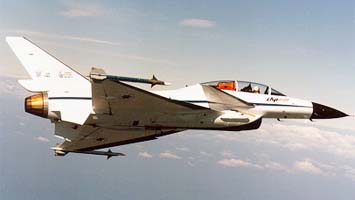
Consider that all fighter with canards have high aspect canards and trapezoidal in shape why? a triangular canard is low aspect and has its center of lift in a more limited geometry since retangular shapes are twice than a triangular shape just by math, that is the simple reason all modern fighters have trapezoidal canards and not triangular, besides the canards have less swept than their wings, a stealthy canard will have more drag, a smaller area and will more compromised as an moment arm


kiwinopalLERxes are not delta wings are compound wings, one section is highly sweep, you can call it delta if you want but the main wing has a moderate sweep.
Now if you want to understand canards you have to understand foreplanes do move and this will affect the wing, remember the wing is behind the canard and any flextion of the canard will affect it.
see
A difficulty with the above equations is that a, the ratio of canard to wing lift curve slopes must be calculated. If the wings did not interfere with each other one could use the approximate relations:
However, the surfaces produce upwash and downwash on each other so that the effective lift curve slope is changed. Unless the canard and wing are very close together, the major effect is that of the canard on the wing. The canard produces downwash on the inner part of the wing and upwash outboard of the canard tip vortices. The net effect, though, is a reduction in wing lift which can be estimated roughly by the following formula which is based on the Hayes Reverse Flow Theorem (see Ref. 3):
source
http://174.120.241.105/appliedaero/configuration/canardstability.html
Now see why canards are more difficult to adapt to stealth
The situation is less favorable for canard designs. Although small canards of high aspect ratio produce least drag, large canards of small aspect ratio achieve the highest CLmax. Moreover, the sensitivity of CLmax and drag to canard aspect ratio leads to greater compromises in each of these areas than would be required for an aft-tail design.
http://aero.stanford.edu/Reports/MultOp/multop.html
Triangular canards such as the ones on the X-36 is a design compromise; the Rafale, J-10, Lavi, Su-33, Su-35, Su-37, Eurofighter, Gripen, Su-34 all have high aspect canards, the Viggen is the exception with a large canard of low aspect ratio, guess what effect a triangular canard will have since a canard to be effective needs to have a relation between its center of lift and the center of gravity of the aircraft.
kiwinopalThe wing is swept forward because unswept wings at subsonic speeds have better lift/drag coefficients. in few words straight wings are better at subsonic speeds that is the reason subsonic aircraft do not use delta wings.
In fact the F-14 won`t need higher AoA with the swept forward wings at landing because it has enough lift but with the wings swept back you will need higher AoA in order to get the same lift.
Delta wings are used for supersonic speeds and because they produce relatively good drag lift coefficient eliminating the need for Variable Geometry wings.
The SST example is a good one concord used a doble delta wing not a VG like Boeing`s STT, variable goemetry wings have the problem of mechanical complexities and added weight besides they are stable at supersonic due to supersonic aerodynamic shift of the center of lift.
A delta wing has vortices that increase lift but as AoA increases vortex breakdown appears stalling the wing, this is fixed with Canards or cranked wings/double delta wings. Canards eliminate that problem by keeping the vortex attached and the center of lift forward eliminating the need for trimming at supersonic speeds.
kiwinopalIF your statement was true them explain why a F-14 will have a low sweep when it touches down? why the F-111 will sweep back for supersonic speeds and forward with subsonic speeds and touch down?
The Delta produces a vortex that well used can allow for extra lift but have you seen why the Tu-144 uses a canard when landing?
And by the way the Vortices are produced in a double delta wing which basicly is a delta with a LERX, a Cranked delta wing will have even better lift and AoA handling, in order to have better lift in a highly sweep wing canards or compound wings are used.
Ask your self why subsonic comercial aircraft have not delta wings but mildly swept wings, only the Concord and Tu-144 will have double deltas


 Sign In







