 kiwinopal
***removed by moderator***
If you really wanted to understand what I meant I wouldn’t have to respond to this, but oh’well. There’s a difference in how the FCS commands the control surfaces when in landing/take off mode in comparison to in flight mode.
And what are the elevons on a canard/delta for? Contrary to tailpushers the canard/delta has more control surfaces to help achieve the best lift/drag possible. The canards work in conjuction with the elevons. You are focusing way to much on the canards.
Drag management will always be prio, and that includes subsonic ACM. For all we know the F-22 could be a more draggy design in comparison to, for example a fully loaded Typhoon or Gripen. The F-22 has sacrificed aerodynamics to achieve a higher level of stealth than the Eurocanards. I think it’s safe to say that just like the Eurocanards falls short in the stealth department, the F-22 falls short in aerodynamics department. But, naturally you can’t believe that. The F-22 is infallible after all. :rolleyes:
And please show us the facts you have that canards provide downforce during maneuvers.If LERX’s are so effective at controlling the airflow over the wings, why use slats at all?
Robban
Having a canard is not a guarantee of being better than a tailplane, a fighter is a product of thrust and lift plus control surfaces.
The Viggen and Kfir for example were completly outmatched by fighters like the F-4 and MiG-23, the sustained turn radius of a Viggen is below of what a F-4 and MiG-23 can achieve and way below what an F-15 does.
The MiG-29 also has better sustained turn rate than the Gripen.
Now the F-22 has an excess of power and a huge wing, the F-22 versus the Gripen is quit similar to an F-15 versus Viggen comparation
kiwinopalBut planeform should point in the same direction, you should only have one peak and not multiple peaks or near indefinitely peaks caused by twisting. This contradicts planeform.;)
Maybe look again on a Typhoon inlet and you see no 90°, the same at a Rafale.
A Typhoon and a Rafale are not copareable whit a vintage F-15.:rolleyes:
what you are saying has some truth by its own, the best stealthy platform will be the one with less elements such as flying wing or something like the aircraft envisioned by Lippisch in the 1940s
and that is what the americans did with the bird of prey
Less elements mean you can concentrate the radiation in one direction away from the source.
However aerodynamics do not go well with that.
The Eurofighter was built for performance. its canards are for performance and are not compromised as the canards of the X-36.
Also you have the inlets which interrupt the basic aircraft configuration as a clean performer.
you need also control surfaces if you want to have highly agile fighters look at the MiG-1.44 it has more control surfaces than the Eurofighter same is with the Su-30MKI or Su-47.
In the F-22 they are content with rear, frontal, upper and lower reduction of RCS.
In the T-50 this has been done with lower, upper and frontal but rear is not so important like in the F-35.
The Eurofighter only included stealth design with very little compromise with aerodynamics.
In fact with TVC and Supercruise the Eurofighter can beat in dogfight a F-22 once it has stablished visual contact.
That is what the Russians have done with the Su-35BM
kiwinopalMaybe take a look to the side?
Leading edge of the differter, inlets and fins point in differents direction.
Where is your planform?
That what you see on the photos happens whit Radarwaves too, we are in the optical behavior of HF. :diablo:
The planform does exist is just a matter of knowing a few geometrical figures, first let us say the F-22 inlets and nacelles use a rhombohedron, why? well a rhomboid has oblique angles but a rhombohedron is a 3d image of that.

here what is important is the fact it has angles which are not of 90 degrees, and that is simply as you already know it to reflect the radiation away from the emiting source.
The F-15`s nacelles are cuboids with 90 degree angles
The F-22 nose is a rombohedron that blends into a pyramid that later becomes an ojive.
The inlet is basicly a cut of that hollow rhomboid on one of its tips from one of the diagonals
That is planform aligment and the fins do have the same angle with respect the vertical
kiwinopalWhit planform has you a RCS peak in the planform direction.
The YF-22 has a greater wing sweep angle therfor is this peak wider outwarts as for the F-22. Then is a twisted leading edge better for the worst chase scenario, Radar wave 90° towards the leading edge. 😉
Another place with non planform is the outer wing trailing edge and the tail of the stab. The F-22 use clear no real planform. 2D and 3D geometry two different things.Maybe sould you use better photos?!
The leading edge are for interrest and not the shadows.:diablo:
Then use maybe a lienal first then see you that the fin and the airframe use different angles.
It’s simple pointless use planform at this point. We have not a plan geometry, we have the the fin profile a straigth side panel.
Then point the leading egde of the fin in up the inlet and differter leading edge points in down direction. Where is this planform?!
Planform alignment is a fact in the F-22, you might deny it or dislike it but it does exist in 3D in the F-22, you picture analysis is highly subjective, due to the fact the angle the picture was taken can distort the view, now it is true the F-22 has some compromises, the aircraft has wing fuselage blending and same is with the boom tailplane blending, like any aircraft aerodynamics have to be prioritized, same is with the PAK FA T-50 from the rear it is not as stealthy, in fact the nozzles it has at the moment are as stealthy as the Su-27`s nozzles any one can see the round nozzles of the T-50 are not stealthy.
In that sense the F-22`s 2D flat nozzles are far ahead of the 3D TVC nozzles in the T-50 and same is with the T-50 engine rounded engine nacelles.
Now no aircraft will be invisble to radar all aircraft reflect radio waves, what they try to do with planform alignment is make the aircraft stealthy in the most combat used attack angles such as frontal RCS, the T-50 has excellent frontal RCS and the same is the F-35, even the Rafale and Eurofighter have taken some measures to do the same.
All aircraft need planes or large flat or near flat surfaces like wings, canards or vertical fins, these are radar signature hot spots, but from some angles they can be disguised and weaken like frontal and rear angles and aircraft also use RAM to weaken the reflected radiation.
kiwinopalHere we have the Azcarate E, this aircraft was a derivative of the
O-E-1 but in a smaller airframe, 10 were built as trainers for the FAM by Juan Azcarate in 1930.
kiwinopalNot really, Maxwell, Sommerfeld are more important.
Ufimtsev mathematics allowed only the estimation of the RCS.Always short coupled and the only long coupled US Canard ends in a fiasco.;)
What is whit the diadral of the F-22 wing?
The F-22 planform dump not all reflection to the same point. Simpel the leading edge of the wing is twisted and inlets pointed down. The leading edge of the fins and inlet points in different direction. Inlets down and leading edge up. 😉
Really, and what with this differents angle?
Your problem, we are in the optical behavior (HF) and for this point is continuous curvature the better choice.
The YF-22 did not have the wing twist
see
In my opinion that must be aerodynamic tweaking to improve the model since stealth does not go always well with aerodynamics, besides the F-22A`s fin does planform with the inlet lips, radome fore and aft fuselage. that is very similar to the F-15 wing and it is done to keep the wing tip in an lower AoA
in this picture you can see they really have planforming
kiwinopalHere we have few of the aerospace products that Mexico exported and were in a way influential beyond its borders, the Anahuac propeller was an early product of Villasana`s mind, it was exported to several countries in particular to Japan, where it was copied, modified and used in the early Japanese aircraft of the 1920s and 1930s, Villasana received from the government of El Salvador recognition for his brilliant invention. The same was done by the Japanese government, through the General Nagaokoa, commander of Japan’s Imperial Air Corps.
It was designed and built in 1915 at the Talleres de la escuela de artes y oficios, its design was optimised for high altitude or the atmospheric conditions found in Mexico City
kiwinopalHere we have another historical aircraft
This is the MTW-1, only one was built, it was built by TNCA as a request of Francisco Sarabia, it was build to fly from Mexico City to Madrid Spain, however the flight was cancelled and never took place due to structural problems. It was built in 1934.
kiwinopalWhat’s the story behind this?
Madrat
You have to consider the following points.
Any stealth fighter uses basic radar reflection angles, it is around 30 degrees, this is based upon the mathematics of Ufimtsev , basicly all the aircraft surfaces and edges should be align upon that angle
This will be in opposition to the basic canard aerodynamics, if you check the picture of the JSF with canards you posted you will see it is basicly a triangle, its leading and trailing edge have the same angle and and its wing has the same angle.
If you compare that to an eurofighter Typhoon you will see from the aerodynamic point of view it is much easier to give that angle to the trailing edge of the wing than to the canard. Its canards need to be high aspect ratio while the first stealthy JSF with canards picture shows a low aspect ratio canard.
Besides most canards are above the wing and most have dihedral.
this makes aerodynamicly speaking harder to keep the basic angles for planforming
The F-22 has a planforming which blends better that angle with the basic aerodynamics, but canards in the Typhoon and other modern fighters need trailings edges with a different angles with respect their leading edges.
If you look at the F-22, you can see the trailing edge of the tailplane do have the same angle of the wing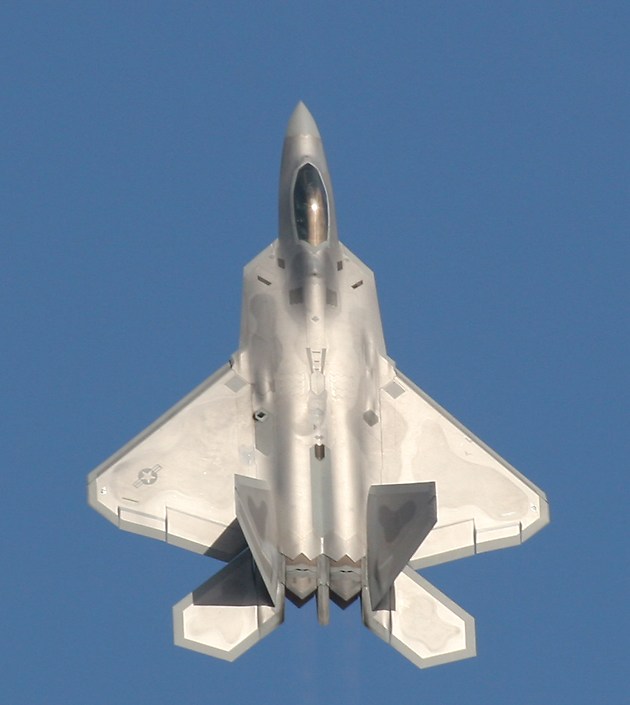
The X-36 still has the same angle but in a more complex wing but still the canard is a triangle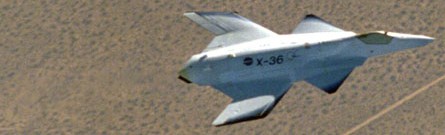
same is with the JSF studies still a triangle
kiwinopalCanards have all the benefits of LERX’s and more, as they can be trimmed and “stowed away” when not needed, = less drag penalty.
The AoA limit set for the Eurocanards FCS does not tell the AoA limit of the airframe. The Gripen for example has been flown to more than 110 degrees AoA without problems during testing.
Except here the canards are movable and able to control the amount of lift needed, enough to make the aircraft highly unstable when they are used.
A stable delta canard pushes the tail down killing lift in order to turn and maintain a turn, just like a stable aircraft with a conventional tail arrangement.
THE most aired clip in the history of Swedish television.
When this accident occured the FCS wasn’t ready. This was the first machine delivered to the RSwAF. Several changes was made to the FCS after this accident. The video is not a good example if you want to show what an FCS failure would look like on an operational aircraft.
Sure it does. Tail pusher = larger elevator inputs. Canard = small inputs. It speaks for itself I think.
i think you are over reaching the abilities of canards, first of all no aerodynamic configuration is the best in everything.
everything depends in what you need and what are you willing to sacrifice.
In the F-22 they were willing to sacrifice some degree of agility and you can see it in the fact the T-50 has returned to the Su-27 basic configuration and has added a LEVCON which is niether a canard or a LERX but a hybrid of both however the F-22 it is a simplier stealth platform.
the Su-35, Su-33 and Su-34 wanted to have the good qualities of both worlds they had canards plus tailplanes but that also means a lot of drag and a poor stealth platform.
the J-10, Rafale, Lavi, Typhoon and Gripen lost some advantages of tailplanes.
The X-32 was a very good compromise of stealth like the B-2 is, a simple delta wing in the case of the X-32 or a flying wing in the B-2s both are excellent stealth platforms.
If you compare fighters like the F-16 and Gripen or MiG-29 and Typhoon you will find out there is not total superiority in having canards and delta wings or tailplanes and LERXes
The MiG-29 and F-16 will enjoy better sustained turns than the Typhoon and Gripen but will have worse instantaneous turn rates.
Having tailplanes doest not make the Su-27 do not make the pugachev`s cobra and 120 deg of AoA
The F-22 with TVC is very agile without it is not, take the Su-35BM too remove its TVC and it is a regular first generation Su-27B.
The F-22 will be ultra expensive compared to the J-10 or Gripen but these aircraft are very agile and at a cheaper price.
A regular Su-33 is not much better than the Su-29K and the Su-35 is better than the Su-27B also it depends in the flight control system
Price is another factor the Su-35 without TVC is not a bad aircraft is quit agile and cheaper than the new Su-35BM but all comes with a price it has more drag, in the other hand the Su-35BM has less drag and better engines and the same agility and more.
Compare the YF-23 with the T-50 PAK FA, basicly both aircraft are basicly the same concept but the T-50 has been improved with levcons and tailplanes, but the YF-23 is a cleaner configuration for stealth
kiwinopalI was about to say the view forward in the BC-1 is like that out of “The Spirit of St Louis” when I saw the picture and your comment of the BC-2.
The Celia is a very sleek looking machine with the wings contoured into the fuselage? any views of that from another angle?
Roger Smith.
Saddly i do not have more pictures but the Celia was based upon the Sport and earlier model so you can have a rough idea how did it look here is the picture
kiwinopalhere is the Quetzatcoatl built by TNCA and designed by Lascurain, they were built in 1923 and were used to fly from Mexico City to Ciudad Juarez in a 1800km flight. One of the pictures shows the Coahuila, this was plane used for that flight with the code 4E131.
Only 3 were built.
kiwinopalI was about to say the view forward in the BC-1 is like that out of “The Spirit of St Louis” when I saw the picture and your comment of the BC-2.
The Celia is a very sleek looking machine with the wings contoured into the fuselage? any views of that from another angle?
Roger Smith.
The BC-2 had several innovative technologies it was not built of wood but of chromium-molybdenum-steel frame tubing and had an air cooled radial engine Wright J-5C Whirlwind. The aircraft was highly influenced by Lindbergh’s Spirit of St. Louis and was far more advanced than the TNCA`s Quetzatcoatl which was a bomber built and designed in Mexico too but built of wood and with a water cooled engine, this allowed it to fly farther and carry twice the payload of the Quetzatcoalt.
The BC-1, BC-2 and BC-3 were built and designed in Mexico by ‘Compañía Aérea de Construcciones y Transportes’ or otherwise known as Compañía Aeronáutica de Baja California in Tijuana, the BC-1 had a BMW engine
kiwinopalNice pictures, thanks a lot. These are informative.
No problem it is a pleasure, i like to share what i have recently learnt. Here we have the BC-3 it was a design used by the FAM as a VIP transport it was the first aircraft built in Mexico as a dedicated transport aircraft it could carry up to 4 passengers
kiwinopalYou have to remember who the target audience is, when those statements are made.
i do not think that is an impossibility they never said new engines but upgraded, besides aircraft jet engines are not as advanced in fact is already a 80 years technology just upgraded.
Most countries can make at least aircraft engine parts mine does build lots of components for jet engines, in fact in Mexico, we do build several engine parts; Iran most be no different, what makes aircraft engines difficult are the fact most engines are required to be in the range of 15 tonnes or more in modern fighters or 20 tonnes in airliners, besides they need to be profitable. Brazil for example has made jet engines for a UAV see http://diariodopresal.files.wordpress.com/2010/01/tr3500-2-foto-ita.jpg
http://diariodopresal.files.wordpress.com/2010/01/tr3500-2-foto-ita.jpg in mexico recently are designing low preassure turbines for jet aircraft, in few words a modified TF-30 is not an impossibility and after all they are almost 35 years old built jet engines
http://diariodopresal.files.wordpress.com/2010/01/tr3500-1-foto-ita.jpg


 Sign In







