 Vnomad
For years I have been implying that pilots most likely will be closely instructed on what to say about the aircraft and therefore, especially the positive claims have to be taken with a {large} grain of salt. This was furiously denied and rejected by the usual worshipping suspects.. This has confirmed it.. That’s it, I am not making any scandal out of it..
The USAF’s Public Affairs office is NOT staffed by fighter pilots.
VnomadMy position as a technician that has worked on machines all my life is the fact that ANY machine that is supposed to be a do all, end all, all things to all people, ends up doing all those jobs rather poorly. This would include the F-35
Would also include the Rafale, F-16 and Gripen. Also PAK FA & J-20.
VnomadVnomadHAL Light Helicopter Makes First Flight
Ajai Shukla
Business Standard, 7th Sept 16On Tuesday, nine months after Prime Minister Narendra Modi laid a foundation stone at Tumakuru for Hindustan Aeronautics Ltd’s (HAL’s) new helicopter manufacturing complex, the helicopter that will be built there made its inaugural flight.
HAL announced today: “Achieving yet another significant milestone, HAL conducted a technical flight of indigenous Light Utility Helicopter (LUH) in Bengaluru, today. The helicopter lifted [off] at 1210 hours (12.10 p.m.) and was in the air for 15 minutes at HAL facilities.”
The LUH will replace the military’s obsolescent fleet of Chetak and Cheetah helicopters that have flown, in many cases, for over three decades. The defence ministry is following a dual track — HAL is designing, developing and building 187 LUHs, while importing-cum-building 197 Kamov-226T light helicopters with technology transferred from Russia.
HAL’s today stated: “Apart from replacement of ageing fleet of Cheetah/Chetak, LUH is expected to capture a sizeable share both in domestic and international market.”
In the test, which HAL described as “flawless”, veteran test pilots, Wing Commanders Unni Pillai and Anil Bhambari, got airborne and carried out a few basic turns and manoeuvres. Helicopter testing is unforgiving, since pilots have no way of bailing out of a chopper that loses control.
Veteran test pilots like Pillai are part of an experienced HAL helicopter division that has already masterminded two successful indigenous programmes — the Dhruv Advanced Light Helicopter (ALH) that is serving the army in large numbers; and the Light Combat Helicopter (LCH) that is undergoing flight-testing before being inducted into the army and air force.
HAL intends to speed up flight-testing of the LUH by distributing flight-testing over three prototypes. It hopes to obtain initial operational certification by end-2017.
Limited Series Production will be done in Bengaluru, and the 610-acre Tumakuru unit is slated to commence series production in 2018-19. The defence ministry told Parliament in a statement on July 29: “The initial investment for the [Tumakuru] project could be of the order of Rs 2000 crore.”
According to HAL’s internal manufacturing targets, the Tumakuru plant will ship about 30 LUHs annually, starting in 2019-20. In Phase II, which will take another 3-4 years, production will be ramped up to 60 helicopters per year.
HAL today described the LUH as a light, single-engine helicopter that is powered by the Safran HE Ardiden-1U engine. In addition to two pilots, the helicopter can fly six passengers at sea level, with load capacity reducing with altitude. HAL says the LUH’s engine, which delivers 750 KiloWatts of power, permits flight operations as high as 6,500 metres (21,325 feet). That would allow it to fly to India’s highest posts in the Siachen Glacier sector.
HAL says the LUH has an “all-up weight” of 3,150 kilogrammes, which places it in the 3-tonne class. Its operating range of 350 kilometres allows it to carry out various roles, including reconnaissance, transport, cargo load and high-altitude rescue operations.
The twin-engine Dhruv ALH, which is a 5-tonne class helicopter, was initially sold by HAL to the military for about Rs 40 crore ($6 million); but the current order is likely to be priced at Rs 65-70 crore ($10 million). By that yardstick, industry analysts estimate the smaller LUH would be delivered at about Rs 40 crore per piece; and the 200-helicopter order would be worth about Rs 8,000 crore.
VnomadSure… :stupid:
http://fortune.com/2015/09/25/air-force-f-35/
https://www.ecnmag.com/blog/2015/09/if-you-cant-say-nice-things-about-f-35-air-force-will-tell-you-how
And you think that its a scandal that the USAF gave its PR junior staff a script to follow?!!
Better to let AFC Jones, E-3 who in all likelihood knows less about the F-35 than MSphere of Keypub does, manage the Air Force’s official communications on his own?
Truth is, the only problem with that document is the “For Official Use Only – Not for Public Release” part making it look like some secret memo instead of “FAQs for General Release“.
There is absolutely nothing controversial about the actual contents of the document. In fact, it goes some way in addressing some canards raised with respect to the aircraft.. with regard to the serviceability for example.
VnomadLarger wings help reduce wing loading so is very good for A2A fighter.
An higher wing loading however give plane stability, so usually is accepted if not sought in A2G oriented plane, so not a surprise to found it in F-35.
Drag depend however more by the profile of wing that to their overall dimension, hence the sucess of delta wing in fighter role.
Wing loading – (empty)
F-16C: 307.5 kg/m^2
F-35A: 309.1 kg/m^2
So for the same fuel fraction, the wingloading for the F-35 and F-16 is nearly identical…. which would make the F-16 an ‘A2G oriented plane’…
(BTW the need for ‘stability’ in a strike platform went out with the advent of large scale PGM usage.)
VnomadIn the words of Russian classics: Hope nourish young men … 🙂
In words of Aesop’s classics: Look before you leap (or employ similes). 🙂
VnomadThat is a Blue Shark. When not in pursuit it cruises around at about 5 miles/hr.
The fat little Emperor Penguin while ungainly on land is superb swimmer than also cruises around at 4-5 miles/hr.
In bursts it can do a very respectable 12 mil/hr (though less than the 22 mil/hr that a Blue Shark touches).
VnomadIn a head-on profile at cruise speeds the exhaust plume should be mostly shrouded by the airframe. The video would have been more illuminating though if they’d captured the F-35 flying in formation with an F-16, if not an F-22.
VnomadF-35 Thermal Scan Highlights New Stealth Features
By Tamir Eshel – Aug 12, 2016
FLIR Systems published today a short video depicting the F-35 Lightning II 5th Generation fighter during its flight display at the recent Farnborough Airshow (2016). The clip shows the JSF after a simulated takeoff, in forward flight, approach to vertical landing and hover.
While the video highlights the extremely hot air exhaust during vertical hovering, it also shows the striking low thermal contrast of the skin, canopy and engine bay, against the sky, which testify to the Lightning II’s effective thermal masking. While the aircraft and exhaust are clearly visible against the sky background in the flypast, it is clear that such image is taken with maximum gain, which isn’t likely to be useful for normal operation. In other shots that are tuned to show the exhaust heat, the aircraft itself almost blends with background, as it would be, when seen in a front view that masks most of the jet exhaust. Low contrast objects would be less detectable by thermal imagers, at long range. For aircraft it also improves protection from heat seeking missiles.
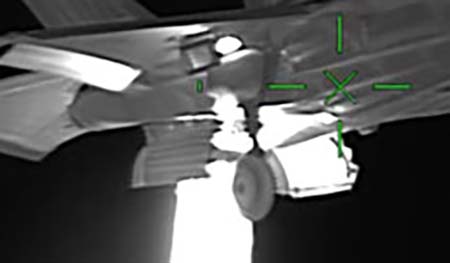
The IR image maps the hot areas inside the wheels and weapons bays, which are covered in forward flight. Particularly impressive are the rear vertical engine doors – one side is boiling hot, the other side is as cool as the rest of the aircraft. Photo: FLIR Systems
Critics of the F-35 claim that while its stealth design denies its detection by radars, infrared imagers can easily spot the aircraft at long range, by its heat signature. Unlike Russian, Chinese and European aircraft manufacturers that have employed infra-red search and track (IRST) technologies, US services are relying almost exclusively on radar for aerial situational awareness. While the F-35, like every physical object, has a thermal signature, this thermal scan shows its designers made significant effort to ‘flatten’ its thermal image, making the aircraft less detectable and trackable at long distance.
The video clip shown below compares the recent images taken with FLIR Systems’ new Star SAFIRE 380-HDc high definition FLIR, with a similar video taken by another FLIR sensor in 2010, showing the F-22 Raptor. At the recent Farnborough show the F-35 Lightning II performed a flyby and hover, but did not perform high performance maneuvering like the Raptor did back in 2010. Previous FLIR videos of 4 Generation fighters such as the F-16, Typhoon, and Su-27 showed skin area with much higher thermal contrast.
The most intriguing view is the forward flight, showing the aircraft from a forward 3/4 view, in very high contrast to the sky but low contrast between the hot air and cold aircraft – note that the camera shows minimal difference between the aircraft and hot air plume of the engine exhaust. In the flight phases where the engine runs in high power, the contrast between the air exhaust and aircraft, especially around the engine, is striking.
At that short distance, the FLIR SAFIRE 380-HDc camera details the hot and cold parts on the aircraft, for example, the windows of the Distributed Aperture Systems (DAS), where high-resolution IR cameras are located.
VnomadArms dealer connection holds up the Rafale deal
By Pradip R Sagar
Published: 31st Jul 2016 07:49:42 AMNEW DELHI: Having learnt from UPA’s follies in defence deals, which marred its image due to bribery scandals, the BJP-led NDA government is taking care before inking its first major acquisition deal to procure 36 Rafale warplanes with France.
A highly-placed source said that the Ministry of Defence before going ahead with the much-awaited deal, is seeking a ‘no-objection’ from the investigating agencies probing arms lobbyist Sanjay Bhandari, whose name had figured in various defence deals during UPA government.
A top official claimed that during a series of raids at Bhandari’s office and residential premises in May, Income Tax and Enforcement Directorate investigators had seized several documents related to defence deals, including Mirage-2000 upgrade with French companies Dassault and Thales.
Dassault Aviation is the manufacturer of Rafale fighter jets. Leads generated from raids at Sanjay Bhandari’s premises gave key inputs on other lobbyists, who are now being scanned for swinging defence deals.
“We are simply verifying with the investigating agencies whether they have found any linkages of Bhandari with French firm manufacturing Rafale jets,” said a top source. Defence sources are apprehensive about Bhandari’s deep-rooted links with French defence firms.
It is learnt that investigating agencies are looking into Bhandari role in the Ministry of Defence’s (MoD) Rs 10,947 crore project, finalised in 2011-12 for an upgrade of 51 Mirage-2000s with the help of French companies Dassault Aviation and Thales (weapons systems integrator). The CAG has criticised the high cost of upgrade the project.
Vnomadwow, are they really going through with this?
Defense Minister Manohar Parrikar told parliament Aug. 2 in a written reply that an agreement has been reached to sign the IGA.
He’s reporting the original agreement to sign the the IGA i.e. the one agreed upon at Paris in Feb last year. If there’d been some breakthrough, the next bit would have been given in past tense (“negotiating team has recommended a draft agreement”).
Both sides also agreed to conclude an Inter-Governmental Agreement (IGA) for supply of the aircraft. A negotiating team has been constituted to negotiate the terms and conditions of the procurement of 36 Rafale jets and recommend a draft agreement. – MoD statement
Boiler plate response I think. The ‘negotiating team’ has been at it for several months now.
At this stage, I am somewhat puzzled they don’t buy 36 F-35A instead? Should be roughly the same price and more capable.
Its stuck because the foolishness of the decision to buy Rafales at this price point is bound to be raising red flags within the MoD. Coupled with the fact that a Dassault-linked arms dealer is being investigated for facilitating corruption/money-laundering, the caution is justified.
That said, stupidity has been has only ever been a hurdle for the Indian MoD, not a barrier. The deal’s quite capable of rolling through on sheer inertia. After all, its only the taxpayer’s money.
Or are they still concerned about potential lack of support from the US in the future?
Just signed an $1 bn order for 4 more P-8Is last week (bringing the total value of US defence imports since 2005 to about $15 bn IIRC). Also issued an RFP for 22 Reapers and one EMALS. They’re long past the stage of warranted wariness with respect to weapons purchases from the US.
VnomadWhen did Boeing offer conversions of used 767s on the KC-46 line? AFAIK Boeing’s only ever built new KC-767s, & the KC-46 is a special beast, not a bog-standard old 767. You can get Bedek to convert 767s, but they hardly have economies of scale. One delivered & two on order so far, for Colombia & Brazil. Note that Bedek offered its conversions to S. Korea & Singapore in competition with the A330 & KC-46, but despite a rumoured lower price it was rejected, & the A330 was chosen.
I highly doubt IAI has any design IPRs with respect to a 767 conversion. Boeing should be able to carry it out at its Everett facility, or indeed have a local (albeit slightly pricier) conversion done in India under supervision (perhaps by TASL). With regard to the scale, I’m assuming there will still be commonalities with the KC-46. Fuel tanks, drogue systems… maybe even the new boom.
The A330 & 767 are both available in hose-only & boom plus hoses variants. So why do you refer to a second type for boom refuelling? That’s not what I meant. I meant buy one type, but don’t fit booms to every airframe.
Well there are already six hose-only refuelers in service (Il-78s). I’m guessing on average, two thirds of the A330/767 fleet (4 aircraft) will be available at any time. So that’s three boom-equipped units required to have at least one available 24×7. At that point, you may as well spend a bit more and go all the way. Especially if you intend to further expand the P-8I fleet.
VnomadThe SFC of the oldie is 13-18% higher (depending on which engine is used on the A330), the newer PS-90A have comparable SFC, the PD-14 are some 10% lower at cruise (@M0.8, 11,000 m, around 80% throttle setting)
D-30Kp 0.67 lb/lbf/h
PS-90A 0.595 lb/lbf/h
PD-14 0.526 lb/lbf/h
RR Trent 700 0.565 lb/lbf/h
PW 4000 family 0.591 lb/lbf/h
GE CF6 family 0.583 lb/lbf/h
You can put whatever engine you want under it. A high wing rear ramp design like the Il-76 (or C-17 for that matter) will NEVER be anywhere as fuel-efficient as a civilian airliner derivative.
I think it’s mainly due to the 15,321 tons hauled in 4,275 sorties which means the “much needed” strategic airlifters are being flown around almost empty..
The weight of the payload has little to do with the aircraft being ‘full’ or ’empty’. A C-17 carrying a full infantry compan, less than 15 tons in payload, is hardly empty.
VnomadWhy would it be smart? You’ve said that, but not explained why.
The 767 is cheaper to acquire and likely cheaper to operate. You could get a well-used one for under $10 mil or lightly used one in good condition for $20 mil.
Cost of converting it to tanker configuration will also be lower than for the A330, mostly on account of the volumes Boeing is dealing with through KC-46 program (18 per year).
A new-build Il-78 will be (relatively) pricey while used ones will likely face reliability issues. Fuel burn will be higher too. And it’ll lack a refueling boom.
The IAF could do with some tankers with booms for refuelling P-8s, & maybe C-17s. Only a few: mostly hose-equipped is OK.
Its not economical to purchase a second type for boom refueling refueling especially where fewer numbers are required.
Also, 10 C-17s, 12 C-130Js & 12 P-8Is is just what’s on order currently. Over the next 10 years the SHerc & Neptune fleets will certainly grow further. The IN in particular has a stated intention of buying another 12 P-8s.
Point is, boom-receptacle capability still has to be a consideration.


 Sign In








